 Add to Chrome
 Add to Firefox
 Add to Edge
OSWorld2.0: Benchmarking Computer Use Agents on Long-Horizon Real-World Tasks
Jun 28, 2026
Existing computer-use benchmarks fail to capture the realism, complexity, and long-horizon demands of real-world computer use, limiting their ability to reveal the limitations of frontier agents. We introduce OSWorld 2.0, a benchmark of 108 long-horizon computer-use workflows across everyday and professional tasks, designed to capture complex and challenging real-world phenomena. Each task represents a realistic end-to-end workflow that takes human users a median of about 1.6 hours to complete and requires an average of 318 tool calls with Claude Opus 4.7 using maximum thinking, compared with about 30 in OSWorld 1.0. OSWorld 2.0 targets challenge phenomena that are common in real workflows yet underrepresented in prior benchmarks, spanning interaction-design challenges such as streaming interaction and dynamic environments, as well as agent-pattern challenges such as cross-source reasoning, implicit-state inference, and visual-spatial precision. Tasks are grounded in authentic input artifacts and cross-referenced against realistic stateful user profile data, and include separate safety reports auditing safety-sensitive execution. Under our primary binary-completion metric at 500 steps, Claude Opus 4.8 with maximum thinking and batched tool calls scores best but still completes only 20.6% of tasks at a 54.8% partial score; GPT-5.5 is far more token-efficient yet plateaus near 13%. These results show that current agents are still far from professional-level computer use: rather than stumbling on basic GUI control or coding, they lose track of constraints, miss information that arrives mid-task, guess rather than ask the user, and skip verification, struggling most when a task hinges on hidden state they must recover.

AOHP: An Open-Source OS-Level Agent Harness for Personalized, Efficient and Secure Interaction
Jun 22, 2026AI agents are driving a new software paradigm, with the ability to autonomously call tools, extract information, manage memory, and complete tasks that span applications and data sources. Most existing end-user operating systems, however, are designed for application-centric workflows and offer little native support for AI agents. This mismatch limits the wider adoption of agents and leads to execution overhead and safety risks when running agents on conventional systems. While the concept of agent-native operating systems is emerging, the research community lacks an open testbed to explore the architectural primitives desired for agent-mediated interaction. We present AOHP (Android Open Harness Project), an OS-level agent harness built on the Android Open Source Project (AOSP). The core design principle of AOHP is to treat agents as first-class OS actors, enabling adaptive user interfaces and agent-friendly runtime environments. AOHP preserves the mature Android software and hardware ecosystem while introducing three agent-oriented system mechanisms: personalized service composition, efficient agent interfaces, and secure information flow. Based on preliminary experiments on challenging tasks covering key capabilities of OS agents, AOHP shows clear advantages in task completion (+21.12% completion rate), execution cost (-51.55% token cost), and security-policy compliance.
Beyond Skeletons: Learning Animation Directly from Driving Videos with Same2X Training Strategy
Jun 05, 2026Human image animation aims to generate a video from a static reference image, guided by pose information extracted from a driving video. Existing approaches often rely on pose estimators to extract intermediate representations, but such signals are prone to errors under occlusion or complex poses. Building on these observations, we present DirectAnimator, a framework that bypasses pose extraction and directly learns from raw driving videos. We introduce a Driving Cue Triplet consisting of pose, face, and location cues that captures motion, expression, and alignment in a semantically rich yet stable form, and we fuse them through a CueFusion DiT block for reliable control during denoising. To make learning dependable when the driving and reference identities differ, we devise a Same2X training strategy that aligns cross-ID features with those learned from same-ID data, regularizing optimization and accelerating convergence. Extensive experiments demonstrate that DirectAnimator attains state-of-the-art visual quality and identity preservation while remaining robust to occlusions and complex articulation, and it does so with fewer computational resources. Our project page is at https://directanimator.github.io/.
When Does Hierarchy Help? Benchmarking Agent Coordination in Event-Driven Industrial Scheduling
May 13, 2026Recent advances in agent and multi-agent systems have shown strong performance on tool use, reasoning, and collaborative tasks. However, existing benchmarks mostly evaluate task completion in weakly coupled environments, and provide limited support for studying coordination in shared, dynamically evolving systems with hierarchy and coupled constraints. This leaves an important question underexplored: when do different coordination paradigms succeed or fail? We introduce Distributed Event-driven Scheduling Benchmark (DESBench), a benchmark for evaluating agent coordination in hierarchical event-driven scheduling. Built on a shared discrete-event driven environment in industrial scheduling, our benchmark captures multi-timescale decision making, partial observability, and dynamically coupled constraints. We define tasks and metrics that evaluate effectiveness, constraint alignment, coordination efficiency, and robustness, and focus on four representative coordination paradigms: centralized, hierarchical, heterarchical, and holonic. These paradigms correspond to distinct mechanisms of information flow, decision authority, and conflict resolution. Our controlled evaluations reveal clear coordination trade-offs: centralized coordination is robust and communication-efficient but scales poorly with difficulty; hierarchical coordination improves efficiency through decomposition but suffers from cross-level misalignment; heterarchical coordination is flexible but communication-heavy; and holonic coordination satisfies constraints well but loses global robustness. These findings demonstrate that coordination design fundamentally shapes agent system behavior in complex environments, revealing structural trade-offs that cannot be captured by outcome metrics alone and underscoring the imperative for more adaptive, principled, and dynamic coordination mechanisms in future MAS research.
Nemotron 3 Nano Omni: Efficient and Open Multimodal Intelligence
Apr 27, 2026We introduce Nemotron 3 Nano Omni, the latest model in the Nemotron multimodal series and the first to natively support audio inputs alongside text, images, and video. Nemotron 3 Nano Omni delivers consistent accuracy improvements over its predecessor, Nemotron Nano V2 VL, across all modalities, enabled by advances in architecture, training data and recipes. In particular, Nemotron 3 delivers leading results in real-world document understanding, long audio-video comprehension, and agentic computer use. Built on the highly efficient Nemotron 3 Nano 30B-A3B backbone, Nemotron 3 Nano Omni further incorporates innovative multimodal token-reduction techniques to deliver substantially lower inference latency and higher throughput than other models of similar size. We are releasing model checkpoints in BF16, FP8, and FP4 formats, along with portions of the training data and codebase to facilitate further research and development.
GLM-5: from Vibe Coding to Agentic Engineering
Feb 17, 2026We present GLM-5, a next-generation foundation model designed to transition the paradigm of vibe coding to agentic engineering. Building upon the agentic, reasoning, and coding (ARC) capabilities of its predecessor, GLM-5 adopts DSA to significantly reduce training and inference costs while maintaining long-context fidelity. To advance model alignment and autonomy, we implement a new asynchronous reinforcement learning infrastructure that drastically improves post-training efficiency by decoupling generation from training. Furthermore, we propose novel asynchronous agent RL algorithms that further improve RL quality, enabling the model to learn from complex, long-horizon interactions more effectively. Through these innovations, GLM-5 achieves state-of-the-art performance on major open benchmarks. Most critically, GLM-5 demonstrates unprecedented capability in real-world coding tasks, surpassing previous baselines in handling end-to-end software engineering challenges. Code, models, and more information are available at https://github.com/zai-org/GLM-5.
S2SServiceBench: A Multimodal Benchmark for Last-Mile S2S Climate Services
Feb 15, 2026Subseasonal-to-seasonal (S2S) forecasts play an essential role in providing a decision-critical weeks-to-months planning window for climate resilience and sustainability, yet a growing bottleneck is the last-mile gap: translating scientific forecasts into trusted, actionable climate services, requiring reliable multimodal understanding and decision-facing reasoning under uncertainty. Meanwhile, multimodal large language models (MLLMs) and corresponding agentic paradigms have made rapid progress in supporting various workflows, but it remains unclear whether they can reliably generate decision-making deliverables from operational service products (e.g., actionable signal comprehension, decision-making handoff, and decision analysis & planning) under uncertainty. We introduce S2SServiceBench, a multimodal benchmark for last-mile S2S climate services curated from an operational climate-service system to evaluate this capability. S2SServiceBenchcovers 10 service products with about 150+ expert-selected cases in total, spanning six application domains - Agriculture, Disasters, Energy, Finance, Health, and Shipping. Each case is instantiated at three service levels, yielding around 500 tasks and 1,000+ evaluation items across climate resilience and sustainability applications. Using S2SServiceBench, we benchmark state-of-the-art MLLMs and agents, and analyze performance across products and service levels, revealing persistent challenges in S2S service plot understanding and reasoning - namely, actionable signal comprehension, operationalizing uncertainty into executable handoffs, and stable, evidence-grounded analysis and planning for dynamic hazards-while offering actionable guidance for building future climate-service agents.
6DAttack: Backdoor Attacks in the 6DoF Pose Estimation
Dec 22, 2025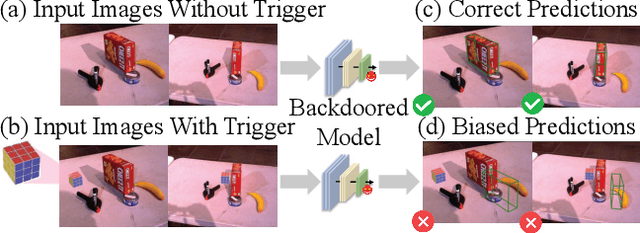
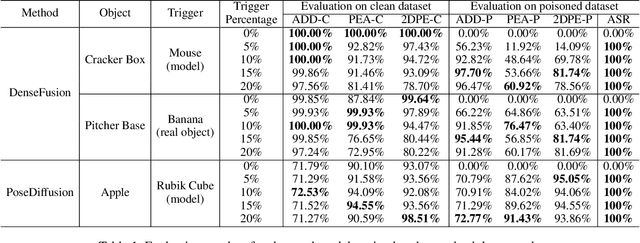
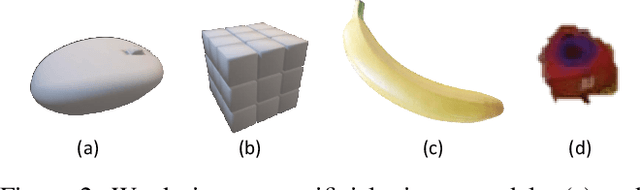
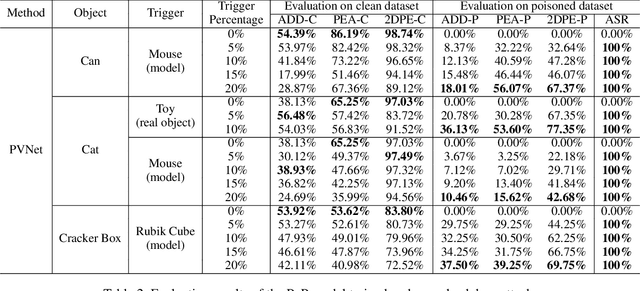
Deep learning advances have enabled accurate six-degree-of-freedom (6DoF) object pose estimation, widely used in robotics, AR/VR, and autonomous systems. However, backdoor attacks pose significant security risks. While most research focuses on 2D vision, 6DoF pose estimation remains largely unexplored. Unlike traditional backdoors that only change classes, 6DoF attacks must control continuous parameters like translation and rotation, rendering 2D methods inapplicable. We propose 6DAttack, a framework using 3D object triggers to induce controlled erroneous poses while maintaining normal behavior. Evaluations on PVNet, DenseFusion, and PoseDiffusion across LINEMOD, YCB-Video, and CO3D show high attack success rates (ASRs) without compromising clean performance. Backdoored models achieve up to 100% clean ADD accuracy and 100% ASR, with triggered samples reaching 97.70% ADD-P. Furthermore, a representative defense remains ineffective. Our findings reveal a serious, underexplored threat to 6DoF pose estimation.
See-Control: A Multimodal Agent Framework for Smartphone Interaction with a Robotic Arm
Dec 09, 2025Recent advances in Multimodal Large Language Models (MLLMs) have enabled their use as intelligent agents for smartphone operation. However, existing methods depend on the Android Debug Bridge (ADB) for data transmission and action execution, limiting their applicability to Android devices. In this work, we introduce the novel Embodied Smartphone Operation (ESO) task and present See-Control, a framework that enables smartphone operation via direct physical interaction with a low-DoF robotic arm, offering a platform-agnostic solution. See-Control comprises three key components: (1) an ESO benchmark with 155 tasks and corresponding evaluation metrics; (2) an MLLM-based embodied agent that generates robotic control commands without requiring ADB or system back-end access; and (3) a richly annotated dataset of operation episodes, offering valuable resources for future research. By bridging the gap between digital agents and the physical world, See-Control provides a concrete step toward enabling home robots to perform smartphone-dependent tasks in realistic environments.
Hi-Agent: Hierarchical Vision-Language Agents for Mobile Device Control
Oct 16, 2025Building agents that autonomously operate mobile devices has attracted increasing attention. While Vision-Language Models (VLMs) show promise, most existing approaches rely on direct state-to-action mappings, which lack structured reasoning and planning, and thus generalize poorly to novel tasks or unseen UI layouts. We introduce Hi-Agent, a trainable hierarchical vision-language agent for mobile control, featuring a high-level reasoning model and a low-level action model that are jointly optimized. For efficient training, we reformulate multi-step decision-making as a sequence of single-step subgoals and propose a foresight advantage function, which leverages execution feedback from the low-level model to guide high-level optimization. This design alleviates the path explosion issue encountered by Group Relative Policy Optimization (GRPO) in long-horizon tasks and enables stable, critic-free joint training. Hi-Agent achieves a new State-Of-The-Art (SOTA) 87.9% task success rate on the Android-in-the-Wild (AitW) benchmark, significantly outperforming prior methods across three paradigms: prompt-based (AppAgent: 17.7%), supervised (Filtered BC: 54.5%), and reinforcement learning-based (DigiRL: 71.9%). It also demonstrates competitive zero-shot generalization on the ScreenSpot-v2 benchmark. On the more challenging AndroidWorld benchmark, Hi-Agent also scales effectively with larger backbones, showing strong adaptability in high-complexity mobile control scenarios.