 Add to Chrome
 Add to Firefox
 Add to Edge
TACT: Taxonomy-Aligned Post-Training for Pedagogically Adaptive English Tutoring
Aug 04, 2026
Large language models (LLMs) are increasingly used to provide conversational practice for English-as-a-second-language (ESL) learners. Effective ESL tutoring, however, requires more than fluent response generation: a tutor must select an appropriate pedagogical action based on learner behavior and dialogue context. Human-tutoring research offers principles for adaptive support, but they are often task-specific and remain insufficiently integrated into LLM-based ESL tutor training and evaluation. We present TACT (Taxonomy-Aligned Conversational Tutor), a human-grounded framework for post-training and evaluating pedagogically adaptive ESL tutors. Drawing on established literature, we develop two complementary taxonomies: the Tutor-Strategy Taxonomy with 13 tutor response strategies and the Student-Move Taxonomy characterizing learner behavior by move type and status. Using these taxonomies, we construct TACTCorpus, which enriches 260 authentic teacher-student conversations with 32,379 annotations and quality-controlled augmented training data. We then post-train Qwen3.5-4B through supervised fine-tuning followed by taxonomy-aligned Group Relative Policy Optimization, producing TACTutor and optimizing it for scaffolding quality rather than reference imitation alone. On TACTBench, a strategy-balanced diagnostic benchmark comprising 78 authentic tutoring contexts, TACTutor improves over its backbone by 20.30% and outperforms all evaluated proprietary baselines under the same protocol, while maintaining backbone performance on established external educational benchmarks; in a blinded study with 50 learners, it also receives the highest overall mean rating among the evaluated tutors. We release the data, benchmark, and model weights, providing an open foundation for developing pedagogically adaptive ESL tutors.

AutoSupervision: Closing the Feedback Loop in Scientific Workflows with Grounded Revision Verification
Jul 30, 2026Recent advances in large language models (LLMs) have enabled AI systems to assist scientific research and peer review. However, an essential capability for reliable AI-assisted scientific workflows remains underexplored: verifying whether reviewer feedback leads to meaningful and evidence-supported manuscript improvements. We introduce AutoSupervision, which evaluates whether scientific manuscript revisions genuinely address reviewer concerns through grounded evidence. AutoSupervision leverages transparent peer-review records as a natural source of supervision, where reviewer comments specify scientific concerns, author responses describe claimed resolutions, and revised manuscripts provide evidence of changes. Given reviewer comments, author responses, and revised manuscripts, models must characterize reviewer concerns, determine whether concerns have been addressed, and identify supporting manuscript evidence. We construct AutoSupervision from 56,000 Nature Communications articles and corresponding review records. Then we conducted experiments on LLMs, the ablation study, and the case study. Our results show that while LLMs perform well in characterizing reviewer concerns, with GPT-5.5 achieving a score of 0.754, evidence-based verification remains the primary bottleneck, with the best-performing model reaching only 0.501.
WILDTRACE: Benchmarking Natural Evidence Trails in Long-Context Reasoning
Jul 10, 2026Answering complex questions over long documents frequently requires integrating evidence that the source itself disperses naturally across distant passages. In an incident report, the operating condition, design flaw, and missed safety check that jointly explain a disaster may appear dozens of sections apart; in a novel, a character's true motive may surface only through scenes far removed from the moment it becomes relevant. This source-internal evidence integration is central to real-world long-document analysis, yet existing benchmarks largely sidestep it. Needle probes, planted facts, and reverse-engineered multi-hop chains embed evidence that may differ from the host text in distribution, placement, or register, making it unclear whether strong performance reflects genuine source reasoning or distributional artifacts. We introduce WILDTRACE, a benchmark of 481 tasks over 214 naturally occurring long-form sources such as technical incident reports and lesser-known literary narratives, where all evidence trails arise from the document's own causal, temporal, and narrative logic. Drawing on Pearl's causal hierarchy and prior multi-hop reasoning typologies, we define seven source-internal evidence geometries that characterize the distinct relational demands of analytical reading in long documents. A source-first construction pipeline mines candidate trails from document structure before writing questions; each item then undergoes multi-stage validation covering clue necessity, answer groundedness, rubric fidelity, contamination resistance and answerability. As models are increasingly entrusted with real-world high-stakes analytical tasks, this gap between accessing information and reasoning over naturally dispersed evidence emerges as a defining challenge for the next stage of long-context research.
Are Agents Ready to Teach? A Multi-Stage Benchmark for Real-World Teaching Workflows
May 14, 2026Language agents are increasingly deployed in complex professional workflows, with tutoring emerging as a particularly high-stakes capability that remains largely unmeasured in existing benchmarks. Effective tutor agents require more than producing correct answers or executing accurate tool calls: a robust tutor must diagnose learner state, adapt support over time, make pedagogically justified decisions grounded in educational evidence, and execute interventions within realistic learning-management systems. We introduce EduAgentBench, a source-grounded benchmark for holistically evaluating tutor agents across the full scope of teaching work. It contains 150 quality-controlled tasks across three capability surfaces: professional pedagogical judgment, situated multi-turn tutoring, and Canvas-style teaching workflow completion. Tasks are constructed through a pedagogical-insight-driven pipeline and evaluated with complementary verification signals and human review. Across a comprehensive evaluation of frontier models, our findings reveal that current models are generally capable of bounded pedagogical judgment, but still fall short of professional teaching standards in situated tutoring and autonomous teaching-workflow execution. To our knowledge, EduAgentBench is the first theory-grounded and realistic benchmark for evaluating the holistic teaching capability of tutor agents, providing a measurement foundation for developing future tutor agents that can support realistic teaching work.
VeriLLMed: Interactive Visual Debugging of Medical Large Language Models with Knowledge Graphs
Apr 25, 2026Large language models (LLMs) show promise in medical diagnosis, but real-world deployment remains challenging due to high-stakes clinical decisions and imperfect reasoning reliability. As a result, careful inspection of model behavior is essential for assessing whether diagnostic reasoning is reliable and clinically grounded. However, debugging medical LLMs remains difficult. First, developers often lack sufficient medical domain expertise to interpret model errors in clinically meaningful terms. Second, models can fail across a large and diverse set of instances involving different input types, tasks, and reasoning steps, making it challenging for developers to prioritize which errors deserve focused inspection. Third, developers struggle to identify recurring error patterns across cases, as existing debugging practices are largely instance-centric and rely on manual inspection of isolated failures. To address these challenges, we present VeriLLMed, a visual analytics system that integrates external biomedical knowledge to audit and debug medical LLM diagnostic reasoning. VeriLLMed transforms model outputs into comparable reasoning paths, constructs knowledge graph-grounded reference paths, and identifies three recurring classes of diagnosis errors: relation errors, branch errors, and missing errors. Case studies and expert evaluation demonstrate that VeriLLMed helps developers identify clinically implausible reasoning and generate actionable insights that can inform the improvement of medical LLMs.
Navigating the Mirage: A Dual-Path Agentic Framework for Robust Misleading Chart Question Answering
Mar 30, 2026Despite the success of Vision-Language Models (VLMs), misleading charts remain a significant challenge due to their deceptive visual structures and distorted data representations. We present ChartCynics, an agentic dual-path framework designed to unmask visual deception via a "skeptical" reasoning paradigm. Unlike holistic models, ChartCynics decouples perception from verification: a Diagnostic Vision Path captures structural anomalies (e.g., inverted axes) through strategic ROI cropping, while an OCR-Driven Data Path ensures numerical grounding. To resolve cross-modal conflicts, we introduce an Agentic Summarizer optimized via a two-stage protocol: Oracle-Informed SFT for reasoning distillation and Deception-Aware GRPO for adversarial alignment. This pipeline effectively penalizes visual traps and enforces logical consistency. Evaluations on two benchmarks show that ChartCynics achieves 74.43% and 64.55% accuracy, providing an absolute performance boost of ~29% over the Qwen3-VL-8B backbone, outperforming state-of-the-art proprietary models. Our results demonstrate that specialized agentic workflows can grant smaller open-source models superior robustness, establishing a new foundation for trustworthy chart interpretation.
Towards Comprehensive Stage-wise Benchmarking of Large Language Models in Fact-Checking
Jan 06, 2026Large Language Models (LLMs) are increasingly deployed in real-world fact-checking systems, yet existing evaluations focus predominantly on claim verification and overlook the broader fact-checking workflow, including claim extraction and evidence retrieval. This narrow focus prevents current benchmarks from revealing systematic reasoning failures, factual blind spots, and robustness limitations of modern LLMs. To bridge this gap, we present FactArena, a fully automated arena-style evaluation framework that conducts comprehensive, stage-wise benchmarking of LLMs across the complete fact-checking pipeline. FactArena integrates three key components: (i) an LLM-driven fact-checking process that standardizes claim decomposition, evidence retrieval via tool-augmented interactions, and justification-based verdict prediction; (ii) an arena-styled judgment mechanism guided by consolidated reference guidelines to ensure unbiased and consistent pairwise comparisons across heterogeneous judge agents; and (iii) an arena-driven claim-evolution module that adaptively generates more challenging and semantically controlled claims to probe LLMs' factual robustness beyond fixed seed data. Across 16 state-of-the-art LLMs spanning seven model families, FactArena produces stable and interpretable rankings. Our analyses further reveal significant discrepancies between static claim-verification accuracy and end-to-end fact-checking competence, highlighting the necessity of holistic evaluation. The proposed framework offers a scalable and trustworthy paradigm for diagnosing LLMs' factual reasoning, guiding future model development, and advancing the reliable deployment of LLMs in safety-critical fact-checking applications.
VizDefender: Unmasking Visualization Tampering through Proactive Localization and Intent Inference
Dec 21, 2025
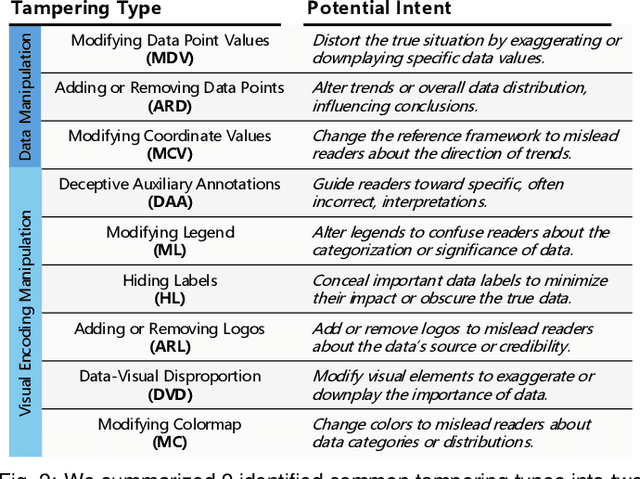
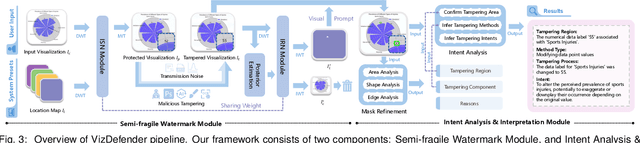
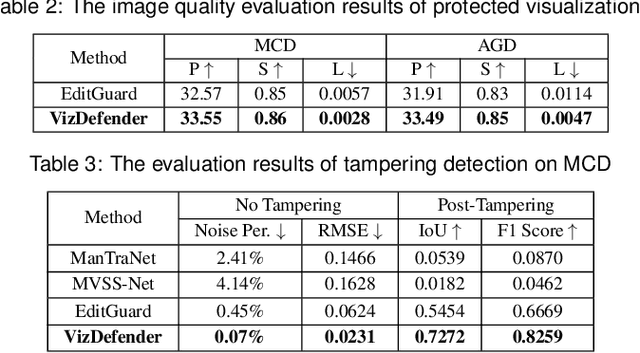
The integrity of data visualizations is increasingly threatened by image editing techniques that enable subtle yet deceptive tampering. Through a formative study, we define this challenge and categorize tampering techniques into two primary types: data manipulation and visual encoding manipulation. To address this, we present VizDefender, a framework for tampering detection and analysis. The framework integrates two core components: 1) a semi-fragile watermark module that protects the visualization by embedding a location map to images, which allows for the precise localization of tampered regions while preserving visual quality, and 2) an intent analysis module that leverages Multimodal Large Language Models (MLLMs) to interpret manipulation, inferring the attacker's intent and misleading effects. Extensive evaluations and user studies demonstrate the effectiveness of our methods.
MemeArena: Automating Context-Aware Unbiased Evaluation of Harmfulness Understanding for Multimodal Large Language Models
Oct 31, 2025The proliferation of memes on social media necessitates the capabilities of multimodal Large Language Models (mLLMs) to effectively understand multimodal harmfulness. Existing evaluation approaches predominantly focus on mLLMs' detection accuracy for binary classification tasks, which often fail to reflect the in-depth interpretive nuance of harmfulness across diverse contexts. In this paper, we propose MemeArena, an agent-based arena-style evaluation framework that provides a context-aware and unbiased assessment for mLLMs' understanding of multimodal harmfulness. Specifically, MemeArena simulates diverse interpretive contexts to formulate evaluation tasks that elicit perspective-specific analyses from mLLMs. By integrating varied viewpoints and reaching consensus among evaluators, it enables fair and unbiased comparisons of mLLMs' abilities to interpret multimodal harmfulness. Extensive experiments demonstrate that our framework effectively reduces the evaluation biases of judge agents, with judgment results closely aligning with human preferences, offering valuable insights into reliable and comprehensive mLLM evaluations in multimodal harmfulness understanding. Our code and data are publicly available at https://github.com/Lbotirx/MemeArena.
AdamMeme: Adaptively Probe the Reasoning Capacity of Multimodal Large Language Models on Harmfulness
Jul 02, 2025The proliferation of multimodal memes in the social media era demands that multimodal Large Language Models (mLLMs) effectively understand meme harmfulness. Existing benchmarks for assessing mLLMs on harmful meme understanding rely on accuracy-based, model-agnostic evaluations using static datasets. These benchmarks are limited in their ability to provide up-to-date and thorough assessments, as online memes evolve dynamically. To address this, we propose AdamMeme, a flexible, agent-based evaluation framework that adaptively probes the reasoning capabilities of mLLMs in deciphering meme harmfulness. Through multi-agent collaboration, AdamMeme provides comprehensive evaluations by iteratively updating the meme data with challenging samples, thereby exposing specific limitations in how mLLMs interpret harmfulness. Extensive experiments show that our framework systematically reveals the varying performance of different target mLLMs, offering in-depth, fine-grained analyses of model-specific weaknesses. Our code is available at https://github.com/Lbotirx/AdamMeme.