 Add to Chrome
 Add to Firefox
 Add to Edge
From Texts to Scores: Tracing the Emergence of Essay Quality Representations in Large Language Models
Jun 18, 2026
Recent advances in Large Language Models (LLMs) have substantially transformed Automated Essay Scoring (AES), yet the internal mechanisms underlying LLM-based scoring remain poorly understood. In this work, we systematically analyze the hidden representations of eight LLMs across two English essay datasets (ASAP++, CSEE) and one Portuguese dataset (ENEM). Using linear probing, cross-prompt generalization, dimensionality reduction, and neuron-level analyses, we find consistent evidence that essay quality information is encoded in a linearly accessible form within LLM representations. These representations emerge progressively across layers, remain robust across prompting strategies, and partially transfer across essay prompts despite differences in scoring rubrics. In addition, nonlinear probes provide only marginal and inconsistent improvements over linear probes, suggesting that most essay quality information is already linearly decodable. We further identify individual ``essay scoring neurons'' whose activations strongly correlate with essay scores and whose behavior is sensitive to targeted intervention. Moreover, the layer-wise distribution of these neurons systematically shifts with essay length, with longer essays relying more heavily on deeper layers. Overall, our findings provide evidence that LLMs encode structured representations related to essay quality and offer new insights into the interpretability of LLM-based AES systems.

G-IdiomAlign: A Gloss-Pivoted Benchmark for Cross-Lingual Idiom Alignment
Jun 17, 2026Idioms are difficult to transfer across languages due to their non-compositionality and weak surface-form grounding, making literal mappings unreliable. We present G-IdiomAlign, a gloss-pivoted benchmark where each idiom is anchored by an English gloss from Wiktionary. We further construct a high-confidence reference alignment set for reproducible evaluation. G-IdiomAlign supports two protocols: (1) a controlled Multiple-Choice Idiom Equivalence with typed distractors for error attribution; and (2) a Gloss-Contrastive Generation contrasting No-gloss and With-gloss inputs to isolate the effect of an explicit semantic pivot. Across diverse LLMs, a bias to literal translation is a dominant failure mode, especially when the target is a low-resource language. Glosses consistently improve Gloss-Contrastive Generation under an embedding-based semantic proxy, but performance remains modest, indicating substantial headroom in the open output space. Subsequent analysis on Qwen3-8B further suggests that cross-condition differences are concentrated more in attention heads than in layers, while better With-gloss generations coincide with stronger gloss anchoring.
MC-PDD: Masked Corpus-Level Pretraining Data Detection for Black-Box Large Language Models
Jun 06, 2026Pretraining is fundamental to the development of Large Language Models (LLMs), yet the opacity of pretraining data complicates model analysis and raises ethical, legal, and fairness concerns. Detecting whether specific datasets were used during pretraining is, therefore, critical. Existing state-of-the-art methods typically rely on access to model probability distributions, making them unsuitable for closed-source LLMs that provide only input-output interfaces. To address this limitation, we introduce Masked Corpus-level Pretraining Data Detection (MC-PDD), a novel method inspired by the masked language modeling paradigm. MC-PDD masks highly specific tokens in each text and prompts the LLM to predict the missing content. It then assesses whether the difference in prediction hit rates between a candidate corpus and a reference non-member corpus is statistically significant. Based on this comparison, MC-PDD determines whether the candidate texts were likely included in the model's pretraining data. Experimental results demonstrate clear and consistent differences in prediction hit rates between pretrained and unseen data across three datasets, for both open-source and closed-source LLMs. Despite operating under a stricter black-box setting, MC-PDD achieves performance comparable to existing detection methods. Our approach enables practical applications such as model auditing and data copyright verification using only standard API access. Upon acceptance, we will publicly release the code and datasets.
Worlds Within Words: Translating Culture in Ancient Chinese Texts with Multi-Agent Coordination
May 31, 2026Large language model (LLM)-based machine translation has advanced cross-cultural communication, yet it still struggles with culture-loaded words (CLWs) in ancient Chinese texts. The challenge extends beyond lexical alignment to deciding when and how culture-dependent knowledge should be explicated for readers lacking relevant background. Literal translation often preserves surface forms while missing underlying concepts, whereas over-explicitation harms conciseness and readability. To address this problem, we formulate CLW translation as a selective explicitation task and propose \textbf{MACAT}, a \textbf{M}ulti-\textbf{A}gent \textbf{C}ulture-\textbf{A}ware \textbf{T}ranslation framework that dynamically identifies culturally salient phrases and injects concise explanatory knowledge when necessary. MACAT further incorporates a quality-aware reranking module for candidate selection and a multi-round evaluation agent that assesses translations across terminological precision, readability, fidelity, cultural preservation, and cultural explicitation. Experiments on traditional Chinese medicine (TCM) classics and the \textit{Analects} show that, under a unified GPT-5.4 evaluation setting, MACAT consistently outperforms both the backbone model and general-purpose MT baselines on 100 TCM documents and a 20-chapter subset of the \textit{Analects}.
Chain-of-Procedure: Hierarchical Visual-Language Reasoning for Procedural QA
May 14, 2026Recent advances in vision-language models (VLMs) have achieved impressive results on standard image-text tasks, yet their potential for visual procedure question answering (VP-QA) remains largely unexplored. VP-QA presents unique challenges where users query next-step actions by uploading images for intermediate states of complex procedures. To systematically evaluate VLMs on this practical task, we propose ProcedureVQA, a novel multimodal benchmark specifically designed for visual procedural reasoning. Through comprehensive analysis, we identify two critical limitations in current VLMs: inadequate cross-modal retrieval of structured procedures given visual states, and misalignment between image sequence granularity and textual step decomposition. To address these issues, we present Chain-of-Procedure (CoP), a hierarchical reasoning framework that first retrieves relevant instructions using visual cues, then performs step refinement through semantic decomposition, and finally generates the next step. Experiments across six VLMs demonstrate CoP's effectiveness, achieving up to 13% absolute improvement over standard baselines.
From Scenes to Elements: Multi-Granularity Evidence Retrieval for Verifiable Multimodal RAG
May 14, 2026Multimodal Retrieval-Augmented Generation (RAG) systems retrieve evidence at coarse granularities (entire images or scenes), creating a mismatch with fine-grained user queries and making failures unverifiable. We introduce GranuVistaVQA, a multimodal benchmark featuring real-world landmarks with element-level annotations across multiple viewpoints, capturing the partial observation challenge where individual images contain only subsets of entities. We further propose GranuRAG, a multi-granularity framework that treats visual elements as first-class retrieval units through three stages: element-level detection and classification, multi-granularity cross-modal alignment for evidence retrieval, and attribution-constrained generation. By grounding retrieval at the element level rather than relying on implicit attention, our approach enables transparent error diagnosis. Experiments demonstrate that GranuRAG achieves up to 29.2% improvement over six strong baselines for this task.
Can ChatGPT Really Understand Modern Chinese Poetry?
Mar 21, 2026ChatGPT has demonstrated remarkable capabilities on both poetry generation and translation, yet its ability to truly understand poetry remains unexplored. Previous poetry-related work merely analyzed experimental outcomes without addressing fundamental issues of comprehension. This paper introduces a comprehensive framework for evaluating ChatGPT's understanding of modern poetry. We collaborated with professional poets to evaluate ChatGPT's interpretation of modern Chinese poems by different poets along multiple dimensions. Evaluation results show that ChatGPT's interpretations align with the original poets' intents in over 73% of the cases. However, its understanding in certain dimensions, particularly in capturing poeticity, proved to be less satisfactory. These findings highlight the effectiveness and necessity of our proposed framework. This study not only evaluates ChatGPT's ability to understand modern poetry but also establishes a solid foundation for future research on LLMs and their application to poetry-related tasks.
Neuron-Aware Data Selection In Instruction Tuning For Large Language Models
Mar 13, 2026Instruction Tuning (IT) has been proven to be an effective approach to unlock the powerful capabilities of large language models (LLMs). Recent studies indicate that excessive IT data can degrade LLMs performance, while carefully selecting a small subset of high-quality IT data can significantly enhance their capabilities. Therefore, identifying the most efficient subset data from the IT dataset to effectively develop either specific or general abilities in LLMs has become a critical challenge. To address this, we propose a novel and efficient framework called NAIT. NAIT evaluates the impact of IT data on LLMs performance by analyzing the similarity of neuron activation patterns between the IT dataset and the target domain capability. Specifically, NAIT captures neuron activation patterns from in-domain datasets of target domain capabilities to construct reusable and transferable neuron activation features. It then evaluates and selects optimal samples based on the similarity between candidate samples and the expected activation features of the target capabilities. Experimental results show that training on the 10\% Alpaca-GPT4 IT data subset selected by NAIT consistently outperforms methods that rely on external advanced models or uncertainty-based features across various tasks. Our findings also reveal the transferability of neuron activation features across different capabilities of LLMs. In particular, IT data with more logical reasoning and programmatic features possesses strong general transferability, enabling models to develop stronger capabilities across multiple tasks, while a stable core subset of data is sufficient to consistently activate fundamental model capabilities and universally improve performance across diverse tasks.
Are Large Reasoning Models Good Translation Evaluators? Analysis and Performance Boost
Oct 23, 2025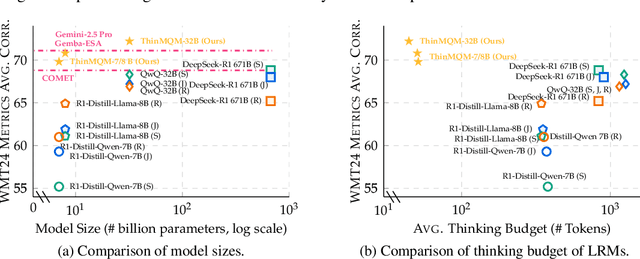
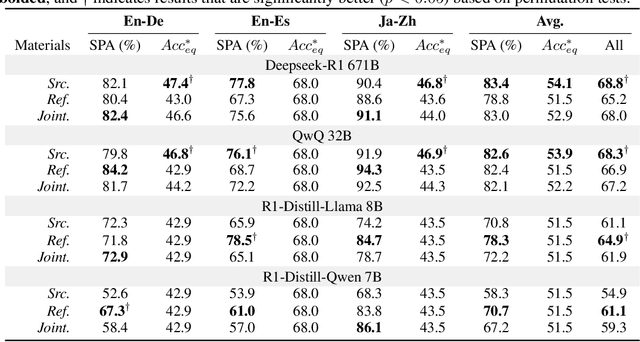
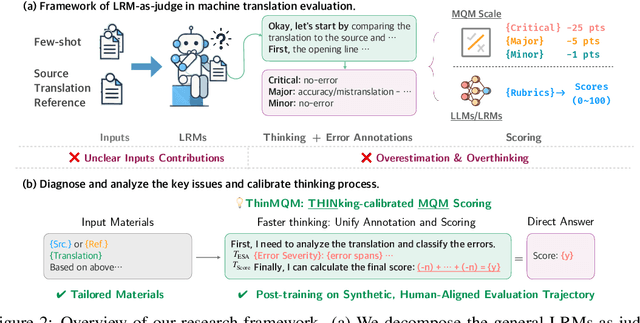
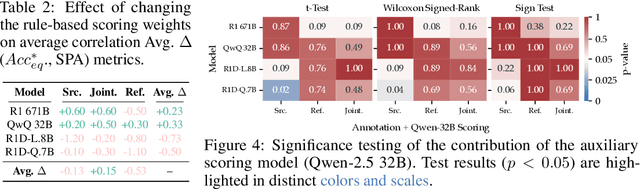
Recent advancements in large reasoning models (LRMs) have introduced an intermediate "thinking" process prior to generating final answers, improving their reasoning capabilities on complex downstream tasks. However, the potential of LRMs as evaluators for machine translation (MT) quality remains underexplored. We provides the first systematic analysis of LRM-as-a-judge in MT evaluation. We identify key challenges, revealing LRMs require tailored evaluation materials, tend to "overthink" simpler instances and have issues with scoring mechanisms leading to overestimation. To address these, we propose to calibrate LRM thinking by training them on synthetic, human-like thinking trajectories. Our experiments on WMT24 Metrics benchmarks demonstrate that this approach largely reduces thinking budgets by ~35x while concurrently improving evaluation performance across different LRM scales from 7B to 32B (e.g., R1-Distill-Qwen-7B achieves a +8.7 correlation point improvement). These findings highlight the potential of efficiently calibrated LRMs to advance fine-grained automatic MT evaluation.
Exposing the Cracks: Vulnerabilities of Retrieval-Augmented LLM-based Machine Translation
Oct 01, 2025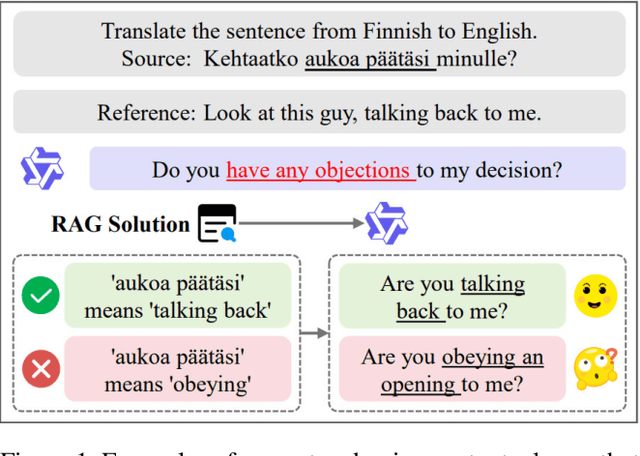
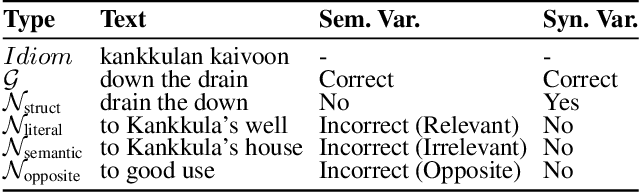
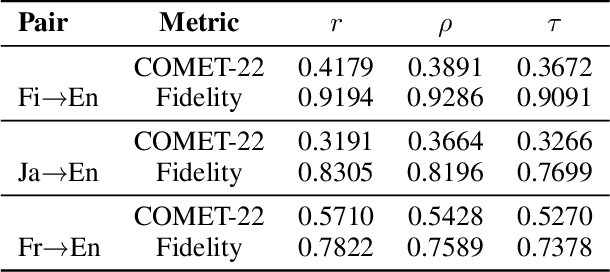
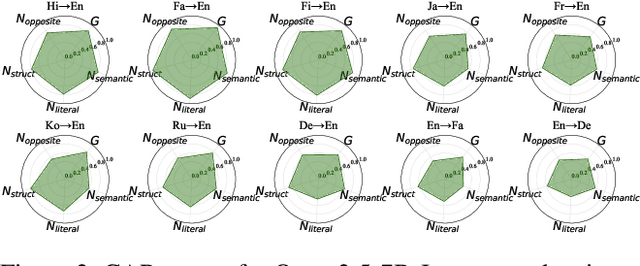
\textbf{RE}trieval-\textbf{A}ugmented \textbf{L}LM-based \textbf{M}achine \textbf{T}ranslation (REAL-MT) shows promise for knowledge-intensive tasks like idiomatic translation, but its reliability under noisy retrieval contexts remains poorly understood despite this being a common challenge in real-world deployment. To address this gap, we propose a noise synthesis framework and new metrics to evaluate the robustness of REAL-MT systematically. Using this framework, we instantiate REAL-MT with Qwen-series models, including standard LLMs and large reasoning models (LRMs) with enhanced reasoning, and evaluate their performance on idiomatic translation across high-, medium-, and low-resource language pairs under synthesized noise. Our results show that low-resource language pairs, which rely more heavily on retrieved context, degrade more severely under noise than high-resource ones and often produce nonsensical translations. Although LRMs possess enhanced reasoning capabilities, they show no improvement in error correction and are even more susceptible to noise, tending to rationalize incorrect contexts. We find that this stems from an attention shift away from the source idiom to noisy content, while confidence increases despite declining accuracy, indicating poor calibration. To mitigate these issues, we investigate training-free and fine-tuning strategies, which improve robustness at the cost of performance in clean contexts, revealing a fundamental trade-off. Our findings highlight the limitations of current approaches, underscoring the need for self-verifying integration mechanisms.