 Add to Chrome
 Add to Firefox
 Add to Edge
Information Routing across Batch Boundaries: Memory--Batch Tradeoffs in Lipschitz Bandits
Aug 08, 2026
Adaptive learning needs both a state that preserves what observations imply and opportunities to act on that state. We study this width--depth tradeoff in stochastic Lipschitz bandits. After each pull, the learner retains at most $W$ bits of live reward-dependent state and organizes its pulls into at most $B$ committed batches. For $W\gtrsim_d\log(eT)$, we characterize minimax expected pseudo-regret up to logarithmic factors; the lower bounds hold for every $W$. Besides the classical sequential and unrestricted-memory batch costs, the frontier contains the new penalty \[ T^{\frac{d+2}{d+3}} \bigl(1+(B-1)W\bigr)^{-\frac1{d(d+3)}}, \] proving that state width and update depth are not interchangeable. The interaction is an information-routing constraint: at regional scale $s$, low regret forces the committed action transcript to encode $Θ_d(s^{-d})$ regional decisions, while the collected boundary states carry at most $(B-1)W$ bits of entropy. Matching policies stream and erase verification statistics while retaining a mask of a safe active set, either in memory or fragment by fragment. The theorem recovers the full-dimensional worst-case batch-only frontier and logarithmic-memory achievability in the fully sequential specialization; static batch boundaries match predictable adaptive ones.

Scale-Dependent Radial Geometry and Metric Mismatch in Wasserstein Propagation for Reverse Diffusion
Mar 20, 2026Existing analyses of reverse diffusion often propagate sampling error in the Euclidean geometry underlying \(\Wtwo\) along the entire reverse trajectory. Under weak log-concavity, however, Gaussian smoothing can create contraction first at large separations while short separations remain non-dissipative. The first usable contraction is therefore radial rather than Euclidean, creating a metric mismatch between the geometry that contracts early and the geometry in which the terminal error is measured. We formalize this mismatch through an explicit radial lower profile for the learned reverse drift. Its far-field limit gives a contraction reserve, its near-field limit gives the Euclidean load governing direct \(\Wtwo\) propagation, and admissible switch times are characterized by positivity of the reserve on the remaining smoothing window. We exploit this structure with a one-switch routing argument. Before the switch, reflection coupling yields contraction in a concave transport metric adapted to the radial profile. At the switch, we convert once from this metric back to \(\Wtwo\) under a \(p\)-moment budget, and then propagate the converted discrepancy over the remaining short window in Euclidean geometry. For discretizations of the learned reverse SDE under \(L^2\) score-error control, a one-sided Lipschitz condition of score error, and standard well-posedness and coupling hypotheses, we obtain explicit non-asymptotic end-to-end \(\Wtwo\) guarantees, a scalar switch-selection objective, and a sharp structural limit on the conversion exponent within the affine-tail concave class.
Few Batches or Little Memory, But Not Both: Simultaneous Space and Adaptivity Constraints in Stochastic Bandits
Mar 14, 2026We study stochastic multi-armed bandits under simultaneous constraints on space and adaptivity: the learner interacts with the environment in $B$ batches and has only $W$ bits of persistent memory. Prior work shows that each constraint alone is surprisingly mild: near-minimax regret $\widetilde{O}(\sqrt{KT})$ is achievable with $O(\log T)$ bits of memory under fully adaptive interaction, and with a $K$-independent $O(\log\log T)$-type number of batches when memory is unrestricted. We show that this picture breaks down in the simultaneously constrained regime. We prove that any algorithm with a $W$-bit memory constraint must use at least $Ω(K/W)$ batches to achieve near-minimax regret $\widetilde{O}(\sqrt{KT})$ , even under adaptive grids. In particular, logarithmic memory rules out $K$-independent batch complexity. Our proof is based on an information bottleneck. We show that near-minimax regret forces the learner to acquire $Ω(K)$ bits of information about the hidden set of good arms under a suitable hard prior, whereas an algorithm with $B$ batches and $W$ bits of memory allows only $O(BW)$ bits of information. A key ingredient is a localized change-of-measure lemma that yields probability-level arm exploration guarantees, which is of independent interest. We also give an algorithm using $O(\log T)$ bits of memory and $\widetilde{O}(K)$ batches that achieves regret $\widetilde{O}(\sqrt{KT})$, which nearly matches our lower bound.
MOVA: Towards Scalable and Synchronized Video-Audio Generation
Feb 09, 2026Audio is indispensable for real-world video, yet generation models have largely overlooked audio components. Current approaches to producing audio-visual content often rely on cascaded pipelines, which increase cost, accumulate errors, and degrade overall quality. While systems such as Veo 3 and Sora 2 emphasize the value of simultaneous generation, joint multimodal modeling introduces unique challenges in architecture, data, and training. Moreover, the closed-source nature of existing systems limits progress in the field. In this work, we introduce MOVA (MOSS Video and Audio), an open-source model capable of generating high-quality, synchronized audio-visual content, including realistic lip-synced speech, environment-aware sound effects, and content-aligned music. MOVA employs a Mixture-of-Experts (MoE) architecture, with a total of 32B parameters, of which 18B are active during inference. It supports IT2VA (Image-Text to Video-Audio) generation task. By releasing the model weights and code, we aim to advance research and foster a vibrant community of creators. The released codebase features comprehensive support for efficient inference, LoRA fine-tuning, and prompt enhancement.
FourierSampler: Unlocking Non-Autoregressive Potential in Diffusion Language Models via Frequency-Guided Generation
Jan 30, 2026Despite the non-autoregressive potential of diffusion language models (dLLMs), existing decoding strategies demonstrate positional bias, failing to fully unlock the potential of arbitrary generation. In this work, we delve into the inherent spectral characteristics of dLLMs and present the first frequency-domain analysis showing that low-frequency components in hidden states primarily encode global structural information and long-range dependencies, while high-frequency components are responsible for characterizing local details. Based on this observation, we propose FourierSampler, which leverages a frequency-domain sliding window mechanism to dynamically guide the model to achieve a "structure-to-detail" generation. FourierSampler outperforms other inference enhancement strategies on LLADA and SDAR, achieving relative improvements of 20.4% on LLaDA1.5-8B and 16.0% on LLaDA-8B-Instruct. It notably surpasses similarly sized autoregressive models like Llama3.1-8B-Instruct.
DiRL: An Efficient Post-Training Framework for Diffusion Language Models
Dec 23, 2025Diffusion Language Models (dLLMs) have emerged as promising alternatives to Auto-Regressive (AR) models. While recent efforts have validated their pre-training potential and accelerated inference speeds, the post-training landscape for dLLMs remains underdeveloped. Existing methods suffer from computational inefficiency and objective mismatches between training and inference, severely limiting performance on complex reasoning tasks such as mathematics. To address this, we introduce DiRL, an efficient post-training framework that tightly integrates FlexAttention-accelerated blockwise training with LMDeploy-optimized inference. This architecture enables a streamlined online model update loop, facilitating efficient two-stage post-training (Supervised Fine-Tuning followed by Reinforcement Learning). Building on this framework, we propose DiPO, the first unbiased Group Relative Policy Optimization (GRPO) implementation tailored for dLLMs. We validate our approach by training DiRL-8B-Instruct on high-quality math data. Our model achieves state-of-the-art math performance among dLLMs and surpasses comparable models in the Qwen2.5 series on several benchmarks.
Beyond Real: Imaginary Extension of Rotary Position Embeddings for Long-Context LLMs
Dec 08, 2025Rotary Position Embeddings (RoPE) have become a standard for encoding sequence order in Large Language Models (LLMs) by applying rotations to query and key vectors in the complex plane. Standard implementations, however, utilize only the real component of the complex-valued dot product for attention score calculation. This simplification discards the imaginary component, which contains valuable phase information, leading to a potential loss of relational details crucial for modeling long-context dependencies. In this paper, we propose an extension that re-incorporates this discarded imaginary component. Our method leverages the full complex-valued representation to create a dual-component attention score. We theoretically and empirically demonstrate that this approach enhances the modeling of long-context dependencies by preserving more positional information. Furthermore, evaluations on a suite of long-context language modeling benchmarks show that our method consistently improves performance over the standard RoPE, with the benefits becoming more significant as context length increases. The code is available at https://github.com/OpenMOSS/rope_pp.
EvolProver: Advancing Automated Theorem Proving by Evolving Formalized Problems via Symmetry and Difficulty
Oct 01, 2025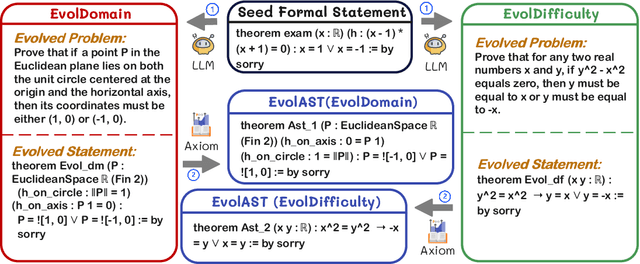
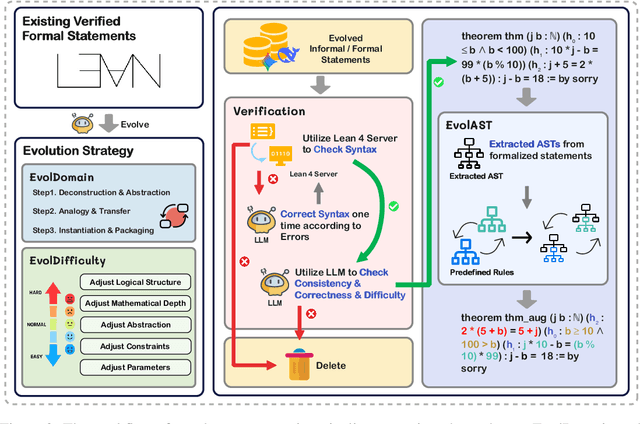
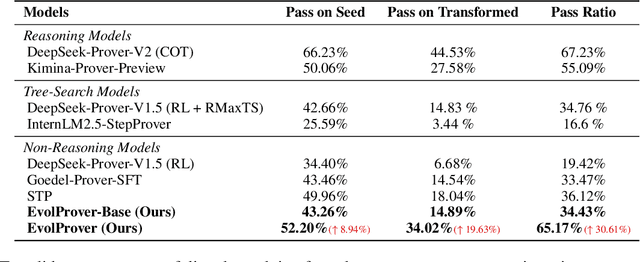
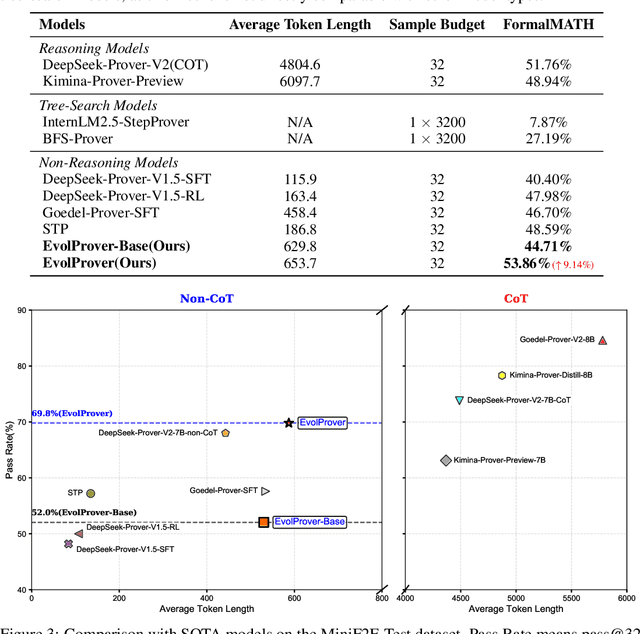
Large Language Models (LLMs) for formal theorem proving have shown significant promise, yet they often lack generalizability and are fragile to even minor transformations of problem statements. To address this limitation, we introduce a novel data augmentation pipeline designed to enhance model robustness from two perspectives: symmetry and difficulty. From the symmetry perspective, we propose two complementary methods: EvolAST, an Abstract Syntax Tree (AST) based approach that targets syntactic symmetry to generate semantically equivalent problem variants, and EvolDomain, which leverages LLMs to address semantic symmetry by translating theorems across mathematical domains. From the difficulty perspective, we propose EvolDifficulty, which uses carefully designed evolutionary instructions to guide LLMs in generating new theorems with a wider range of difficulty. We then use the evolved data to train EvolProver, a 7B-parameter non-reasoning theorem prover. EvolProver establishes a new state-of-the-art (SOTA) on FormalMATH-Lite with a 53.8% pass@32 rate, surpassing all models of comparable size, including reasoning-based models. It also sets new SOTA records for non-reasoning models on MiniF2F-Test (69.8% pass@32), Ineq-Comp-Seed (52.2% pass@32), and Ineq-Comp-Transformed (34.0% pass@32). Ablation studies further confirm our data augmentation pipeline's effectiveness across multiple benchmarks.
LongLLaDA: Unlocking Long Context Capabilities in Diffusion LLMs
Jun 17, 2025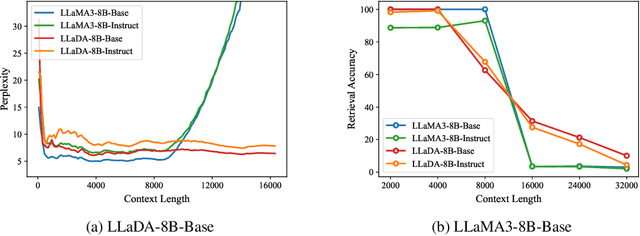
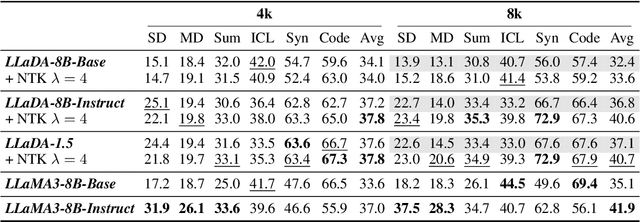
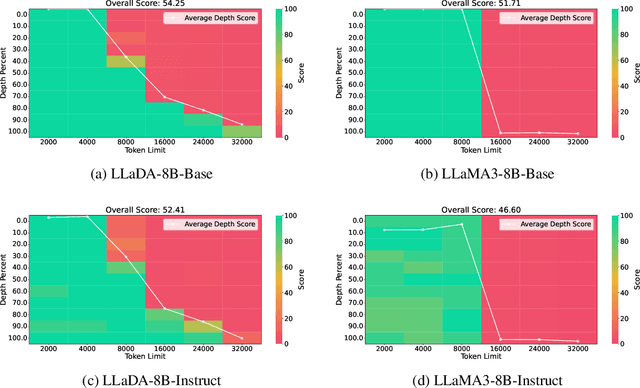
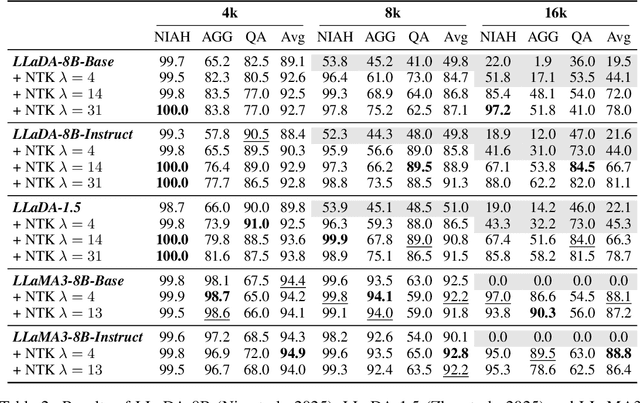
Large Language Diffusion Models, or diffusion LLMs, have emerged as a significant focus in NLP research, with substantial effort directed toward understanding their scalability and downstream task performance. However, their long-context capabilities remain unexplored, lacking systematic analysis or methods for context extension. In this work, we present the first systematic investigation comparing the long-context performance of diffusion LLMs and traditional auto-regressive LLMs. We first identify a unique characteristic of diffusion LLMs, unlike auto-regressive LLMs, they maintain remarkably \textbf{\textit{stable perplexity}} during direct context extrapolation. Furthermore, where auto-regressive models fail outright during the Needle-In-A-Haystack task with context exceeding their pretrained length, we discover diffusion LLMs exhibit a distinct \textbf{\textit{local perception}} phenomenon, enabling successful retrieval from recent context segments. We explain both phenomena through the lens of Rotary Position Embedding (RoPE) scaling theory. Building on these observations, we propose LongLLaDA, a training-free method that integrates LLaDA with the NTK-based RoPE extrapolation. Our results validate that established extrapolation scaling laws remain effective for extending the context windows of diffusion LLMs. Furthermore, we identify long-context tasks where diffusion LLMs outperform auto-regressive LLMs and others where they fall short. Consequently, this study establishes the first context extrapolation method for diffusion LLMs while providing essential theoretical insights and empirical benchmarks critical for advancing future research on long-context diffusion LLMs.
Beyond Homogeneous Attention: Memory-Efficient LLMs via Fourier-Approximated KV Cache
Jun 13, 2025Large Language Models struggle with memory demands from the growing Key-Value (KV) cache as context lengths increase. Existing compression methods homogenize head dimensions or rely on attention-guided token pruning, often sacrificing accuracy or introducing computational overhead. We propose FourierAttention, a training-free framework that exploits the heterogeneous roles of transformer head dimensions: lower dimensions prioritize local context, while upper ones capture long-range dependencies. By projecting the long-context-insensitive dimensions onto orthogonal Fourier bases, FourierAttention approximates their temporal evolution with fixed-length spectral coefficients. Evaluations on LLaMA models show that FourierAttention achieves the best long-context accuracy on LongBench and Needle-In-A-Haystack (NIAH). Besides, a custom Triton kernel, FlashFourierAttention, is designed to optimize memory via streamlined read-write operations, enabling efficient deployment without performance compromise.