 Add to Chrome
 Add to Firefox
 Add to Edge
End-to-End Direction-Aware Keyword Spotting with Spatial Priors in Noisy Environments
Mar 10, 2026
Keyword spotting (KWS) is crucial for many speech-driven applications, but robust KWS in noisy environments remains challenging. Conventional systems often rely on single-channel inputs and a cascaded pipeline separating front-end enhancement from KWS. This precludes joint optimization, inherently limiting performance. We present an end-to-end multi-channel KWS framework that exploits spatial cues to improve noise robustness. A spatial encoder learns inter-channel features, while a spatial embedding injects directional priors; the fused representation is processed by a streaming backbone. Experiments in simulated noisy conditions across multiple signal-to-noise ratios (SNRs) show that spatial modeling and directional priors each yield clear gains over baselines, with their combination achieving the best results. These findings validate end-to-end multi-channel spatial modeling, indicating strong potential for the target-speaker-aware detection in complex acoustic scenarios.

Both Semantics and Reconstruction Matter: Making Representation Encoders Ready for Text-to-Image Generation and Editing
Dec 19, 2025Modern Latent Diffusion Models (LDMs) typically operate in low-level Variational Autoencoder (VAE) latent spaces that are primarily optimized for pixel-level reconstruction. To unify vision generation and understanding, a burgeoning trend is to adopt high-dimensional features from representation encoders as generative latents. However, we empirically identify two fundamental obstacles in this paradigm: (1) the discriminative feature space lacks compact regularization, making diffusion models prone to off-manifold latents that lead to inaccurate object structures; and (2) the encoder's inherently weak pixel-level reconstruction hinders the generator from learning accurate fine-grained geometry and texture. In this paper, we propose a systematic framework to adapt understanding-oriented encoder features for generative tasks. We introduce a semantic-pixel reconstruction objective to regularize the latent space, enabling the compression of both semantic information and fine-grained details into a highly compact representation (96 channels with 16x16 spatial downsampling). This design ensures that the latent space remains semantically rich and achieves state-of-the-art image reconstruction, while remaining compact enough for accurate generation. Leveraging this representation, we design a unified Text-to-Image (T2I) and image editing model. Benchmarking against various feature spaces, we demonstrate that our approach achieves state-of-the-art reconstruction, faster convergence, and substantial performance gains in both T2I and editing tasks, validating that representation encoders can be effectively adapted into robust generative components.
DiffusionBrowser: Interactive Diffusion Previews via Multi-Branch Decoders
Dec 15, 2025
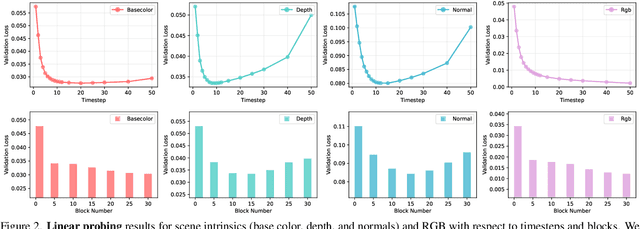
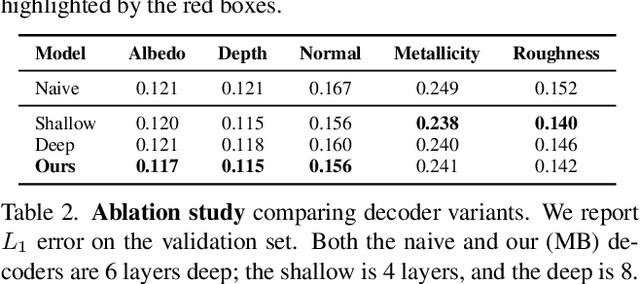
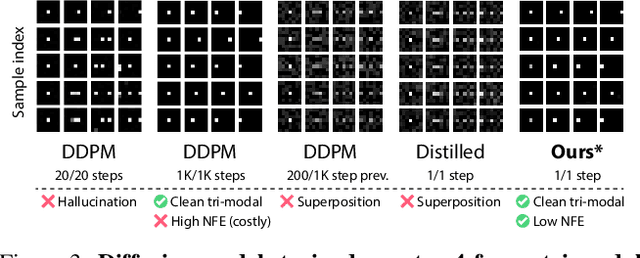
Video diffusion models have revolutionized generative video synthesis, but they are imprecise, slow, and can be opaque during generation -- keeping users in the dark for a prolonged period. In this work, we propose DiffusionBrowser, a model-agnostic, lightweight decoder framework that allows users to interactively generate previews at any point (timestep or transformer block) during the denoising process. Our model can generate multi-modal preview representations that include RGB and scene intrinsics at more than 4$\times$ real-time speed (less than 1 second for a 4-second video) that convey consistent appearance and motion to the final video. With the trained decoder, we show that it is possible to interactively guide the generation at intermediate noise steps via stochasticity reinjection and modal steering, unlocking a new control capability. Moreover, we systematically probe the model using the learned decoders, revealing how scene, object, and other details are composed and assembled during the otherwise black-box denoising process.
TRAIL: Transferable Robust Adversarial Images via Latent diffusion
May 22, 2025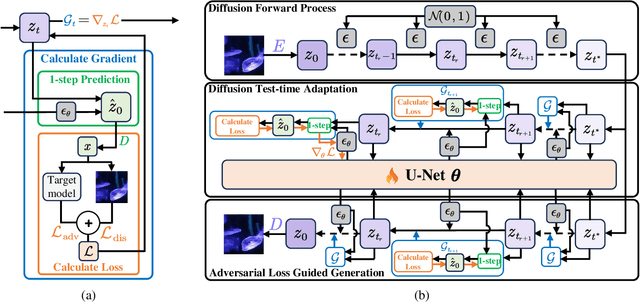
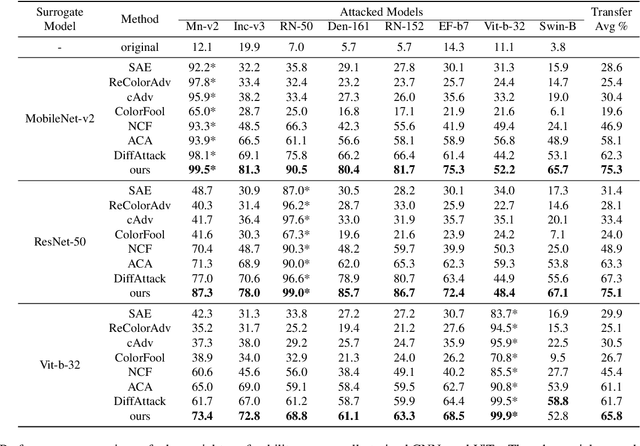
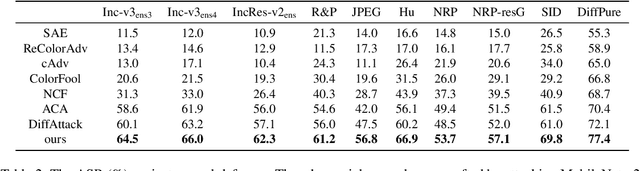
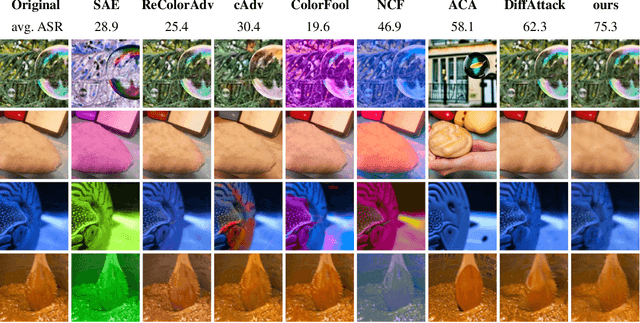
Adversarial attacks exploiting unrestricted natural perturbations present severe security risks to deep learning systems, yet their transferability across models remains limited due to distribution mismatches between generated adversarial features and real-world data. While recent works utilize pre-trained diffusion models as adversarial priors, they still encounter challenges due to the distribution shift between the distribution of ideal adversarial samples and the natural image distribution learned by the diffusion model. To address the challenge, we propose Transferable Robust Adversarial Images via Latent Diffusion (TRAIL), a test-time adaptation framework that enables the model to generate images from a distribution of images with adversarial features and closely resembles the target images. To mitigate the distribution shift, during attacks, TRAIL updates the diffusion U-Net's weights by combining adversarial objectives (to mislead victim models) and perceptual constraints (to preserve image realism). The adapted model then generates adversarial samples through iterative noise injection and denoising guided by these objectives. Experiments demonstrate that TRAIL significantly outperforms state-of-the-art methods in cross-model attack transferability, validating that distribution-aligned adversarial feature synthesis is critical for practical black-box attacks.
ZipIR: Latent Pyramid Diffusion Transformer for High-Resolution Image Restoration
Apr 11, 2025Recent progress in generative models has significantly improved image restoration capabilities, particularly through powerful diffusion models that offer remarkable recovery of semantic details and local fidelity. However, deploying these models at ultra-high resolutions faces a critical trade-off between quality and efficiency due to the computational demands of long-range attention mechanisms. To address this, we introduce ZipIR, a novel framework that enhances efficiency, scalability, and long-range modeling for high-res image restoration. ZipIR employs a highly compressed latent representation that compresses image 32x, effectively reducing the number of spatial tokens, and enabling the use of high-capacity models like the Diffusion Transformer (DiT). Toward this goal, we propose a Latent Pyramid VAE (LP-VAE) design that structures the latent space into sub-bands to ease diffusion training. Trained on full images up to 2K resolution, ZipIR surpasses existing diffusion-based methods, offering unmatched speed and quality in restoring high-resolution images from severely degraded inputs.
TurboFill: Adapting Few-step Text-to-image Model for Fast Image Inpainting
Apr 01, 2025This paper introduces TurboFill, a fast image inpainting model that enhances a few-step text-to-image diffusion model with an inpainting adapter for high-quality and efficient inpainting. While standard diffusion models generate high-quality results, they incur high computational costs. We overcome this by training an inpainting adapter on a few-step distilled text-to-image model, DMD2, using a novel 3-step adversarial training scheme to ensure realistic, structurally consistent, and visually harmonious inpainted regions. To evaluate TurboFill, we propose two benchmarks: DilationBench, which tests performance across mask sizes, and HumanBench, based on human feedback for complex prompts. Experiments show that TurboFill outperforms both multi-step BrushNet and few-step inpainting methods, setting a new benchmark for high-performance inpainting tasks. Our project page: https://liangbinxie.github.io/projects/TurboFill/
Multitwine: Multi-Object Compositing with Text and Layout Control
Feb 07, 2025


We introduce the first generative model capable of simultaneous multi-object compositing, guided by both text and layout. Our model allows for the addition of multiple objects within a scene, capturing a range of interactions from simple positional relations (e.g., next to, in front of) to complex actions requiring reposing (e.g., hugging, playing guitar). When an interaction implies additional props, like `taking a selfie', our model autonomously generates these supporting objects. By jointly training for compositing and subject-driven generation, also known as customization, we achieve a more balanced integration of textual and visual inputs for text-driven object compositing. As a result, we obtain a versatile model with state-of-the-art performance in both tasks. We further present a data generation pipeline leveraging visual and language models to effortlessly synthesize multimodal, aligned training data.
TransPixar: Advancing Text-to-Video Generation with Transparency
Jan 06, 2025


Text-to-video generative models have made significant strides, enabling diverse applications in entertainment, advertising, and education. However, generating RGBA video, which includes alpha channels for transparency, remains a challenge due to limited datasets and the difficulty of adapting existing models. Alpha channels are crucial for visual effects (VFX), allowing transparent elements like smoke and reflections to blend seamlessly into scenes. We introduce TransPixar, a method to extend pretrained video models for RGBA generation while retaining the original RGB capabilities. TransPixar leverages a diffusion transformer (DiT) architecture, incorporating alpha-specific tokens and using LoRA-based fine-tuning to jointly generate RGB and alpha channels with high consistency. By optimizing attention mechanisms, TransPixar preserves the strengths of the original RGB model and achieves strong alignment between RGB and alpha channels despite limited training data. Our approach effectively generates diverse and consistent RGBA videos, advancing the possibilities for VFX and interactive content creation.
Generative Video Propagation
Dec 27, 2024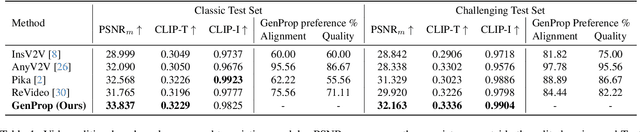

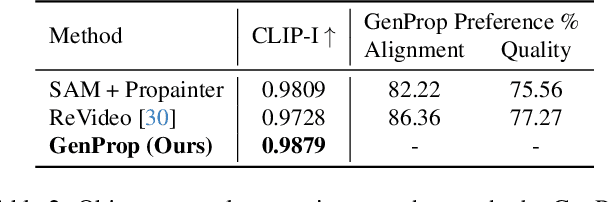
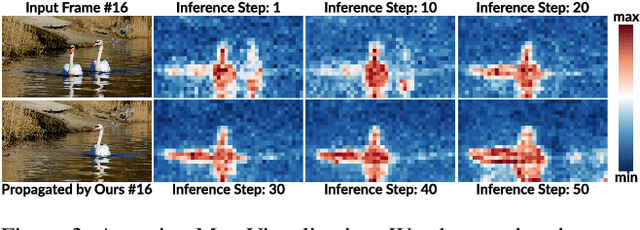
Large-scale video generation models have the inherent ability to realistically model natural scenes. In this paper, we demonstrate that through a careful design of a generative video propagation framework, various video tasks can be addressed in a unified way by leveraging the generative power of such models. Specifically, our framework, GenProp, encodes the original video with a selective content encoder and propagates the changes made to the first frame using an image-to-video generation model. We propose a data generation scheme to cover multiple video tasks based on instance-level video segmentation datasets. Our model is trained by incorporating a mask prediction decoder head and optimizing a region-aware loss to aid the encoder to preserve the original content while the generation model propagates the modified region. This novel design opens up new possibilities: In editing scenarios, GenProp allows substantial changes to an object's shape; for insertion, the inserted objects can exhibit independent motion; for removal, GenProp effectively removes effects like shadows and reflections from the whole video; for tracking, GenProp is capable of tracking objects and their associated effects together. Experiment results demonstrate the leading performance of our model in various video tasks, and we further provide in-depth analyses of the proposed framework.
UniReal: Universal Image Generation and Editing via Learning Real-world Dynamics
Dec 10, 2024
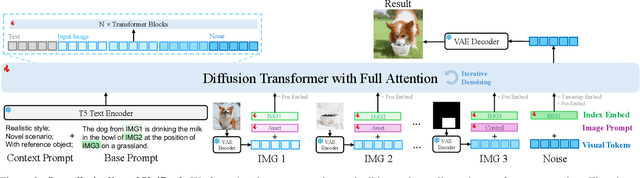
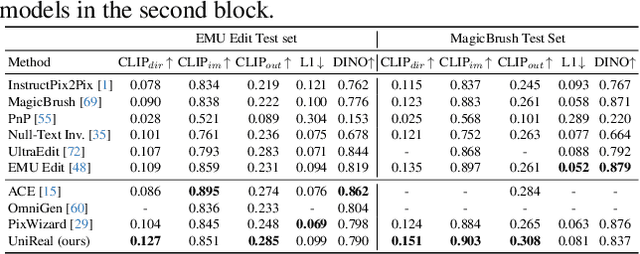

We introduce UniReal, a unified framework designed to address various image generation and editing tasks. Existing solutions often vary by tasks, yet share fundamental principles: preserving consistency between inputs and outputs while capturing visual variations. Inspired by recent video generation models that effectively balance consistency and variation across frames, we propose a unifying approach that treats image-level tasks as discontinuous video generation. Specifically, we treat varying numbers of input and output images as frames, enabling seamless support for tasks such as image generation, editing, customization, composition, etc. Although designed for image-level tasks, we leverage videos as a scalable source for universal supervision. UniReal learns world dynamics from large-scale videos, demonstrating advanced capability in handling shadows, reflections, pose variation, and object interaction, while also exhibiting emergent capability for novel applications.