 Add to Chrome
 Add to Firefox
 Add to Edge
Physics-Informed Generative Solver: Bridging Data-Driven Priors and Conservation Laws for Stable Spatiotemporal Field Reconstruction
May 21, 2026
Reconstructing continuous physical fields from sparse measurements is a central inverse problem, but data-driven generative models can produce states that violate governing dynamics. We introduce a physics-informed generative solver that separates stable prior learning from inference-time enforcement of conservation laws. Martingale-Regularized Score Matching regularizes score pretraining with a Score Fokker-Planck constraint, yielding a dynamically stable prior. Physics-Informed Implicit Score Sampling then guides denoising trajectories by gradients of physical residuals, projecting samples toward admissible manifolds without retraining. In acoustics, the method co-generates pressure and particle velocity from sparse sensors, enabling dense virtual arrays that suppress spatial aliasing. The same framework generalizes to real-world ERA5 meteorological fields under extreme sparsity. Together, this work establishes a rigorous and generalizable paradigm for solving high-dimensional inverse problems, bridging the gap between generative artificial intelligence and first-principles science.

CalliMaster: Mastering Page-level Chinese Calligraphy via Layout-guided Spatial Planning
Mar 12, 2026Page-level calligraphy synthesis requires balancing glyph precision with layout composition. Existing character models lack spatial context, while page-level methods often compromise brushwork detail. In this paper, we present \textbf{CalliMaster}, a unified framework for controllable generation and editing that resolves this conflict by decoupling spatial planning from content synthesis. Inspired by the human cognitive process of ``planning before writing'', we introduce a coarse-to-fine pipeline \textbf{(Text $\rightarrow$ Layout $\rightarrow$ Image)} to tackle the combinatorial complexity of page-scale synthesis. Operating within a single Multimodal Diffusion Transformer, a spatial planning stage first predicts character bounding boxes to establish the global spatial arrangement. This intermediate layout then serves as a geometric prompt for the content synthesis stage, where the same network utilizes flow-matching to render high-fidelity brushwork. Beyond achieving state-of-the-art generation quality, this disentanglement supports versatile downstream capabilities. By treating the layout as a modifiable constraint, CalliMaster enables controllable semantic re-planning: users can resize or reposition characters while the model automatically harmonizes the surrounding void space and brush momentum. Furthermore, we demonstrate the framework's extensibility to artifact restoration and forensic analysis, providing a comprehensive tool for digital cultural heritage.
Motion Forcing: A Decoupled Framework for Robust Video Generation in Motion Dynamics
Mar 11, 2026The ultimate goal of video generation is to satisfy a fundamental trilemma: achieving high visual quality, maintaining rigorous physical consistency, and enabling precise controllability. While recent models can maintain this balance in simple, isolated scenarios, we observe that this equilibrium is fragile and often breaks down as scene complexity increases (e.g., involving collisions or dense traffic). To address this, we introduce \textbf{Motion Forcing}, a framework designed to stabilize this trilemma even in complex generative tasks. Our key insight is to explicitly decouple physical reasoning from visual synthesis via a hierarchical \textbf{``Point-Shape-Appearance''} paradigm. This approach decomposes generation into verifiable stages: modeling complex dynamics as sparse geometric anchors (\textbf{Point}), expanding them into dynamic depth maps that explicitly resolve 3D geometry (\textbf{Shape}), and finally rendering high-fidelity textures (\textbf{Appearance}). Furthermore, to foster robust physical understanding, we employ a \textbf{Masked Point Recovery} strategy. By randomly masking input anchors during training and enforcing the reconstruction of complete dynamic depth, the model is compelled to move beyond passive pattern matching and learn latent physical laws (e.g., inertia) to infer missing trajectories. Extensive experiments on autonomous driving benchmarks show that Motion Forcing significantly outperforms state-of-the-art baselines, maintaining trilemma stability across complex scenes. Evaluations on physics and robotics further confirm our framework's generality.
A Mechanistic View on Video Generation as World Models: State and Dynamics
Jan 22, 2026Large-scale video generation models have demonstrated emergent physical coherence, positioning them as potential world models. However, a gap remains between contemporary "stateless" video architectures and classic state-centric world model theories. This work bridges this gap by proposing a novel taxonomy centered on two pillars: State Construction and Dynamics Modeling. We categorize state construction into implicit paradigms (context management) and explicit paradigms (latent compression), while dynamics modeling is analyzed through knowledge integration and architectural reformulation. Furthermore, we advocate for a transition in evaluation from visual fidelity to functional benchmarks, testing physical persistence and causal reasoning. We conclude by identifying two critical frontiers: enhancing persistence via data-driven memory and compressed fidelity, and advancing causality through latent factor decoupling and reasoning-prior integration. By addressing these challenges, the field can evolve from generating visually plausible videos to building robust, general-purpose world simulators.
TransPixar: Advancing Text-to-Video Generation with Transparency
Jan 06, 2025


Text-to-video generative models have made significant strides, enabling diverse applications in entertainment, advertising, and education. However, generating RGBA video, which includes alpha channels for transparency, remains a challenge due to limited datasets and the difficulty of adapting existing models. Alpha channels are crucial for visual effects (VFX), allowing transparent elements like smoke and reflections to blend seamlessly into scenes. We introduce TransPixar, a method to extend pretrained video models for RGBA generation while retaining the original RGB capabilities. TransPixar leverages a diffusion transformer (DiT) architecture, incorporating alpha-specific tokens and using LoRA-based fine-tuning to jointly generate RGB and alpha channels with high consistency. By optimizing attention mechanisms, TransPixar preserves the strengths of the original RGB model and achieves strong alignment between RGB and alpha channels despite limited training data. Our approach effectively generates diverse and consistent RGBA videos, advancing the possibilities for VFX and interactive content creation.
Uni-Renderer: Unifying Rendering and Inverse Rendering Via Dual Stream Diffusion
Dec 19, 2024

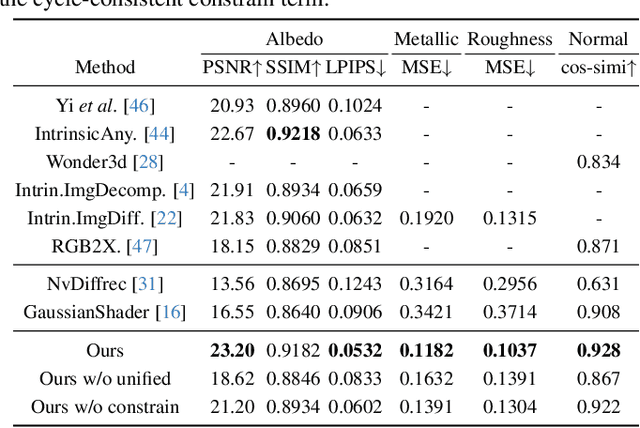

Rendering and inverse rendering are pivotal tasks in both computer vision and graphics. The rendering equation is the core of the two tasks, as an ideal conditional distribution transfer function from intrinsic properties to RGB images. Despite achieving promising results of existing rendering methods, they merely approximate the ideal estimation for a specific scene and come with a high computational cost. Additionally, the inverse conditional distribution transfer is intractable due to the inherent ambiguity. To address these challenges, we propose a data-driven method that jointly models rendering and inverse rendering as two conditional generation tasks within a single diffusion framework. Inspired by UniDiffuser, we utilize two distinct time schedules to model both tasks, and with a tailored dual streaming module, we achieve cross-conditioning of two pre-trained diffusion models. This unified approach, named Uni-Renderer, allows the two processes to facilitate each other through a cycle-consistent constrain, mitigating ambiguity by enforcing consistency between intrinsic properties and rendered images. Combined with a meticulously prepared dataset, our method effectively decomposition of intrinsic properties and demonstrates a strong capability to recognize changes during rendering. We will open-source our training and inference code to the public, fostering further research and development in this area.
Motion Dreamer: Realizing Physically Coherent Video Generation through Scene-Aware Motion Reasoning
Nov 30, 2024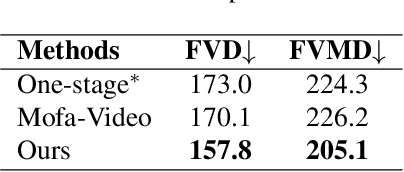
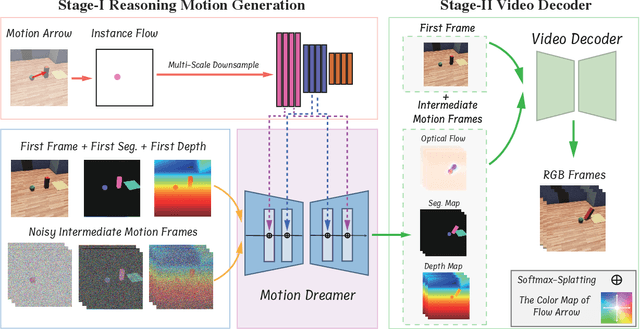
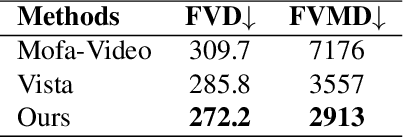
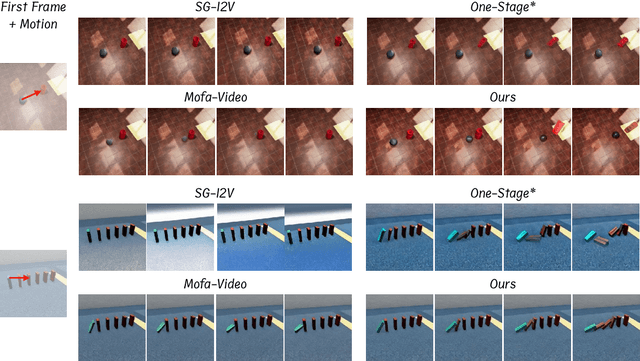
Recent numerous video generation models, also known as world models, have demonstrated the ability to generate plausible real-world videos. However, many studies have shown that these models often produce motion results lacking logical or physical coherence. In this paper, we revisit video generation models and find that single-stage approaches struggle to produce high-quality results while maintaining coherent motion reasoning. To address this issue, we propose \textbf{Motion Dreamer}, a two-stage video generation framework. In Stage I, the model generates an intermediate motion representation-such as a segmentation map or depth map-based on the input image and motion conditions, focusing solely on the motion itself. In Stage II, the model uses this intermediate motion representation as a condition to generate a high-detail video. By decoupling motion reasoning from high-fidelity video synthesis, our approach allows for more accurate and physically plausible motion generation. We validate the effectiveness of our approach on the Physion dataset and in autonomous driving scenarios. For example, given a single push, our model can synthesize the sequential toppling of a set of dominoes. Similarly, by varying the movements of ego-cars, our model can produce different effects on other vehicles. Our work opens new avenues in creating models that can reason about physical interactions in a more coherent and realistic manner.
Defect Spectrum: A Granular Look of Large-Scale Defect Datasets with Rich Semantics
Nov 06, 2023Defect inspection is paramount within the closed-loop manufacturing system. However, existing datasets for defect inspection often lack precision and semantic granularity required for practical applications. In this paper, we introduce the Defect Spectrum, a comprehensive benchmark that offers precise, semantic-abundant, and large-scale annotations for a wide range of industrial defects. Building on four key industrial benchmarks, our dataset refines existing annotations and introduces rich semantic details, distinguishing multiple defect types within a single image. Furthermore, we introduce Defect-Gen, a two-stage diffusion-based generator designed to create high-quality and diverse defective images, even when working with limited datasets. The synthetic images generated by Defect-Gen significantly enhance the efficacy of defect inspection models. Overall, The Defect Spectrum dataset demonstrates its potential in defect inspection research, offering a solid platform for testing and refining advanced models.