 Add to Chrome
 Add to Firefox
 Add to Edge
Learning How the World Evolves: Extrapolative Video World Models via Latent Dynamics Reasoning
Aug 10, 2026
The world evolves following its dynamics, i.e., its laws of motion. However, leading video diffusion models largely fit the pixels without modeling how the pixels transit over time. Thus, they render visually plausible frames but may not accurately obey the laws. To capture the dynamics purely from pixels, we introduce Latent Dynamics Reasoning (LDR). LDR casts the latent transition as an explicit kinematic integration, where the lower-order dynamics are integrated numerically and the model regresses only the third- and higher-order residual that drives the rollout. For this integration to extrapolate better, LDR runs it on a structured latent rather than dense convolutional features. Following PhyWorld, we validate LDR on a controlled white-box physics benchmark spanning five tasks (uniform motion, parabola, collision, bouncing, looming), focusing on out-of-distribution scenarios that reveal whether a model has truly learned the underlying dynamics. LDR extrapolates the learned dynamics far better: the gap between its in- and out-of-distribution error is over 20$\times$ smaller than the video diffusion baseline's, under both single- and joint-task training at 256$^2$ resolution, while using 26$\times$ fewer parameters and running 143$\times$ faster. LDR can even generalize under severe shift: for example, trained only on red balls moving left-to-right, it correctly predicts the motion of a blue square moving right-to-left. To our knowledge, this is the first video world model that extrapolates learned dynamics beyond its training distribution. Project page: https://lat-dyn-reason.github.io/

Chimera: Designing and Chinchilla-Scaling Hybrid Visual Diffusion Transformers
Jul 30, 2026Visual generation increasingly requires high-resolution images, long videos, and multimodal context, making the quadratic cost of full attention prohibitive. We introduce Chimera, a hybrid visual diffusion backbone with a principled scaling recipe. Chimera processes text, image, and video tokens in one raster-ordered stream without positional embeddings. It combines Kimi Delta Attention (KDA) for long-context state tracking with O(N) complexity, interleaved Multi-head Latent Attention (MLA) for direct global interaction, and modality-aware short convolutions for local spatiotemporal context. Sparse Mixture-of-Experts (MoE) layers expand capacity while controlling activated compute. To scale this heterogeneous architecture, we introduce HeteroP, a module-wise scheme that transfers hyperparameters across width and depth according to each tensor's functional fan-in and model depth. HeteroP yields a consistently tuned family used to fit Chinchilla-style compute-optimal laws for activated model size, training-token count, and image-video data ratio. Guided by these laws, we train an 11B-parameter Chimera with 2B activated parameters. Experiments show three results. First, measured by pretraining diffusion loss, the dense backbone is 1.7x as compute-efficient as a matched full-attention Wan-2.1 2B baseline, while the complete system reaches 7.3x. Second, without length-specific fine-tuning, Chimera extrapolates zero-shot from 5-second training clips to 30-second videos, with only 6.5% FID degradation in the last five seconds. Third, the fitted laws show that compute-optimal image pretraining divides compute nearly evenly between activated model size and training-token count, whereas video pretraining modestly favors model size at higher budgets. These results establish a foundation for designing and scaling efficient long-context diffusion architectures.
LongLive-2.0: An NVFP4 Parallel Infrastructure for Long Video Generation
May 19, 2026We present LongLive-2.0, an NVFP4-based parallel infrastructure throughout the full training and inference workflow of long video generation, addressing speed and memory bottlenecks. For training, we introduce sequence-parallel autoregressive (AR) training, instantiated as Balanced SP, which co-designs the efficient teacher-forcing layout with SP execution by pairing clean-history and noisy-target temporal chunks on each rank, enabling a natural teacher-forcing mask with SP-aware chunked VAE encoding. Combined with NVFP4 precision, it reduces GPU memory cost and accelerates GEMM computation during training, the proportion of which increases as video length grows. Moreover, we show that a high-quality infrastructure and dataset enable a remarkably clean training pipeline. Unlike existing Self-Forcing series methods that rely on ODE initialization and subsequent distribution matching distillation (DMD), LongLive-2.0 directly tunes a diffusion model into a long, multi-shot, interactive auto-regressive (AR) diffusion model. It can be further converted to real-time generation (4 to 2 denoising steps) with standalone LoRA weights. For inference on Blackwell GPUs, we enable W4A4 NVFP4 inference, quantize KV cache into NVFP4 for memory savings, and boost end-to-end throughput with asynchronous streaming VAE decoding. On non-Blackwell GPU architectures, we deploy SP inference to match the speed on Blackwell GPUs, while the quantized KV cache can lower inter-GPU communication of SP. Experiments show up to 2.15x speedup in training, and 1.84x in inference. LongLive-2.0-5B achieves 45.7 FPS inference while attaining strong performance on benchmarks. To our knowledge, LongLive-2.0 is the first NVFP4 training and inference system for long video generation.
Masked Generative Transformer Is What You Need for Image Editing
May 11, 2026Diffusion models dominate image editing, yet their global denoising mechanism entangles edited regions with surrounding context, causing modifications to propagate into areas that should remain intact. We propose a fundamentally different approach by leveraging Masked Generative Transformers (MGTs), whose localized token-prediction paradigm naturally confines changes to intended regions. We present EditMGT, an MGT-based editing framework that is the first of its kind. Our approach employs multi-layer attention consolidation to aggregate cross-attention maps into precise edit localization signals, and region-hold sampling to explicitly prevent token flipping in non-target areas. To support training, we construct CrispEdit-2M, a 2M-sample high-resolution (>1024) editing dataset spanning seven categories. With only 960M parameters, EditMGT achieves state-of-the-art image similarity on multiple benchmarks while delivering 6x faster editing, demonstrating that MGTs offer a compelling alternative to diffusion-based editing.
Rolling Sink: Bridging Limited-Horizon Training and Open-Ended Testing in Autoregressive Video Diffusion
Feb 08, 2026Recently, autoregressive (AR) video diffusion models has achieved remarkable performance. However, due to their limited training durations, a train-test gap emerges when testing at longer horizons, leading to rapid visual degradations. Following Self Forcing, which studies the train-test gap within the training duration, this work studies the train-test gap beyond the training duration, i.e., the gap between the limited horizons during training and open-ended horizons during testing. Since open-ended testing can extend beyond any finite training window, and long-video training is computationally expensive, we pursue a training-free solution to bridge this gap. To explore a training-free solution, we conduct a systematic analysis of AR cache maintenance. These insights lead to Rolling Sink. Built on Self Forcing (trained on only 5s clips), Rolling Sink effectively scales the AR video synthesis to ultra-long durations (e.g., 5-30 minutes at 16 FPS) at test time, with consistent subjects, stable colors, coherent structures, and smooth motions. As demonstrated by extensive experiments, Rolling Sink achieves superior long-horizon visual fidelity and temporal consistency compared to SOTA baselines. Project page: https://rolling-sink.github.io/
Both Semantics and Reconstruction Matter: Making Representation Encoders Ready for Text-to-Image Generation and Editing
Dec 19, 2025Modern Latent Diffusion Models (LDMs) typically operate in low-level Variational Autoencoder (VAE) latent spaces that are primarily optimized for pixel-level reconstruction. To unify vision generation and understanding, a burgeoning trend is to adopt high-dimensional features from representation encoders as generative latents. However, we empirically identify two fundamental obstacles in this paradigm: (1) the discriminative feature space lacks compact regularization, making diffusion models prone to off-manifold latents that lead to inaccurate object structures; and (2) the encoder's inherently weak pixel-level reconstruction hinders the generator from learning accurate fine-grained geometry and texture. In this paper, we propose a systematic framework to adapt understanding-oriented encoder features for generative tasks. We introduce a semantic-pixel reconstruction objective to regularize the latent space, enabling the compression of both semantic information and fine-grained details into a highly compact representation (96 channels with 16x16 spatial downsampling). This design ensures that the latent space remains semantically rich and achieves state-of-the-art image reconstruction, while remaining compact enough for accurate generation. Leveraging this representation, we design a unified Text-to-Image (T2I) and image editing model. Benchmarking against various feature spaces, we demonstrate that our approach achieves state-of-the-art reconstruction, faster convergence, and substantial performance gains in both T2I and editing tasks, validating that representation encoders can be effectively adapted into robust generative components.
EditMGT: Unleashing Potentials of Masked Generative Transformers in Image Editing
Dec 12, 2025Recent advances in diffusion models (DMs) have achieved exceptional visual quality in image editing tasks. However, the global denoising dynamics of DMs inherently conflate local editing targets with the full-image context, leading to unintended modifications in non-target regions. In this paper, we shift our attention beyond DMs and turn to Masked Generative Transformers (MGTs) as an alternative approach to tackle this challenge. By predicting multiple masked tokens rather than holistic refinement, MGTs exhibit a localized decoding paradigm that endows them with the inherent capacity to explicitly preserve non-relevant regions during the editing process. Building upon this insight, we introduce the first MGT-based image editing framework, termed EditMGT. We first demonstrate that MGT's cross-attention maps provide informative localization signals for localizing edit-relevant regions and devise a multi-layer attention consolidation scheme that refines these maps to achieve fine-grained and precise localization. On top of these adaptive localization results, we introduce region-hold sampling, which restricts token flipping within low-attention areas to suppress spurious edits, thereby confining modifications to the intended target regions and preserving the integrity of surrounding non-target areas. To train EditMGT, we construct CrispEdit-2M, a high-resolution dataset spanning seven diverse editing categories. Without introducing additional parameters, we adapt a pre-trained text-to-image MGT into an image editing model through attention injection. Extensive experiments across four standard benchmarks demonstrate that, with fewer than 1B parameters, our model achieves similarity performance while enabling 6 times faster editing. Moreover, it delivers comparable or superior editing quality, with improvements of 3.6% and 17.6% on style change and style transfer tasks, respectively.
Training-Free Efficient Video Generation via Dynamic Token Carving
May 22, 2025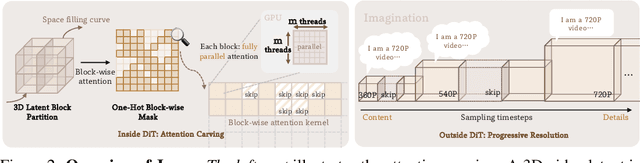
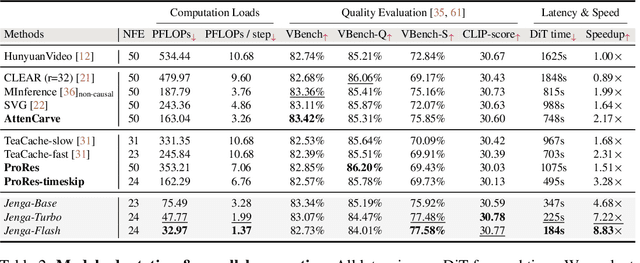
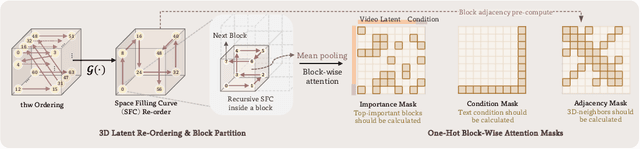
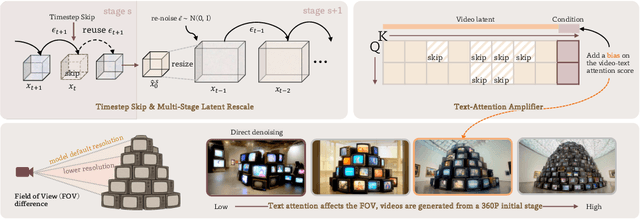
Despite the remarkable generation quality of video Diffusion Transformer (DiT) models, their practical deployment is severely hindered by extensive computational requirements. This inefficiency stems from two key challenges: the quadratic complexity of self-attention with respect to token length and the multi-step nature of diffusion models. To address these limitations, we present Jenga, a novel inference pipeline that combines dynamic attention carving with progressive resolution generation. Our approach leverages two key insights: (1) early denoising steps do not require high-resolution latents, and (2) later steps do not require dense attention. Jenga introduces a block-wise attention mechanism that dynamically selects relevant token interactions using 3D space-filling curves, alongside a progressive resolution strategy that gradually increases latent resolution during generation. Experimental results demonstrate that Jenga achieves substantial speedups across multiple state-of-the-art video diffusion models while maintaining comparable generation quality (8.83$\times$ speedup with 0.01\% performance drop on VBench). As a plug-and-play solution, Jenga enables practical, high-quality video generation on modern hardware by reducing inference time from minutes to seconds -- without requiring model retraining. Code: https://github.com/dvlab-research/Jenga
Generative Video Propagation
Dec 27, 2024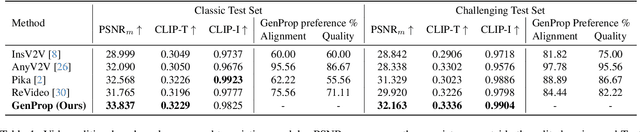

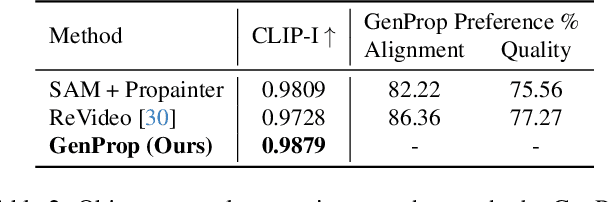
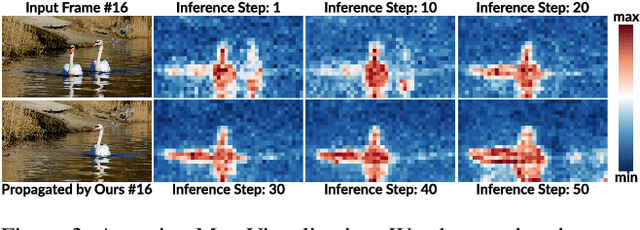
Large-scale video generation models have the inherent ability to realistically model natural scenes. In this paper, we demonstrate that through a careful design of a generative video propagation framework, various video tasks can be addressed in a unified way by leveraging the generative power of such models. Specifically, our framework, GenProp, encodes the original video with a selective content encoder and propagates the changes made to the first frame using an image-to-video generation model. We propose a data generation scheme to cover multiple video tasks based on instance-level video segmentation datasets. Our model is trained by incorporating a mask prediction decoder head and optimizing a region-aware loss to aid the encoder to preserve the original content while the generation model propagates the modified region. This novel design opens up new possibilities: In editing scenarios, GenProp allows substantial changes to an object's shape; for insertion, the inserted objects can exhibit independent motion; for removal, GenProp effectively removes effects like shadows and reflections from the whole video; for tracking, GenProp is capable of tracking objects and their associated effects together. Experiment results demonstrate the leading performance of our model in various video tasks, and we further provide in-depth analyses of the proposed framework.
Mini-Gemini: Mining the Potential of Multi-modality Vision Language Models
Mar 27, 2024
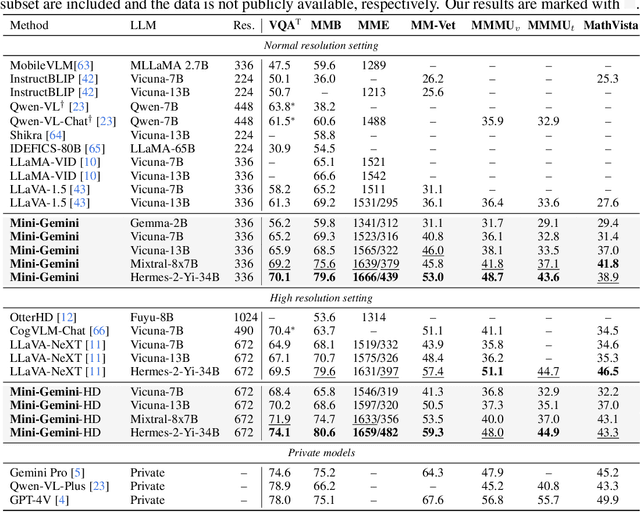


In this work, we introduce Mini-Gemini, a simple and effective framework enhancing multi-modality Vision Language Models (VLMs). Despite the advancements in VLMs facilitating basic visual dialog and reasoning, a performance gap persists compared to advanced models like GPT-4 and Gemini. We try to narrow the gap by mining the potential of VLMs for better performance and any-to-any workflow from three aspects, i.e., high-resolution visual tokens, high-quality data, and VLM-guided generation. To enhance visual tokens, we propose to utilize an additional visual encoder for high-resolution refinement without increasing the visual token count. We further construct a high-quality dataset that promotes precise image comprehension and reasoning-based generation, expanding the operational scope of current VLMs. In general, Mini-Gemini further mines the potential of VLMs and empowers current frameworks with image understanding, reasoning, and generation simultaneously. Mini-Gemini supports a series of dense and MoE Large Language Models (LLMs) from 2B to 34B. It is demonstrated to achieve leading performance in several zero-shot benchmarks and even surpasses the developed private models. Code and models are available at https://github.com/dvlab-research/MiniGemini.