 Add to Chrome
 Add to Firefox
 Add to Edge
ASUMOT: Motion-Consistency-Based Asynchronous UAV Detection and Tracking with Event Cameras
Jul 13, 2026
Event cameras offer microsecond-level temporal resolution and high dynamic range for low-altitude UAV perception. However, long-range UAVs often produce sparse, fragmented, and noise-contaminated event responses, where one semantic target may appear as multiple spatially separated blobs. Direct blob-level asynchronous tracking therefore suffers from duplicate trajectories and unstable identities. We propose ASUMOT, a motion-consistency-based asynchronous UAV detection and tracking framework operating directly on raw events. ASUMOT models each UAV as a set of motion-consistent event blobs. A local motion-consistency estimator triggers reliable candidates, a lightweight multi-task verifier provides UAV confidence and motion-direction cues, and motion-consistency clustering aggregates fragmented blobs into identity-consistent UAV tracks. We also introduce ES-UAV, a high-definition event-level UAV benchmark with dense semantic annotations. Experiments on public UAV tracking data and ES-UAV show that ASUMOT improves the accuracy--efficiency trade-off while preserving asynchronous event processing. Code and Dataset will be released.

CMDS-AD: Cross-Modal Dual-Stream Decoupling for Few-Shot Anomaly Detection
Jun 18, 2026Few-shot anomaly detection remains challenging due to limited training data. Multi-modal anomaly detection (MAD) offers a viable solution, leveraging 3D geometric cues to enrich 2D RGB representations and compensate for this scarcity. However, existing MAD methods apply spatially uniform feature processing, conflating stable macroscopic structures with high-frequency localized defect signals, exacerbating cross-modal misalignment and inflating false-positive rates. To overcome this, we present CMDS-AD, a Cross-Modal Dual-Stream Anomaly Detection framework. A LoRA-guided diffusion model generates diverse RGB samples to mitigate extreme data scarcity. For 3D normal augmentation, we employ a pre-trained diffusion model as a normal estimator. Crucially, this estimator inherently acts as a non-linear low-pass filter, directly extracting low-frequency normal representations from RGB inputs. This establishes an auxiliary estimated stream of purely low-frequency information, anchoring robust structural templates and assisting the uncompressed real stream, containing coupled high- and low-frequency components, to precisely isolate micro-defects. A Coordinate-Aware Hierarchical Feature Mapper adaptively aligns cross-modal semantics, while a multiplicative scoring mechanism filters modality-specific noise. Under the extreme 1-shot setting, CMDS-AD achieves absolute performance gains of 5.7% (I-AUROC) and 2.0% (AUPRO) on MVTec 3D-AD, alongside 7.7% and 5.6% improvements on EyeCandies, establishing a new state-of-the-art.
Improved Baselines with Representation Autoencoders
May 18, 2026Representation Autoencoders (RAE) replace traditional VAE with pretrained vision encoders. In this paper, we systematically investigate several design choices and find three insights which simplify and improve RAE. First, we study a generalized formulation where the representation is defined as sum of the last k encoder layers rather than solely the final layer. This simple change greatly improves reconstruction without encoder finetuning or specialized data (e.g., text, faces). Second, we study the prevalent assumption that RAE (using pretrained representation as encoder) replaces representation alignment (REPA), which distills the same representation to intermediate layers instead. Through large-scale empirical analysis, we uncover a surprising finding: RAE and REPA exhibit complementary working mechanisms, allowing the same representation to be used as both encoder and target for intermediate diffusion layers. Finally, the original RAE struggles with classifier-free guidance (CFG) and requires training a second, weaker diffusion model for AutoGuidance (AG). We show that REPA itself can be viewed as x-prediction in RAE latent space. By simply re-parameterizing the output of the DiT model, it can provide guidance for "free". Overall, RAEv2 leads to more than 10x faster convergence over the original RAE, achieving a state-of-the-art gFID of 1.06 in just 80 epochs on ImageNet-256. On FDr^k, RAEv2 achieves a state-of-the-art 2.17 at just 80 epochs compared to the previous best 3.26 (800 epochs) without any post-training. This motivates EP_FID@k (epochs to reach unguided gFID <= k) as a measure of training efficiency. RAEv2 attains an EP_FID@2 of 35 epochs, versus 177 for the original RAE. We also validate our approach across diverse settings for text-to-image generation and navigation world models, showing consistent improvements. Code is available at https://raev2.github.io.
End-to-End Training for Unified Tokenization and Latent Denoising
Mar 23, 2026Latent diffusion models (LDMs) enable high-fidelity synthesis by operating in learned latent spaces. However, training state-of-the-art LDMs requires complex staging: a tokenizer must be trained first, before the diffusion model can be trained in the frozen latent space. We propose UNITE - an autoencoder architecture for unified tokenization and latent diffusion. UNITE consists of a Generative Encoder that serves as both image tokenizer and latent generator via weight sharing. Our key insight is that tokenization and generation can be viewed as the same latent inference problem under different conditioning regimes: tokenization infers latents from fully observed images, whereas generation infers them from noise together with text or class conditioning. Motivated by this, we introduce a single-stage training procedure that jointly optimizes both tasks via two forward passes through the same Generative Encoder. The shared parameters enable gradients to jointly shape the latent space, encouraging a "common latent language". Across image and molecule modalities, UNITE achieves near state of the art performance without adversarial losses or pretrained encoders (e.g., DINO), reaching FID 2.12 and 1.73 for Base and Large models on ImageNet 256 x 256. We further analyze the Generative Encoder through the lenses of representation alignment and compression. These results show that single stage joint training of tokenization & generation from scratch is feasible.
ForgeDreamer: Industrial Text-to-3D Generation with Multi-Expert LoRA and Cross-View Hypergraph
Mar 10, 2026Current text-to-3D generation methods excel in natural scenes but struggle with industrial applications due to two critical limitations: domain adaptation challenges where conventional LoRA fusion causes knowledge interference across categories, and geometric reasoning deficiencies where pairwise consistency constraints fail to capture higher-order structural dependencies essential for precision manufacturing. We propose a novel framework named ForgeDreamer addressing both challenges through two key innovations. First, we introduce a Multi-Expert LoRA Ensemble mechanism that consolidates multiple category-specific LoRA models into a unified representation, achieving superior cross-category generalization while eliminating knowledge interference. Second, building on enhanced semantic understanding, we develop a Cross-View Hypergraph Geometric Enhancement approach that captures structural dependencies spanning multiple viewpoints simultaneously. These components work synergistically improved semantic understanding, enables more effective geometric reasoning, while hypergraph modeling ensures manufacturing-level consistency. Extensive experiments on a custom industrial dataset demonstrate superior semantic generalization and enhanced geometric fidelity compared to state-of-the-art approaches. Our code and data are provided in the supplementary material attached in the appendix for review purposes.
Causality in Video Diffusers is Separable from Denoising
Feb 10, 2026Causality -- referring to temporal, uni-directional cause-effect relationships between components -- underlies many complex generative processes, including videos, language, and robot trajectories. Current causal diffusion models entangle temporal reasoning with iterative denoising, applying causal attention across all layers, at every denoising step, and over the entire context. In this paper, we show that the causal reasoning in these models is separable from the multi-step denoising process. Through systematic probing of autoregressive video diffusers, we uncover two key regularities: (1) early layers produce highly similar features across denoising steps, indicating redundant computation along the diffusion trajectory; and (2) deeper layers exhibit sparse cross-frame attention and primarily perform intra-frame rendering. Motivated by these findings, we introduce Separable Causal Diffusion (SCD), a new architecture that explicitly decouples once-per-frame temporal reasoning, via a causal transformer encoder, from multi-step frame-wise rendering, via a lightweight diffusion decoder. Extensive experiments on both pretraining and post-training tasks across synthetic and real benchmarks show that SCD significantly improves throughput and per-frame latency while matching or surpassing the generation quality of strong causal diffusion baselines.
Rethinking Global Text Conditioning in Diffusion Transformers
Feb 09, 2026Diffusion transformers typically incorporate textual information via attention layers and a modulation mechanism using a pooled text embedding. Nevertheless, recent approaches discard modulation-based text conditioning and rely exclusively on attention. In this paper, we address whether modulation-based text conditioning is necessary and whether it can provide any performance advantage. Our analysis shows that, in its conventional usage, the pooled embedding contributes little to overall performance, suggesting that attention alone is generally sufficient for faithfully propagating prompt information. However, we reveal that the pooled embedding can provide significant gains when used from a different perspective-serving as guidance and enabling controllable shifts toward more desirable properties. This approach is training-free, simple to implement, incurs negligible runtime overhead, and can be applied to various diffusion models, bringing improvements across diverse tasks, including text-to-image/video generation and image editing.
What matters for Representation Alignment: Global Information or Spatial Structure?
Dec 11, 2025Representation alignment (REPA) guides generative training by distilling representations from a strong, pretrained vision encoder to intermediate diffusion features. We investigate a fundamental question: what aspect of the target representation matters for generation, its \textit{global} \revision{semantic} information (e.g., measured by ImageNet-1K accuracy) or its spatial structure (i.e. pairwise cosine similarity between patch tokens)? Prevalent wisdom holds that stronger global semantic performance leads to better generation as a target representation. To study this, we first perform a large-scale empirical analysis across 27 different vision encoders and different model scales. The results are surprising; spatial structure, rather than global performance, drives the generation performance of a target representation. To further study this, we introduce two straightforward modifications, which specifically accentuate the transfer of \emph{spatial} information. We replace the standard MLP projection layer in REPA with a simple convolution layer and introduce a spatial normalization layer for the external representation. Surprisingly, our simple method (implemented in $<$4 lines of code), termed iREPA, consistently improves convergence speed of REPA, across a diverse set of vision encoders, model sizes, and training variants (such as REPA, REPA-E, Meanflow, JiT etc). %, etc. Our work motivates revisiting the fundamental working mechanism of representational alignment and how it can be leveraged for improved training of generative models. The code and project page are available at https://end2end-diffusion.github.io/irepa
TurboFill: Adapting Few-step Text-to-image Model for Fast Image Inpainting
Apr 01, 2025This paper introduces TurboFill, a fast image inpainting model that enhances a few-step text-to-image diffusion model with an inpainting adapter for high-quality and efficient inpainting. While standard diffusion models generate high-quality results, they incur high computational costs. We overcome this by training an inpainting adapter on a few-step distilled text-to-image model, DMD2, using a novel 3-step adversarial training scheme to ensure realistic, structurally consistent, and visually harmonious inpainted regions. To evaluate TurboFill, we propose two benchmarks: DilationBench, which tests performance across mask sizes, and HumanBench, based on human feedback for complex prompts. Experiments show that TurboFill outperforms both multi-step BrushNet and few-step inpainting methods, setting a new benchmark for high-performance inpainting tasks. Our project page: https://liangbinxie.github.io/projects/TurboFill/
Near-infrared Image Deblurring and Event Denoising with Synergistic Neuromorphic Imaging
Mar 05, 2025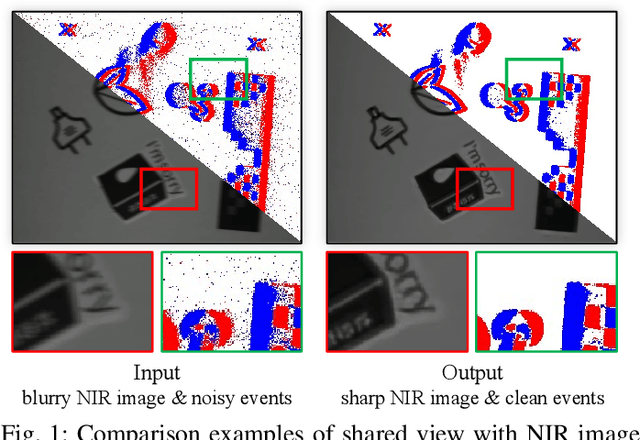
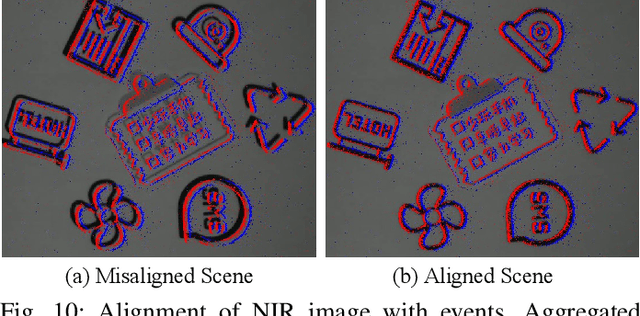
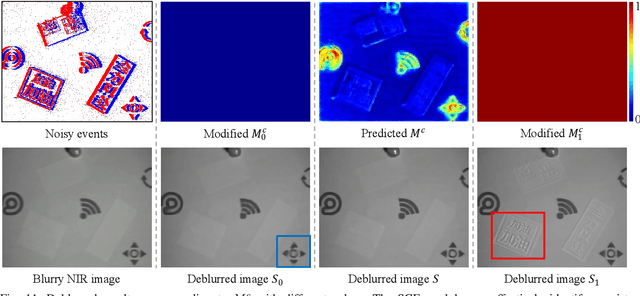
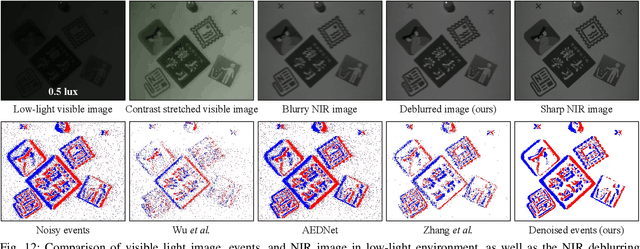
The fields of imaging in the nighttime dynamic and other extremely dark conditions have seen impressive and transformative advancements in recent years, partly driven by the rise of novel sensing approaches, e.g., near-infrared (NIR) cameras with high sensitivity and event cameras with minimal blur. However, inappropriate exposure ratios of near-infrared cameras make them susceptible to distortion and blur. Event cameras are also highly sensitive to weak signals at night yet prone to interference, often generating substantial noise and significantly degrading observations and analysis. Herein, we develop a new framework for low-light imaging combined with NIR imaging and event-based techniques, named synergistic neuromorphic imaging, which can jointly achieve NIR image deblurring and event denoising. Harnessing cross-modal features of NIR images and visible events via spectral consistency and higher-order interaction, the NIR images and events are simultaneously fused, enhanced, and bootstrapped. Experiments on real and realistically simulated sequences demonstrate the effectiveness of our method and indicate better accuracy and robustness than other methods in practical scenarios. This study gives impetus to enhance both NIR images and events, which paves the way for high-fidelity low-light imaging and neuromorphic reasoning.