 Add to Chrome
 Add to Firefox
 Add to Edge
UniWorld-Design: From Pixel Generation to Layer-Native Design
Aug 04, 2026
We introduce UniWorld-Design, a framework that redefines image generation from flat pixel synthesis to structured visual composition, with semantic RGBA layers as the atomic units of generation, understanding, and editing. Our key insight is that pixels define how an image is rendered, whereas layers define how an image is created, understood, and edited. Just as human designers create and manipulate visual content through layers rather than raw pixels, UniWorld-Design equips multimodal generative models with a layer-native design space. UniWorld-Design comprises two models. The Text-to-RGBA (T2RGBA) model generates standalone RGBA assets directly from text. The Image-to-Layer (I2L) model conditions on a finished image, a global instruction and per-layer prompts, and jointly produces ordered, complete semantic RGBA layers. Its instruction interface supports top-level decomposition, recursive decomposition and targeted extraction, making layering an instruction-addressable operation for agentic editing. Because I2L learns complete semantic objects rather than visible-pixel partitions, its layers stay usable when moved or removed. On the Crello benchmark, I2L reduces per-layer RGB L1 error by 37% and achieves a 34% relative improvement in Alpha Soft IoU over Qwen-Image-Layered. Separately, T2RGBA achieves the highest CLIP Score, outperforming LayerDiffuse and OmniAlpha.

Echo-Memory: A Controlled Study of Memory in Action World Models
Jun 08, 2026We present \textbf{Echo-Memory}, a controlled study of memory mechanisms in action-conditioned world models. These models generate multi-segment videos from a first frame, text prompt, and camera-action sequence, but their central failure is often memory rather than local image synthesis: after the camera leaves and returns, the scene or salient object may silently change. Existing memory designs are hard to compare because gains are entangled with backbone, training, retrieval, and evaluation differences. Echo-Memory fixes the action-to-video interface and varies only how history is stored and read by the generator. Under a shared video diffusion backbone, optimizer, camera-action representation, sampler, and evaluation pipeline, we compare raw context, compression-based memory, spatial summaries with different read-out paths, and state-space recurrence. This matched matrix separates four otherwise conflated axes: \emph{capacity}, \emph{compression}, \emph{read-out}, and \emph{recurrence}. We also evaluate memory through a three-branch protocol: replay quality, in-domain loop revisit, and open-domain return probes. The branches routinely disagree, showing that replay fidelity is not a sufficient proxy for remembering a world. Three findings follow. Raw context is a strong capacity baseline and improves open-domain return far more than it improves replay metrics. Compactness is not a free substitute for capacity: aggressive spatial and hybrid-compression memories lose the salient evidence needed for return. Finally, block-wise state-space recurrence is the strongest open-domain return mechanism in our matrix, showing that the structure of implicit memory matters as much as the decision to use it. These results provide a compact protocol for studying memory in action world models beyond isolated replay metrics.
ChronoPhyBench: Do MLLMs Truly Understand the World or Merely Exploit Language Priors?
Jun 06, 2026Recent advancements in Multimodal Large Language Models (MLLMs) have demonstrated remarkable proficiency in open-world reasoning and understanding. However, a critical ambiguity persists: it remains unclear whether these models genuinely synthesize cross-modal information to construct physically grounded reasoning chains, or if they merely exploit strong language priors to mask single-modality reliance, thereby hallucinating advanced multimodal capabilities. Motivated by this, and to rigorously mitigate language modality bias and shortcuts, we propose a novel multimodal Chrono}logical Physical Dynamics Reasoning Benchmark ChronoPhyBench, which unifies next state prediction with Visual Question Answering (VQA) paradigms by conditioning on historical video context and textual captions to enforce models to deduce subsequent physical states through both single image selection and the inherently more complex task of multiple frame chronological sorting. Concurrently, we construct a large-scale multimodal reasoning dataset curated using the ChronoPhyBench criteria, comprising over 10,000 long-form videos paired with meticulously annotated captions, totaling 5M tokens. Our experimental evaluations reveal a stark contrast to conclusions drawn by previous benchmarks. The capacity of current open-source models to perform physically grounded multimodal reasoning remains in its infancy. Ultimately, this work seeks to systematically stress-test the reasoning capabilities of multimodal models, quantify hallucination rates, and advance the development of Physical AI, thereby providing the community with a robust and transparent evaluation framework toward Artificial General Intelligence (AGI).
From Pixels to Words -- Towards Native One-Vision Models at Scale
May 27, 2026Current vision-language models (VLMs) typically stitch together separate image encoders and language decoders via multi-stage alignment, a modular framework that inevitably fragments pixel-level signals across frames and scatters early pixel-word interactions. In parallel, native VLMs, despite impressive performance on single images, remain largely unexplored in multi-image, video understanding, and spatial intelligence. Hence, we introduce NEO-ov, a native foundation model that learns cross-frame and pixel-word correspondence end-to-end, without any external encoders, auxiliary adapters, or post-hoc fusion. By eliminating module boundaries entirely, NEO-ov enables fine-grained and unified spatiotemporal modeling to emerge natively inside the model. Notably, NEO-ov largely narrows the gap to modular counterparts while excelling at fine-grained visual perception, validating that native "one-vision" architectures are not only feasible but competitive at scale. Beyond empirical performance, we unveil systematic architectural analyses and detailed training recipes to facilitate subsequent native multimodal modeling. Our code and models are publicly available at: https://github.com/EvolvingLMMs-Lab/NEO.
SenseNova-U1: Unifying Multimodal Understanding and Generation with NEO-unify Architecture
May 12, 2026Recent large vision-language models (VLMs) remain fundamentally constrained by a persistent dichotomy: understanding and generation are treated as distinct problems, leading to fragmented architectures, cascaded pipelines, and misaligned representation spaces. We argue that this divide is not merely an engineering artifact, but a structural limitation that hinders the emergence of native multimodal intelligence. Hence, we introduce SenseNova-U1, a native unified multimodal paradigm built upon NEO-unify, in which understanding and generation evolve as synergistic views of a single underlying process. We launch two native unified variants, SenseNova-U1-8B-MoT and SenseNova-U1-A3B-MoT, built on dense (8B) and mixture-of-experts (30B-A3B) understanding baselines, respectively. Designed from first principles, they rival top-tier understanding-only VLMs across text understanding, vision-language perception, knowledge reasoning, agentic decision-making, and spatial intelligence. Meanwhile, they deliver strong semantic consistency and visual fidelity, excelling in conventional or knowledge-intensive any-to-image (X2I) synthesis, complex text-rich infographic generation, and interleaved vision-language generation, with or without think patterns. Beyond performance, we show detailed model design, data preprocessing, pre-/post-training, and inference strategies to support community research. Last but not least, preliminary evidence demonstrates that our models extend beyond perception and generation, performing strongly in vision-language-action (VLA) and world model (WM) scenarios. This points toward a broader roadmap where models do not translate between modalities, but think and act across them in a native manner. Multimodal AI is no longer about connecting separate systems, but about building a unified one and trusting the necessary capabilities to emerge from within.
ClawMark: A Living-World Benchmark for Multi-Turn, Multi-Day, Multimodal Coworker Agents
Apr 26, 2026Language-model agents are increasingly used as persistent coworkers that assist users across multiple working days. During such workflows, the surrounding environment may change independently of the agent: new emails arrive, calendar entries shift, knowledge-base records are updated, and evidence appears across images, scanned PDFs, audio, video, and spreadsheets. Existing benchmarks do not adequately evaluate this setting because they typically run within a single static episode and remain largely text-centric. We introduce \bench{}, a benchmark for coworker agents built around multi-turn multi-day tasks, a stateful sandboxed service environment whose state evolves between turns, and rule-based verification. The current release contains 100 tasks across 13 professional scenarios, executed against five stateful sandboxed services (filesystem, email, calendar, knowledge base, spreadsheet) and scored by 1537 deterministic Python checkers over post-execution service state; no LLM-as-judge is invoked during scoring. We benchmark seven frontier agent systems. The strongest model reaches 75.8 weighted score, but the best strict Task Success is only 20.0\%, indicating that partial progress is common while complete end-to-end workflow completion remains rare. Turn-level analysis shows that performance drops after the first exogenous environment update, highlighting adaptation to changing state as a key open challenge. We release the benchmark, evaluation harness, and construction pipeline to support reproducible coworker-agent evaluation.
iFSQ: Improving FSQ for Image Generation with 1 Line of Code
Jan 27, 2026The field of image generation is currently bifurcated into autoregressive (AR) models operating on discrete tokens and diffusion models utilizing continuous latents. This divide, rooted in the distinction between VQ-VAEs and VAEs, hinders unified modeling and fair benchmarking. Finite Scalar Quantization (FSQ) offers a theoretical bridge, yet vanilla FSQ suffers from a critical flaw: its equal-interval quantization can cause activation collapse. This mismatch forces a trade-off between reconstruction fidelity and information efficiency. In this work, we resolve this dilemma by simply replacing the activation function in original FSQ with a distribution-matching mapping to enforce a uniform prior. Termed iFSQ, this simple strategy requires just one line of code yet mathematically guarantees both optimal bin utilization and reconstruction precision. Leveraging iFSQ as a controlled benchmark, we uncover two key insights: (1) The optimal equilibrium between discrete and continuous representations lies at approximately 4 bits per dimension. (2) Under identical reconstruction constraints, AR models exhibit rapid initial convergence, whereas diffusion models achieve a superior performance ceiling, suggesting that strict sequential ordering may limit the upper bounds of generation quality. Finally, we extend our analysis by adapting Representation Alignment (REPA) to AR models, yielding LlamaGen-REPA. Codes is available at https://github.com/Tencent-Hunyuan/iFSQ
Memory in the Age of AI Agents
Dec 15, 2025Memory has emerged, and will continue to remain, a core capability of foundation model-based agents. As research on agent memory rapidly expands and attracts unprecedented attention, the field has also become increasingly fragmented. Existing works that fall under the umbrella of agent memory often differ substantially in their motivations, implementations, and evaluation protocols, while the proliferation of loosely defined memory terminologies has further obscured conceptual clarity. Traditional taxonomies such as long/short-term memory have proven insufficient to capture the diversity of contemporary agent memory systems. This work aims to provide an up-to-date landscape of current agent memory research. We begin by clearly delineating the scope of agent memory and distinguishing it from related concepts such as LLM memory, retrieval augmented generation (RAG), and context engineering. We then examine agent memory through the unified lenses of forms, functions, and dynamics. From the perspective of forms, we identify three dominant realizations of agent memory, namely token-level, parametric, and latent memory. From the perspective of functions, we propose a finer-grained taxonomy that distinguishes factual, experiential, and working memory. From the perspective of dynamics, we analyze how memory is formed, evolved, and retrieved over time. To support practical development, we compile a comprehensive summary of memory benchmarks and open-source frameworks. Beyond consolidation, we articulate a forward-looking perspective on emerging research frontiers, including memory automation, reinforcement learning integration, multimodal memory, multi-agent memory, and trustworthiness issues. We hope this survey serves not only as a reference for existing work, but also as a conceptual foundation for rethinking memory as a first-class primitive in the design of future agentic intelligence.
SRUM: Fine-Grained Self-Rewarding for Unified Multimodal Models
Oct 14, 2025Recently, remarkable progress has been made in Unified Multimodal Models (UMMs), which integrate vision-language generation and understanding capabilities within a single framework. However, a significant gap exists where a model's strong visual understanding often fails to transfer to its visual generation. A model might correctly understand an image based on user instructions, yet be unable to generate a faithful image from text prompts. This phenomenon directly raises a compelling question: Can a model achieve self-improvement by using its understanding module to reward its generation module? To bridge this gap and achieve self-improvement, we introduce SRUM, a self-rewarding post-training framework that can be directly applied to existing UMMs of various designs. SRUM creates a feedback loop where the model's own understanding module acts as an internal ``evaluator'', providing corrective signals to improve its generation module, without requiring additional human-labeled data. To ensure this feedback is comprehensive, we designed a global-local dual reward system. To tackle the inherent structural complexity of images, this system offers multi-scale guidance: a \textbf{global reward} ensures the correctness of the overall visual semantics and layout, while a \textbf{local reward} refines fine-grained, object-level fidelity. SRUM leads to powerful capabilities and shows strong generalization, boosting performance on T2I-CompBench from 82.18 to \textbf{88.37} and on T2I-ReasonBench from 43.82 to \textbf{46.75}. Overall, our work establishes a powerful new paradigm for enabling a UMMs' understanding module to guide and enhance its own generation via self-rewarding.
LangBridge: Interpreting Image as a Combination of Language Embeddings
Mar 26, 2025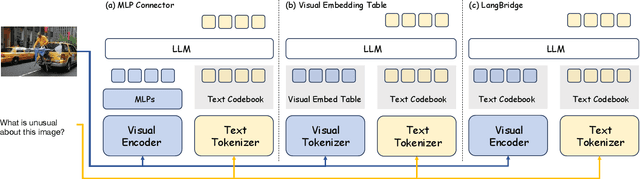
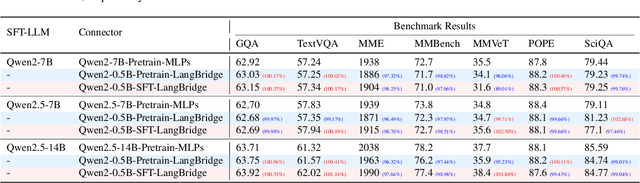
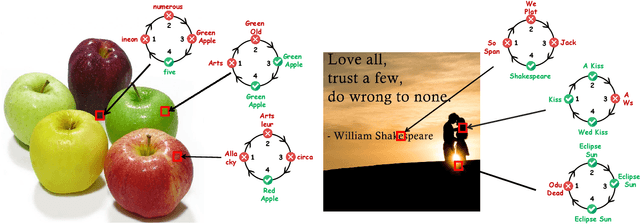
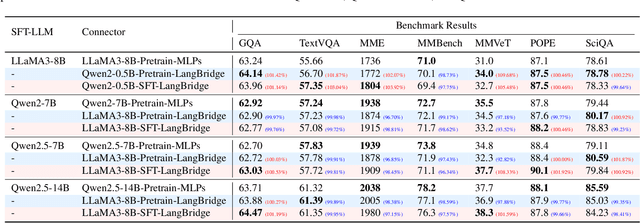
Recent years have witnessed remarkable advances in Large Vision-Language Models (LVLMs), which have achieved human-level performance across various complex vision-language tasks. Following LLaVA's paradigm, mainstream LVLMs typically employ a shallow MLP for visual-language alignment through a two-stage training process: pretraining for cross-modal alignment followed by instruction tuning. While this approach has proven effective, the underlying mechanisms of how MLPs bridge the modality gap remain poorly understood. Although some research has explored how LLMs process transformed visual tokens, few studies have investigated the fundamental alignment mechanism. Furthermore, the MLP adapter requires retraining whenever switching LLM backbones. To address these limitations, we first investigate the working principles of MLP adapters and discover that they learn to project visual embeddings into subspaces spanned by corresponding text embeddings progressively. Based on this insight, we propose LangBridge, a novel adapter that explicitly maps visual tokens to linear combinations of LLM vocabulary embeddings. This innovative design enables pretraining-free adapter transfer across different LLMs while maintaining performance. Our experimental results demonstrate that a LangBridge adapter pre-trained on Qwen2-0.5B can be directly applied to larger models such as LLaMA3-8B or Qwen2.5-14B while maintaining competitive performance. Overall, LangBridge enables interpretable vision-language alignment by grounding visual representations in LLM vocab embedding, while its plug-and-play design ensures efficient reuse across multiple LLMs with nearly no performance degradation. See our project page at https://jiaqiliao77.github.io/LangBridge.github.io/