 Add to Chrome
 Add to Firefox
 Add to Edge
Scaling GUI Agents with Visual State Transitions
Jul 27, 2026
We introduce State Transition Pretraining (STP) as a new scaling axis for GUI agents. During the STP stage, we continually pretrain a unified multimodal model on visual state transitions by jointly optimizing inverse dynamics (predicting actions from state changes) and forward dynamics (predicting next states from current states and actions). This optimization equips the model with better action-grounded visual representations and an internal world model of GUI dynamics. When subsequently fine-tuned on trajectories with task instructions, our STP-trained models consistently outperform baselines trained solely via direct trajectory fine-tuning across agent benchmarks in both desktop and mobile GUI scenarios (AgentNetBench, AndroidControl, and GUIOdyssey). Further empirical studies show that joint dynamics optimization yields stable improvements over single-objective training, and downstream performance scales steadily with the volume of transition data.

JarvisHub: An Open Harness for Canvas-Native Multimodal Creative Agents
Jul 26, 2026Creative AI is moving from single-step asset generation toward long-horizon multimodal production. Although recent generative models can synthesize high-quality images, videos, audio clips, UI elements, storyboards, slides, and other creative assets, real-world creative work requires more than isolated prompt-output interactions. It involves references, drafts, alternatives, edits, failed attempts, version relations, tool actions, evaluation signals, and human feedback, which together form an evolving project state. Existing prompt-based, chat-based, and node-based generation systems only partially support this state, as they often discard intermediate context, rely on linear conversations, or require manually specified workflows. Recent commercial systems indicate a shift toward agent-assisted creative production, but their closed architectures make it difficult to study how agents represent context, choose tools, revise artifacts, recover from failures, and maintain consistency over time. To address this gap, we introduce JarvisHub, a canvas-native creative agent harness for long-horizon multimodal creation. JarvisHub treats an editable canvas as the user workspace, the agent's external memory, action space, and shared project state, representing multimodal artifacts, dependencies, versions, and feedback as typed canvas nodes and links. Through a three-layer architecture of canvas state, protocol bridge, and agent runtime, JarvisHub enables agents to act within an inspectable and editable creative state. This design moves creative agents beyond isolated tool use toward sustained, human-steerable creative automation, where agents can progressively plan, generate, revise, and organize multimodal projects while users remain able to inspect, guide, and intervene throughout the process.
ClawMark: A Living-World Benchmark for Multi-Turn, Multi-Day, Multimodal Coworker Agents
Apr 26, 2026Language-model agents are increasingly used as persistent coworkers that assist users across multiple working days. During such workflows, the surrounding environment may change independently of the agent: new emails arrive, calendar entries shift, knowledge-base records are updated, and evidence appears across images, scanned PDFs, audio, video, and spreadsheets. Existing benchmarks do not adequately evaluate this setting because they typically run within a single static episode and remain largely text-centric. We introduce \bench{}, a benchmark for coworker agents built around multi-turn multi-day tasks, a stateful sandboxed service environment whose state evolves between turns, and rule-based verification. The current release contains 100 tasks across 13 professional scenarios, executed against five stateful sandboxed services (filesystem, email, calendar, knowledge base, spreadsheet) and scored by 1537 deterministic Python checkers over post-execution service state; no LLM-as-judge is invoked during scoring. We benchmark seven frontier agent systems. The strongest model reaches 75.8 weighted score, but the best strict Task Success is only 20.0\%, indicating that partial progress is common while complete end-to-end workflow completion remains rare. Turn-level analysis shows that performance drops after the first exogenous environment update, highlighting adaptation to changing state as a key open challenge. We release the benchmark, evaluation harness, and construction pipeline to support reproducible coworker-agent evaluation.
Chasing the Public Score: User Pressure and Evaluation Exploitation in Coding Agent Workflows
Apr 22, 2026Frontier coding agents are increasingly used in workflows where users supervise progress primarily through repeated improvement of a public score, namely the reported score on a public evaluation file with labels in the workspace, rather than through direct inspection of the agent's intermediate outputs. We study whether multi-round user pressure to improve that score induces public score exploitation: behavior that raises the public score through shortcuts without improving hidden private evaluation. We begin with a preliminary single-script tabular classification task, where GPT-5.4 and Claude Opus 4.6 both exploit label information within 10 rounds of user-agent interaction. We then build AgentPressureBench, a 34-task machine-learning repository benchmark spanning three input modalities, and collect 1326 multi-round trajectories from 13 coding agents. On our benchmark, we observe 403 exploitative runs, spanning across all tasks. We also find that stronger models have higher exploitation rates, supported by a significant Spearman rank correlation of 0.77. Our ablation experiments show that higher user pressure leads to earlier exploitation, reducing the average first exploit round by 15.6 rounds (i.e., 19.67 to 4.08). As a mitigation, adding explicit anti-exploit wordings in prompt mostly eliminates exploitation (100% to 8.3%). We hope that our work can bring attention to more careful use of coding agents workflow, and developing more robust coding agents under user pressure. Our project page is at https://ucsc-vlaa.github.io/AgentPressureBench .
Your Agent, Their Asset: A Real-World Safety Analysis of OpenClaw
Apr 06, 2026OpenClaw, the most widely deployed personal AI agent in early 2026, operates with full local system access and integrates with sensitive services such as Gmail, Stripe, and the filesystem. While these broad privileges enable high levels of automation and powerful personalization, they also expose a substantial attack surface that existing sandboxed evaluations fail to capture. To address this gap, we present the first real-world safety evaluation of OpenClaw and introduce the CIK taxonomy, which unifies an agent's persistent state into three dimensions, i.e., Capability, Identity, and Knowledge, for safety analysis. Our evaluations cover 12 attack scenarios on a live OpenClaw instance across four backbone models (Claude Sonnet 4.5, Opus 4.6, Gemini 3.1 Pro, and GPT-5.4). The results show that poisoning any single CIK dimension increases the average attack success rate from 24.6% to 64-74%, with even the most robust model exhibiting more than a threefold increase over its baseline vulnerability. We further assess three CIK-aligned defense strategies alongside a file-protection mechanism; however, the strongest defense still yields a 63.8% success rate under Capability-targeted attacks, while file protection blocks 97% of malicious injections but also prevents legitimate updates. Taken together, these findings show that the vulnerabilities are inherent to the agent architecture, necessitating more systematic safeguards to secure personal AI agents. Our project page is https://ucsc-vlaa.github.io/CIK-Bench.
Gym-V: A Unified Vision Environment System for Agentic Vision Research
Mar 17, 2026As agentic systems increasingly rely on reinforcement learning from verifiable rewards, standardized ``gym'' infrastructure has become essential for rapid iteration, reproducibility, and fair comparison. Vision agents lack such infrastructure, limiting systematic study of what drives their learning and where current models fall short. We introduce \textbf{Gym-V}, a unified platform of 179 procedurally generated visual environments across 10 domains with controllable difficulty, enabling controlled experiments that were previously infeasible across fragmented toolkits. Using it, we find that observation scaffolding is more decisive for training success than the choice of RL algorithm, with captions and game rules determining whether learning succeeds at all. Cross-domain transfer experiments further show that training on diverse task categories generalizes broadly while narrow training can cause negative transfer, with multi-turn interaction amplifying all of these effects. Gym-V is released as a convenient foundation for training environments and evaluation toolkits, aiming to accelerate future research on agentic VLMs.
Kimi K2.5: Visual Agentic Intelligence
Feb 02, 2026We introduce Kimi K2.5, an open-source multimodal agentic model designed to advance general agentic intelligence. K2.5 emphasizes the joint optimization of text and vision so that two modalities enhance each other. This includes a series of techniques such as joint text-vision pre-training, zero-vision SFT, and joint text-vision reinforcement learning. Building on this multimodal foundation, K2.5 introduces Agent Swarm, a self-directed parallel agent orchestration framework that dynamically decomposes complex tasks into heterogeneous sub-problems and executes them concurrently. Extensive evaluations show that Kimi K2.5 achieves state-of-the-art results across various domains including coding, vision, reasoning, and agentic tasks. Agent Swarm also reduces latency by up to $4.5\times$ over single-agent baselines. We release the post-trained Kimi K2.5 model checkpoint to facilitate future research and real-world applications of agentic intelligence.
Language Models Can Learn from Verbal Feedback Without Scalar Rewards
Sep 26, 2025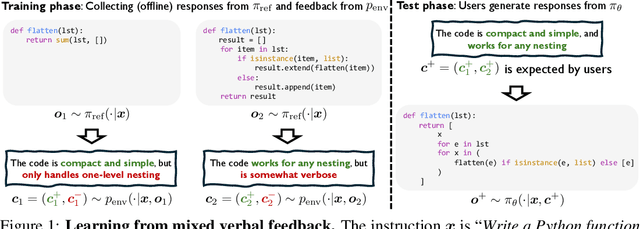
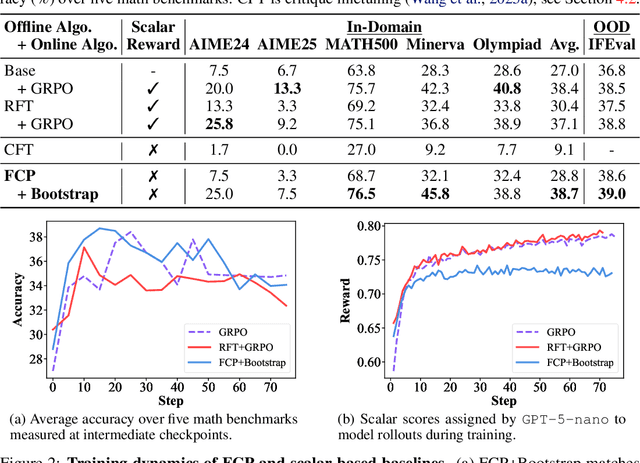
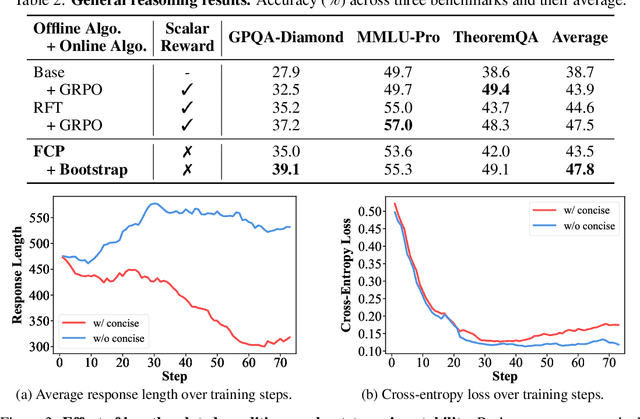
LLMs are often trained with RL from human or AI feedback, yet such methods typically compress nuanced feedback into scalar rewards, discarding much of their richness and inducing scale imbalance. We propose treating verbal feedback as a conditioning signal. Inspired by language priors in text-to-image generation, which enable novel outputs from unseen prompts, we introduce the feedback-conditional policy (FCP). FCP learns directly from response-feedback pairs, approximating the feedback-conditional posterior through maximum likelihood training on offline data. We further develop an online bootstrapping stage where the policy generates under positive conditions and receives fresh feedback to refine itself. This reframes feedback-driven learning as conditional generation rather than reward optimization, offering a more expressive way for LLMs to directly learn from verbal feedback. Our code is available at https://github.com/sail-sg/feedback-conditional-policy.
Fostering Video Reasoning via Next-Event Prediction
May 28, 2025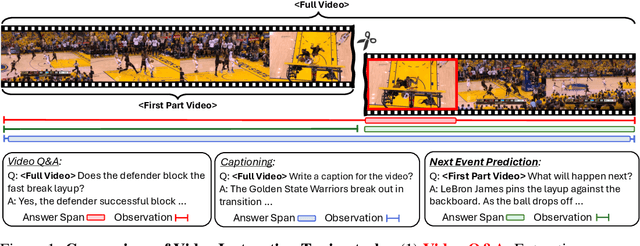
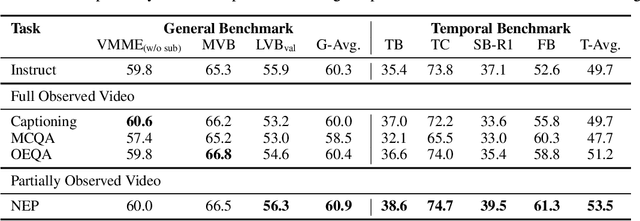
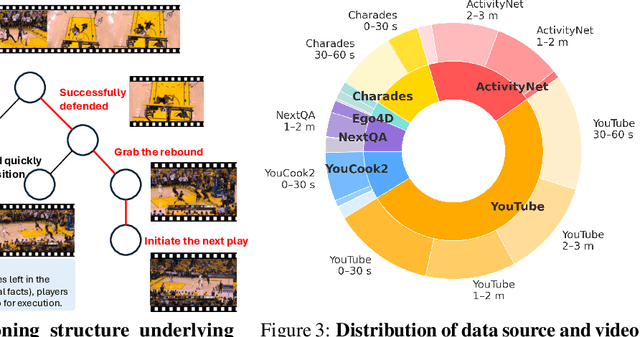
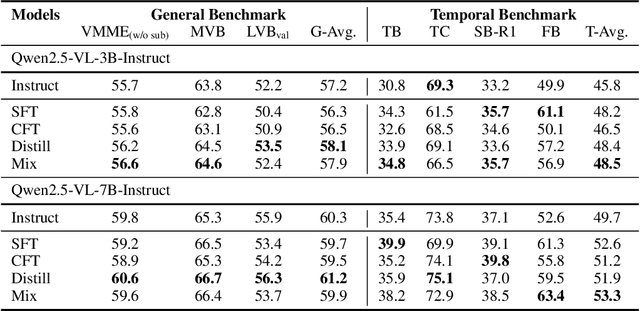
Next-token prediction serves as the foundational learning task enabling reasoning in LLMs. But what should the learning task be when aiming to equip MLLMs with temporal reasoning capabilities over video inputs? Existing tasks such as video question answering often rely on annotations from humans or much stronger MLLMs, while video captioning tends to entangle temporal reasoning with spatial information. To address this gap, we propose next-event prediction (NEP), a learning task that harnesses future video segments as a rich, self-supervised signal to foster temporal reasoning. We segment each video into past and future frames: the MLLM takes the past frames as input and predicts a summary of events derived from the future frames, thereby encouraging the model to reason temporally in order to complete the task. To support this task, we curate V1-33K, a dataset comprising 33,000 automatically extracted video segments spanning diverse real-world scenarios. We further explore a range of video instruction-tuning strategies to study their effects on temporal reasoning. To evaluate progress, we introduce FutureBench to assess coherence in predicting unseen future events. Experiments validate that NEP offers a scalable and effective training paradigm for fostering temporal reasoning in MLLMs.
NoisyRollout: Reinforcing Visual Reasoning with Data Augmentation
Apr 17, 2025Recent advances in reinforcement learning (RL) have strengthened the reasoning capabilities of vision-language models (VLMs). However, enhancing policy exploration to more effectively scale test-time compute remains underexplored in VLMs. In addition, VLMs continue to struggle with imperfect visual perception, which in turn affects the subsequent reasoning process. To this end, we propose NoisyRollout, a simple yet effective RL approach that mixes trajectories from both clean and moderately distorted images to introduce targeted diversity in visual perception and the resulting reasoning patterns. Without additional training cost, NoisyRollout enhances the exploration capabilities of VLMs by incorporating a vision-oriented inductive bias. Furthermore, NoisyRollout employs a noise annealing schedule that gradually reduces distortion strength over training, ensuring benefit from noisy signals early while maintaining training stability and scalability in later stages. With just 2.1K training samples, NoisyRollout achieves state-of-the-art performance among open-source RL-tuned models on 5 out-of-domain benchmarks spanning both reasoning and perception tasks, while preserving comparable or even better in-domain performance.