 Add to Chrome
 Add to Firefox
 Add to Edge
D-OPSD: On-Policy Self-Distillation for Continuously Tuning Step-Distilled Diffusion Models
May 06, 2026
The landscape of high-performance image generation models is currently shifting from the inefficient multi-step ones to the efficient few-step counterparts (e.g, Z-Image-Turbo and FLUX.2-klein). However, these models present significant challenges for directly continuous supervised fine-tuning. For example, applying the commonly used fine-tuning technique would compromises their inherent few-step inference capability. To address this, we propose D-OPSD, a novel training paradigm for step-distilled diffusion models that enables on-policy learning during supervised fine-tuning. We first find that the modern diffusion model where the LLM/VLM serves as the encoder can inherit its encoder's in-context capabilities. This enables us to make the training as an on-policy self-distillation process. Specifically, during training, we make the model acts as both the teacher and the student with different contexts, where the student is conditioned only on the text feature, while the teacher is conditioned on the multimodal feature of both the text prompt and the target image. Training minimizes the two predicted distributions over the student's own roll-outs. By optimized on the model's own trajectory and under it's own supervision, D-OPSD enables the model to learn new concept, style, etc. without sacrificing the original few-step capacity.

Group Editing : Edit Multiple Images in One Go
Mar 25, 2026In this paper, we tackle the problem of performing consistent and unified modifications across a set of related images. This task is particularly challenging because these images may vary significantly in pose, viewpoint, and spatial layout. Achieving coherent edits requires establishing reliable correspondences across the images, so that modifications can be applied accurately to semantically aligned regions. To address this, we propose GroupEditing, a novel framework that builds both explicit and implicit relationships among images within a group. On the explicit side, we extract geometric correspondences using VGGT, which provides spatial alignment based on visual features. On the implicit side, we reformulate the image group as a pseudo-video and leverage the temporal coherence priors learned by pre-trained video models to capture latent relationships. To effectively fuse these two types of correspondences, we inject the explicit geometric cues from VGGT into the video model through a novel fusion mechanism. To support large-scale training, we construct GroupEditData, a new dataset containing high-quality masks and detailed captions for numerous image groups. Furthermore, to ensure identity preservation during editing, we introduce an alignment-enhanced RoPE module, which improves the model's ability to maintain consistent appearance across multiple images. Finally, we present GroupEditBench, a dedicated benchmark designed to evaluate the effectiveness of group-level image editing. Extensive experiments demonstrate that GroupEditing significantly outperforms existing methods in terms of visual quality, cross-view consistency, and semantic alignment.
Manifold-Aware Exploration for Reinforcement Learning in Video Generation
Mar 23, 2026Group Relative Policy Optimization (GRPO) methods for video generation like FlowGRPO remain far less reliable than their counterparts for language models and images. This gap arises because video generation has a complex solution space, and the ODE-to-SDE conversion used for exploration can inject excess noise, lowering rollout quality and making reward estimates less reliable, which destabilizes post-training alignment. To address this problem, we view the pre-trained model as defining a valid video data manifold and formulate the core problem as constraining exploration within the vicinity of this manifold, ensuring that rollout quality is preserved and reward estimates remain reliable. We propose SAGE-GRPO (Stable Alignment via Exploration), which applies constraints at both micro and macro levels. At the micro level, we derive a precise manifold-aware SDE with a logarithmic curvature correction and introduce a gradient norm equalizer to stabilize sampling and updates across timesteps. At the macro level, we use a dual trust region with a periodic moving anchor and stepwise constraints so that the trust region tracks checkpoints that are closer to the manifold and limits long-horizon drift. We evaluate SAGE-GRPO on HunyuanVideo1.5 using the original VideoAlign as the reward model and observe consistent gains over previous methods in VQ, MQ, TA, and visual metrics (CLIPScore, PickScore), demonstrating superior performance in both reward maximization and overall video quality. The code and visual gallery are available at https://dungeonmassster.github.io/SAGE-GRPO-Page/.
FastVMT: Eliminating Redundancy in Video Motion Transfer
Feb 05, 2026Video motion transfer aims to synthesize videos by generating visual content according to a text prompt while transferring the motion pattern observed in a reference video. Recent methods predominantly use the Diffusion Transformer (DiT) architecture. To achieve satisfactory runtime, several methods attempt to accelerate the computations in the DiT, but fail to address structural sources of inefficiency. In this work, we identify and remove two types of computational redundancy in earlier work: motion redundancy arises because the generic DiT architecture does not reflect the fact that frame-to-frame motion is small and smooth; gradient redundancy occurs if one ignores that gradients change slowly along the diffusion trajectory. To mitigate motion redundancy, we mask the corresponding attention layers to a local neighborhood such that interaction weights are not computed unnecessarily distant image regions. To exploit gradient redundancy, we design an optimization scheme that reuses gradients from previous diffusion steps and skips unwarranted gradient computations. On average, FastVMT achieves a 3.43x speedup without degrading the visual fidelity or the temporal consistency of the generated videos.
iFSQ: Improving FSQ for Image Generation with 1 Line of Code
Jan 27, 2026The field of image generation is currently bifurcated into autoregressive (AR) models operating on discrete tokens and diffusion models utilizing continuous latents. This divide, rooted in the distinction between VQ-VAEs and VAEs, hinders unified modeling and fair benchmarking. Finite Scalar Quantization (FSQ) offers a theoretical bridge, yet vanilla FSQ suffers from a critical flaw: its equal-interval quantization can cause activation collapse. This mismatch forces a trade-off between reconstruction fidelity and information efficiency. In this work, we resolve this dilemma by simply replacing the activation function in original FSQ with a distribution-matching mapping to enforce a uniform prior. Termed iFSQ, this simple strategy requires just one line of code yet mathematically guarantees both optimal bin utilization and reconstruction precision. Leveraging iFSQ as a controlled benchmark, we uncover two key insights: (1) The optimal equilibrium between discrete and continuous representations lies at approximately 4 bits per dimension. (2) Under identical reconstruction constraints, AR models exhibit rapid initial convergence, whereas diffusion models achieve a superior performance ceiling, suggesting that strict sequential ordering may limit the upper bounds of generation quality. Finally, we extend our analysis by adapting Representation Alignment (REPA) to AR models, yielding LlamaGen-REPA. Codes is available at https://github.com/Tencent-Hunyuan/iFSQ
Follow-Your-Shape: Shape-Aware Image Editing via Trajectory-Guided Region Control
Aug 12, 2025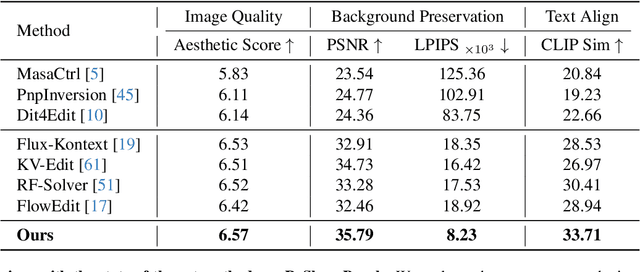
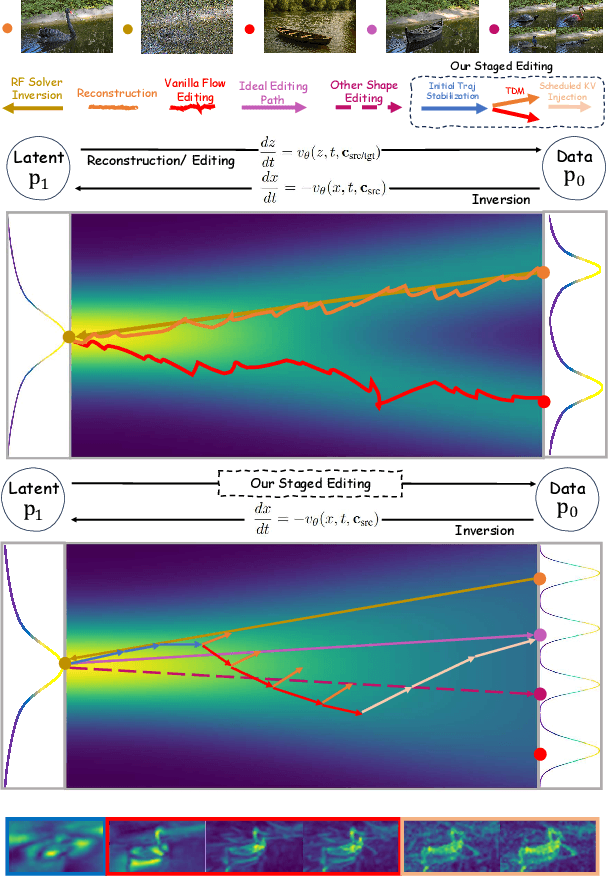
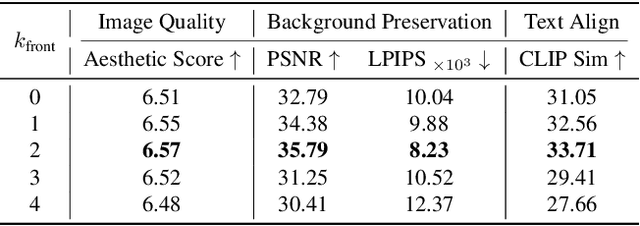
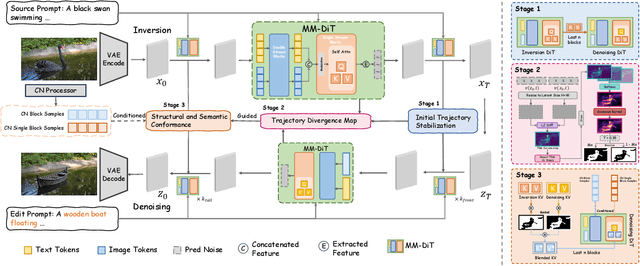
While recent flow-based image editing models demonstrate general-purpose capabilities across diverse tasks, they often struggle to specialize in challenging scenarios -- particularly those involving large-scale shape transformations. When performing such structural edits, these methods either fail to achieve the intended shape change or inadvertently alter non-target regions, resulting in degraded background quality. We propose Follow-Your-Shape, a training-free and mask-free framework that supports precise and controllable editing of object shapes while strictly preserving non-target content. Motivated by the divergence between inversion and editing trajectories, we compute a Trajectory Divergence Map (TDM) by comparing token-wise velocity differences between the inversion and denoising paths. The TDM enables precise localization of editable regions and guides a Scheduled KV Injection mechanism that ensures stable and faithful editing. To facilitate a rigorous evaluation, we introduce ReShapeBench, a new benchmark comprising 120 new images and enriched prompt pairs specifically curated for shape-aware editing. Experiments demonstrate that our method achieves superior editability and visual fidelity, particularly in tasks requiring large-scale shape replacement.
Model Reveals What to Cache: Profiling-Based Feature Reuse for Video Diffusion Models
Apr 04, 2025
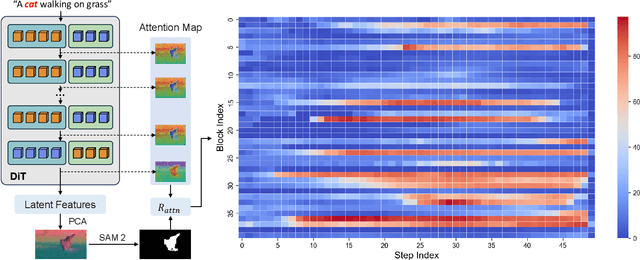

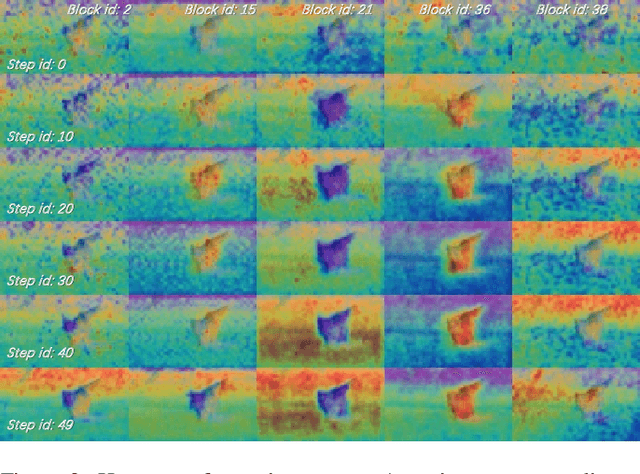
Recent advances in diffusion models have demonstrated remarkable capabilities in video generation. However, the computational intensity remains a significant challenge for practical applications. While feature caching has been proposed to reduce the computational burden of diffusion models, existing methods typically overlook the heterogeneous significance of individual blocks, resulting in suboptimal reuse and degraded output quality. To this end, we address this gap by introducing ProfilingDiT, a novel adaptive caching strategy that explicitly disentangles foreground and background-focused blocks. Through a systematic analysis of attention distributions in diffusion models, we reveal a key observation: 1) Most layers exhibit a consistent preference for either foreground or background regions. 2) Predicted noise shows low inter-step similarity initially, which stabilizes as denoising progresses. This finding inspires us to formulate a selective caching strategy that preserves full computation for dynamic foreground elements while efficiently caching static background features. Our approach substantially reduces computational overhead while preserving visual fidelity. Extensive experiments demonstrate that our framework achieves significant acceleration (e.g., 2.01 times speedup for Wan2.1) while maintaining visual fidelity across comprehensive quality metrics, establishing a viable method for efficient video generation.
VideoGen-of-Thought: Step-by-step generating multi-shot video with minimal manual intervention
Mar 20, 2025Current video generation models excel at short clips but fail to produce cohesive multi-shot narratives due to disjointed visual dynamics and fractured storylines. Existing solutions either rely on extensive manual scripting/editing or prioritize single-shot fidelity over cross-scene continuity, limiting their practicality for movie-like content. We introduce VideoGen-of-Thought (VGoT), a step-by-step framework that automates multi-shot video synthesis from a single sentence by systematically addressing three core challenges: (1) Narrative Fragmentation: Existing methods lack structured storytelling. We propose dynamic storyline modeling, which first converts the user prompt into concise shot descriptions, then elaborates them into detailed, cinematic specifications across five domains (character dynamics, background continuity, relationship evolution, camera movements, HDR lighting), ensuring logical narrative progression with self-validation. (2) Visual Inconsistency: Existing approaches struggle with maintaining visual consistency across shots. Our identity-aware cross-shot propagation generates identity-preserving portrait (IPP) tokens that maintain character fidelity while allowing trait variations (expressions, aging) dictated by the storyline. (3) Transition Artifacts: Abrupt shot changes disrupt immersion. Our adjacent latent transition mechanisms implement boundary-aware reset strategies that process adjacent shots' features at transition points, enabling seamless visual flow while preserving narrative continuity. VGoT generates multi-shot videos that outperform state-of-the-art baselines by 20.4% in within-shot face consistency and 17.4% in style consistency, while achieving over 100% better cross-shot consistency and 10x fewer manual adjustments than alternatives.
VideoGen-of-Thought: A Collaborative Framework for Multi-Shot Video Generation
Dec 03, 2024Current video generation models excel at generating short clips but still struggle with creating multi-shot, movie-like videos. Existing models trained on large-scale data on the back of rich computational resources are unsurprisingly inadequate for maintaining a logical storyline and visual consistency across multiple shots of a cohesive script since they are often trained with a single-shot objective. To this end, we propose VideoGen-of-Thought (VGoT), a collaborative and training-free architecture designed specifically for multi-shot video generation. VGoT is designed with three goals in mind as follows. Multi-Shot Video Generation: We divide the video generation process into a structured, modular sequence, including (1) Script Generation, which translates a curt story into detailed prompts for each shot; (2) Keyframe Generation, responsible for creating visually consistent keyframes faithful to character portrayals; and (3) Shot-Level Video Generation, which transforms information from scripts and keyframes into shots; (4) Smoothing Mechanism that ensures a consistent multi-shot output. Reasonable Narrative Design: Inspired by cinematic scriptwriting, our prompt generation approach spans five key domains, ensuring logical consistency, character development, and narrative flow across the entire video. Cross-Shot Consistency: We ensure temporal and identity consistency by leveraging identity-preserving (IP) embeddings across shots, which are automatically created from the narrative. Additionally, we incorporate a cross-shot smoothing mechanism, which integrates a reset boundary that effectively combines latent features from adjacent shots, resulting in smooth transitions and maintaining visual coherence throughout the video. Our experiments demonstrate that VGoT surpasses existing video generation methods in producing high-quality, coherent, multi-shot videos.
DreamDance: Animating Human Images by Enriching 3D Geometry Cues from 2D Poses
Nov 30, 2024In this work, we present DreamDance, a novel method for animating human images using only skeleton pose sequences as conditional inputs. Existing approaches struggle with generating coherent, high-quality content in an efficient and user-friendly manner. Concretely, baseline methods relying on only 2D pose guidance lack the cues of 3D information, leading to suboptimal results, while methods using 3D representation as guidance achieve higher quality but involve a cumbersome and time-intensive process. To address these limitations, DreamDance enriches 3D geometry cues from 2D poses by introducing an efficient diffusion model, enabling high-quality human image animation with various guidance. Our key insight is that human images naturally exhibit multiple levels of correlation, progressing from coarse skeleton poses to fine-grained geometry cues, and further from these geometry cues to explicit appearance details. Capturing such correlations could enrich the guidance signals, facilitating intra-frame coherency and inter-frame consistency. Specifically, we construct the TikTok-Dance5K dataset, comprising 5K high-quality dance videos with detailed frame annotations, including human pose, depth, and normal maps. Next, we introduce a Mutually Aligned Geometry Diffusion Model to generate fine-grained depth and normal maps for enriched guidance. Finally, a Cross-domain Controller incorporates multi-level guidance to animate human images effectively with a video diffusion model. Extensive experiments demonstrate that our method achieves state-of-the-art performance in animating human images.