 Add to Chrome
 Add to Firefox
 Add to Edge
From Pixels to Words -- Towards Native One-Vision Models at Scale
May 27, 2026
Current vision-language models (VLMs) typically stitch together separate image encoders and language decoders via multi-stage alignment, a modular framework that inevitably fragments pixel-level signals across frames and scatters early pixel-word interactions. In parallel, native VLMs, despite impressive performance on single images, remain largely unexplored in multi-image, video understanding, and spatial intelligence. Hence, we introduce NEO-ov, a native foundation model that learns cross-frame and pixel-word correspondence end-to-end, without any external encoders, auxiliary adapters, or post-hoc fusion. By eliminating module boundaries entirely, NEO-ov enables fine-grained and unified spatiotemporal modeling to emerge natively inside the model. Notably, NEO-ov largely narrows the gap to modular counterparts while excelling at fine-grained visual perception, validating that native "one-vision" architectures are not only feasible but competitive at scale. Beyond empirical performance, we unveil systematic architectural analyses and detailed training recipes to facilitate subsequent native multimodal modeling. Our code and models are publicly available at: https://github.com/EvolvingLMMs-Lab/NEO.

InterSketch: An Interleaved Reasoning Model with Self-correcting Visual Sketch and Stepwise Reward
May 26, 2026While vision-language models (VLMs) have exhibited multi-turn visual reasoning capabilities, their reasoning trajectories remain relatively shallow and are dominated by a text-centric paradigm, limiting their applicability to complex visual challenges. In contrast, human-like thought typically involves long-horizon reasoning with an interleaved visual-textual chain-of-thought (VT-CoT). To bridge this gap, we introduce InterSketch, an interleaved reasoning model to enhance the VT-CoT capability via self-correcting and stepwise reward mechanisms. InterSketch dynamically generates intermediate visual sketches using external tools and interleaves them with textual reasoning, enabling effective perception and logical reasoning over long-horizon visual understanding tasks. Specifically, in the first cold-start stage, we propose a synthesized high-quality interleaved VT-CoT dataset and include a reflection mechanism to enable the model's capability in multi-turn interleaved reasoning and self-correction. In the subsequent reinforcement learning (RL) stage, we design a stepwise reward mechanism to mitigate the sparsity of reward signals inherent in end-only supervision over long-horizon reasoning. Extensive experiments on visual reasoning benchmarks demonstrate the effectiveness of InterSketch, even outperforming proprietary models such as Gemini-3-Pro.
SenseNova-U1: Unifying Multimodal Understanding and Generation with NEO-unify Architecture
May 12, 2026Recent large vision-language models (VLMs) remain fundamentally constrained by a persistent dichotomy: understanding and generation are treated as distinct problems, leading to fragmented architectures, cascaded pipelines, and misaligned representation spaces. We argue that this divide is not merely an engineering artifact, but a structural limitation that hinders the emergence of native multimodal intelligence. Hence, we introduce SenseNova-U1, a native unified multimodal paradigm built upon NEO-unify, in which understanding and generation evolve as synergistic views of a single underlying process. We launch two native unified variants, SenseNova-U1-8B-MoT and SenseNova-U1-A3B-MoT, built on dense (8B) and mixture-of-experts (30B-A3B) understanding baselines, respectively. Designed from first principles, they rival top-tier understanding-only VLMs across text understanding, vision-language perception, knowledge reasoning, agentic decision-making, and spatial intelligence. Meanwhile, they deliver strong semantic consistency and visual fidelity, excelling in conventional or knowledge-intensive any-to-image (X2I) synthesis, complex text-rich infographic generation, and interleaved vision-language generation, with or without think patterns. Beyond performance, we show detailed model design, data preprocessing, pre-/post-training, and inference strategies to support community research. Last but not least, preliminary evidence demonstrates that our models extend beyond perception and generation, performing strongly in vision-language-action (VLA) and world model (WM) scenarios. This points toward a broader roadmap where models do not translate between modalities, but think and act across them in a native manner. Multimodal AI is no longer about connecting separate systems, but about building a unified one and trusting the necessary capabilities to emerge from within.
V-ABS: Action-Observer Driven Beam Search for Dynamic Visual Reasoning
May 11, 2026Multimodal large language models (MLLMs) have achieved remarkable success in general perception, yet complex multi-step visual reasoning remains a persistent challenge. Although recent agentic approaches incorporate tool use, they often neglect critical execution feedback. Consequently, they suffer from the imagination-action-observer (IAO) bias, a misalignment between prior imagination and observer feedback that undermines reasoning stability and optimality. To bridge this gap, we introduce V-ABS, an action-observer driven beam search framework that enables deliberate reasoning through thinker-actor-observer iterations. We also propose an entropy-based adaptive weighting algorithm to mitigate the IAO bias by dynamically balancing the confidence scores between the policy priors and the observational feedback. Moreover, we construct a large-scale supervised fine-tuning (SFT) dataset comprising over 80k samples to guide the model to assign higher prior confidence to correct action paths. Extensive experiments across eight diverse benchmarks show that V-ABS achieves state-of-the-art performance, delivering an average improvement of 19.7% on the Qwen3-VL-8B baseline and consistent gains across both open-source and proprietary models.
EVA: Efficient Reinforcement Learning for End-to-End Video Agent
Mar 24, 2026Video understanding with multimodal large language models (MLLMs) remains challenging due to the long token sequences of videos, which contain extensive temporal dependencies and redundant frames. Existing approaches typically treat MLLMs as passive recognizers, processing entire videos or uniformly sampled frames without adaptive reasoning. Recent agent-based methods introduce external tools, yet still depend on manually designed workflows and perception-first strategies, resulting in inefficiency on long videos. We present EVA, an Efficient Reinforcement Learning framework for End-to-End Video Agent, which enables planning-before-perception through iterative summary-plan-action-reflection reasoning. EVA autonomously decides what to watch, when to watch, and how to watch, achieving query-driven and efficient video understanding. To train such agents, we design a simple yet effective three-stage learning pipeline - comprising supervised fine-tuning (SFT), Kahneman-Tversky Optimization (KTO), and Generalized Reward Policy Optimization (GRPO) - that bridges supervised imitation and reinforcement learning. We further construct high-quality datasets for each stage, supporting stable and reproducible training. We evaluate EVA on six video understanding benchmarks, demonstrating its comprehensive capabilities. Compared with existing baselines, EVA achieves a substantial improvement of 6-12% over general MLLM baselines and a further 1-3% gain over prior adaptive agent methods. Our code and model are available at https://github.com/wangruohui/EfficientVideoAgent.
ACPO: Counteracting Likelihood Displacement in Vision-Language Alignment with Asymmetric Constraints
Mar 23, 2026While Direct Preference Optimization (DPO) has become the de facto approach for aligning Large Vision-Language Models (LVLMs), it suffers from Likelihood Displacement, where the probability of both chosen and rejected responses collapses. This optimization flaw is especially detrimental in multimodal settings: the erosion of chosen likelihoods -- a failure we term Visual Anchor Collapse -- causes models to abandon visual evidence for strong language priors, precipitating significant hallucinations. To address this, we propose Asymmetric Constrained Preference Optimization (ACPO), a modality-agnostic alignment mechanism that applies dynamic, target-oriented scaling to preference optimization. ACPO derives a complexity-aware scaling coefficient applied exclusively to the rejected reward, asymmetrically suppressing the gradient flow on the rejected term while preserving the chosen distribution as a gradient-stable reference. While fundamentally a general-purpose objective, breaking this gradient symmetry is crucial for multimodal tasks, as it mitigates the suppression of visual tokens by language priors. Experiments on InternVL models demonstrate that ACPO effectively reverses the chosen-reward degradation of standard DPO. By halting Visual Anchor Collapse, ACPO generally outperforms baselines on hallucination benchmarks (HallusionBench, MM-IFEval) and general leaderboards (MMBench, MMStar, OCRBenchV2) while driving concurrent improvements in general capabilities.
SenseNova-MARS: Empowering Multimodal Agentic Reasoning and Search via Reinforcement Learning
Dec 30, 2025While Vision-Language Models (VLMs) can solve complex tasks through agentic reasoning, their capabilities remain largely constrained to text-oriented chain-of-thought or isolated tool invocation. They fail to exhibit the human-like proficiency required to seamlessly interleave dynamic tool manipulation with continuous reasoning, particularly in knowledge-intensive and visually complex scenarios that demand coordinated external tools such as search and image cropping. In this work, we introduce SenseNova-MARS, a novel Multimodal Agentic Reasoning and Search framework that empowers VLMs with interleaved visual reasoning and tool-use capabilities via reinforcement learning (RL). Specifically, SenseNova-MARS dynamically integrates the image search, text search, and image crop tools to tackle fine-grained and knowledge-intensive visual understanding challenges. In the RL stage, we propose the Batch-Normalized Group Sequence Policy Optimization (BN-GSPO) algorithm to improve the training stability and advance the model's ability to invoke tools and reason effectively. To comprehensively evaluate the agentic VLMs on complex visual tasks, we introduce the HR-MMSearch benchmark, the first search-oriented benchmark composed of high-resolution images with knowledge-intensive and search-driven questions. Experiments demonstrate that SenseNova-MARS achieves state-of-the-art performance on open-source search and fine-grained image understanding benchmarks. Specifically, on search-oriented benchmarks, SenseNova-MARS-8B scores 67.84 on MMSearch and 41.64 on HR-MMSearch, surpassing proprietary models such as Gemini-3-Flash and GPT-5. SenseNova-MARS represents a promising step toward agentic VLMs by providing effective and robust tool-use capabilities. To facilitate further research in this field, we will release all code, models, and datasets.
Scaling Spatial Intelligence with Multimodal Foundation Models
Nov 17, 2025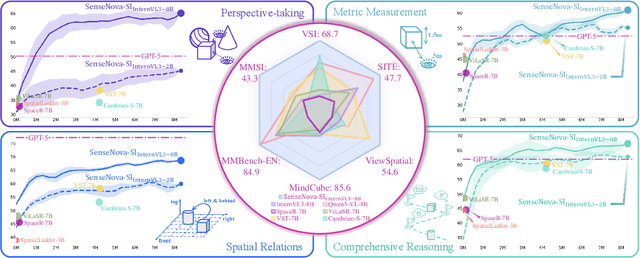
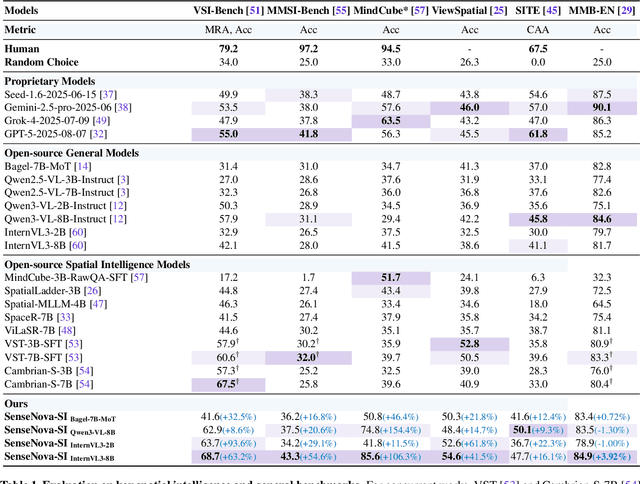
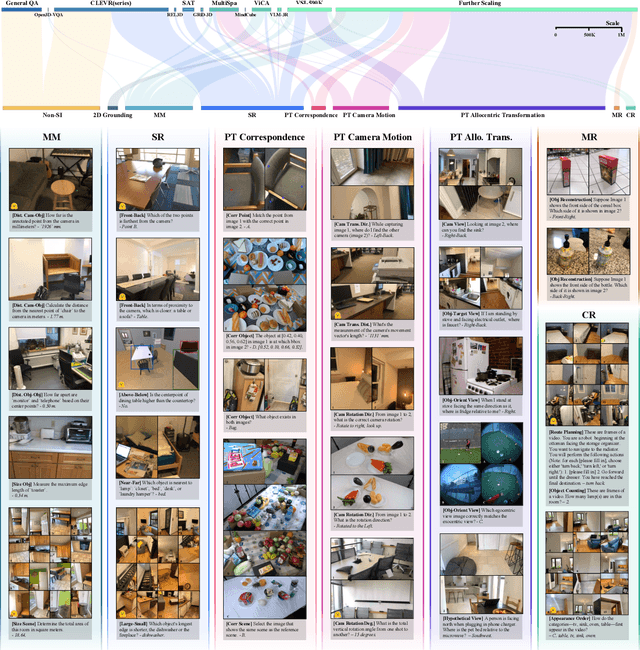
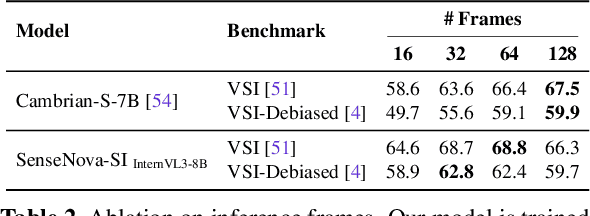
Despite remarkable progress, multimodal foundation models still exhibit surprising deficiencies in spatial intelligence. In this work, we explore scaling up multimodal foundation models to cultivate spatial intelligence within the SenseNova-SI family, built upon established multimodal foundations including visual understanding models (i.e., Qwen3-VL and InternVL3) and unified understanding and generation models (i.e., Bagel). We take a principled approach to constructing high-performing and robust spatial intelligence by systematically curating SenseNova-SI-8M: eight million diverse data samples under a rigorous taxonomy of spatial capabilities. SenseNova-SI demonstrates unprecedented performance across a broad range of spatial intelligence benchmarks: 68.7% on VSI-Bench, 43.3% on MMSI, 85.6% on MindCube, 54.6% on ViewSpatial, and 50.1% on SITE, while maintaining strong general multimodal understanding (e.g., 84.9% on MMBench-En). More importantly, we analyze the impact of data scaling, discuss early signs of emergent generalization capabilities enabled by diverse data training, analyze the risk of overfitting and language shortcuts, present a preliminary study on spatial chain-of-thought reasoning, and validate the potential downstream application. SenseNova-SI is an ongoing project, and this report will be updated continuously. All newly trained multimodal foundation models are publicly released to facilitate further research in this direction.
From Pixels to Words -- Towards Native Vision-Language Primitives at Scale
Oct 16, 2025The edifice of native Vision-Language Models (VLMs) has emerged as a rising contender to typical modular VLMs, shaped by evolving model architectures and training paradigms. Yet, two lingering clouds cast shadows over its widespread exploration and promotion: (-) What fundamental constraints set native VLMs apart from modular ones, and to what extent can these barriers be overcome? (-) How to make research in native VLMs more accessible and democratized, thereby accelerating progress in the field. In this paper, we clarify these challenges and outline guiding principles for constructing native VLMs. Specifically, one native VLM primitive should: (i) effectively align pixel and word representations within a shared semantic space; (ii) seamlessly integrate the strengths of formerly separate vision and language modules; (iii) inherently embody various cross-modal properties that support unified vision-language encoding, aligning, and reasoning. Hence, we launch NEO, a novel family of native VLMs built from first principles, capable of rivaling top-tier modular counterparts across diverse real-world scenarios. With only 390M image-text examples, NEO efficiently develops visual perception from scratch while mitigating vision-language conflicts inside a dense and monolithic model crafted from our elaborate primitives. We position NEO as a cornerstone for scalable and powerful native VLMs, paired with a rich set of reusable components that foster a cost-effective and extensible ecosystem. Our code and models are publicly available at: https://github.com/EvolvingLMMs-Lab/NEO.
Has GPT-5 Achieved Spatial Intelligence? An Empirical Study
Aug 18, 2025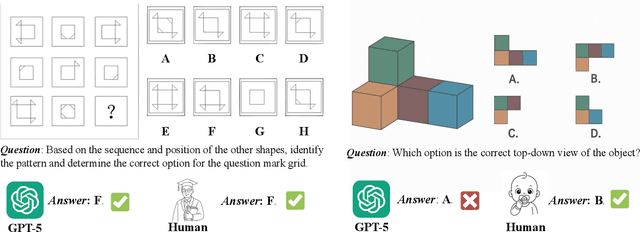
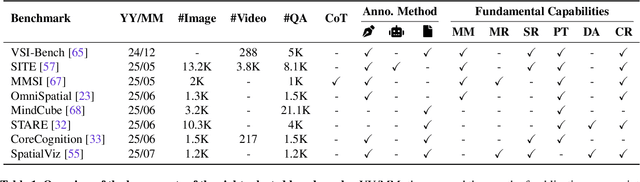
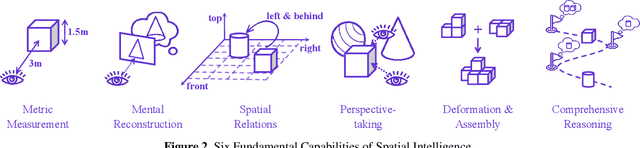
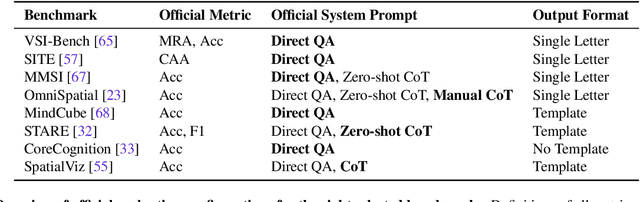
Multi-modal models have achieved remarkable progress in recent years. Nevertheless, they continue to exhibit notable limitations in spatial understanding and reasoning, which are fundamental capabilities to achieving artificial general intelligence. With the recent release of GPT-5, allegedly the most powerful AI model to date, it is timely to examine where the leading models stand on the path toward spatial intelligence. First, we propose a comprehensive taxonomy of spatial tasks that unifies existing benchmarks and discuss the challenges in ensuring fair evaluation. We then evaluate state-of-the-art proprietary and open-source models on eight key benchmarks, at a cost exceeding one billion total tokens. Our empirical study reveals that (1) GPT-5 demonstrates unprecedented strength in spatial intelligence, yet (2) still falls short of human performance across a broad spectrum of tasks. Moreover, we (3) identify the more challenging spatial intelligence problems for multi-modal models, and (4) proprietary models do not exhibit a decisive advantage when facing the most difficult problems. In addition, we conduct a qualitative evaluation across a diverse set of scenarios that are intuitive for humans yet fail even the most advanced multi-modal models.