 Add to Chrome
 Add to Firefox
 Add to Edge
RoboDojo: A Unified Sim-and-Real Benchmark for Comprehensive Evaluation of Generalist Robot Manipulation Policies
Jul 05, 2026
Generalist robot manipulation policies have advanced rapidly, yet existing benchmarks remain limited in systematically evaluating their capabilities. Many rely on simple, short-horizon, or skill-narrow tasks with limited capability coverage, and are often conducted only in simulation or only in the real world. Simulation enables scalable feedback but misses physical deployment challenges, while real-world evaluation is costly, time-consuming, and difficult to reproduce. We introduce RoboDojo, a unified sim-and-real benchmark for comprehensive evaluation of generalist robot manipulation policies. RoboDojo includes 42 simulation tasks and 18 real-world tasks covering diverse and complementary manipulation capabilities. The simulation benchmark evaluates five dimensions: generalization, memory, precision, long-horizon execution, and open-vocabulary instruction following, while the real-world benchmark exposes policies to challenging physical-world deployment conditions. RoboDojo supports scalable evaluation through heterogeneous parallel simulation in Isaac Sim and provides RoboDojo-RealEval, a reproducible real-world evaluation system with remote cloud access, standardized hardware, scene reset, evaluation protocol, and deployment interface. Together with XPolicyLab, policies can be integrated once and evaluated across simulation and real-world settings with minimal adaptation. We integrate 30 policies into XPolicyLab and evaluate them on RoboDojo, establishing a public leaderboard and systematic analysis of current policy performance. The website is available at http://robodojo-benchmark.com/.

Ultra Flash: Scaling Real-Time Streaming Video Generation to High Resolutions
Jun 08, 2026While recent autoregressive video diffusion models achieve remarkable streaming quality, they remain confined to low resolutions (e.g., 480P), leaving efficient, scalable, real-time high-resolution video generation a fundamental open challenge. To bridge this gap, we present Ultra Flash, a cascaded streaming framework capable of real-time high-resolution video generation. Ultra Flash achieves ~30 FPS at 1K resolution and ~18 FPS at 2K resolution on a single GPU through three key contributions: (1) an architecture-preserving T2V-to-TV2V super-resolution training paradigm coupled with an AIGC-oriented data degradation pipeline that effectively preserves the generative capability of the base model, enabling enhanced high-resolution detail when cascaded after mainstream low-resolution generative models; (2) a causal streaming latent upsampler paired with a high-resolution decoder, which enhances spatiotemporal coherence while enabling efficient latent spatial scaling and precise high-resolution decoding with negligible computational overhead; and (3) a cascade high-resolution streaming video generation optimization scheme that first performs hybrid-reward-enhanced sparse causalization and single-step distillation of the super-resolution model, then introduces cascaded streaming self-forcing preference optimization with dynamic cache management, jointly enhancing overall coherence, improving quality, and enabling real-time high-resolution streaming video generation. Extensive experiments demonstrate that Ultra Flash reliably produces ultra-high-resolution streaming video while maintaining state-of-the-art visual quality and superior efficiency.
Echo-Infinity: Learning Evolving Memory for Real-Time Infinite Video Generation
Jun 03, 2026We present Echo Infinity, an autoregressive (AR) framework towards real-time infinite video generation that employs a learnable evolving memory to dynamically filter, abstract, and compress any-length history at constant cost. Existing methods mainly curate memory with predefined KV-cache schedules, fixed-ratio heuristic compression, or inference-time RoPE adaptation. These designs inevitably lose historical information and amplify compounding errors due to their limited cache window and ignorance of autoregressive generation noise. Inspired by human memory consolidation, Echo-Infinity replaces handcrafted memory curation with learnable Memory Query, which are updated by attention and a gating mechanism when past frames are evicted from the local window. The queries are optimized end-to-end with the video diffusion transformers (DiTs), forming an evolving memory that supports arbitrary compression ratios with constant computation independent of video length. They also act as a generalizable generation prior, improving quality even when only the optimized initial state is used. We further introduce Unified Relative RoPE Recipe, which anchors the sink frames to start from id 0 and lets the newest frame id grow at most to the DiTs' pretrained maximum temporal RoPE id throughout training and inference, freeing the model from the finite RoPE constraint and closing the train-test RoPE extrapolation gap. In long and short video generation, Echo-Infinity achieves state-of-the-art performance, and, to our knowledge, demonstrates promising 24-hour (>1.3 M frames) real-time rollouts for the first time, suggesting a practical path toward infinite video generation.
ClawMark: A Living-World Benchmark for Multi-Turn, Multi-Day, Multimodal Coworker Agents
Apr 26, 2026Language-model agents are increasingly used as persistent coworkers that assist users across multiple working days. During such workflows, the surrounding environment may change independently of the agent: new emails arrive, calendar entries shift, knowledge-base records are updated, and evidence appears across images, scanned PDFs, audio, video, and spreadsheets. Existing benchmarks do not adequately evaluate this setting because they typically run within a single static episode and remain largely text-centric. We introduce \bench{}, a benchmark for coworker agents built around multi-turn multi-day tasks, a stateful sandboxed service environment whose state evolves between turns, and rule-based verification. The current release contains 100 tasks across 13 professional scenarios, executed against five stateful sandboxed services (filesystem, email, calendar, knowledge base, spreadsheet) and scored by 1537 deterministic Python checkers over post-execution service state; no LLM-as-judge is invoked during scoring. We benchmark seven frontier agent systems. The strongest model reaches 75.8 weighted score, but the best strict Task Success is only 20.0\%, indicating that partial progress is common while complete end-to-end workflow completion remains rare. Turn-level analysis shows that performance drops after the first exogenous environment update, highlighting adaptation to changing state as a key open challenge. We release the benchmark, evaluation harness, and construction pipeline to support reproducible coworker-agent evaluation.
Frontier-Eng: Benchmarking Self-Evolving Agents on Real-World Engineering Tasks with Generative Optimization
Apr 14, 2026Current LLM agent benchmarks, which predominantly focus on binary pass/fail tasks such as code generation or search-based question answering, often neglect the value of real-world engineering that is often captured through the iterative optimization of feasible designs. To this end, we introduce Frontier-Eng, a human-verified benchmark for generative optimization -- an iterative propose-execute-evaluate loop in which an agent generates candidate artifacts, receives executable verifier feedback, and revises them under a fixed interaction budget -- spanning $47$ tasks across five broad engineering categories. Unlike previous suites, Frontier-Eng tasks are grounded in industrial-grade simulators and verifiers that provide continuous reward signals and enforce hard feasibility constraints under constrained budgets. We evaluate eight frontier language models using representative search frameworks, finding that while Claude 4.6 Opus achieves the most robust performance, the benchmark remains challenging for all models. Our analysis suggests a dual power-law decay in improvement frequency ($\sim$ 1/iteration) and magnitude ($\sim$ 1/improvement count). We further show that although width improves parallelism and diversity, depth remains crucial for hard-won improvements under a fixed budget. Frontier-Eng establishes a new standard for assessing the capacity of AI agents to integrate domain knowledge with executable feedback to solve complex, open-ended engineering problems.
ST4VLA: Spatially Guided Training for Vision-Language-Action Models
Feb 10, 2026Large vision-language models (VLMs) excel at multimodal understanding but fall short when extended to embodied tasks, where instructions must be transformed into low-level motor actions. We introduce ST4VLA, a dual-system Vision-Language-Action framework that leverages Spatial Guided Training to align action learning with spatial priors in VLMs. ST4VLA includes two stages: (i) spatial grounding pre-training, which equips the VLM with transferable priors via scalable point, box, and trajectory prediction from both web-scale and robot-specific data, and (ii) spatially guided action post-training, which encourages the model to produce richer spatial priors to guide action generation via spatial prompting. This design preserves spatial grounding during policy learning and promotes consistent optimization across spatial and action objectives. Empirically, ST4VLA achieves substantial improvements over vanilla VLA, with performance increasing from 66.1 -> 84.6 on Google Robot and from 54.7 -> 73.2 on WidowX Robot, establishing new state-of-the-art results on SimplerEnv. It also demonstrates stronger generalization to unseen objects and paraphrased instructions, as well as robustness to long-horizon perturbations in real-world settings. These results highlight scalable spatially guided training as a promising direction for robust, generalizable robot learning. Source code, data and models are released at https://internrobotics.github.io/internvla-m1.github.io/
Next-Embedding Prediction Makes Strong Vision Learners
Dec 23, 2025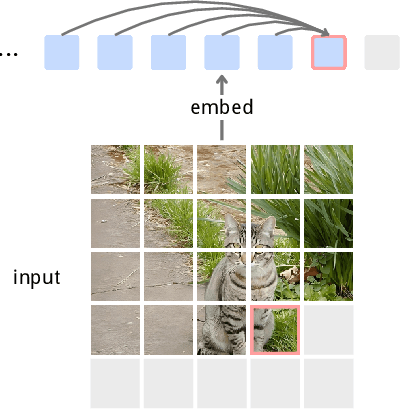
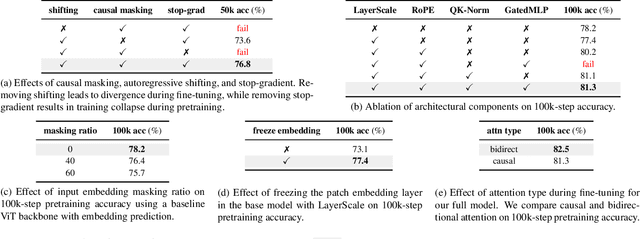
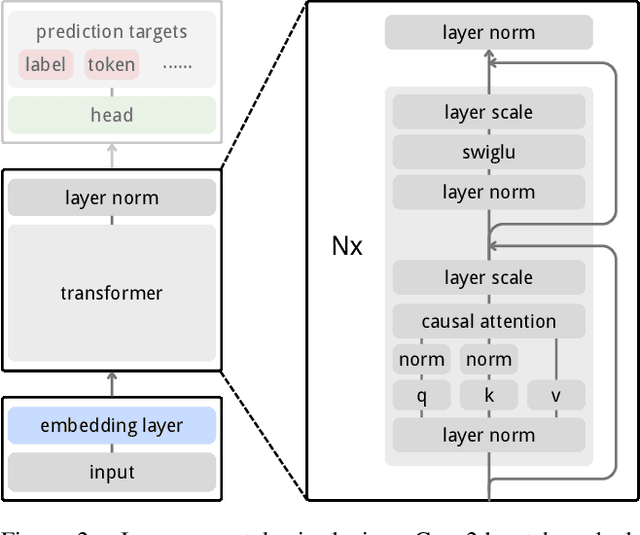
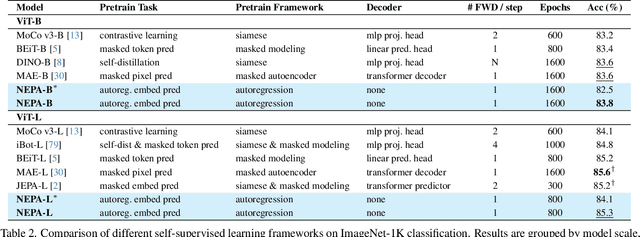
Inspired by the success of generative pretraining in natural language, we ask whether the same principles can yield strong self-supervised visual learners. Instead of training models to output features for downstream use, we train them to generate embeddings to perform predictive tasks directly. This work explores such a shift from learning representations to learning models. Specifically, models learn to predict future patch embeddings conditioned on past ones, using causal masking and stop gradient, which we refer to as Next-Embedding Predictive Autoregression (NEPA). We demonstrate that a simple Transformer pretrained on ImageNet-1k with next embedding prediction as its sole learning objective is effective - no pixel reconstruction, discrete tokens, contrastive loss, or task-specific heads. This formulation retains architectural simplicity and scalability, without requiring additional design complexity. NEPA achieves strong results across tasks, attaining 83.8% and 85.3% top-1 accuracy on ImageNet-1K with ViT-B and ViT-L backbones after fine-tuning, and transferring effectively to semantic segmentation on ADE20K. We believe generative pretraining from embeddings provides a simple, scalable, and potentially modality-agnostic alternative to visual self-supervised learning.
SRUM: Fine-Grained Self-Rewarding for Unified Multimodal Models
Oct 14, 2025Recently, remarkable progress has been made in Unified Multimodal Models (UMMs), which integrate vision-language generation and understanding capabilities within a single framework. However, a significant gap exists where a model's strong visual understanding often fails to transfer to its visual generation. A model might correctly understand an image based on user instructions, yet be unable to generate a faithful image from text prompts. This phenomenon directly raises a compelling question: Can a model achieve self-improvement by using its understanding module to reward its generation module? To bridge this gap and achieve self-improvement, we introduce SRUM, a self-rewarding post-training framework that can be directly applied to existing UMMs of various designs. SRUM creates a feedback loop where the model's own understanding module acts as an internal ``evaluator'', providing corrective signals to improve its generation module, without requiring additional human-labeled data. To ensure this feedback is comprehensive, we designed a global-local dual reward system. To tackle the inherent structural complexity of images, this system offers multi-scale guidance: a \textbf{global reward} ensures the correctness of the overall visual semantics and layout, while a \textbf{local reward} refines fine-grained, object-level fidelity. SRUM leads to powerful capabilities and shows strong generalization, boosting performance on T2I-CompBench from 82.18 to \textbf{88.37} and on T2I-ReasonBench from 43.82 to \textbf{46.75}. Overall, our work establishes a powerful new paradigm for enabling a UMMs' understanding module to guide and enhance its own generation via self-rewarding.
Unveiling the Backbone-Optimizer Coupling Bias in Visual Representation Learning
Oct 08, 2024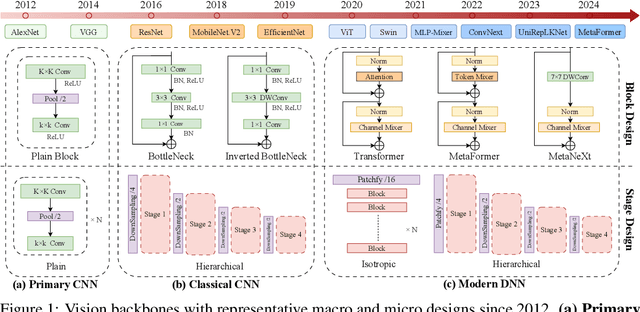
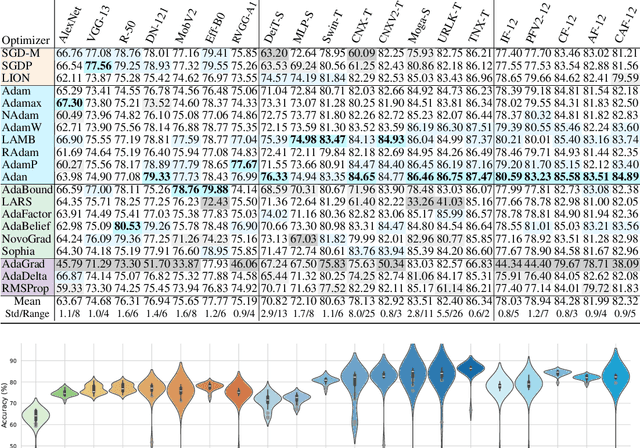
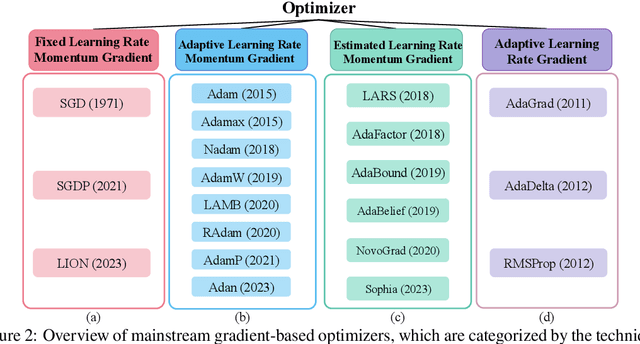
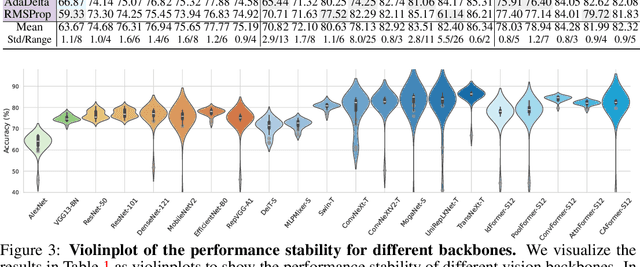
This paper delves into the interplay between vision backbones and optimizers, unvealing an inter-dependent phenomenon termed \textit{\textbf{b}ackbone-\textbf{o}ptimizer \textbf{c}oupling \textbf{b}ias} (BOCB). We observe that canonical CNNs, such as VGG and ResNet, exhibit a marked co-dependency with SGD families, while recent architectures like ViTs and ConvNeXt share a tight coupling with the adaptive learning rate ones. We further show that BOCB can be introduced by both optimizers and certain backbone designs and may significantly impact the pre-training and downstream fine-tuning of vision models. Through in-depth empirical analysis, we summarize takeaways on recommended optimizers and insights into robust vision backbone architectures. We hope this work can inspire the community to question long-held assumptions on backbones and optimizers, stimulate further explorations, and thereby contribute to more robust vision systems. The source code and models are publicly available at https://bocb-ai.github.io/.
Switch EMA: A Free Lunch for Better Flatness and Sharpness
Feb 14, 2024Exponential Moving Average (EMA) is a widely used weight averaging (WA) regularization to learn flat optima for better generalizations without extra cost in deep neural network (DNN) optimization. Despite achieving better flatness, existing WA methods might fall into worse final performances or require extra test-time computations. This work unveils the full potential of EMA with a single line of modification, i.e., switching the EMA parameters to the original model after each epoch, dubbed as Switch EMA (SEMA). From both theoretical and empirical aspects, we demonstrate that SEMA can help DNNs to reach generalization optima that better trade-off between flatness and sharpness. To verify the effectiveness of SEMA, we conduct comparison experiments with discriminative, generative, and regression tasks on vision and language datasets, including image classification, self-supervised learning, object detection and segmentation, image generation, video prediction, attribute regression, and language modeling. Comprehensive results with popular optimizers and networks show that SEMA is a free lunch for DNN training by improving performances and boosting convergence speeds.