 Add to Chrome
 Add to Firefox
 Add to Edge
UniWorld-Design: From Pixel Generation to Layer-Native Design
Aug 04, 2026
We introduce UniWorld-Design, a framework that redefines image generation from flat pixel synthesis to structured visual composition, with semantic RGBA layers as the atomic units of generation, understanding, and editing. Our key insight is that pixels define how an image is rendered, whereas layers define how an image is created, understood, and edited. Just as human designers create and manipulate visual content through layers rather than raw pixels, UniWorld-Design equips multimodal generative models with a layer-native design space. UniWorld-Design comprises two models. The Text-to-RGBA (T2RGBA) model generates standalone RGBA assets directly from text. The Image-to-Layer (I2L) model conditions on a finished image, a global instruction and per-layer prompts, and jointly produces ordered, complete semantic RGBA layers. Its instruction interface supports top-level decomposition, recursive decomposition and targeted extraction, making layering an instruction-addressable operation for agentic editing. Because I2L learns complete semantic objects rather than visible-pixel partitions, its layers stay usable when moved or removed. On the Crello benchmark, I2L reduces per-layer RGB L1 error by 37% and achieves a 34% relative improvement in Alpha Soft IoU over Qwen-Image-Layered. Separately, T2RGBA achieves the highest CLIP Score, outperforming LayerDiffuse and OmniAlpha.

ContractHIL-HLS: Contract-Aligned Multi-Agent Workflow with Hardware-in-the-Loop Feedback for HLS Design
Jul 28, 2026This paper presents ContractHIL-HLS, a contract-aligned multi-agent workflow for practical high-level synthesis (HLS) engineering. The workflow makes three contributions. First, it introduces a structured contract as the semantic-alignment and task-execution artifact that translates natural language requirements into explicit interfaces, constraints, validation checks, and rollback rules. Second, it incorporates hardware information into the feedback loop by feeding HLS, Vivado, PYNQ runtime, power, and failure evidence back into generation, thereby extending LLM-assisted HLS from kernel code toward system- and board-level closure. Third, it decomposes agents by semantic lowering and execution tasks rather than by conversational roles: a Contract Agent lowers natural language into the contract, an HTML Agent renders the contract as persistent structured HTML, and a Hardware-in-the-Loop Agent implements and revises the design with measured evidence. We evaluate ContractHIL-HLS in two parts. On 94 locally executable HLS-Eval tasks, the structured contract provides the largest small design gain, improving the estimated single-sample testbench pass rate from 64.0% to 70.2%; the full flow reaches 70.4% pass@1 and 76.6% pass@5. Because HLS-Eval does not exercise board-level design, we also validate ContractHIL-HLS on a board tested ML-KEM/ML-DSA post-quantum cryptography (PQC) secure-message accelerator, where the retained dual-bitstream organization reduces six-message average text runtime from 207.3 ms to 52.4 ms with positive routed WNS on both images while preserving decrypted-message verification. We open-source our work at BJUT-CS316-LAB/ContractHIL-HLS (https://github.com/BJUT-CS316-LAB/ContractHIL-HLS).
From Structure to Synergy: A Survey of Vision-Language Perception Paradigm Evolution in Multimodal Large Language Models
Jun 24, 2026Multimodal Large Language Models (MLLMs) have recently made remarkable progress in unifying vision-language understanding and reasoning, especially following the introduction of models such as OpenAI's O-series and DeepSeek's R-series, which have driven a paradigm shift toward perception-centric intelligence. However, there remains a lack of systematic surveys that examine perception from a truly unified vision-language perspective -- one that treats vision and language as an inseparable modality. Existing reviews are often fragmented, focusing separately on either vision or language, and thus rarely capture the cross-modal evolution of perception as an integrated capability. To bridge this gap, we present the first systematic survey of unified vision-language perception in MLLMs. Specifically, we (1) formalize MLLM perception as an intrinsic, unified vision-language capability analogous to human innate perception, (2) introduce a five-stage taxonomy tracing the paradigm evolution of MLLM perception and survey representative methods and milestones at each phase, and (3) identify open challenges and outline promising research directions toward truly general, unified multimodal intelligence. We hope our study will provide both a foundational understanding and an actionable roadmap to foster further innovation on the path toward artificial general intelligence (AGI).
V-Zero: Answer-Label-Free On-Policy Distillation with Contrastive Evidence Gating for Fine-Grained Visual Reasoning
Jun 24, 2026Fine-grained visual reasoning requires multimodal large language models (MLLMs) to identify task-relevant visual evidence and ground their reasoning in local image regions. Existing agentic methods typically rely on reinforcement learning with verifiable rewards or supervised fine-tuning on large-scale annotated reasoning traces, leading to costly exploration, hand-designed verification rules, or heavy dependence on textual supervision. A natural way to avoid such external answer labels is to learn from trajectories sampled by the student itself, which points to On-Policy Distillation (OPD). To understand what OPD can and cannot provide for visual reasoning, we revisit it as negative-free stop-gradient alignment. This perspective shows that, although OPD provides effective token-level correction, its ceiling is constrained by the absence of trajectory-level discrimination. Motivated by these observations, we propose V-Zero, an answer-label-free framework for visual reasoning with contrastive evidence gating. V-Zero uses no annotated textual answer labels; instead, during training it pairs a question-relevant regional crop with a negative visual view to evaluate student-sampled trajectories and gate dense token-level distillation. Experiments on multiple visual reasoning benchmarks show that V-Zero consistently improves fine-grained visual reasoning while preserving strong generalization. Notably, V-Zero is more than 5$\times$ faster than previous supervised fine-tuning methods and more than 10$\times$ faster than reinforcement learning baselines. Code and dataset will be released at https://github.com/eVI-group-SCU/V-Zero
Which Models Are Our Models Built On? Auditing Invisible Dependencies in Modern LLMs
Jun 10, 2026Modern LLM training pipelines increasingly rely on other models to generate data, filter corpora, judge outputs, and guide development decisions. These dependencies are recursive: a model may depend on an upstream artifact whose own dependencies are documented only in separate releases and artifacts. As a result, the full dependency structure is fragmented across heterogeneous public artifacts, with complexity and recursive depth far outpacing humans' ability to trace. We introduce ModSleuth, an agentic system that recursively reconstructs LLM dependency graphs from public artifacts with source-grounded evidence. We find that the primary challenge is no longer information extraction, but defining what constitutes a dependency and reconciling artifact references across inconsistent documentation. We address these challenges through a formalization that distinguishes direct and indirect dependencies, represents heterogeneous pipeline roles through operation-centered relationships, and resolves artifact identities across names, versions, and repositories. Applying ModSleuth to four public-artifact-rich LLM releases, we recover 1,060 source-verified dependencies and construct large-scale dependency graphs of modern LLM development. These graphs reveal multi-hop license obligations, train-evaluation coupling, discrepancies between released and training-time artifacts, and documentation inconsistencies that would otherwise be difficult to uncover. We release ModSleuth and the resulting dependency graphs to support transparent analysis of the increasingly complex ecosystems underlying modern LLMs.
DeepVision-103K: A Visually Diverse, Broad-Coverage, and Verifiable Mathematical Dataset for Multimodal Reasoning
Feb 18, 2026Reinforcement Learning with Verifiable Rewards (RLVR) has been shown effective in enhancing the visual reflection and reasoning capabilities of Large Multimodal Models (LMMs). However, existing datasets are predominantly derived from either small-scale manual construction or recombination of prior resources, which limits data diversity and coverage, thereby constraining further gains in model performance. To this end, we introduce \textbf{DeepVision-103K}, a comprehensive dataset for RLVR training that covers diverse K12 mathematical topics, extensive knowledge points, and rich visual elements. Models trained on DeepVision achieve strong performance on multimodal mathematical benchmarks, and generalize effectively to general multimodal reasoning tasks. Further analysis reveals enhanced visual perception, reflection and reasoning capabilities in trained models, validating DeepVision's effectiveness for advancing multimodal reasoning. Data: \href{https://huggingface.co/datasets/skylenage/DeepVision-103K}{this url}.
Unmasking Reasoning Processes: A Process-aware Benchmark for Evaluating Structural Mathematical Reasoning in LLMs
Jan 31, 2026Recent large language models (LLMs) achieve near-saturation accuracy on many established mathematical reasoning benchmarks, raising concerns about their ability to diagnose genuine reasoning competence. This saturation largely stems from the dominance of template-based computation and shallow arithmetic decomposition in existing datasets, which underrepresent reasoning skills such as multi-constraint coordination, constructive logical synthesis, and spatial inference. To address this gap, we introduce ReasoningMath-Plus, a benchmark of 150 carefully curated problems explicitly designed to evaluate structural reasoning. Each problem emphasizes reasoning under interacting constraints, constructive solution formation, or non-trivial structural insight, and is annotated with a minimal reasoning skeleton to support fine-grained process-level evaluation. Alongside the dataset, we introduce HCRS (Hazard-aware Chain-based Rule Score), a deterministic step-level scoring function, and train a Process Reward Model (PRM) on the annotated reasoning traces. Empirically, while leading models attain relatively high final-answer accuracy (up to 5.8/10), HCRS-based holistic evaluation yields substantially lower scores (average 4.36/10, best 5.14/10), showing that answer-only metrics can overestimate reasoning robustness.
Challenging the Boundaries of Reasoning: An Olympiad-Level Math Benchmark for Large Language Models
Mar 27, 2025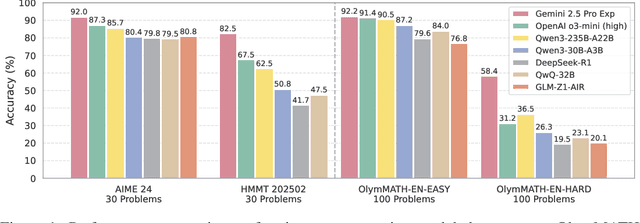
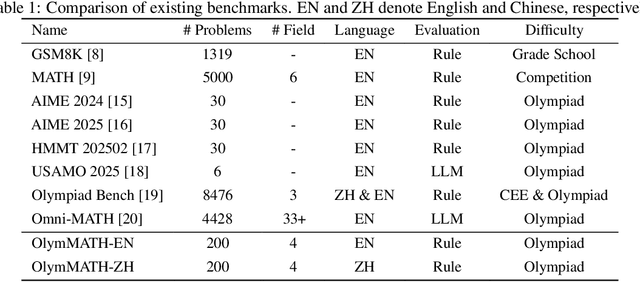
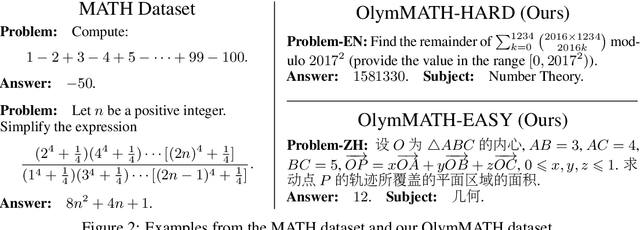
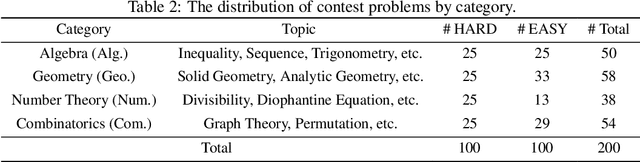
In recent years, the rapid development of large reasoning models has resulted in the saturation of existing benchmarks for evaluating mathematical reasoning, highlighting the urgent need for more challenging and rigorous evaluation frameworks. To address this gap, we introduce OlymMATH, a novel Olympiad-level mathematical benchmark, designed to rigorously test the complex reasoning capabilities of LLMs. OlymMATH features 200 meticulously curated problems, each manually verified and available in parallel English and Chinese versions. The problems are systematically organized into two distinct difficulty tiers: (1) AIME-level problems (easy) that establish a baseline for mathematical reasoning assessment, and (2) significantly more challenging problems (hard) designed to push the boundaries of current state-of-the-art models. In our benchmark, these problems span four core mathematical fields, each including a verifiable numerical solution to enable objective, rule-based evaluation. Empirical results underscore the significant challenge presented by OlymMATH, with state-of-the-art models including DeepSeek-R1 and OpenAI's o3-mini demonstrating notably limited accuracy on the hard subset. Furthermore, the benchmark facilitates comprehensive bilingual assessment of mathematical reasoning abilities-a critical dimension that remains largely unaddressed in mainstream mathematical reasoning benchmarks. We release the OlymMATH benchmark at the STILL project: https://github.com/RUCAIBox/Slow_Thinking_with_LLMs.
Technical Report: Enhancing LLM Reasoning with Reward-guided Tree Search
Nov 18, 2024

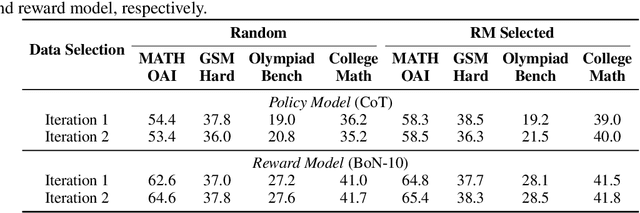

Recently, test-time scaling has garnered significant attention from the research community, largely due to the substantial advancements of the o1 model released by OpenAI. By allocating more computational resources during the inference phase, large language models~(LLMs) can extensively explore the solution space by generating more thought tokens or diverse solutions, thereby producing more accurate responses. However, developing an o1-like reasoning approach is challenging, and researchers have been making various attempts to advance this open area of research. In this paper, we present a preliminary exploration into enhancing the reasoning abilities of LLMs through reward-guided tree search algorithms. This framework is implemented by integrating the policy model, reward model, and search algorithm. It is primarily constructed around a tree search algorithm, where the policy model navigates a dynamically expanding tree guided by a specially trained reward model. We thoroughly explore various design considerations necessary for implementing this framework and provide a detailed report of the technical aspects. To assess the effectiveness of our approach, we focus on mathematical reasoning tasks and conduct extensive evaluations on four challenging datasets, significantly enhancing the reasoning abilities of LLMs.
$p$SVM: Soft-margin SVMs with $p$-norm Hinge Loss
Aug 20, 2024Support Vector Machines (SVMs) based on hinge loss have been extensively discussed and applied to various binary classification tasks. These SVMs achieve a balance between margin maximization and the minimization of slack due to outliers. Although many efforts have been dedicated to enhancing the performance of SVMs with hinge loss, studies on $p$SVMs, soft-margin SVMs with $p$-norm hinge loss, remain relatively scarce. In this paper, we explore the properties, performance, and training algorithms of $p$SVMs. We first derive the generalization bound of $p$SVMs, then formulate the dual optimization problem, comparing it with the traditional approach. Furthermore, we discuss a generalized version of the Sequential Minimal Optimization (SMO) algorithm, $p$SMO, to train our $p$SVM model. Comparative experiments on various datasets, including binary and multi-class classification tasks, demonstrate the effectiveness and advantages of our $p$SVM model and the $p$SMO method. Code is available at https://github.com/CoderBak/pSVM.