 Add to Chrome
 Add to Firefox
 Add to Edge
Self Gradient Forcing: Native Long Video Extrapolation
Jul 24, 2026
Recent autoregressive video diffusion methods are increasingly built upon Self Forcing, where the student is trained on histories produced by its own rollout rather than ground-truth video contexts. This reduces exposure bias, but the historical key-value cache is still used by future frames only as frozen rollout state. As a result, future losses cannot supervise how earlier generated latents should be written into more useful keys and values for later video-latent generation. We call this the historical context-gradient gap. We propose Self Gradient Forcing (SGF), a two-pass training strategy that restores this missing supervision signal without backpropagating through the full serial rollout. Pass 1 performs a no-gradient autoregressive rollout matching inference and, at a sampled denoising exit step, records both the self-generated context and the noisy latents fed to the model. Pass 2 performs parallel context-gradient reconstruction for the recorded exit step. The generated context is used as stop-gradient clean-latent input, while the model recomputes the context KV representations and future-to-context causal attention. Thus, SGF provides the missing memory-writing supervision within the native autoregressive training objective, using losses on future video latents to train the model to encode context into more effective causal memory. Across extensive long-horizon frame-wise and chunk-wise experiments under different initializations, SGF achieves stronger native long-video extrapolation than Self Forcing, especially in subject identity, background/layout consistency, and temporal stability. Remarkably, using only a 5-second training window, SGF can extrapolate to videos lasting several minutes. Code and models will be released to advance research on autoregressive video generation.

Ultra Flash: Scaling Real-Time Streaming Video Generation to High Resolutions
Jun 08, 2026While recent autoregressive video diffusion models achieve remarkable streaming quality, they remain confined to low resolutions (e.g., 480P), leaving efficient, scalable, real-time high-resolution video generation a fundamental open challenge. To bridge this gap, we present Ultra Flash, a cascaded streaming framework capable of real-time high-resolution video generation. Ultra Flash achieves ~30 FPS at 1K resolution and ~18 FPS at 2K resolution on a single GPU through three key contributions: (1) an architecture-preserving T2V-to-TV2V super-resolution training paradigm coupled with an AIGC-oriented data degradation pipeline that effectively preserves the generative capability of the base model, enabling enhanced high-resolution detail when cascaded after mainstream low-resolution generative models; (2) a causal streaming latent upsampler paired with a high-resolution decoder, which enhances spatiotemporal coherence while enabling efficient latent spatial scaling and precise high-resolution decoding with negligible computational overhead; and (3) a cascade high-resolution streaming video generation optimization scheme that first performs hybrid-reward-enhanced sparse causalization and single-step distillation of the super-resolution model, then introduces cascaded streaming self-forcing preference optimization with dynamic cache management, jointly enhancing overall coherence, improving quality, and enabling real-time high-resolution streaming video generation. Extensive experiments demonstrate that Ultra Flash reliably produces ultra-high-resolution streaming video while maintaining state-of-the-art visual quality and superior efficiency.
Echo-Memory: A Controlled Study of Memory in Action World Models
Jun 08, 2026We present \textbf{Echo-Memory}, a controlled study of memory mechanisms in action-conditioned world models. These models generate multi-segment videos from a first frame, text prompt, and camera-action sequence, but their central failure is often memory rather than local image synthesis: after the camera leaves and returns, the scene or salient object may silently change. Existing memory designs are hard to compare because gains are entangled with backbone, training, retrieval, and evaluation differences. Echo-Memory fixes the action-to-video interface and varies only how history is stored and read by the generator. Under a shared video diffusion backbone, optimizer, camera-action representation, sampler, and evaluation pipeline, we compare raw context, compression-based memory, spatial summaries with different read-out paths, and state-space recurrence. This matched matrix separates four otherwise conflated axes: \emph{capacity}, \emph{compression}, \emph{read-out}, and \emph{recurrence}. We also evaluate memory through a three-branch protocol: replay quality, in-domain loop revisit, and open-domain return probes. The branches routinely disagree, showing that replay fidelity is not a sufficient proxy for remembering a world. Three findings follow. Raw context is a strong capacity baseline and improves open-domain return far more than it improves replay metrics. Compactness is not a free substitute for capacity: aggressive spatial and hybrid-compression memories lose the salient evidence needed for return. Finally, block-wise state-space recurrence is the strongest open-domain return mechanism in our matrix, showing that the structure of implicit memory matters as much as the decision to use it. These results provide a compact protocol for studying memory in action world models beyond isolated replay metrics.
Echo-Infinity: Learning Evolving Memory for Real-Time Infinite Video Generation
Jun 03, 2026We present Echo Infinity, an autoregressive (AR) framework towards real-time infinite video generation that employs a learnable evolving memory to dynamically filter, abstract, and compress any-length history at constant cost. Existing methods mainly curate memory with predefined KV-cache schedules, fixed-ratio heuristic compression, or inference-time RoPE adaptation. These designs inevitably lose historical information and amplify compounding errors due to their limited cache window and ignorance of autoregressive generation noise. Inspired by human memory consolidation, Echo-Infinity replaces handcrafted memory curation with learnable Memory Query, which are updated by attention and a gating mechanism when past frames are evicted from the local window. The queries are optimized end-to-end with the video diffusion transformers (DiTs), forming an evolving memory that supports arbitrary compression ratios with constant computation independent of video length. They also act as a generalizable generation prior, improving quality even when only the optimized initial state is used. We further introduce Unified Relative RoPE Recipe, which anchors the sink frames to start from id 0 and lets the newest frame id grow at most to the DiTs' pretrained maximum temporal RoPE id throughout training and inference, freeing the model from the finite RoPE constraint and closing the train-test RoPE extrapolation gap. In long and short video generation, Echo-Infinity achieves state-of-the-art performance, and, to our knowledge, demonstrates promising 24-hour (>1.3 M frames) real-time rollouts for the first time, suggesting a practical path toward infinite video generation.
IC-Custom: Diverse Image Customization via In-Context Learning
Jul 02, 2025Image customization, a crucial technique for industrial media production, aims to generate content that is consistent with reference images. However, current approaches conventionally separate image customization into position-aware and position-free customization paradigms and lack a universal framework for diverse customization, limiting their applications across various scenarios. To overcome these limitations, we propose IC-Custom, a unified framework that seamlessly integrates position-aware and position-free image customization through in-context learning. IC-Custom concatenates reference images with target images to a polyptych, leveraging DiT's multi-modal attention mechanism for fine-grained token-level interactions. We introduce the In-context Multi-Modal Attention (ICMA) mechanism with learnable task-oriented register tokens and boundary-aware positional embeddings to enable the model to correctly handle different task types and distinguish various inputs in polyptych configurations. To bridge the data gap, we carefully curated a high-quality dataset of 12k identity-consistent samples with 8k from real-world sources and 4k from high-quality synthetic data, avoiding the overly glossy and over-saturated synthetic appearance. IC-Custom supports various industrial applications, including try-on, accessory placement, furniture arrangement, and creative IP customization. Extensive evaluations on our proposed ProductBench and the publicly available DreamBench demonstrate that IC-Custom significantly outperforms community workflows, closed-source models, and state-of-the-art open-source approaches. IC-Custom achieves approximately 73% higher human preference across identity consistency, harmonicity, and text alignment metrics, while training only 0.4% of the original model parameters. Project page: https://liyaowei-stu.github.io/project/IC_Custom
VideoPainter: Any-length Video Inpainting and Editing with Plug-and-Play Context Control
Mar 07, 2025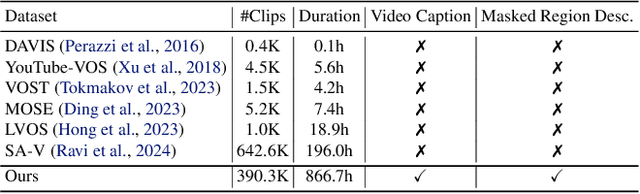
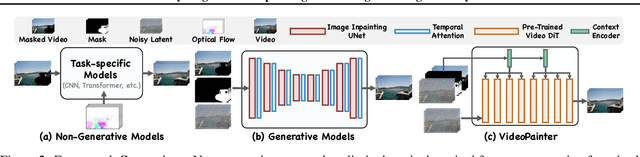
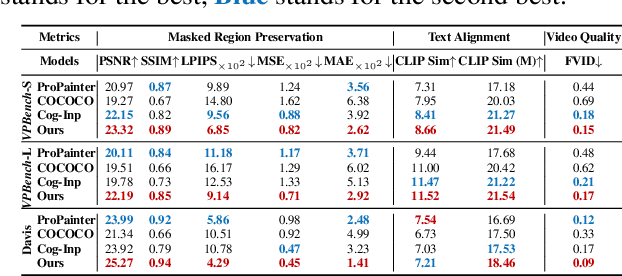
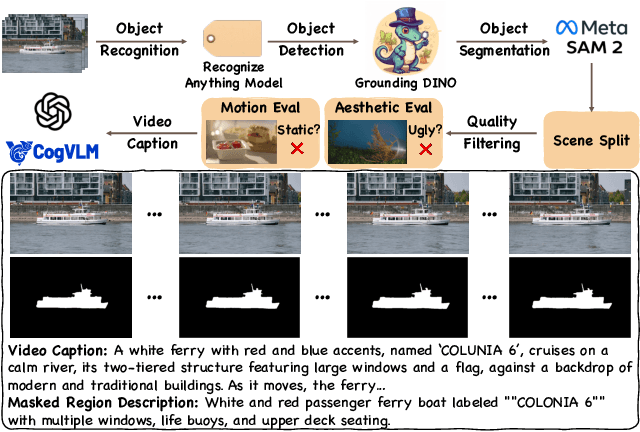
Video inpainting, which aims to restore corrupted video content, has experienced substantial progress. Despite these advances, existing methods, whether propagating unmasked region pixels through optical flow and receptive field priors, or extending image-inpainting models temporally, face challenges in generating fully masked objects or balancing the competing objectives of background context preservation and foreground generation in one model, respectively. To address these limitations, we propose a novel dual-stream paradigm VideoPainter that incorporates an efficient context encoder (comprising only 6% of the backbone parameters) to process masked videos and inject backbone-aware background contextual cues to any pre-trained video DiT, producing semantically consistent content in a plug-and-play manner. This architectural separation significantly reduces the model's learning complexity while enabling nuanced integration of crucial background context. We also introduce a novel target region ID resampling technique that enables any-length video inpainting, greatly enhancing our practical applicability. Additionally, we establish a scalable dataset pipeline leveraging current vision understanding models, contributing VPData and VPBench to facilitate segmentation-based inpainting training and assessment, the largest video inpainting dataset and benchmark to date with over 390K diverse clips. Using inpainting as a pipeline basis, we also explore downstream applications including video editing and video editing pair data generation, demonstrating competitive performance and significant practical potential. Extensive experiments demonstrate VideoPainter's superior performance in both any-length video inpainting and editing, across eight key metrics, including video quality, mask region preservation, and textual coherence.
BrushEdit: All-In-One Image Inpainting and Editing
Dec 13, 2024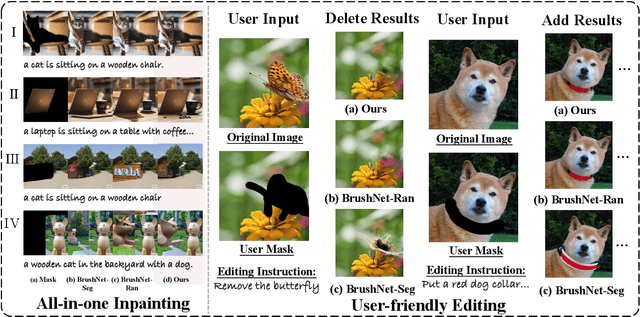
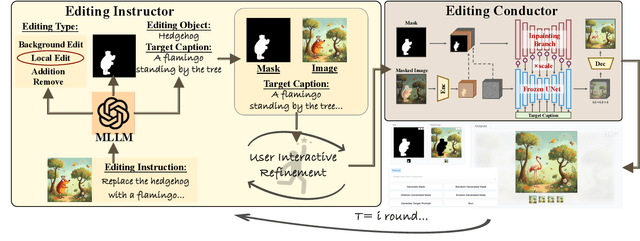
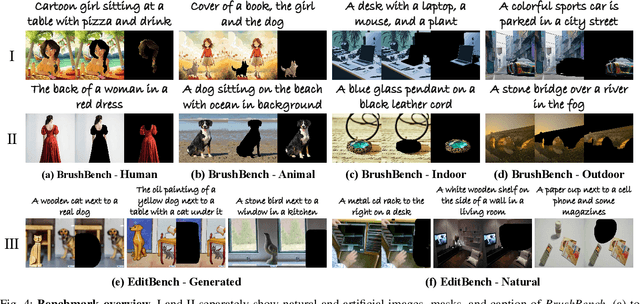
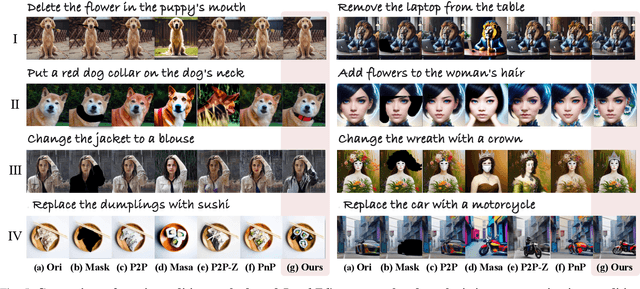
Image editing has advanced significantly with the development of diffusion models using both inversion-based and instruction-based methods. However, current inversion-based approaches struggle with big modifications (e.g., adding or removing objects) due to the structured nature of inversion noise, which hinders substantial changes. Meanwhile, instruction-based methods often constrain users to black-box operations, limiting direct interaction for specifying editing regions and intensity. To address these limitations, we propose BrushEdit, a novel inpainting-based instruction-guided image editing paradigm, which leverages multimodal large language models (MLLMs) and image inpainting models to enable autonomous, user-friendly, and interactive free-form instruction editing. Specifically, we devise a system enabling free-form instruction editing by integrating MLLMs and a dual-branch image inpainting model in an agent-cooperative framework to perform editing category classification, main object identification, mask acquisition, and editing area inpainting. Extensive experiments show that our framework effectively combines MLLMs and inpainting models, achieving superior performance across seven metrics including mask region preservation and editing effect coherence.
Adding Multimodal Controls to Whole-body Human Motion Generation
Aug 04, 2024

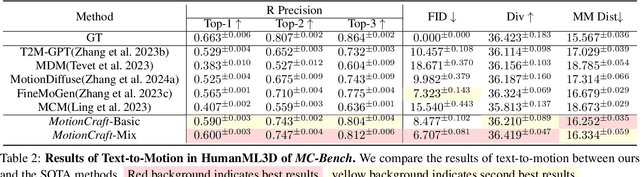
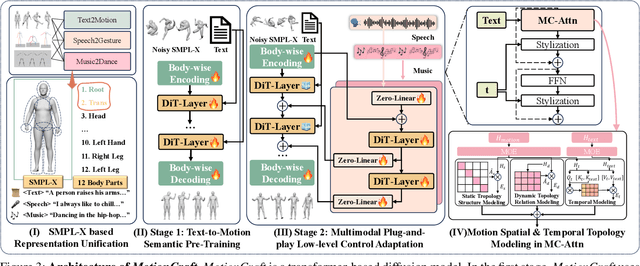
Whole-body multimodal motion generation, controlled by text, speech, or music, has numerous applications including video generation and character animation. However, employing a unified model to accomplish various generation tasks with different condition modalities presents two main challenges: motion distribution drifts across different generation scenarios and the complex optimization of mixed conditions with varying granularity. Furthermore, inconsistent motion formats in existing datasets further hinder effective multimodal motion generation. In this paper, we propose ControlMM, a unified framework to Control whole-body Multimodal Motion generation in a plug-and-play manner. To effectively learn and transfer motion knowledge across different motion distributions, we propose ControlMM-Attn, for parallel modeling of static and dynamic human topology graphs. To handle conditions with varying granularity, ControlMM employs a coarse-to-fine training strategy, including stage-1 text-to-motion pre-training for semantic generation and stage-2 multimodal control adaptation for conditions of varying low-level granularity. To address existing benchmarks' varying motion format limitations, we introduce ControlMM-Bench, the first publicly available multimodal whole-body human motion generation benchmark based on the unified whole-body SMPL-X format. Extensive experiments show that ControlMM achieves state-of-the-art performance across various standard motion generation tasks. Our website is at https://yxbian23.github.io/ControlMM.
Adding Multi-modal Controls to Whole-body Human Motion Generation
Jul 30, 2024Whole-body multi-modal motion generation, controlled by text, speech, or music, has numerous applications including video generation and character animation. However, employing a unified model to accomplish various generation tasks with different condition modalities presents two main challenges: motion distribution drifts across different generation scenarios and the complex optimization of mixed conditions with varying granularity. Furthermore, inconsistent motion formats in existing datasets further hinder effective multi-modal motion generation. In this paper, we propose ControlMM, a unified framework to Control whole-body Multi-modal Motion generation in a plug-and-play manner. To effectively learn and transfer motion knowledge across different motion distributions, we propose ControlMM-Attn, for parallel modeling of static and dynamic human topology graphs. To handle conditions with varying granularity, ControlMM employs a coarse-to-fine training strategy, including stage-1 text-to-motion pre-training for semantic generation and stage-2 multi-modal control adaptation for conditions of varying low-level granularity. To address existing benchmarks' varying motion format limitations, we introduce ControlMM-Bench, the first publicly available multi-modal whole-body human motion generation benchmark based on the unified whole-body SMPL-X format. Extensive experiments show that ControlMM achieves state-of-the-art performance across various standard motion generation tasks. Our website is at https://yxbian23.github.io/ControlMM.
Image Inpainting Models are Effective Tools for Instruction-guided Image Editing
Jul 18, 2024

This is the technique report for the winning solution of the CVPR2024 GenAI Media Generation Challenge Workshop's Instruction-guided Image Editing track. Instruction-guided image editing has been largely studied in recent years. The most advanced methods, such as SmartEdit and MGIE, usually combine large language models with diffusion models through joint training, where the former provides text understanding ability, and the latter provides image generation ability. However, in our experiments, we find that simply connecting large language models and image generation models through intermediary guidance such as masks instead of joint fine-tuning leads to a better editing performance and success rate. We use a 4-step process IIIE (Inpainting-based Instruction-guided Image Editing): editing category classification, main editing object identification, editing mask acquisition, and image inpainting. Results show that through proper combinations of language models and image inpainting models, our pipeline can reach a high success rate with satisfying visual quality.