 Add to Chrome
 Add to Firefox
 Add to Edge
UniSpace: Unified Visual Representation and Scalable Multimodal Modeling
Aug 09, 2026
Semantic vision encoders have become a central visual interface for multimodal understanding and semantic conditioning in image generation. However, their final tokens discard fine-grained visual details, leading to poor pixel reconstruction and limiting their use in reconstruction-sensitive tasks such as image generation and editing. In this work, we ask whether understanding, generation, and editing can be modeled in a single visual representation space built from a pretrained semantic ViT. We show that the frozen Transformer blocks of a semantic ViT are not intrinsically unable to preserve visual details. Instead, the original patch parameterization drives the representation toward semantic abstraction, making fine-grained information difficult to recover from the final tokens. Based on this observation, we introduce \emph{Patch Reparameterization}, which preserves the original semantic pathway while adding a reconstruction-aware patch embedding that provides fine-grained visual information to the same frozen ViT blocks. The resulting unified representation preserves multimodal understanding while enabling high-fidelity image reconstruction and a favorable reconstruction--generation trade-off. We further scale this representation into \emph{UniSpace}, an 8B Mixture-of-Transformer-Experts model that performs understanding, generation, and editing in the same visual space without a separate VAE pathway. System-level evaluations demonstrate practical text-to-image generation and instruction-based image editing, showing that a reparameterized pretrained ViT can serve as a unified visual interface for scalable multimodal modeling.

UniWorld-Design: From Pixel Generation to Layer-Native Design
Aug 04, 2026We introduce UniWorld-Design, a framework that redefines image generation from flat pixel synthesis to structured visual composition, with semantic RGBA layers as the atomic units of generation, understanding, and editing. Our key insight is that pixels define how an image is rendered, whereas layers define how an image is created, understood, and edited. Just as human designers create and manipulate visual content through layers rather than raw pixels, UniWorld-Design equips multimodal generative models with a layer-native design space. UniWorld-Design comprises two models. The Text-to-RGBA (T2RGBA) model generates standalone RGBA assets directly from text. The Image-to-Layer (I2L) model conditions on a finished image, a global instruction and per-layer prompts, and jointly produces ordered, complete semantic RGBA layers. Its instruction interface supports top-level decomposition, recursive decomposition and targeted extraction, making layering an instruction-addressable operation for agentic editing. Because I2L learns complete semantic objects rather than visible-pixel partitions, its layers stay usable when moved or removed. On the Crello benchmark, I2L reduces per-layer RGB L1 error by 37% and achieves a 34% relative improvement in Alpha Soft IoU over Qwen-Image-Layered. Separately, T2RGBA achieves the highest CLIP Score, outperforming LayerDiffuse and OmniAlpha.
VGGT-Det: Mining VGGT Internal Priors for Sensor-Geometry-Free Multi-View Indoor 3D Object Detection
Mar 01, 2026Current multi-view indoor 3D object detectors rely on sensor geometry that is costly to obtain (i.e., precisely calibrated multi-view camera poses) to fuse multi-view information into a global scene representation, limiting deployment in real-world scenes. We target a more practical setting: Sensor-Geometry-Free (SG-Free) multi-view indoor 3D object detection, where there are no sensor-provided geometric inputs (multi-view poses or depth). Recent Visual Geometry Grounded Transformer (VGGT) shows that strong 3D cues can be inferred directly from images. Building on this insight, we present VGGT-Det, the first framework tailored for SG-Free multi-view indoor 3D object detection. Rather than merely consuming VGGT predictions, our method integrates VGGT encoder into a transformer-based pipeline. To effectively leverage both the semantic and geometric priors from inside VGGT, we introduce two novel key components: (i) Attention-Guided Query Generation (AG): exploits VGGT attention maps as semantic priors to initialize object queries, improving localization by focusing on object regions while preserving global spatial structure; (ii) Query-Driven Feature Aggregation (QD): a learnable See-Query interacts with object queries to 'see' what they need, and then dynamically aggregates multi-level geometric features across VGGT layers that progressively lift 2D features into 3D. Experiments show that VGGT-Det significantly surpasses the best-performing method in the SG-Free setting by 4.4 and 8.6 mAP@0.25 on ScanNet and ARKitScenes, respectively. Ablation study shows that VGGT's internally learned semantic and geometric priors can be effectively leveraged by our AG and QD.
CoRe: Context-Regularized Text Embedding Learning for Text-to-Image Personalization
Aug 28, 2024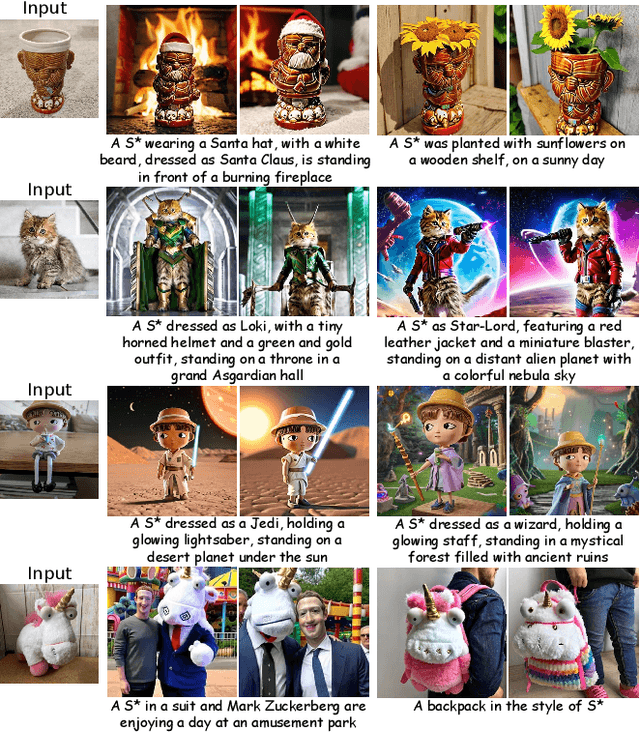


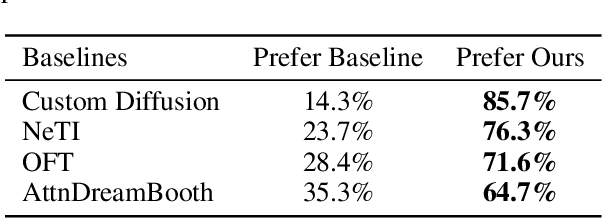
Recent advances in text-to-image personalization have enabled high-quality and controllable image synthesis for user-provided concepts. However, existing methods still struggle to balance identity preservation with text alignment. Our approach is based on the fact that generating prompt-aligned images requires a precise semantic understanding of the prompt, which involves accurately processing the interactions between the new concept and its surrounding context tokens within the CLIP text encoder. To address this, we aim to embed the new concept properly into the input embedding space of the text encoder, allowing for seamless integration with existing tokens. We introduce Context Regularization (CoRe), which enhances the learning of the new concept's text embedding by regularizing its context tokens in the prompt. This is based on the insight that appropriate output vectors of the text encoder for the context tokens can only be achieved if the new concept's text embedding is correctly learned. CoRe can be applied to arbitrary prompts without requiring the generation of corresponding images, thus improving the generalization of the learned text embedding. Additionally, CoRe can serve as a test-time optimization technique to further enhance the generations for specific prompts. Comprehensive experiments demonstrate that our method outperforms several baseline methods in both identity preservation and text alignment. Code will be made publicly available.
AttnDreamBooth: Towards Text-Aligned Personalized Text-to-Image Generation
Jun 07, 2024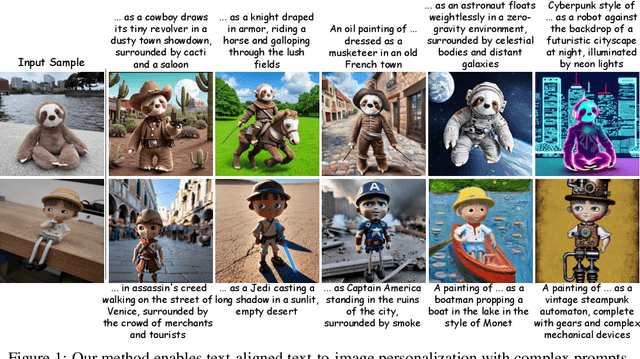
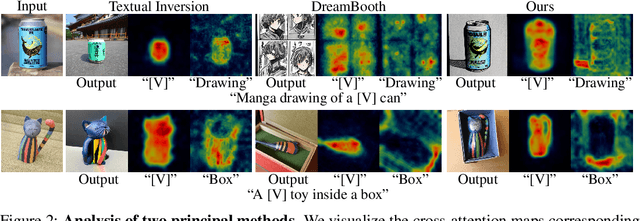
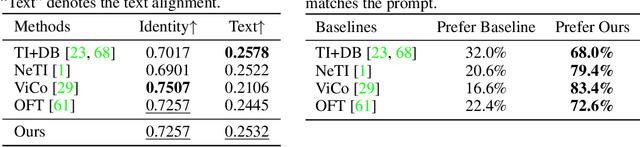
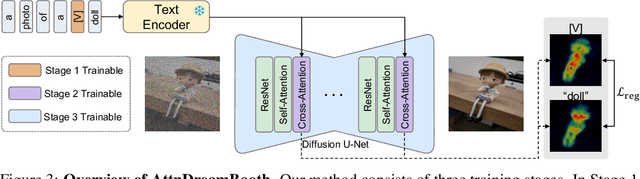
Recent advances in text-to-image models have enabled high-quality personalized image synthesis of user-provided concepts with flexible textual control. In this work, we analyze the limitations of two primary techniques in text-to-image personalization: Textual Inversion and DreamBooth. When integrating the learned concept into new prompts, Textual Inversion tends to overfit the concept, while DreamBooth often overlooks it. We attribute these issues to the incorrect learning of the embedding alignment for the concept. We introduce AttnDreamBooth, a novel approach that addresses these issues by separately learning the embedding alignment, the attention map, and the subject identity in different training stages. We also introduce a cross-attention map regularization term to enhance the learning of the attention map. Our method demonstrates significant improvements in identity preservation and text alignment compared to the baseline methods.