 Add to Chrome
 Add to Firefox
 Add to Edge
GEAR: Guided End-to-End AutoRegression for Image Synthesis
Jun 30, 2026
Visual generative models are typically trained in two stages. A tokenizer is first trained for reconstruction and then frozen, after which a generator is trained on its discrete indices or continuous latents. This decoupling leaves the tokenizer unaware of what the generator finds easy to model. We present GEAR (Guided End-to-end AutoRegression), which trains a vector-quantized (VQ) tokenizer and an autoregressive (AR) generator jointly and end-to-end, guided by representation alignment. The key obstacle is that the VQ index fed to the AR model is non-differentiable, so gradients cannot reach the tokenizer, and a straight-through estimator collapses. GEAR resolves this with a dual read-out of the codebook assignment. A hard, one-hot branch trains the AR with next-token prediction, while a differentiable soft branch carries a representation-alignment loss that flows back to guide only the tokenizer. The AR model thereby steers its tokenizer toward an index distribution it can predict more easily. This shifts the alignment burden from the tokenizer to the AR: the tokenizer's own features become less DINOv2-like while the AR's become more so, the opposite of diffusion-side recipes that make the latent itself semantic. GEAR speeds up ImageNet gFID convergence by up to 10x relative to the strong LlamaGen-REPA baseline, learns markedly better patch-level and spatially-coherent features, and generalizes across quantizers (VQVAE, LFQ, IBQ) and to text-to-image generation.

ChronoPhyBench: Do MLLMs Truly Understand the World or Merely Exploit Language Priors?
Jun 06, 2026Recent advancements in Multimodal Large Language Models (MLLMs) have demonstrated remarkable proficiency in open-world reasoning and understanding. However, a critical ambiguity persists: it remains unclear whether these models genuinely synthesize cross-modal information to construct physically grounded reasoning chains, or if they merely exploit strong language priors to mask single-modality reliance, thereby hallucinating advanced multimodal capabilities. Motivated by this, and to rigorously mitigate language modality bias and shortcuts, we propose a novel multimodal Chrono}logical Physical Dynamics Reasoning Benchmark ChronoPhyBench, which unifies next state prediction with Visual Question Answering (VQA) paradigms by conditioning on historical video context and textual captions to enforce models to deduce subsequent physical states through both single image selection and the inherently more complex task of multiple frame chronological sorting. Concurrently, we construct a large-scale multimodal reasoning dataset curated using the ChronoPhyBench criteria, comprising over 10,000 long-form videos paired with meticulously annotated captions, totaling 5M tokens. Our experimental evaluations reveal a stark contrast to conclusions drawn by previous benchmarks. The capacity of current open-source models to perform physically grounded multimodal reasoning remains in its infancy. Ultimately, this work seeks to systematically stress-test the reasoning capabilities of multimodal models, quantify hallucination rates, and advance the development of Physical AI, thereby providing the community with a robust and transparent evaluation framework toward Artificial General Intelligence (AGI).
OSP-Next: Efficient High-Quality Video Generation with Sparse Sequence Parallelism, HiF8 Quantization, and Reinforcement Learning
May 27, 2026Diffusion Transformers achieve strong video generation quality, but the quadratic cost of full attention limits efficiency. We introduce OSP-Next, an efficient text-to-video generation model that integrates sparse attention, parallelism, quantization, and reinforcement learning. OSP-Next uses a hybrid full-sparse attention architecture, where the sparse component is implemented with Skiparse-2D Attention. This fixed-pattern mechanism applies token-wise and group-wise sparse attention along spatial dimensions, leveraging locality while maintaining native compatibility with FlashAttention kernels. Based on the local equivalence of rearrangement in Skiparse-2D Attention, we further propose Sparse Sequence Parallelism (SSP), which partitions subsequences across ranks and switches sparse patterns through a single All-to-All communication. Compared with Ulysses Sequence Parallelism (SP), SSP provides a native parallel strategy for sparse attention and reduces communication volume by 75%. OSP-Next also incorporates HiF8 quantization to enable stable joint training with 8-bit quantization and sparse fine-tuning, and applies Mix-GRPO post-training to improve the performance of the sparse model. Experiments show that OSP-Next achieves a VBench total score of 83.73%, surpassing the Wan2.1 baseline. Under the 5-second 720P and 5-second 768P settings, OSP-Next achieves up to 1.64$\times$ single-GPU speedup and over 1.52$\times$ eight-GPU speedup on NVIDIA H200 GPUs. In addition, with only a 0.4% drop in VBench total score, OSP-Next-HiF8 achieves 1.69$\times$ and 2.27$\times$ speedups under the two settings on a single Ascend 950PR, demonstrating the efficiency and performance of OSP-Next across hardware platforms.
iFSQ: Improving FSQ for Image Generation with 1 Line of Code
Jan 27, 2026The field of image generation is currently bifurcated into autoregressive (AR) models operating on discrete tokens and diffusion models utilizing continuous latents. This divide, rooted in the distinction between VQ-VAEs and VAEs, hinders unified modeling and fair benchmarking. Finite Scalar Quantization (FSQ) offers a theoretical bridge, yet vanilla FSQ suffers from a critical flaw: its equal-interval quantization can cause activation collapse. This mismatch forces a trade-off between reconstruction fidelity and information efficiency. In this work, we resolve this dilemma by simply replacing the activation function in original FSQ with a distribution-matching mapping to enforce a uniform prior. Termed iFSQ, this simple strategy requires just one line of code yet mathematically guarantees both optimal bin utilization and reconstruction precision. Leveraging iFSQ as a controlled benchmark, we uncover two key insights: (1) The optimal equilibrium between discrete and continuous representations lies at approximately 4 bits per dimension. (2) Under identical reconstruction constraints, AR models exhibit rapid initial convergence, whereas diffusion models achieve a superior performance ceiling, suggesting that strict sequential ordering may limit the upper bounds of generation quality. Finally, we extend our analysis by adapting Representation Alignment (REPA) to AR models, yielding LlamaGen-REPA. Codes is available at https://github.com/Tencent-Hunyuan/iFSQ
SwapAnyone: Consistent and Realistic Video Synthesis for Swapping Any Person into Any Video
Mar 12, 2025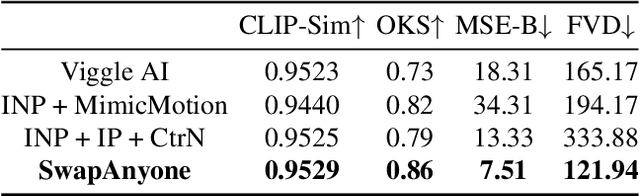
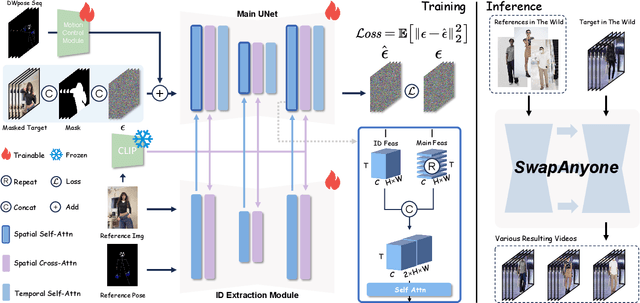
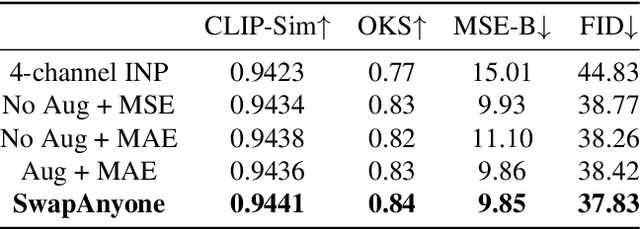
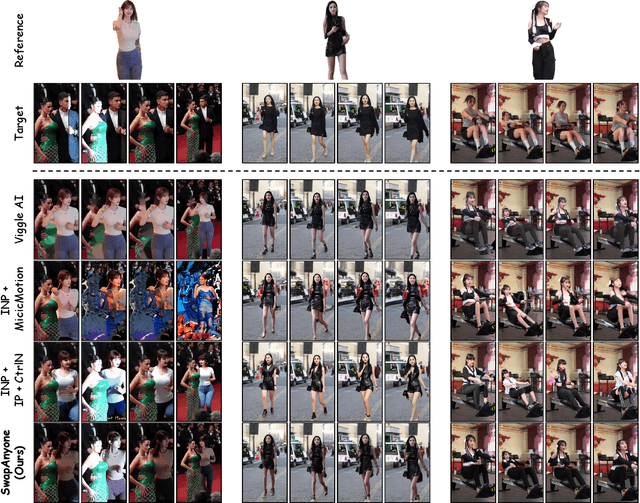
Video body-swapping aims to replace the body in an existing video with a new body from arbitrary sources, which has garnered more attention in recent years. Existing methods treat video body-swapping as a composite of multiple tasks instead of an independent task and typically rely on various models to achieve video body-swapping sequentially. However, these methods fail to achieve end-to-end optimization for the video body-swapping which causes issues such as variations in luminance among frames, disorganized occlusion relationships, and the noticeable separation between bodies and background. In this work, we define video body-swapping as an independent task and propose three critical consistencies: identity consistency, motion consistency, and environment consistency. We introduce an end-to-end model named SwapAnyone, treating video body-swapping as a video inpainting task with reference fidelity and motion control. To improve the ability to maintain environmental harmony, particularly luminance harmony in the resulting video, we introduce a novel EnvHarmony strategy for training our model progressively. Additionally, we provide a dataset named HumanAction-32K covering various videos about human actions. Extensive experiments demonstrate that our method achieves State-Of-The-Art (SOTA) performance among open-source methods while approaching or surpassing closed-source models across multiple dimensions. All code, model weights, and the HumanAction-32K dataset will be open-sourced at https://github.com/PKU-YuanGroup/SwapAnyone.
RoomPainter: View-Integrated Diffusion for Consistent Indoor Scene Texturing
Dec 21, 2024Indoor scene texture synthesis has garnered significant interest due to its important potential applications in virtual reality, digital media, and creative arts. Existing diffusion model-based researches either rely on per-view inpainting techniques, which are plagued by severe cross-view inconsistencies and conspicuous seams, or they resort to optimization-based approaches that entail substantial computational overhead. In this work, we present RoomPainter, a framework that seamlessly integrates efficiency and consistency to achieve high-fidelity texturing of indoor scenes. The core of RoomPainter features a zero-shot technique that effectively adapts a 2D diffusion model for 3D-consistent texture synthesis, along with a two-stage generation strategy that ensures both global and local consistency. Specifically, we introduce Attention-Guided Multi-View Integrated Sampling (MVIS) combined with a neighbor-integrated attention mechanism for zero-shot texture map generation. Using the MVIS, we firstly generate texture map for the entire room to ensure global consistency, then adopt its variant, namely an attention-guided multi-view integrated repaint sampling (MVRS) to repaint individual instances within the room, thereby further enhancing local consistency. Experiments demonstrate that RoomPainter achieves superior performance for indoor scene texture synthesis in visual quality, global consistency, and generation efficiency.
Open-Sora Plan: Open-Source Large Video Generation Model
Nov 28, 2024


We introduce Open-Sora Plan, an open-source project that aims to contribute a large generation model for generating desired high-resolution videos with long durations based on various user inputs. Our project comprises multiple components for the entire video generation process, including a Wavelet-Flow Variational Autoencoder, a Joint Image-Video Skiparse Denoiser, and various condition controllers. Moreover, many assistant strategies for efficient training and inference are designed, and a multi-dimensional data curation pipeline is proposed for obtaining desired high-quality data. Benefiting from efficient thoughts, our Open-Sora Plan achieves impressive video generation results in both qualitative and quantitative evaluations. We hope our careful design and practical experience can inspire the video generation research community. All our codes and model weights are publicly available at \url{https://github.com/PKU-YuanGroup/Open-Sora-Plan}.