 Add to Chrome
 Add to Firefox
 Add to Edge
Probing Scientific General Intelligence of LLMs with Scientist-Aligned Workflows
Dec 18, 2025
Despite advances in scientific AI, a coherent framework for Scientific General Intelligence (SGI)-the ability to autonomously conceive, investigate, and reason across scientific domains-remains lacking. We present an operational SGI definition grounded in the Practical Inquiry Model (PIM: Deliberation, Conception, Action, Perception) and operationalize it via four scientist-aligned tasks: deep research, idea generation, dry/wet experiments, and experimental reasoning. SGI-Bench comprises over 1,000 expert-curated, cross-disciplinary samples inspired by Science's 125 Big Questions, enabling systematic evaluation of state-of-the-art LLMs. Results reveal gaps: low exact match (10--20%) in deep research despite step-level alignment; ideas lacking feasibility and detail; high code executability but low execution result accuracy in dry experiments; low sequence fidelity in wet protocols; and persistent multimodal comparative-reasoning challenges. We further introduce Test-Time Reinforcement Learning (TTRL), which optimizes retrieval-augmented novelty rewards at inference, enhancing hypothesis novelty without reference answer. Together, our PIM-grounded definition, workflow-centric benchmark, and empirical insights establish a foundation for AI systems that genuinely participate in scientific discovery.

ParaFormer: A Generalized PageRank Graph Transformer for Graph Representation Learning
Dec 16, 2025Graph Transformers (GTs) have emerged as a promising graph learning tool, leveraging their all-pair connected property to effectively capture global information. To address the over-smoothing problem in deep GNNs, global attention was initially introduced, eliminating the necessity for using deep GNNs. However, through empirical and theoretical analysis, we verify that the introduced global attention exhibits severe over-smoothing, causing node representations to become indistinguishable due to its inherent low-pass filtering. This effect is even stronger than that observed in GNNs. To mitigate this, we propose PageRank Transformer (ParaFormer), which features a PageRank-enhanced attention module designed to mimic the behavior of deep Transformers. We theoretically and empirically demonstrate that ParaFormer mitigates over-smoothing by functioning as an adaptive-pass filter. Experiments show that ParaFormer achieves consistent performance improvements across both node classification and graph classification tasks on 11 datasets ranging from thousands to millions of nodes, validating its efficacy. The supplementary material, including code and appendix, can be found in https://github.com/chaohaoyuan/ParaFormer.
AutoMV: An Automatic Multi-Agent System for Music Video Generation
Dec 13, 2025Music-to-Video (M2V) generation for full-length songs faces significant challenges. Existing methods produce short, disjointed clips, failing to align visuals with musical structure, beats, or lyrics, and lack temporal consistency. We propose AutoMV, a multi-agent system that generates full music videos (MVs) directly from a song. AutoMV first applies music processing tools to extract musical attributes, such as structure, vocal tracks, and time-aligned lyrics, and constructs these features as contextual inputs for following agents. The screenwriter Agent and director Agent then use this information to design short script, define character profiles in a shared external bank, and specify camera instructions. Subsequently, these agents call the image generator for keyframes and different video generators for "story" or "singer" scenes. A Verifier Agent evaluates their output, enabling multi-agent collaboration to produce a coherent longform MV. To evaluate M2V generation, we further propose a benchmark with four high-level categories (Music Content, Technical, Post-production, Art) and twelve ine-grained criteria. This benchmark was applied to compare commercial products, AutoMV, and human-directed MVs with expert human raters: AutoMV outperforms current baselines significantly across all four categories, narrowing the gap to professional MVs. Finally, we investigate using large multimodal models as automatic MV judges; while promising, they still lag behind human expert, highlighting room for future work.
Stable spectral neural operator for learning stiff PDE systems from limited data
Dec 12, 2025Accurate modeling of spatiotemporal dynamics is crucial to understanding complex phenomena across science and engineering. However, this task faces a fundamental challenge when the governing equations are unknown and observational data are sparse. System stiffness, the coupling of multiple time-scales, further exacerbates this problem and hinders long-term prediction. Existing methods fall short: purely data-driven methods demand massive datasets, whereas physics-aware approaches are constrained by their reliance on known equations and fine-grained time steps. To overcome these limitations, we introduce an equation-free learning framework, namely, the Stable Spectral Neural Operator (SSNO), for modeling stiff partial differential equation (PDE) systems based on limited data. Instead of encoding specific equation terms, SSNO embeds spectrally inspired structures in its architecture, yielding strong inductive biases for learning the underlying physics. It automatically learns local and global spatial interactions in the frequency domain, while handling system stiffness with a robust integrating factor time-stepping scheme. Demonstrated across multiple 2D and 3D benchmarks in Cartesian and spherical geometries, SSNO achieves prediction errors one to two orders of magnitude lower than leading models. Crucially, it shows remarkable data efficiency, requiring only very few (2--5) training trajectories for robust generalization to out-of-distribution conditions. This work offers a robust and generalizable approach to learning stiff spatiotemporal dynamics from limited data without explicit \textit{a priori} knowledge of PDE terms.
CogMCTS: A Novel Cognitive-Guided Monte Carlo Tree Search Framework for Iterative Heuristic Evolution with Large Language Models
Dec 11, 2025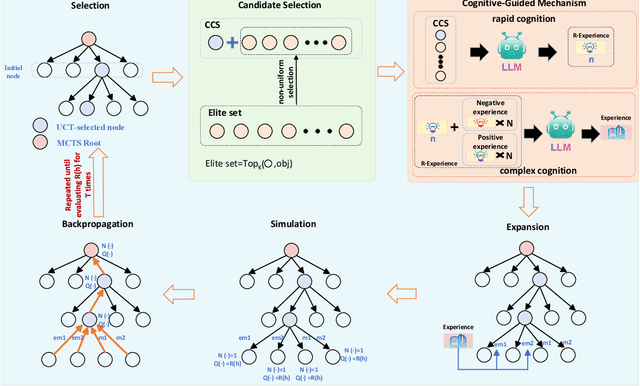
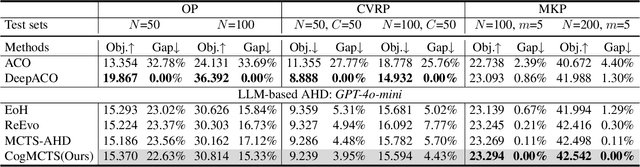
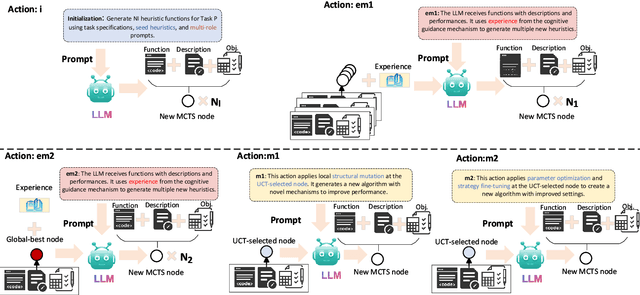
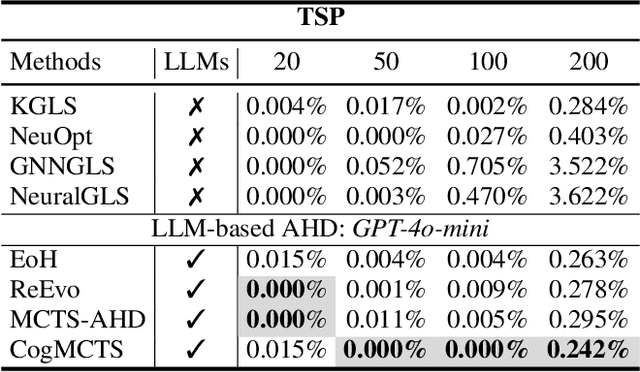
Automatic Heuristic Design (AHD) is an effective framework for solving complex optimization problems. The development of large language models (LLMs) enables the automated generation of heuristics. Existing LLM-based evolutionary methods rely on population strategies and are prone to local optima. Integrating LLMs with Monte Carlo Tree Search (MCTS) improves the trade-off between exploration and exploitation, but multi-round cognitive integration remains limited and search diversity is constrained. To overcome these limitations, this paper proposes a novel cognitive-guided MCTS framework (CogMCTS). CogMCTS tightly integrates the cognitive guidance mechanism of LLMs with MCTS to achieve efficient automated heuristic optimization. The framework employs multi-round cognitive feedback to incorporate historical experience, node information, and negative outcomes, dynamically improving heuristic generation. Dual-track node expansion combined with elite heuristic management balances the exploration of diverse heuristics and the exploitation of high-quality experience. In addition, strategic mutation modifies the heuristic forms and parameters to further enhance the diversity of the solution and the overall optimization performance. The experimental results indicate that CogMCTS outperforms existing LLM-based AHD methods in stability, efficiency, and solution quality.
HiF-VLA: Hindsight, Insight and Foresight through Motion Representation for Vision-Language-Action Models
Dec 10, 2025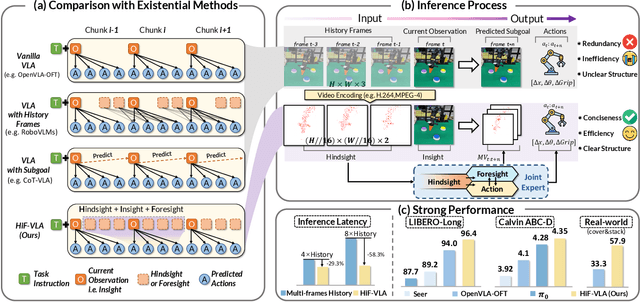
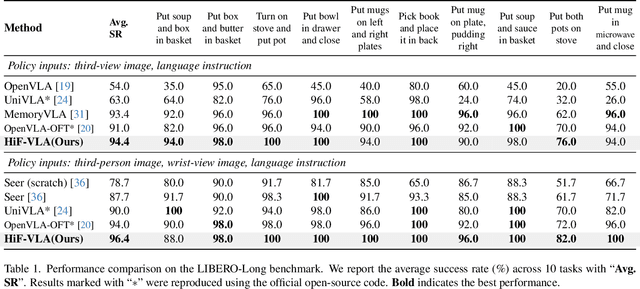
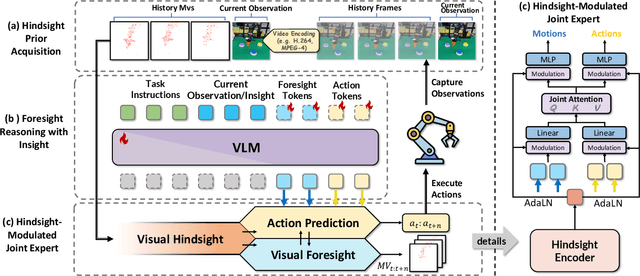
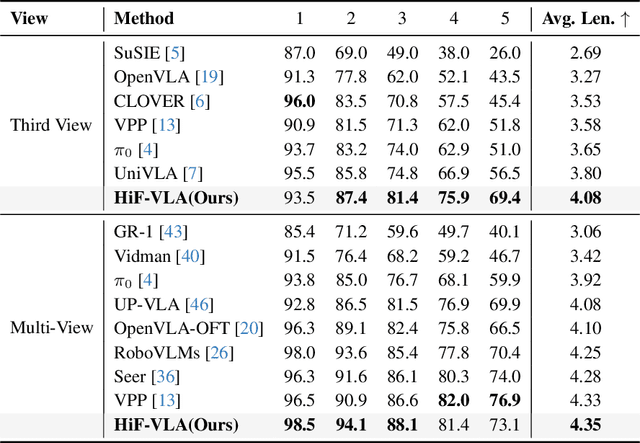
Vision-Language-Action (VLA) models have recently enabled robotic manipulation by grounding visual and linguistic cues into actions. However, most VLAs assume the Markov property, relying only on the current observation and thus suffering from temporal myopia that degrades long-horizon coherence. In this work, we view motion as a more compact and informative representation of temporal context and world dynamics, capturing inter-state changes while filtering static pixel-level noise. Building on this idea, we propose HiF-VLA (Hindsight, Insight, and Foresight for VLAs), a unified framework that leverages motion for bidirectional temporal reasoning. HiF-VLA encodes past dynamics through hindsight priors, anticipates future motion via foresight reasoning, and integrates both through a hindsight-modulated joint expert to enable a ''think-while-acting'' paradigm for long-horizon manipulation. As a result, HiF-VLA surpasses strong baselines on LIBERO-Long and CALVIN ABC-D benchmarks, while incurring negligible additional inference latency. Furthermore, HiF-VLA achieves substantial improvements in real-world long-horizon manipulation tasks, demonstrating its broad effectiveness in practical robotic settings.
Reflecting with Two Voices: A Co-Adaptive Dual-Strategy Framework for LLM-Based Agent Decision Making
Dec 09, 2025Large language model (LLM) agents often rely on external demonstrations or retrieval-augmented planning, leading to brittleness, poor generalization, and high computational overhead. Inspired by human problem-solving, we propose DuSAR (Dual-Strategy Agent with Reflecting) - a demonstration-free framework that enables a single frozen LLM to perform co-adaptive reasoning via two complementary strategies: a high-level holistic plan and a context-grounded local policy. These strategies interact through a lightweight reflection mechanism, where the agent continuously assesses progress via a Strategy Fitness Score and dynamically revises its global plan when stuck or refines it upon meaningful advancement, mimicking human metacognitive behavior. On ALFWorld and Mind2Web, DuSAR achieves state-of-the-art performance with open-source LLMs (7B-70B), reaching 37.1% success on ALFWorld (Llama3.1-70B) - more than doubling the best prior result (13.0%) - and 4.02% on Mind2Web, also more than doubling the strongest baseline. Remarkably, it reduces per-step token consumption by 3-9X while maintaining strong performance. Ablation studies confirm the necessity of dual-strategy coordination. Moreover, optional integration of expert demonstrations further boosts results, highlighting DuSAR's flexibility and compatibility with external knowledge.
Equivariant Diffusion for Crystal Structure Prediction
Dec 08, 2025In addressing the challenge of Crystal Structure Prediction (CSP), symmetry-aware deep learning models, particularly diffusion models, have been extensively studied, which treat CSP as a conditional generation task. However, ensuring permutation, rotation, and periodic translation equivariance during diffusion process remains incompletely addressed. In this work, we propose EquiCSP, a novel equivariant diffusion-based generative model. We not only address the overlooked issue of lattice permutation equivariance in existing models, but also develop a unique noising algorithm that rigorously maintains periodic translation equivariance throughout both training and inference processes. Our experiments indicate that EquiCSP significantly surpasses existing models in terms of generating accurate structures and demonstrates faster convergence during the training process.
SilverTorch: A Unified Model-based System to Democratize Large-Scale Recommendation on GPUs
Nov 18, 2025Serving deep learning based recommendation models (DLRM) at scale is challenging. Existing systems rely on CPU-based ANN indexing and filtering services, suffering from non-negligible costs and forgoing joint optimization opportunities. Such inefficiency makes them difficult to support more complex model architectures, such as learned similarities and multi-task retrieval. In this paper, we propose SilverTorch, a model-based system for serving recommendation models on GPUs. SilverTorch unifies model serving by replacing standalone indexing and filtering services with layers of served models. We propose a Bloom index algorithm on GPUs for feature filtering and a tensor-native fused Int8 ANN kernel on GPUs for nearest neighbor search. We further co-design the ANN search index and filtering index to reduce GPU memory utilization and eliminate unnecessary computation. Benefit from SilverTorch's serving paradigm, we introduce a OverArch scoring layer and a Value Model to aggregate results across multi-tasks. These advancements improve the accuracy for retrieval and enable future studies for serving more complex models. For ranking, SilverTorch's design accelerates item embedding calculation by caching the pre-calculated embeddings inside the serving model. Our evaluation on the industry-scale datasets show that SilverTorch achieves up to 5.6x lower latency and 23.7x higher throughput compared to the state-of-the-art approaches. We also demonstrate that SilverTorch's solution is 13.35x more cost-efficient than CPU-based solution while improving accuracy via serving more complex models. SilverTorch serves over hundreds of models online across major products and recommends contents for billions of daily active users.
Don't Miss the Forest for the Trees: In-Depth Confidence Estimation for LLMs via Reasoning over the Answer Space
Nov 18, 2025Knowing the reliability of a model's response is essential in application. With the strong generation capabilities of LLMs, research has focused on generating verbalized confidence. This is further enhanced by combining chain-of-thought reasoning, which provides logical and transparent estimation. However, how reasoning strategies affect the estimated confidence is still under-explored. In this work, we demonstrate that predicting a verbalized probability distribution can effectively encourage in-depth reasoning for confidence estimation. Intuitively, it requires an LLM to consider all candidates within the answer space instead of basing on a single guess, and to carefully assign confidence scores to meet the requirements of a distribution. This method shows an advantage across different models and various tasks, regardless of whether the answer space is known. Its advantage is maintained even after reinforcement learning, and further analysis shows its reasoning patterns are aligned with human expectations.