 Add to Chrome
 Add to Firefox
 Add to Edge
BiWM: Advancing Open-Source Interactive Video World Models with Bidirectional Autoregression
Jun 08, 2026
Transitioning bidirectional video diffusion models into an autoregressive paradigm improves the interactivity of video world models, but existing causal pipelines need many stages (control fine-tuning, autoregressive training, causal initialization, few-step distillation) and still trail bidirectional models in quality due to error accumulation. Recent world models such as Yume-1.5 and Matrix-Game-3.0 instead adopt a bidirectional autoregressive approach, gaining fidelity and stable long-horizon rollout from self-correcting error propagation, yet open-source frameworks (e.g., minWM) support only causal models. We present BiWM, the first full-stack framework for interactive video world models under the bidirectional autoregressive paradigm, jointly optimizing generation quality and inference speed. From a pretrained video backbone, BiWM injects camera control by fine-tuning, then runs a few-step Distribution Matching Distillation (DMD) stage that turns the backbone into an action/camera-controllable world model: just two training stages instead of four in minWM, converging in a few hundred steps on 8xH200 GPUs. A single recipe spans Wan2.1-1.3B, Wan2.2-5B, HunyuanVideo-1.5-8B, and LTX-2.3-22B, and also supports secondary fine-tuning of existing bidirectional models. BiWM enables real-world camera control where minWM loses controllability, integrates pluggable history compression (FramePack-style and PackForcing-style) for long rollouts, and offers an optional NVFP4 4-bit training/inference pipeline. To counter DMD's mode-seeking degradation, we add GAN and mass-covering forward-KL objectives that preserve scene dynamics. We open-source BiWM for resource-constrained research and high-fidelity environment simulation.

Equivariant Diffusion for Crystal Structure Prediction
Dec 08, 2025In addressing the challenge of Crystal Structure Prediction (CSP), symmetry-aware deep learning models, particularly diffusion models, have been extensively studied, which treat CSP as a conditional generation task. However, ensuring permutation, rotation, and periodic translation equivariance during diffusion process remains incompletely addressed. In this work, we propose EquiCSP, a novel equivariant diffusion-based generative model. We not only address the overlooked issue of lattice permutation equivariance in existing models, but also develop a unique noising algorithm that rigorously maintains periodic translation equivariance throughout both training and inference processes. Our experiments indicate that EquiCSP significantly surpasses existing models in terms of generating accurate structures and demonstrates faster convergence during the training process.
Equivariant Spherical Transformer for Efficient Molecular Modeling
May 29, 2025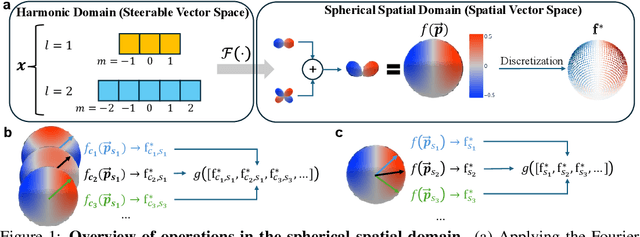
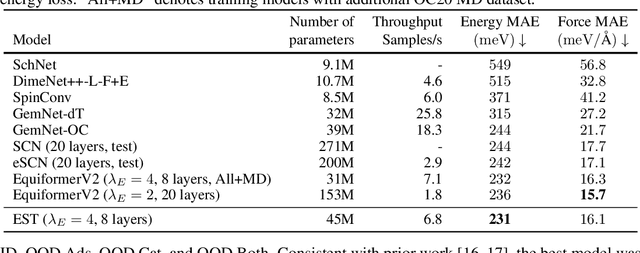
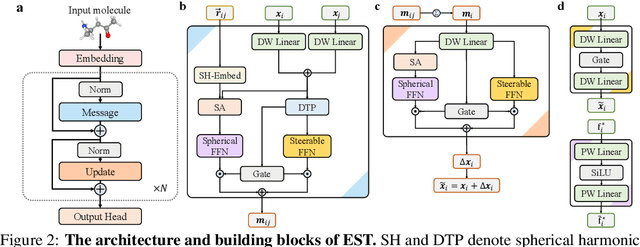
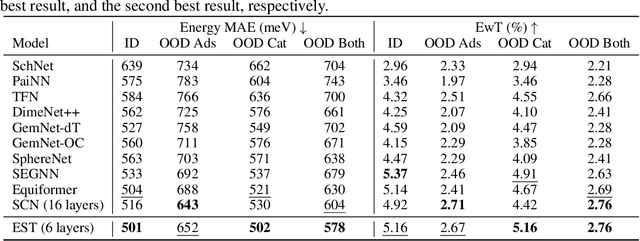
SE(3)-equivariant Graph Neural Networks (GNNs) have significantly advanced molecular system modeling by employing group representations. However, their message passing processes, which rely on tensor product-based convolutions, are limited by insufficient non-linearity and incomplete group representations, thereby restricting expressiveness. To overcome these limitations, we introduce the Equivariant Spherical Transformer (EST), a novel framework that leverages a Transformer structure within the spatial domain of group representations after Fourier transform. We theoretically and empirically demonstrate that EST can encompass the function space of tensor products while achieving superior expressiveness. Furthermore, EST's equivariant inductive bias is guaranteed through a uniform sampling strategy for the Fourier transform. Our experiments demonstrate state-of-the-art performance by EST on various molecular benchmarks, including OC20 and QM9.