 Add to Chrome
 Add to Firefox
 Add to Edge
U-Face: An Efficient and Generalizable Framework for Unsupervised Facial Attribute Editing via Subspace Learning
Mar 14, 2026
Latent space-based facial attribute editing methods have gained popularity in applications such as digital entertainment, virtual avatar creation, and human-computer interaction systems due to their potential for efficient and flexible attribute manipulation, particularly for continuous edits. Among these, unsupervised latent space-based methods, which discover effective semantic vectors without relying on labeled data, have attracted considerable attention in the research community. However, existing methods still encounter difficulties in disentanglement, as manipulating a specific facial attribute may unintentionally affect other attributes, complicating fine-grained controllability. To address these challenges, we propose a novel framework designed to offer an effective and adaptable solution for unsupervised facial attribute editing, called Unsupervised Facial Attribute Controllable Editing (U-Face). The proposed method frames semantic vector learning as a subspace learning problem, where latent vectors are approximated within a lower-dimensional semantic subspace spanned by a semantic vector matrix. This formulation can also be equivalently interpreted from a projection-reconstruction perspective and further generalized into an autoencoder framework, providing a foundation that can support disentangled representation learning in a flexible manner. To improve disentanglement and controllability, we impose orthogonal non-negative constraints on the semantic vectors and incorporate attribute boundary vectors to reduce entanglement in the learned directions. Although these constraints make the optimization problem challenging, we design an alternating iterative algorithm, called Alternating Iterative Disentanglement and Controllability (AIDC), with closed-form updates and provable convergence under specific conditions.

AutoRegressive Generation with B-rep Holistic Token Sequence Representation
Jan 23, 2026Previous representation and generation approaches for the B-rep relied on graph-based representations that disentangle geometric and topological features through decoupled computational pipelines, thereby precluding the application of sequence-based generative frameworks, such as transformer architectures that have demonstrated remarkable performance. In this paper, we propose BrepARG, the first attempt to encode B-rep's geometry and topology into a holistic token sequence representation, enabling sequence-based B-rep generation with an autoregressive architecture. Specifically, BrepARG encodes B-rep into 3 types of tokens: geometry and position tokens representing geometric features, and face index tokens representing topology. Then the holistic token sequence is constructed hierarchically, starting with constructing the geometry blocks (i.e., faces and edges) using the above tokens, followed by geometry block sequencing. Finally, we assemble the holistic sequence representation for the entire B-rep. We also construct a transformer-based autoregressive model that learns the distribution over holistic token sequences via next-token prediction, using a multi-layer decoder-only architecture with causal masking. Experiments demonstrate that BrepARG achieves state-of-the-art (SOTA) performance. BrepARG validates the feasibility of representing B-rep as holistic token sequences, opening new directions for B-rep generation.
Reflecting with Two Voices: A Co-Adaptive Dual-Strategy Framework for LLM-Based Agent Decision Making
Dec 09, 2025Large language model (LLM) agents often rely on external demonstrations or retrieval-augmented planning, leading to brittleness, poor generalization, and high computational overhead. Inspired by human problem-solving, we propose DuSAR (Dual-Strategy Agent with Reflecting) - a demonstration-free framework that enables a single frozen LLM to perform co-adaptive reasoning via two complementary strategies: a high-level holistic plan and a context-grounded local policy. These strategies interact through a lightweight reflection mechanism, where the agent continuously assesses progress via a Strategy Fitness Score and dynamically revises its global plan when stuck or refines it upon meaningful advancement, mimicking human metacognitive behavior. On ALFWorld and Mind2Web, DuSAR achieves state-of-the-art performance with open-source LLMs (7B-70B), reaching 37.1% success on ALFWorld (Llama3.1-70B) - more than doubling the best prior result (13.0%) - and 4.02% on Mind2Web, also more than doubling the strongest baseline. Remarkably, it reduces per-step token consumption by 3-9X while maintaining strong performance. Ablation studies confirm the necessity of dual-strategy coordination. Moreover, optional integration of expert demonstrations further boosts results, highlighting DuSAR's flexibility and compatibility with external knowledge.
BRepFormer: Transformer-Based B-rep Geometric Feature Recognition
Apr 10, 2025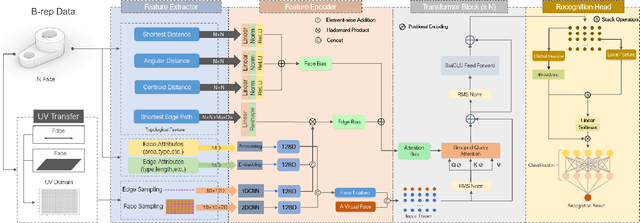
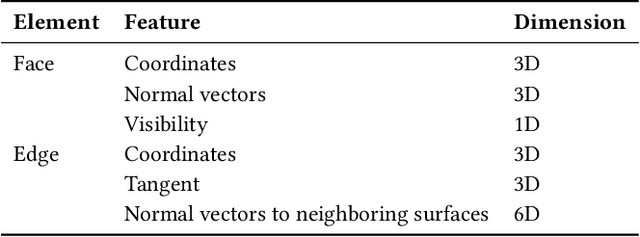
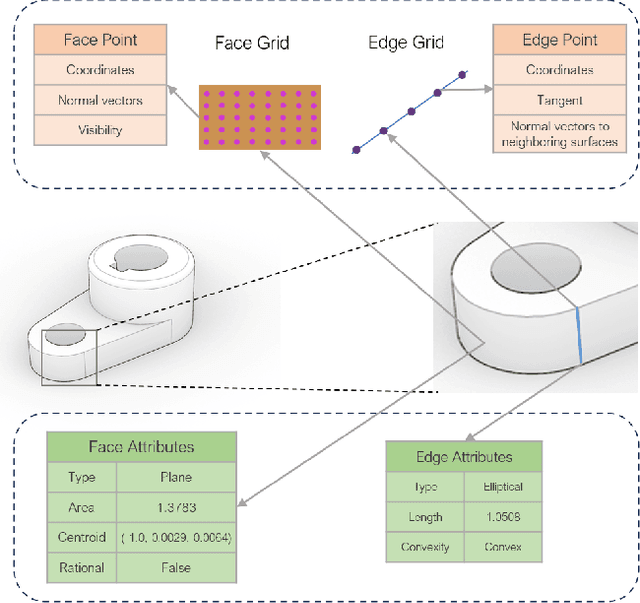
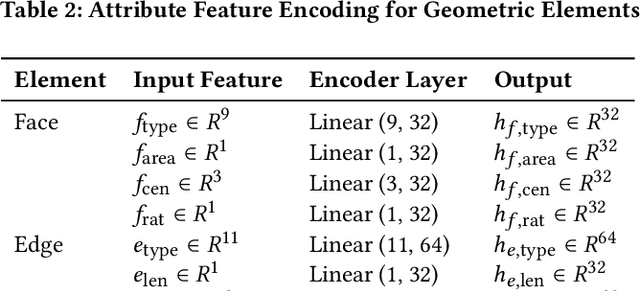
Recognizing geometric features on B-rep models is a cornerstone technique for multimedia content-based retrieval and has been widely applied in intelligent manufacturing. However, previous research often merely focused on Machining Feature Recognition (MFR), falling short in effectively capturing the intricate topological and geometric characteristics of complex geometry features. In this paper, we propose BRepFormer, a novel transformer-based model to recognize both machining feature and complex CAD models' features. BRepFormer encodes and fuses the geometric and topological features of the models. Afterwards, BRepFormer utilizes a transformer architecture for feature propagation and a recognition head to identify geometry features. During each iteration of the transformer, we incorporate a bias that combines edge features and topology features to reinforce geometric constraints on each face. In addition, we also proposed a dataset named Complex B-rep Feature Dataset (CBF), comprising 20,000 B-rep models. By covering more complex B-rep models, it is better aligned with industrial applications. The experimental results demonstrate that BRepFormer achieves state-of-the-art accuracy on the MFInstSeg, MFTRCAD, and our CBF datasets.
Image Reconstruction with B0 Inhomogeneity using an Interpretable Deep Unrolled Network on an Open-bore MRI-Linac
Apr 15, 2024


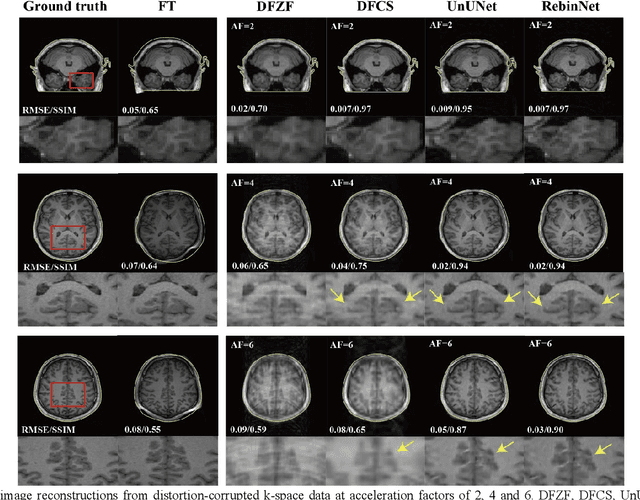
MRI-Linac systems require fast image reconstruction with high geometric fidelity to localize and track tumours for radiotherapy treatments. However, B0 field inhomogeneity distortions and slow MR acquisition potentially limit the quality of the image guidance and tumour treatments. In this study, we develop an interpretable unrolled network, referred to as RebinNet, to reconstruct distortion-free images from B0 inhomogeneity-corrupted k-space for fast MRI-guided radiotherapy applications. RebinNet includes convolutional neural network (CNN) blocks to perform image regularizations and nonuniform fast Fourier Transform (NUFFT) modules to incorporate B0 inhomogeneity information. The RebinNet was trained on a publicly available MR dataset from eleven healthy volunteers for both fully sampled and subsampled acquisitions. Grid phantom and human brain images acquired from an open-bore 1T MRI-Linac scanner were used to evaluate the performance of the proposed network. The RebinNet was compared with the conventional regularization algorithm and our recently developed UnUNet method in terms of root mean squared error (RMSE), structural similarity (SSIM), residual distortions, and computation time. Imaging results demonstrated that the RebinNet reconstructed images with lowest RMSE (<0.05) and highest SSIM (>0.92) at four-time acceleration for simulated brain images. The RebinNet could better preserve structural details and substantially improve the computational efficiency (ten-fold faster) compared to the conventional regularization methods, and had better generalization ability than the UnUNet method. The proposed RebinNet can achieve rapid image reconstruction and overcome the B0 inhomogeneity distortions simultaneously, which would facilitate accurate and fast image guidance in radiotherapy treatments.