 Add to Chrome
 Add to Firefox
 Add to Edge
AudioScape-TTA: A Structured Soundscape Benchmark for Fine-Grained Text-to-Audio Evaluation
Aug 05, 2026
Text-to-audio (TTA) generation has recently achieved remarkable progress in synthesizing realistic audio from natural language descriptions. However, determining whether generated audio faithfully satisfies complex textual instructions remains challenging. Existing benchmarks mainly rely on global similarity metrics, providing limited insight into fine-grained semantic failures. To address this limitation, we introduce \textbf{AudioScape-TTA}, a structured and complexity-aware benchmark for fine-grained TTA evaluation. AudioScape-TTA represents realistic soundscapes through modality-aware semantic structures and characterizes generation complexity using event density and structural complexity. Based on these annotations, we propose a rubric-based audio-grounded evaluation framework that verifies event realization, acoustic attributes, and speech content through fine-grained semantic criteria. The benchmark contains 2,258 audio-text pairs with 25,707 binary QA rubrics, enabling scalable and interpretable analysis of TTA systems. Experiments on 13 representative open-source TTA models reveal persistent limitations in fine-grained attribute control, speech-content preservation, and compositional soundscape generation. Human validation further demonstrates that our rubric-based evaluation achieves stronger alignment with human semantic judgments than conventional global similarity metrics.

Audio Editing in the Era of Foundation Models: A Survey
Jun 22, 2026Audio editing aims to modify a given synthetic or real-world audio signal to satisfy specific user needs. As a promising yet challenging direction in AIGC, it has attracted increasing attention. Recent advances in audio generation have made powerful generative models central to modern audio editing systems. This rapid progress has created a growing need to organize emerging tasks, methods, and resources into a coherent view. In this survey, we provide a comprehensive review of audio editing in the era of foundation models. We first present a unified taxonomy of existing editing tasks and then summarize the major foundation-model paradigms that support modern audio editing, covering representative approaches from both training-based and training-free perspectives. We further discuss related resources, including datasets, evaluation protocols, and data construction tools. Finally, we identify open challenges in this field and outline promising directions for future research. The project page is released at https://github.com/DaViD-Pigeon/AudioEditSurvey.
A Survey of Full-Duplex Spoken Dialogue Systems: Architectural Hierarchy, Interaction Ontology, and Decision State Machine
Jun 17, 2026More than a dozen spoken dialogue systems have recently claimed to be "full-duplex," yet the term has been used to describe substantially different capabilities. Existing surveys collapse them onto a single axis (cascaded/end-to-end, or engineered/learned) and miss the distinctions that matter most for builders. We argue that much of this ambiguity is taxonomical: current terminology does not specify where duplex decisions are made, which interaction types are supported, or how a system behaves moment by moment. This paper introduces three complementary frameworks: (i) an L0-L3 Architectural Hierarchy that locates where duplex decisions are made; (ii) a $T\times I\times R$ Interaction Ontology that specifies the temporal relation, user intent, and required system response for each interaction; and (iii) a Decision State Machine (IDLE/LISTEN/SPEAK/WAIT/DUAL) that describes how systems move between states. Across published systems and benchmarks, our audit documents a realization gap: although many architectures can in principle operate in full-duplex states, their observed behavior remains constrained by the interaction patterns represented in training and evaluation. We point to the limited public training-data coverage relative to the (largely undisclosed) industrial corpora, together with the still-unrealized goal of L3 representation-level modeling, as the key frontiers for future research on full-duplex dialogue. The related material is available at https://github.com/DuplexLM/DuplexSurvey.
DocRetriever: A Plug-and-Play Framework for Multimodal Document Retrieval with Comprehensive Benchmark
May 28, 2026Multimodal documents contain diverse elements, such as tables, figures, and layouts, which can complicate retrieval tasks. While current approaches typically combine dense visual embedding models with supervised rerankers to achieve high-precision retrieval, they face inherent limitations. First, the coarse-grained nature of dense embeddings tends to obfuscate explicit semantics, failing to leverage structurally salient information. Second, supervised reranking models suffer from generalization bottlenecks, as their performance heavily relies on domain-specific training data. Furthermore, existing benchmarks often lack diverse assessment dimensions and comprehensive relevance annotations, limiting reliable evaluation. To address these challenges, we propose DocRetriever, a plug-and-play framework. It enhances visual retrieval via a layout-aware sparse embedding technique, enabling effective hybrid encoding without the overhead of optical character recognition (OCR). We also introduce a generalizable reranker that leverages reasoning-augmented demonstrations and optimized sampling to improve accuracy in few-shot settings. Finally, we construct a new benchmark, MultiDocR, to enable more rigorous evaluation. Experiments across diverse benchmarks validate DocRetriever's superiority over state-of-the-art methods.
TMD-Bench: A Multi-Level Evaluation Paradigm for Music-Dance Co-Generation
May 03, 2026Unified audio-visual generation is rapidly gaining industrial and creative relevance, enabling applications in virtual production and interactive media. However, when moving from general audio-video synthesis to music-dance co-generation, the task becomes substantially harder: musical rhythm, phrasing, and accents must drive choreographic motion at fine temporal resolution, and such rhythmic coupling is not captured by unimodal metrics or generic audiovisual consistency scores used in current evaluation practice. We introduce TMD-Bench, a benchmark for text-driven music-dance co-generation that assesses systems across unimodal generation quality, instruction adherence, and cross-modal rhythmic alignment. The benchmark integrates computable physical metrics with perceptual multimodal judgments, and is supported by a curated rhythm-aligned music-dance dataset and a fine-grained Music Captioner for structured music semantics. TMD-Bench further reveals that (i) modern commercial audio-visual models, such as Veo 3 and Sora 2, produce high-quality music and video, while rhythmic coupling remains less consistently optimized and leaves room for improvement, and (ii) our unified baseline RhyJAM trained on rhythm-aligned data achieves competitive beat-level synchronization while maintaining competitive unimodal fidelity. This presents prospects for building next-generation music-dance models that explicitly optimize rhythmic and kinetic coherence.
A Progressive Training Strategy for Vision-Language Models to Counteract Spatio-Temporal Hallucinations in Embodied Reasoning
Apr 12, 2026Vision-Language Models (VLMs) have made significant strides in static image understanding but continue to face critical hurdles in spatiotemporal reasoning. A major bottleneck is "multi-image reasoning hallucination", where a massive performance drop between forward and reverse temporal queries reveals a dependence on superficial shortcuts instead of genuine causal understanding. To mitigate this, we first develop a new Chain-of-Thought (CoT) dataset that decomposes intricate reasoning into detailed spatiotemporal steps and definitive judgments. Building on this, we present a progressive training framework: it initiates with supervised pre-training on our CoT dataset to instill logical structures, followed by fine-tuning with scalable weakly-labeled data for broader generalization. Our experiments demonstrate that this approach not only improves backbone accuracy but also slashes the forward-backward performance gap from over 70\% to only 6.53\%. This confirms the method's ability to develop authentic dynamic reasoning and reduce the inherent temporal biases of current VLMs.
From Perception to Planning: Evolving Ego-Centric Task-Oriented Spatiotemporal Reasoning via Curriculum Learning
Apr 12, 2026Modern vision-language models achieve strong performance in static perception, but remain limited in the complex spatiotemporal reasoning required for embodied, egocentric tasks. A major source of failure is their reliance on temporal priors learned from passive video data, which often leads to spatiotemporal hallucinations and poor generalization in dynamic environments. To address this, we present EgoTSR, a curriculum-based framework for learning task-oriented spatiotemporal reasoning. EgoTSR is built on the premise that embodied reasoning should evolve from explicit spatial understanding to internalized task-state assessment and finally to long-horizon planning. To support this paradigm, we construct EgoTSR-Data, a large-scale dataset comprising 46 million samples organized into three stages: Chain-of-Thought (CoT) supervision, weakly supervised tagging, and long-horizon sequences. Extensive experiments demonstrate that EgoTSR effectively eliminates chronological biases, achieving 92.4% accuracy on long-horizon logical reasoning tasks while maintaining high fine-grained perceptual precision, significantly outperforming existing open-source and closed-source state-of-the-art models.
ImVideoEdit: Image-learning Video Editing via 2D Spatial Difference Attention Blocks
Apr 09, 2026Current video editing models often rely on expensive paired video data, which limits their practical scalability. In essence, most video editing tasks can be formulated as a decoupled spatiotemporal process, where the temporal dynamics of the pretrained model are preserved while spatial content is selectively and precisely modified. Based on this insight, we propose ImVideoEdit, an efficient framework that learns video editing capabilities entirely from image pairs. By freezing the pre-trained 3D attention modules and treating images as single-frame videos, we decouple the 2D spatial learning process to help preserve the original temporal dynamics. The core of our approach is a Predict-Update Spatial Difference Attention module that progressively extracts and injects spatial differences. Rather than relying on rigid external masks, we incorporate a Text-Guided Dynamic Semantic Gating mechanism for adaptive and implicit text-driven modifications. Despite training on only 13K image pairs for 5 epochs with exceptionally low computational overhead, ImVideoEdit achieves editing fidelity and temporal consistency comparable to larger models trained on extensive video datasets.
SpatialReward: Verifiable Spatial Reward Modeling for Fine-Grained Spatial Consistency in Text-to-Image Generation
Mar 23, 2026Recent advances in text-to-image (T2I) generation via reinforcement learning (RL) have benefited from reward models that assess semantic alignment and visual quality. However, most existing reward models pay limited attention to fine-grained spatial relationships, often producing images that appear plausible overall yet contain inaccuracies in object positioning. In this work, we present \textbf{SpatialReward}, a verifiable reward model explicitly designed to evaluate spatial layouts in generated images. SpatialReward adopts a multi-stage pipeline: a \emph{Prompt Decomposer} extracts entities, attributes, and spatial metadata from free-form prompts; expert detectors provide accurate visual grounding of object positions and attributes; and a vision-language model applies chain-of-thought reasoning over grounded observations to assess complex spatial relations that are challenging for rule-based methods. To more comprehensively evaluate spatial relationships in generated images, we introduce \textbf{SpatRelBench}, a benchmark covering object attributes, orientation, inter-object relations, and rendered text placement. Experiments on Stable Diffusion and FLUX show that incorporating SpatialReward into RL training consistently improves spatial consistency and overall generation quality, with results aligned more closely to human judgments. These findings indicate that verifiable reward models hold considerable potential for enabling more accurate and controllable optimization in text-to-image generation models.
CronusVLA: Transferring Latent Motion Across Time for Multi-Frame Prediction in Manipulation
Jun 24, 2025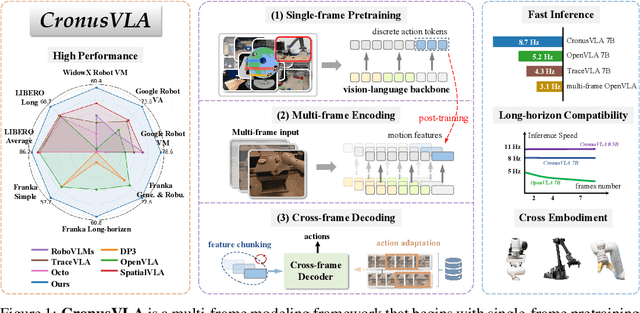
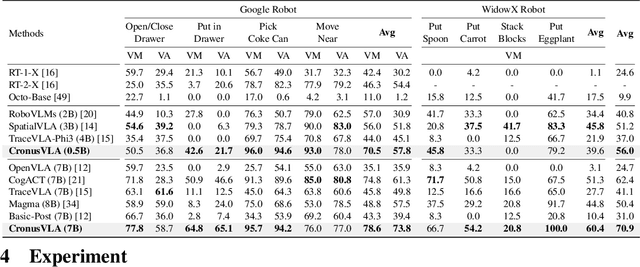
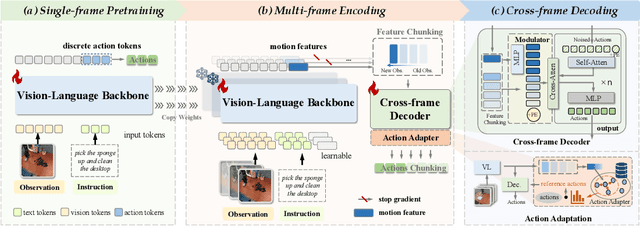
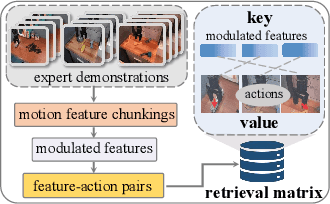
Recent vision-language-action (VLA) models built on pretrained vision-language models (VLMs) have demonstrated strong generalization across manipulation tasks. However, they remain constrained by a single-frame observation paradigm and cannot fully benefit from the motion information offered by aggregated multi-frame historical observations, as the large vision-language backbone introduces substantial computational cost and inference latency. We propose CronusVLA, a unified framework that extends single-frame VLA models to the multi-frame paradigm through an efficient post-training stage. CronusVLA comprises three key components: (1) single-frame pretraining on large-scale embodied datasets with autoregressive action tokens prediction, which establishes an embodied vision-language foundation; (2) multi-frame encoding, adapting the prediction of vision-language backbones from discrete action tokens to motion features during post-training, and aggregating motion features from historical frames into a feature chunking; (3) cross-frame decoding, which maps the feature chunking to accurate actions via a shared decoder with cross-attention. By reducing redundant token computation and caching past motion features, CronusVLA achieves efficient inference. As an application of motion features, we further propose an action adaptation mechanism based on feature-action retrieval to improve model performance during finetuning. CronusVLA achieves state-of-the-art performance on SimplerEnv with 70.9% success rate, and 12.7% improvement over OpenVLA on LIBERO. Real-world Franka experiments also show the strong performance and robustness.