 Add to Chrome
 Add to Firefox
 Add to Edge
TMD-Bench: A Multi-Level Evaluation Paradigm for Music-Dance Co-Generation
May 03, 2026
Unified audio-visual generation is rapidly gaining industrial and creative relevance, enabling applications in virtual production and interactive media. However, when moving from general audio-video synthesis to music-dance co-generation, the task becomes substantially harder: musical rhythm, phrasing, and accents must drive choreographic motion at fine temporal resolution, and such rhythmic coupling is not captured by unimodal metrics or generic audiovisual consistency scores used in current evaluation practice. We introduce TMD-Bench, a benchmark for text-driven music-dance co-generation that assesses systems across unimodal generation quality, instruction adherence, and cross-modal rhythmic alignment. The benchmark integrates computable physical metrics with perceptual multimodal judgments, and is supported by a curated rhythm-aligned music-dance dataset and a fine-grained Music Captioner for structured music semantics. TMD-Bench further reveals that (i) modern commercial audio-visual models, such as Veo 3 and Sora 2, produce high-quality music and video, while rhythmic coupling remains less consistently optimized and leaves room for improvement, and (ii) our unified baseline RhyJAM trained on rhythm-aligned data achieves competitive beat-level synchronization while maintaining competitive unimodal fidelity. This presents prospects for building next-generation music-dance models that explicitly optimize rhythmic and kinetic coherence.

HunyuanVideo-Foley: Multimodal Diffusion with Representation Alignment for High-Fidelity Foley Audio Generation
Aug 23, 2025Recent advances in video generation produce visually realistic content, yet the absence of synchronized audio severely compromises immersion. To address key challenges in video-to-audio generation, including multimodal data scarcity, modality imbalance and limited audio quality in existing methods, we propose HunyuanVideo-Foley, an end-to-end text-video-to-audio framework that synthesizes high-fidelity audio precisely aligned with visual dynamics and semantic context. Our approach incorporates three core innovations: (1) a scalable data pipeline curating 100k-hour multimodal datasets through automated annotation; (2) a representation alignment strategy using self-supervised audio features to guide latent diffusion training, efficiently improving audio quality and generation stability; (3) a novel multimodal diffusion transformer resolving modal competition, containing dual-stream audio-video fusion through joint attention, and textual semantic injection via cross-attention. Comprehensive evaluations demonstrate that HunyuanVideo-Foley achieves new state-of-the-art performance across audio fidelity, visual-semantic alignment, temporal alignment and distribution matching. The demo page is available at: https://szczesnys.github.io/hunyuanvideo-foley/.
Enhance Generation Quality of Flow Matching V2A Model via Multi-Step CoT-Like Guidance and Combined Preference Optimization
Mar 28, 2025Creating high-quality sound effects from videos and text prompts requires precise alignment between visual and audio domains, both semantically and temporally, along with step-by-step guidance for professional audio generation. However, current state-of-the-art video-guided audio generation models often fall short of producing high-quality audio for both general and specialized use cases. To address this challenge, we introduce a multi-stage, multi-modal, end-to-end generative framework with Chain-of-Thought-like (CoT-like) guidance learning, termed Chain-of-Perform (CoP). First, we employ a transformer-based network architecture designed to achieve CoP guidance, enabling the generation of both general and professional audio. Second, we implement a multi-stage training framework that follows step-by-step guidance to ensure the generation of high-quality sound effects. Third, we develop a CoP multi-modal dataset, guided by video, to support step-by-step sound effects generation. Evaluation results highlight the advantages of the proposed multi-stage CoP generative framework compared to the state-of-the-art models on a variety of datasets, with FAD 0.79 to 0.74 (+6.33%), CLIP 16.12 to 17.70 (+9.80%) on VGGSound, SI-SDR 1.98dB to 3.35dB (+69.19%), MOS 2.94 to 3.49(+18.71%) on PianoYT-2h, and SI-SDR 2.22dB to 3.21dB (+44.59%), MOS 3.07 to 3.42 (+11.40%) on Piano-10h.
YingSound: Video-Guided Sound Effects Generation with Multi-modal Chain-of-Thought Controls
Dec 12, 2024
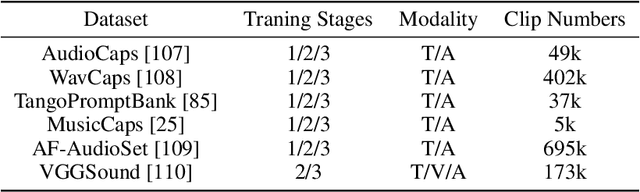


Generating sound effects for product-level videos, where only a small amount of labeled data is available for diverse scenes, requires the production of high-quality sounds in few-shot settings. To tackle the challenge of limited labeled data in real-world scenes, we introduce YingSound, a foundation model designed for video-guided sound generation that supports high-quality audio generation in few-shot settings. Specifically, YingSound consists of two major modules. The first module uses a conditional flow matching transformer to achieve effective semantic alignment in sound generation across audio and visual modalities. This module aims to build a learnable audio-visual aggregator (AVA) that integrates high-resolution visual features with corresponding audio features at multiple stages. The second module is developed with a proposed multi-modal visual-audio chain-of-thought (CoT) approach to generate finer sound effects in few-shot settings. Finally, an industry-standard video-to-audio (V2A) dataset that encompasses various real-world scenarios is presented. We show that YingSound effectively generates high-quality synchronized sounds across diverse conditional inputs through automated evaluations and human studies. Project Page: \url{https://giantailab.github.io/yingsound/}