 Add to Chrome
 Add to Firefox
 Add to Edge
DocRetriever: A Plug-and-Play Framework for Multimodal Document Retrieval with Comprehensive Benchmark
May 28, 2026
Multimodal documents contain diverse elements, such as tables, figures, and layouts, which can complicate retrieval tasks. While current approaches typically combine dense visual embedding models with supervised rerankers to achieve high-precision retrieval, they face inherent limitations. First, the coarse-grained nature of dense embeddings tends to obfuscate explicit semantics, failing to leverage structurally salient information. Second, supervised reranking models suffer from generalization bottlenecks, as their performance heavily relies on domain-specific training data. Furthermore, existing benchmarks often lack diverse assessment dimensions and comprehensive relevance annotations, limiting reliable evaluation. To address these challenges, we propose DocRetriever, a plug-and-play framework. It enhances visual retrieval via a layout-aware sparse embedding technique, enabling effective hybrid encoding without the overhead of optical character recognition (OCR). We also introduce a generalizable reranker that leverages reasoning-augmented demonstrations and optimized sampling to improve accuracy in few-shot settings. Finally, we construct a new benchmark, MultiDocR, to enable more rigorous evaluation. Experiments across diverse benchmarks validate DocRetriever's superiority over state-of-the-art methods.

DynSess: Dynamic Session-Level Evaluation and Optimization Framework for Role-Playing Agents
May 28, 2026Role-playing with large language models is fundamentally a session-level task, requiring agents to sustain character identity and interaction quality across extended multi-turn conversations. Yet existing evaluation and optimization methods remain largely turn-level, failing to capture long-horizon quality. We propose DynSess, a unified session-level framework for role-playing agents. DynSess-Eval scores complete dialogue sessions via rubrics targeting long-horizon behaviors. Leveraging its session-level rewards, we construct high-quality training trajectories through multi-turn lookahead search and train DynSess-Character with two complementary variants: DSPO (off-policy) and GSRPO (on-policy). Experiments show that DynSess-Eval aligns with human judgments substantially better than prior evaluators, and blind human evaluation further shows that DynSess-Character matches the strongest character model despite using substantially fewer parameters, while maintaining strong role consistency and interactive ability. Our dataset and code will be released to facilitate future research.
From Facts to Insights: A Persona-Driven Dual Memory Framework and Dataset for Role-Playing Agents
May 25, 2026While role-playing agents excel in short-term interactions, long-term conversations overwhelm context windows, motivating external memory frameworks. Current systems typically rely on persona-agnostic summarization, which records facts without persona-specific interpretation, yielding generic responses that compromise persona fidelity. To bridge this gap, we introduce RoleMemo, a dataset featuring four reasoning tasks where the factual fragments must be interpreted through the persona to reach the correct answer. Evaluation on RoleMemo exposes critical limitations of persona-agnostic frameworks. We thus propose DualMem, which decouples memory into two streams: factual cognition and persona-conditioned insight. Trained through Supervised Fine-Tuning (SFT) and Reinforcement Learning (RL), our framework with a 4B-parameter model outperforms zero-shot persona-agnostic frameworks powered by DeepSeek-V3.2 for sustained persona fidelity. Our resources are available at https://github.com/role2026/rolememo.
SpatialReward: Verifiable Spatial Reward Modeling for Fine-Grained Spatial Consistency in Text-to-Image Generation
Mar 23, 2026Recent advances in text-to-image (T2I) generation via reinforcement learning (RL) have benefited from reward models that assess semantic alignment and visual quality. However, most existing reward models pay limited attention to fine-grained spatial relationships, often producing images that appear plausible overall yet contain inaccuracies in object positioning. In this work, we present \textbf{SpatialReward}, a verifiable reward model explicitly designed to evaluate spatial layouts in generated images. SpatialReward adopts a multi-stage pipeline: a \emph{Prompt Decomposer} extracts entities, attributes, and spatial metadata from free-form prompts; expert detectors provide accurate visual grounding of object positions and attributes; and a vision-language model applies chain-of-thought reasoning over grounded observations to assess complex spatial relations that are challenging for rule-based methods. To more comprehensively evaluate spatial relationships in generated images, we introduce \textbf{SpatRelBench}, a benchmark covering object attributes, orientation, inter-object relations, and rendered text placement. Experiments on Stable Diffusion and FLUX show that incorporating SpatialReward into RL training consistently improves spatial consistency and overall generation quality, with results aligned more closely to human judgments. These findings indicate that verifiable reward models hold considerable potential for enabling more accurate and controllable optimization in text-to-image generation models.
Generative Reasoning Recommendation via LLMs
Oct 23, 2025Despite their remarkable reasoning capabilities across diverse domains, large language models (LLMs) face fundamental challenges in natively functioning as generative reasoning recommendation models (GRRMs), where the intrinsic modeling gap between textual semantics and collaborative filtering signals, combined with the sparsity and stochasticity of user feedback, presents significant obstacles. This work explores how to build GRRMs by adapting pre-trained LLMs, which achieves a unified understanding-reasoning-prediction manner for recommendation tasks. We propose GREAM, an end-to-end framework that integrates three components: (i) Collaborative-Semantic Alignment, which fuses heterogeneous textual evidence to construct semantically consistent, discrete item indices and auxiliary alignment tasks that ground linguistic representations in interaction semantics; (ii) Reasoning Curriculum Activation, which builds a synthetic dataset with explicit Chain-of-Thought supervision and a curriculum that progresses through behavioral evidence extraction, latent preference modeling, intent inference, recommendation formulation, and denoised sequence rewriting; and (iii) Sparse-Regularized Group Policy Optimization (SRPO), which stabilizes post-training via Residual-Sensitive Verifiable Reward and Bonus-Calibrated Group Advantage Estimation, enabling end-to-end optimization under verifiable signals despite sparse successes. GREAM natively supports two complementary inference modes: Direct Sequence Recommendation for high-throughput, low-latency deployment, and Sequential Reasoning Recommendation that first emits an interpretable reasoning chain for causal transparency. Experiments on three datasets demonstrate consistent gains over strong baselines, providing a practical path toward verifiable-RL-driven LLM recommenders.
CLID-MU: Cross-Layer Information Divergence Based Meta Update Strategy for Learning with Noisy Labels
Jul 16, 2025


Learning with noisy labels (LNL) is essential for training deep neural networks with imperfect data. Meta-learning approaches have achieved success by using a clean unbiased labeled set to train a robust model. However, this approach heavily depends on the availability of a clean labeled meta-dataset, which is difficult to obtain in practice. In this work, we thus tackle the challenge of meta-learning for noisy label scenarios without relying on a clean labeled dataset. Our approach leverages the data itself while bypassing the need for labels. Building on the insight that clean samples effectively preserve the consistency of related data structures across the last hidden and the final layer, whereas noisy samples disrupt this consistency, we design the Cross-layer Information Divergence-based Meta Update Strategy (CLID-MU). CLID-MU leverages the alignment of data structures across these diverse feature spaces to evaluate model performance and use this alignment to guide training. Experiments on benchmark datasets with varying amounts of labels under both synthetic and real-world noise demonstrate that CLID-MU outperforms state-of-the-art methods. The code is released at https://github.com/ruofanhu/CLID-MU.
Vela: Scalable Embeddings with Voice Large Language Models for Multimodal Retrieval
Jun 17, 2025Multimodal large language models (MLLMs) have seen substantial progress in recent years. However, their ability to represent multimodal information in the acoustic domain remains underexplored. In this work, we introduce Vela, a novel framework designed to adapt MLLMs for the generation of universal multimodal embeddings. By leveraging MLLMs with specially crafted prompts and selected in-context learning examples, Vela effectively bridges the modality gap across various modalities. We then propose a single-modality training approach, where the model is trained exclusively on text pairs. Our experiments show that Vela outperforms traditional CLAP models in standard text-audio retrieval tasks. Furthermore, we introduce new benchmarks that expose CLAP models' limitations in handling long texts and complex retrieval tasks. In contrast, Vela, by harnessing the capabilities of MLLMs, demonstrates robust performance in these scenarios. Our code will soon be available.
OmniChat: Enhancing Spoken Dialogue Systems with Scalable Synthetic Data for Diverse Scenarios
Jan 02, 2025


With the rapid development of large language models, researchers have created increasingly advanced spoken dialogue systems that can naturally converse with humans. However, these systems still struggle to handle the full complexity of real-world conversations, including audio events, musical contexts, and emotional expressions, mainly because current dialogue datasets are constrained in both scale and scenario diversity. In this paper, we propose leveraging synthetic data to enhance the dialogue models across diverse scenarios. We introduce ShareChatX, the first comprehensive, large-scale dataset for spoken dialogue that spans diverse scenarios. Based on this dataset, we introduce OmniChat, a multi-turn dialogue system with a heterogeneous feature fusion module, designed to optimize feature selection in different dialogue contexts. In addition, we explored critical aspects of training dialogue systems using synthetic data. Through comprehensive experimentation, we determined the ideal balance between synthetic and real data, achieving state-of-the-art results on the real-world dialogue dataset DailyTalk. We also highlight the crucial importance of synthetic data in tackling diverse, complex dialogue scenarios, especially those involving audio and music. For more details, please visit our demo page at \url{https://sharechatx.github.io/}.
Prompt-Singer: Controllable Singing-Voice-Synthesis with Natural Language Prompt
Mar 18, 2024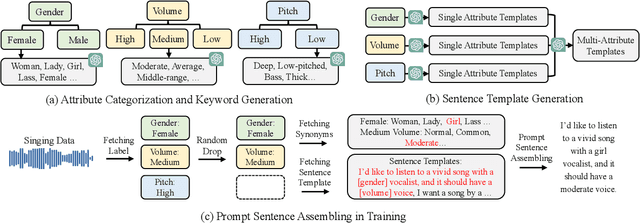
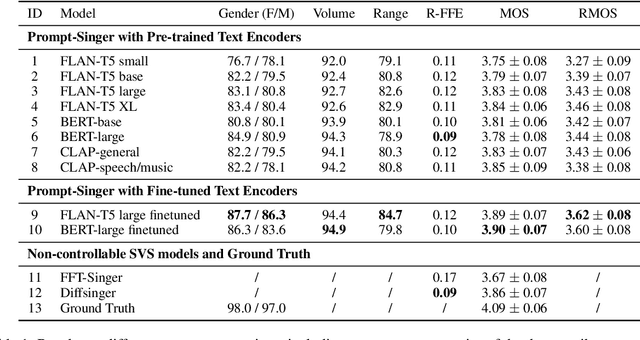
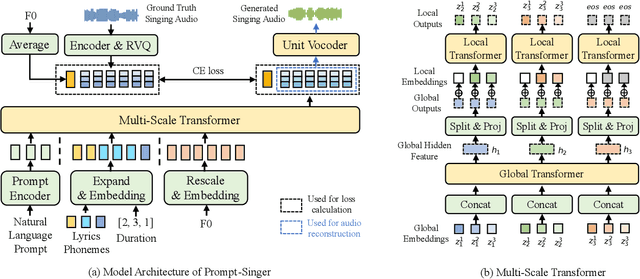
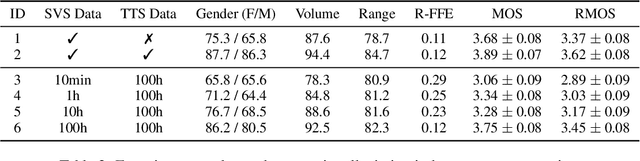
Recent singing-voice-synthesis (SVS) methods have achieved remarkable audio quality and naturalness, yet they lack the capability to control the style attributes of the synthesized singing explicitly. We propose Prompt-Singer, the first SVS method that enables attribute controlling on singer gender, vocal range and volume with natural language. We adopt a model architecture based on a decoder-only transformer with a multi-scale hierarchy, and design a range-melody decoupled pitch representation that enables text-conditioned vocal range control while keeping melodic accuracy. Furthermore, we explore various experiment settings, including different types of text representations, text encoder fine-tuning, and introducing speech data to alleviate data scarcity, aiming to facilitate further research. Experiments show that our model achieves favorable controlling ability and audio quality. Audio samples are available at http://prompt-singer.github.io .
CoLafier: Collaborative Noisy Label Purifier With Local Intrinsic Dimensionality Guidance
Jan 10, 2024Deep neural networks (DNNs) have advanced many machine learning tasks, but their performance is often harmed by noisy labels in real-world data. Addressing this, we introduce CoLafier, a novel approach that uses Local Intrinsic Dimensionality (LID) for learning with noisy labels. CoLafier consists of two subnets: LID-dis and LID-gen. LID-dis is a specialized classifier. Trained with our uniquely crafted scheme, LID-dis consumes both a sample's features and its label to predict the label - which allows it to produce an enhanced internal representation. We observe that LID scores computed from this representation effectively distinguish between correct and incorrect labels across various noise scenarios. In contrast to LID-dis, LID-gen, functioning as a regular classifier, operates solely on the sample's features. During training, CoLafier utilizes two augmented views per instance to feed both subnets. CoLafier considers the LID scores from the two views as produced by LID-dis to assign weights in an adapted loss function for both subnets. Concurrently, LID-gen, serving as classifier, suggests pseudo-labels. LID-dis then processes these pseudo-labels along with two views to derive LID scores. Finally, these LID scores along with the differences in predictions from the two subnets guide the label update decisions. This dual-view and dual-subnet approach enhances the overall reliability of the framework. Upon completion of the training, we deploy the LID-gen subnet of CoLafier as the final classification model. CoLafier demonstrates improved prediction accuracy, surpassing existing methods, particularly under severe label noise. For more details, see the code at https://github.com/zdy93/CoLafier.