 Add to Chrome
 Add to Firefox
 Add to Edge
WavCube: Unifying Speech Representation for Understanding and Generation via Semantic-Acoustic Joint Modeling
May 07, 2026
Integrating speech understanding and generation is a pivotal step toward building unified speech models. However, the different representations required for these two tasks currently pose significant compatibility challenges. Typically, semantics-oriented features are learned from self-supervised learning (SSL), and acoustic-oriented features from reconstruction. Such fragmented representations hinder the realization of truly unified speech systems. We present WavCube, a compact continuous latent derived from an SSL speech encoder that simultaneously supports speech understanding, reconstruction, and generation. WavCube employs a two-stage training scheme. Stage 1 trains a semantic bottleneck to filter off-manifold redundancy that makes raw SSL features intractable for diffusion. Stage 2 injects fine-grained acoustic details via end-to-end reconstruction, while a semantic anchoring loss ensures the representation remains grounded within its original semantic manifold. Comprehensive experiments show that WavCube closely approaches WavLM performance on SUPERB despite an 8x dimensional compression, attains reconstruction quality on par with existing acoustic representations, delivers state-of-the-art zero-shot TTS performance with markedly faster training convergence, and excels in speech enhancement, separation, and voice conversion tasks on the SUPERB-SG benchmark. Systematic ablations reveal that WavCube's two-stage recipe resolves two intrinsic flaws of SSL features for generative modeling, paving the way for future unified speech systems. Codes and checkpoints are available at https://github.com/yanghaha0908/WavCube.

Component-Based Out-of-Distribution Detection
Apr 23, 2026Out-of-Distribution (OOD) detection requires sensitivity to subtle shifts without overreacting to natural In-Distribution (ID) diversity. However, from the viewpoint of detection granularity, global representation inevitably suppress local OOD cues, while patch-based methods are unstable due to entangled spurious-correlation and noise. And neither them is effective in detecting compositional OODs composed of valid ID components. Inspired by recognition-by-components theory, we present a training-free Component-Based OOD Detection (CoOD) framework that addresses the existing limitations by decomposing inputs into functional components. To instantiate CoOD, we derive Component Shift Score (CSS) to detect local appearance shifts, and Compositional Consistency Score (CCS) to identify cross-component compositional inconsistencies. Empirically, CoOD achieves consistent improvements on both coarse- and fine-grained OOD detection.
AgentRob: From Virtual Forum Agents to Hijacked Physical Robots
Feb 14, 2026Large Language Model (LLM)-powered autonomous agents have demonstrated significant capabilities in virtual environments, yet their integration with the physical world remains narrowly confined to direct control interfaces. We present AgentRob, a framework that bridges online community forums, LLM-powered agents, and physical robots through the Model Context Protocol (MCP). AgentRob enables a novel paradigm where autonomous agents participate in online forums--reading posts, extracting natural language commands, dispatching physical robot actions, and reporting results back to the community. The system comprises three layers: a Forum Layer providing asynchronous, persistent, multi-agent interaction; an Agent Layer with forum agents that poll for @mention-targeted commands; and a Robot Layer with VLM-driven controllers and Unitree Go2/G1 hardware that translate commands into robot primitives via iterative tool calling. The framework supports multiple concurrent agents with distinct identities and physical embodiments coexisting in the same forum, establishing the feasibility of forum-mediated multi-agent robot orchestration.
MCPAgentBench: A Real-world Task Benchmark for Evaluating LLM Agent MCP Tool Use
Dec 31, 2025Large Language Models (LLMs) are increasingly serving as autonomous agents, and their utilization of external tools via the Model Context Protocol (MCP) is considered a future trend. Current MCP evaluation sets suffer from issues such as reliance on external MCP services and a lack of difficulty awareness. To address these limitations, we propose MCPAgentBench, a benchmark based on real-world MCP definitions designed to evaluate the tool-use capabilities of agents. We construct a dataset containing authentic tasks and simulated MCP tools. The evaluation employs a dynamic sandbox environment that presents agents with candidate tool lists containing distractors, thereby testing their tool selection and discrimination abilities. Furthermore, we introduce comprehensive metrics to measure both task completion rates and execution efficiency. Experiments conducted on various latest mainstream Large Language Models reveal significant performance differences in handling complex, multi-step tool invocations. All code is open-source at Github.
JoDiffusion: Jointly Diffusing Image with Pixel-Level Annotations for Semantic Segmentation Promotion
Dec 15, 2025Given the inherently costly and time-intensive nature of pixel-level annotation, the generation of synthetic datasets comprising sufficiently diverse synthetic images paired with ground-truth pixel-level annotations has garnered increasing attention recently for training high-performance semantic segmentation models. However, existing methods necessitate to either predict pseudo annotations after image generation or generate images conditioned on manual annotation masks, which incurs image-annotation semantic inconsistency or scalability problem. To migrate both problems with one stone, we present a novel dataset generative diffusion framework for semantic segmentation, termed JoDiffusion. Firstly, given a standard latent diffusion model, JoDiffusion incorporates an independent annotation variational auto-encoder (VAE) network to map annotation masks into the latent space shared by images. Then, the diffusion model is tailored to capture the joint distribution of each image and its annotation mask conditioned on a text prompt. By doing these, JoDiffusion enables simultaneously generating paired images and semantically consistent annotation masks solely conditioned on text prompts, thereby demonstrating superior scalability. Additionally, a mask optimization strategy is developed to mitigate the annotation noise produced during generation. Experiments on Pascal VOC, COCO, and ADE20K datasets show that the annotated dataset generated by JoDiffusion yields substantial performance improvements in semantic segmentation compared to existing methods.
Say More with Less: Variable-Frame-Rate Speech Tokenization via Adaptive Clustering and Implicit Duration Coding
Sep 04, 2025Existing speech tokenizers typically assign a fixed number of tokens per second, regardless of the varying information density or temporal fluctuations in the speech signal. This uniform token allocation mismatches the intrinsic structure of speech, where information is distributed unevenly over time. To address this, we propose VARSTok, a VAriable-frame-Rate Speech Tokenizer that adapts token allocation based on local feature similarity. VARSTok introduces two key innovations: (1) a temporal-aware density peak clustering algorithm that adaptively segments speech into variable-length units, and (2) a novel implicit duration coding scheme that embeds both content and temporal span into a single token index, eliminating the need for auxiliary duration predictors. Extensive experiments show that VARSTok significantly outperforms strong fixed-rate baselines. Notably, it achieves superior reconstruction naturalness while using up to 23% fewer tokens than a 40 Hz fixed-frame-rate baseline. VARSTok further yields lower word error rates and improved naturalness in zero-shot text-to-speech synthesis. To the best of our knowledge, this is the first work to demonstrate that a fully dynamic, variable-frame-rate acoustic speech tokenizer can be seamlessly integrated into downstream speech language models. Speech samples are available at https://zhengrachel.github.io/VARSTok.
Speech Token Prediction via Compressed-to-fine Language Modeling for Speech Generation
May 30, 2025Neural audio codecs, used as speech tokenizers, have demonstrated remarkable potential in the field of speech generation. However, to ensure high-fidelity audio reconstruction, neural audio codecs typically encode audio into long sequences of speech tokens, posing a significant challenge for downstream language models in long-context modeling. We observe that speech token sequences exhibit short-range dependency: due to the monotonic alignment between text and speech in text-to-speech (TTS) tasks, the prediction of the current token primarily relies on its local context, while long-range tokens contribute less to the current token prediction and often contain redundant information. Inspired by this observation, we propose a \textbf{compressed-to-fine language modeling} approach to address the challenge of long sequence speech tokens within neural codec language models: (1) \textbf{Fine-grained Initial and Short-range Information}: Our approach retains the prompt and local tokens during prediction to ensure text alignment and the integrity of paralinguistic information; (2) \textbf{Compressed Long-range Context}: Our approach compresses long-range token spans into compact representations to reduce redundant information while preserving essential semantics. Extensive experiments on various neural audio codecs and downstream language models validate the effectiveness and generalizability of the proposed approach, highlighting the importance of token compression in improving speech generation within neural codec language models. The demo of audio samples will be available at https://anonymous.4open.science/r/SpeechTokenPredictionViaCompressedToFinedLM.
EmoVoice: LLM-based Emotional Text-To-Speech Model with Freestyle Text Prompting
Apr 22, 2025Human speech goes beyond the mere transfer of information; it is a profound exchange of emotions and a connection between individuals. While Text-to-Speech (TTS) models have made huge progress, they still face challenges in controlling the emotional expression in the generated speech. In this work, we propose EmoVoice, a novel emotion-controllable TTS model that exploits large language models (LLMs) to enable fine-grained freestyle natural language emotion control, and a phoneme boost variant design that makes the model output phoneme tokens and audio tokens in parallel to enhance content consistency, inspired by chain-of-thought (CoT) and chain-of-modality (CoM) techniques. Besides, we introduce EmoVoice-DB, a high-quality 40-hour English emotion dataset featuring expressive speech and fine-grained emotion labels with natural language descriptions. EmoVoice achieves state-of-the-art performance on the English EmoVoice-DB test set using only synthetic training data, and on the Chinese Secap test set using our in-house data. We further investigate the reliability of existing emotion evaluation metrics and their alignment with human perceptual preferences, and explore using SOTA multimodal LLMs GPT-4o-audio and Gemini to assess emotional speech. Demo samples are available at https://yanghaha0908.github.io/EmoVoice/. Dataset, code, and checkpoints will be released.
TinyR1-32B-Preview: Boosting Accuracy with Branch-Merge Distillation
Mar 06, 2025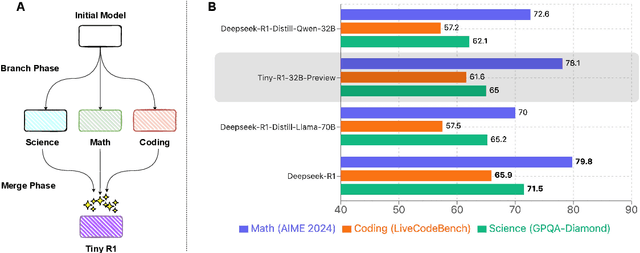
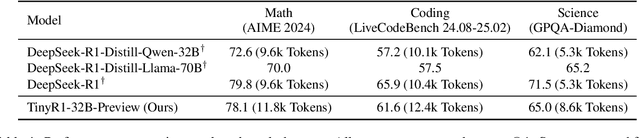
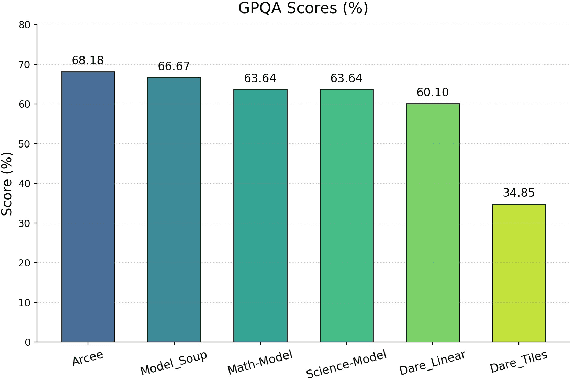
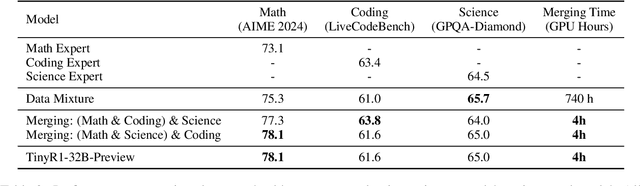
The challenge of reducing the size of Large Language Models (LLMs) while maintaining their performance has gained significant attention. However, existing methods, such as model distillation and transfer learning, often fail to achieve high accuracy. To address this limitation, we introduce the Branch-Merge distillation approach, which enhances model compression through two phases: (1) the Branch Phase, where knowledge from a large teacher model is \textit{selectively distilled} into specialized student models via domain-specific supervised fine-tuning (SFT); And (2) the Merge Phase, where these student models are merged to enable cross-domain knowledge transfer and improve generalization. We validate our distillation approach using DeepSeek-R1 as the teacher and DeepSeek-R1-Distill-Qwen-32B as the student. The resulting merged model, TinyR1-32B-Preview, outperforms its counterpart DeepSeek-R1-Distill-Qwen-32B across multiple benchmarks, including Mathematics (+5.5 points), Coding (+4.4 points) and Science (+2.9 points), while achieving near-equal performance to DeepSeek-R1 on AIME 2024. The Branch-Merge distillation approach provides a scalable solution for creating smaller, high-performing LLMs with reduced computational cost and time.
Enhancing Expressive Voice Conversion with Discrete Pitch-Conditioned Flow Matching Model
Feb 08, 2025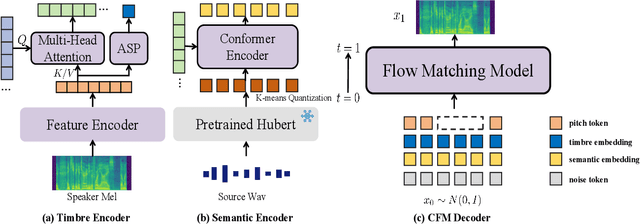
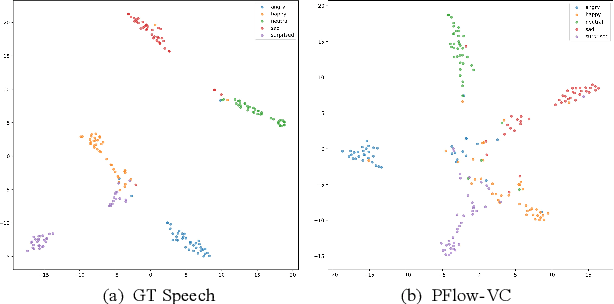
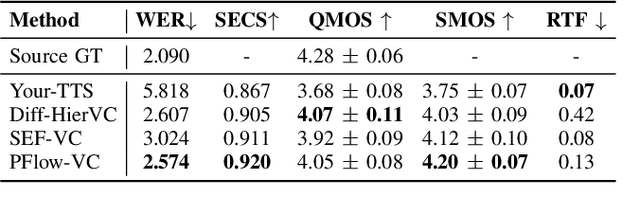
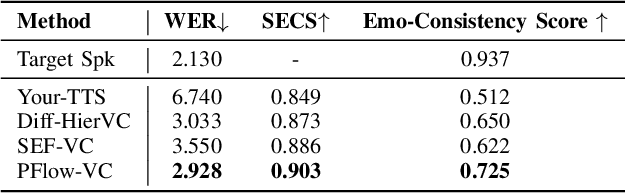
This paper introduces PFlow-VC, a conditional flow matching voice conversion model that leverages fine-grained discrete pitch tokens and target speaker prompt information for expressive voice conversion (VC). Previous VC works primarily focus on speaker conversion, with further exploration needed in enhancing expressiveness (such as prosody and emotion) for timbre conversion. Unlike previous methods, we adopt a simple and efficient approach to enhance the style expressiveness of voice conversion models. Specifically, we pretrain a self-supervised pitch VQVAE model to discretize speaker-irrelevant pitch information and leverage a masked pitch-conditioned flow matching model for Mel-spectrogram synthesis, which provides in-context pitch modeling capabilities for the speaker conversion model, effectively improving the voice style transfer capacity. Additionally, we improve timbre similarity by combining global timbre embeddings with time-varying timbre tokens. Experiments on unseen LibriTTS test-clean and emotional speech dataset ESD show the superiority of the PFlow-VC model in both timbre conversion and style transfer. Audio samples are available on the demo page https://speechai-demo.github.io/PFlow-VC/.