 Add to Chrome
 Add to Firefox
 Add to Edge
AGRO-SQL: Agentic Group-Relative Optimization with High-Fidelity Data Synthesis
Dec 29, 2025
The advancement of Text-to-SQL systems is currently hindered by the scarcity of high-quality training data and the limited reasoning capabilities of models in complex scenarios. In this paper, we propose a holistic framework that addresses these issues through a dual-centric approach. From a Data-Centric perspective, we construct an iterative data factory that synthesizes RL-ready data characterized by high correctness and precise semantic-logic alignment, ensured by strict verification. From a Model-Centric perspective, we introduce a novel Agentic Reinforcement Learning framework. This framework employs a Diversity-Aware Cold Start stage to initialize a robust policy, followed by Group Relative Policy Optimization (GRPO) to refine the agent's reasoning via environmental feedback. Extensive experiments on BIRD and Spider benchmarks demonstrate that our synergistic approach achieves state-of-the-art performance among single-model methods.

Close the Loop: Synthesizing Infinite Tool-Use Data via Multi-Agent Role-Playing
Dec 29, 2025Enabling Large Language Models (LLMs) to reliably invoke external tools remains a critical bottleneck for autonomous agents. Existing approaches suffer from three fundamental challenges: expensive human annotation for high-quality trajectories, poor generalization to unseen tools, and quality ceilings inherent in single-model synthesis that perpetuate biases and coverage gaps. We introduce InfTool, a fully autonomous framework that breaks these barriers through self-evolving multi-agent synthesis. Given only raw API specifications, InfTool orchestrates three collaborative agents (User Simulator, Tool-Calling Assistant, and MCP Server) to generate diverse, verified trajectories spanning single-turn calls to complex multi-step workflows. The framework establishes a closed loop: synthesized data trains the model via Group Relative Policy Optimization (GRPO) with gated rewards, the improved model generates higher-quality data targeting capability gaps, and this cycle iterates without human intervention. Experiments on the Berkeley Function-Calling Leaderboard (BFCL) demonstrate that InfTool transforms a base 32B model from 19.8% to 70.9% accuracy (+258%), surpassing models 10x larger and rivaling Claude-Opus, and entirely from synthetic data without human annotation.
JavisGPT: A Unified Multi-modal LLM for Sounding-Video Comprehension and Generation
Dec 28, 2025This paper presents JavisGPT, the first unified multimodal large language model (MLLM) for Joint Audio-Video (JAV) comprehension and generation. JavisGPT adopts a concise encoder-LLM-decoder architecture, featuring a SyncFusion module for spatio-temporal audio-video fusion and synchrony-aware learnable queries to bridge a pretrained JAV-DiT generator. This design enables temporally coherent video-audio understanding and generation from multimodal instructions. We design an effective three-stage training pipeline consisting of multimodal pretraining, audio-video fine-tuning, and large-scale instruction-tuning, to progressively build multimodal comprehension and generation from existing vision-language models. To support this, we further construct JavisInst-Omni, a high-quality instruction dataset with over 200K GPT-4o-curated audio-video-text dialogues that span diverse and multi-level comprehension and generation scenarios. Extensive experiments on JAV comprehension and generation benchmarks show that JavisGPT outperforms existing MLLMs, particularly in complex and temporally synchronized settings.
FoldAct: Efficient and Stable Context Folding for Long-Horizon Search Agents
Dec 28, 2025Long-horizon reinforcement learning (RL) for large language models faces critical scalability challenges from unbounded context growth, leading to context folding methods that compress interaction history during task execution. However, existing approaches treat summary actions as standard actions, overlooking that summaries fundamentally modify the agent's future observation space, creating a policy-dependent, non-stationary observation distribution that violates core RL assumptions. This introduces three fundamental challenges: (1) gradient dilution where summary tokens receive insufficient training signal, (2) self-conditioning where policy updates change summary distributions, creating a vicious cycle of training collapse, and (3) computational cost from processing unique contexts at each turn. We introduce \textbf{FoldAct}\footnote{https://github.com/SHAO-Jiaqi757/FoldAct}, a framework that explicitly addresses these challenges through three key innovations: separated loss computation for independent gradient signals on summary and action tokens, full context consistency loss to reduce distribution shift, and selective segment training to reduce computational cost. Our method enables stable training of long-horizon search agents with context folding, addressing the non-stationary observation problem while improving training efficiency with 5.19$\times$ speedup.
M2G-Eval: Enhancing and Evaluating Multi-granularity Multilingual Code Generation
Dec 27, 2025The rapid advancement of code large language models (LLMs) has sparked significant research interest in systematically evaluating their code generation capabilities, yet existing benchmarks predominantly assess models at a single structural granularity and focus on limited programming languages, obscuring fine-grained capability variations across different code scopes and multilingual scenarios. We introduce M2G-Eval, a multi-granularity, multilingual framework for evaluating code generation in large language models (LLMs) across four levels: Class, Function, Block, and Line. Spanning 18 programming languages, M2G-Eval includes 17K+ training tasks and 1,286 human-annotated, contamination-controlled test instances. We develop M2G-Eval-Coder models by training Qwen3-8B with supervised fine-tuning and Group Relative Policy Optimization. Evaluating 30 models (28 state-of-the-art LLMs plus our two M2G-Eval-Coder variants) reveals three main findings: (1) an apparent difficulty hierarchy, with Line-level tasks easiest and Class-level most challenging; (2) widening performance gaps between full- and partial-granularity languages as task complexity increases; and (3) strong cross-language correlations, suggesting that models learn transferable programming concepts. M2G-Eval enables fine-grained diagnosis of code generation capabilities and highlights persistent challenges in synthesizing complex, long-form code.
Cross-Population White Matter Atlas Creation for Concurrent Mapping of Brain Connections in Neonates and Adults with Diffusion MRI Tractography
Dec 23, 2025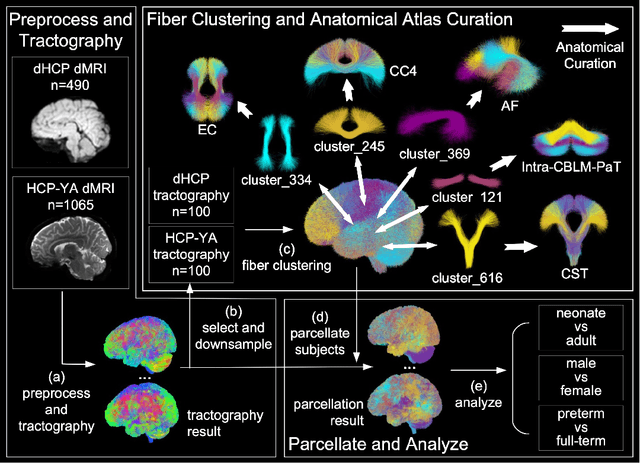
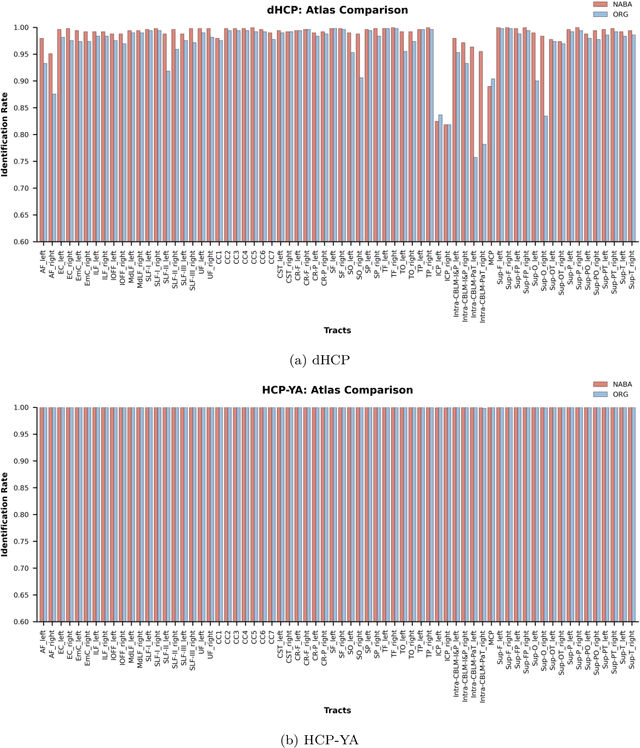
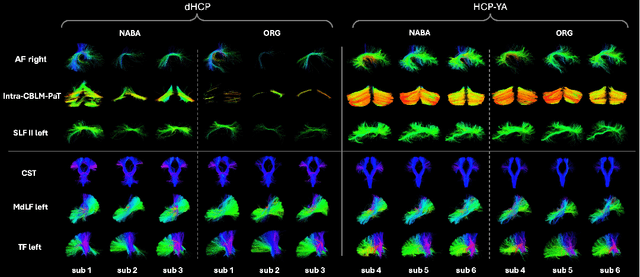
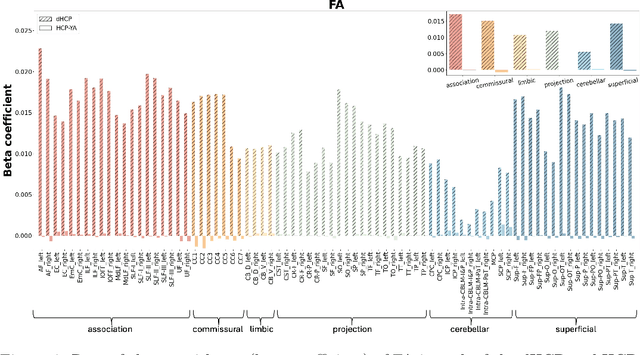
Comparing white matter (WM) connections between adults and neonates using diffusion MRI (dMRI) can advance our understanding of typical brain development and potential biomarkers for neurological disorders. However, existing WM atlases are population-specific (adult or neonatal) and reside in separate spaces, preventing direct cross-population comparisons. A unified WM atlas spanning both neonates and adults is still lacking. In this study, we propose a neonatal/adult brain atlas (NABA), a WM tractography atlas built from dMRI data of both neonates and adults. NABA is constructed using a robust, data-driven fiber clustering pipeline, enabling group-wise WM atlasing across populations despite substantial anatomical variability. The atlas provides a standardized template for WM parcellation, allowing direct comparison of WM tracts between neonates and adults. Using NABA, we conduct four analyses: (1) evaluating the feasibility of joint WM mapping across populations, (2) characterizing WM development across neonatal ages relative to adults, (3) assessing sex-related differences in neonatal WM development, and (4) examining the effects of preterm birth. Our results show that NABA robustly identifies WM tracts in both populations. We observe rapid fractional anisotropy (FA) development in long-range association tracts, including the arcuate fasciculus and superior longitudinal fasciculus II, whereas intra-cerebellar tracts develop more slowly. Neonatal females exhibit faster overall FA development than males. Although preterm neonates show lower overall FA development rates, they demonstrate relatively higher FA growth in specific tracts, including the corticospinal tract, corona radiata-pontine pathway, and intracerebellar tracts. These findings demonstrate that NABA is a useful tool for investigating WM development across neonates and adults.
EchoTrail-GUI: Building Actionable Memory for GUI Agents via Critic-Guided Self-Exploration
Dec 22, 2025Contemporary GUI agents, while increasingly capable due to advances in Large Vision-Language Models (VLMs), often operate with a critical limitation: they treat each task in isolation, lacking a mechanism to systematically learn from past successes. This digital ''amnesia'' results in sub-optimal performance, repeated errors, and poor generalization to novel challenges. To bridge this gap, we introduce EchoTrail-GUI, a novel framework designed to mimic human-like experiential learning by equipping agents with a dynamic, accessible memory. Our framework operates in three distinct stages. First, during Experience Exploration, an agent autonomously interacts with GUI environments to build a curated database of successful task trajectories, validated by a reward model. Crucially, the entire knowledge base construction is thus fully automated, requiring no human supervision. Second, in the Memory Injection stage, upon receiving a new task, our system efficiently retrieves the most relevant past trajectories to serve as actionable ''memories''. Finally, during GUI Task Inference, these memories are injected as in-context guidance to inform the agent's reasoning and decision-making process. We demonstrate the efficacy of our approach on benchmarks including Android World and AndroidLab. The results show that EchoTrail-GUI significantly improves the task success rate and operational efficiency of baseline agents, validating the power of structured memory in creating more robust and intelligent GUI automation.
CodeSimpleQA: Scaling Factuality in Code Large Language Models
Dec 22, 2025Large language models (LLMs) have made significant strides in code generation, achieving impressive capabilities in synthesizing code snippets from natural language instructions. However, a critical challenge remains in ensuring LLMs generate factually accurate responses about programming concepts, technical implementations, etc. Most previous code-related benchmarks focus on code execution correctness, overlooking the factual accuracy of programming knowledge. To address this gap, we present CodeSimpleQA, a comprehensive bilingual benchmark designed to evaluate the factual accuracy of code LLMs in answering code-related questions, which contains carefully curated question-answer pairs in both English and Chinese, covering diverse programming languages and major computer science domains. Further, we create CodeSimpleQA-Instruct, a large-scale instruction corpus with 66M samples, and develop a post-training framework combining supervised fine-tuning and reinforcement learning. Our comprehensive evaluation of diverse LLMs reveals that even frontier LLMs struggle with code factuality. Our proposed framework demonstrates substantial improvements over the base model, underscoring the critical importance of factuality-aware alignment in developing reliable code LLMs.
Generative modeling of conditional probability distributions on the level-sets of collective variables
Dec 22, 2025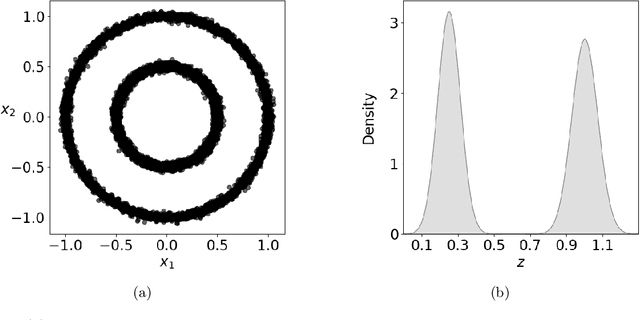
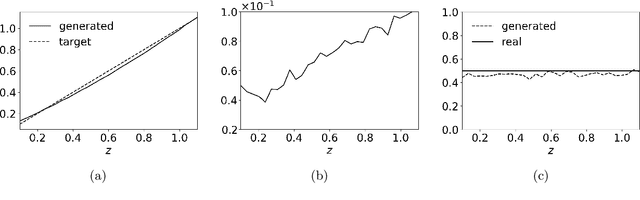

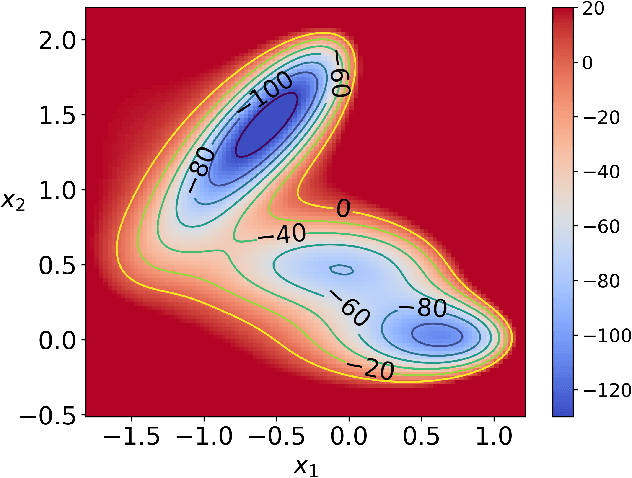
Given a probability distribution $μ$ in $\mathbb{R}^d$ represented by data, we study in this paper the generative modeling of its conditional probability distributions on the level-sets of a collective variable $ξ: \mathbb{R}^d \rightarrow \mathbb{R}^k$, where $1 \le k<d$. We propose a general and efficient learning approach that is able to learn generative models on different level-sets of $ξ$ simultaneously. To improve the learning quality on level-sets in low-probability regions, we also propose a strategy for data enrichment by utilizing data from enhanced sampling techniques. We demonstrate the effectiveness of our proposed learning approach through concrete numerical examples. The proposed approach is potentially useful for the generative modeling of molecular systems in biophysics, for instance.
InSight-o3: Empowering Multimodal Foundation Models with Generalized Visual Search
Dec 21, 2025The ability for AI agents to "think with images" requires a sophisticated blend of reasoning and perception. However, current open multimodal agents still largely fall short on the reasoning aspect crucial for real-world tasks like analyzing documents with dense charts/diagrams and navigating maps. To address this gap, we introduce O3-Bench, a new benchmark designed to evaluate multimodal reasoning with interleaved attention to visual details. O3-Bench features challenging problems that require agents to piece together subtle visual information from distinct image areas through multi-step reasoning. The problems are highly challenging even for frontier systems like OpenAI o3, which only obtains 40.8% accuracy on O3-Bench. To make progress, we propose InSight-o3, a multi-agent framework consisting of a visual reasoning agent (vReasoner) and a visual search agent (vSearcher) for which we introduce the task of generalized visual search -- locating relational, fuzzy, or conceptual regions described in free-form language, beyond just simple objects or figures in natural images. We then present a multimodal LLM purpose-trained for this task via reinforcement learning. As a plug-and-play agent, our vSearcher empowers frontier multimodal models (as vReasoners), significantly improving their performance on a wide range of benchmarks. This marks a concrete step towards powerful o3-like open systems. Our code and dataset can be found at https://github.com/m-Just/InSight-o3 .