 Add to Chrome
 Add to Firefox
 Add to Edge
Robust-WAM: Bridging Generative Pretraining and Semantic Foresight in World-Action Models
Aug 07, 2026
Mainstream World-Action Models (WAMs) adapt pretrained video generation models (VGMs) for robot control, transferring their learned dynamics prior for action prediction. These VGMs are typically trained in a variational autoencoder (VAE) latent space. However, the VAE latent space is optimized for pixel reconstruction, which rewards fine appearance detail and leaves the action prediction fragile under visual shifts. Recent works build WAMs in semantic latent space, which are more robust to appearance shifts. However, these models cannot leverage the large-scale VGM pretraining that exists only in VAE space. To overcome this dilemma, we propose Robust-WAM, a general post-training method for video-generation-based WAMs that preserves the VAE-based generative path and adds a lightweight semantic foresight alignment objective on the action stream. This retains the large-scale VGM pretraining while grounding actions in appearance-invariant dynamics that stay reliable under illumination shifts and other visual out-of-distribution conditions. Specifically, we employ learnable query tokens to bring future-scene semantics into the action stream by aligning their output hidden states with the semantic foresight of future ground-truth frames. To establish the temporal correspondence between each query and the future step it describes, we give it the positional encoding of the matching action tokens. Experiments on out-of-distribution generalization simulation benchmarks and a real-robot setup show that our Robust-WAM consistently improves the success rates of multiple WAM baselines without sacrificing in-distribution performance.

InfiniVerse: Occupancy Guided Unbounded Scene Generation for Autonomous Driving
Jun 30, 2026Generating realistic, controllable, and temporally coherent urban environments is a critical yet unresolved challenge in the autonomous driving community. In this paper, we introduce InfiniVerse, a unified pipeline for long-range, 2D-3D-aligned, and controllable synthesis of dynamic urban scenes from a single frame. In practice, our approach first reconstructs a 3D occupancy representation from the input multi-view frame. This representation serves as a foundation for autoregressive scene extension along arbitrary trajectories. Subsequently, a video diffusion model translates the coarse occupancy grid into realistic, spatiotemporally consistent video sequences. Moreover, we propose a hierarchical sketch-and-refine paradigm, in which the generated videos are re-projected as image-conditioned feedback to enhance the 3D occupancy representation, establishing cross-modal alignment and mutual enhancement between the visual and spatial domains. Extensive evaluations on the Waymo Open Dataset and nuScenes demonstrate that InfiniVerse achieves state-of-the-art performance, with a FID of 6.4 and FVD of 67.97, significantly outperforming existing benchmarks in both duration and stability.
DLWM: Dual Latent World Models enable Holistic Gaussian-centric Pre-training in Autonomous Driving
Apr 01, 2026Vision-based autonomous driving has gained much attention due to its low costs and excellent performance. Compared with dense BEV (Bird's Eye View) or sparse query models, Gaussian-centric method is a comprehensive yet sparse representation by describing scene with 3D semantic Gaussians. In this paper, we introduce DLWM, a novel paradigm with Dual Latent World Models specifically designed to enable holistic gaussian-centric pre-training in autonomous driving using two stages. In the first stage, DLWM predicts 3D Gaussians from queries by self-supervised reconstructing multi-view semantic and depth images. Equipped with fine-grained contextual features, in the second stage, two latent world models are trained separately for temporal feature learning, including Gaussian-flow-guided latent prediction for downstream occupancy perception and forecasting tasks, and ego-planning-guided latent prediction for motion planning. Extensive experiments in SurroundOcc and nuScenes benchmarks demonstrate that DLWM shows significant performance gains across Gaussian-centric 3D occupancy perception, 4D occupancy forecasting and motion planning tasks.
DualCoT-VLA: Visual-Linguistic Chain of Thought via Parallel Reasoning for Vision-Language-Action Models
Mar 23, 2026Vision-Language-Action (VLA) models map visual observations and language instructions directly to robotic actions. While effective for simple tasks, standard VLA models often struggle with complex, multi-step tasks requiring logical planning, as well as precise manipulations demanding fine-grained spatial perception. Recent efforts have incorporated Chain-of-Thought (CoT) reasoning to endow VLA models with a ``thinking before acting'' capability. However, current CoT-based VLA models face two critical limitations: 1) an inability to simultaneously capture low-level visual details and high-level logical planning due to their reliance on isolated, single-modal CoT; 2) high inference latency with compounding errors caused by step-by-step autoregressive decoding. To address these limitations, we propose DualCoT-VLA, a visual-linguistic CoT method for VLA models with a parallel reasoning mechanism. To achieve comprehensive multi-modal reasoning, our method integrates a visual CoT for low-level spatial understanding and a linguistic CoT for high-level task planning. Furthermore, to overcome the latency bottleneck, we introduce a parallel CoT mechanism that incorporates two sets of learnable query tokens, shifting autoregressive reasoning to single-step forward reasoning. Extensive experiments demonstrate that our DualCoT-VLA achieves state-of-the-art performance on the LIBERO and RoboCasa GR1 benchmarks, as well as in real-world platforms.
Lean Learning Beyond Clouds: Efficient Discrepancy-Conditioned Optical-SAR Fusion for Semantic Segmentation
Mar 21, 2026Cloud occlusion severely degrades the semantic integrity of optical remote sensing imagery. While incorporating Synthetic Aperture Radar (SAR) provides complementary observations, achieving efficient global modeling and reliable cross-modal fusion under cloud interference remains challenging. Existing methods rely on dense global attention to capture long-range dependencies, yet such aggregation indiscriminately propagates cloud-induced noise. Improving robustness typically entails enlarging model capacity, which further increases computational overhead. Given the large-scale and high-resolution nature of remote sensing applications, such computational demands hinder practical deployment, leading to an efficiency-reliability trade-off. To address this dilemma, we propose EDC, an efficiency-oriented and discrepancy-conditioned optical-SAR semantic segmentation framework. A tri-stream encoder with Carrier Tokens enables compact global context modeling with reduced complexity. To prevent noise contamination, we introduce a Discrepancy-Conditioned Hybrid Fusion (DCHF) mechanism that selectively suppresses unreliable regions during global aggregation. In addition, an auxiliary cloud removal branch with teacher-guided distillation enhances semantic consistency under occlusion. Extensive experiments demonstrate that EDC achieves superior accuracy and efficiency, improving mIoU by 0.56\% and 0.88\% on M3M-CR and WHU-OPT-SAR, respectively, while reducing the number of parameters by 46.7\% and accelerating inference by 1.98$\times$. Our implementation is available at https://github.com/mengcx0209/EDC.
S-VAM: Shortcut Video-Action Model by Self-Distilling Geometric and Semantic Foresight
Mar 17, 2026Video action models (VAMs) have emerged as a promising paradigm for robot learning, owing to their powerful visual foresight for complex manipulation tasks. However, current VAMs, typically relying on either slow multi-step video generation or noisy one-step feature extraction, cannot simultaneously guarantee real-time inference and high-fidelity foresight. To address this limitation, we propose S-VAM, a shortcut video-action model that foresees coherent geometric and semantic representations via a single forward pass. Serving as a stable blueprint, these foreseen representations significantly simplify the action prediction. To enable this efficient shortcut, we introduce a novel self-distillation strategy that condenses structured generative priors of multi-step denoising into one-step inference. Specifically, vision foundation model (VFM) representations extracted from the diffusion model's own multi-step generated videos provide teacher targets. Lightweight decouplers, as students, learn to directly map noisy one-step features to these targets. Extensive experiments in simulation and the real world demonstrate that our S-VAM outperforms state-of-the-art methods, enabling efficient and precise manipulation in complex environments. Our project page is https://haodong-yan.github.io/S-VAM/
Occ-LLM: Enhancing Autonomous Driving with Occupancy-Based Large Language Models
Feb 10, 2025Large Language Models (LLMs) have made substantial advancements in the field of robotic and autonomous driving. This study presents the first Occupancy-based Large Language Model (Occ-LLM), which represents a pioneering effort to integrate LLMs with an important representation. To effectively encode occupancy as input for the LLM and address the category imbalances associated with occupancy, we propose Motion Separation Variational Autoencoder (MS-VAE). This innovative approach utilizes prior knowledge to distinguish dynamic objects from static scenes before inputting them into a tailored Variational Autoencoder (VAE). This separation enhances the model's capacity to concentrate on dynamic trajectories while effectively reconstructing static scenes. The efficacy of Occ-LLM has been validated across key tasks, including 4D occupancy forecasting, self-ego planning, and occupancy-based scene question answering. Comprehensive evaluations demonstrate that Occ-LLM significantly surpasses existing state-of-the-art methodologies, achieving gains of about 6\% in Intersection over Union (IoU) and 4\% in mean Intersection over Union (mIoU) for the task of 4D occupancy forecasting. These findings highlight the transformative potential of Occ-LLM in reshaping current paradigms within robotic and autonomous driving.
VisionPAD: A Vision-Centric Pre-training Paradigm for Autonomous Driving
Nov 22, 2024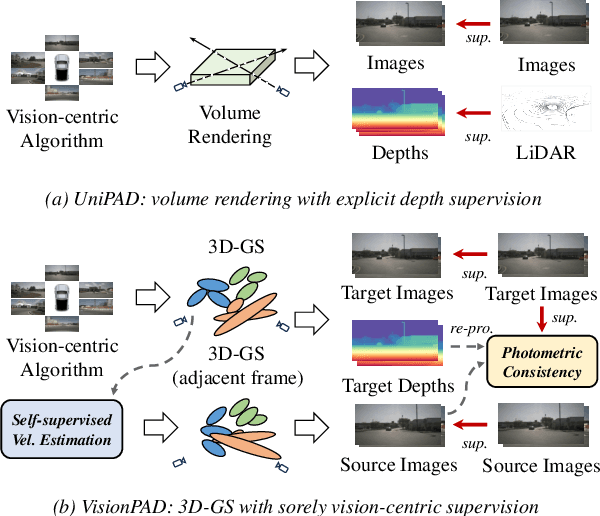
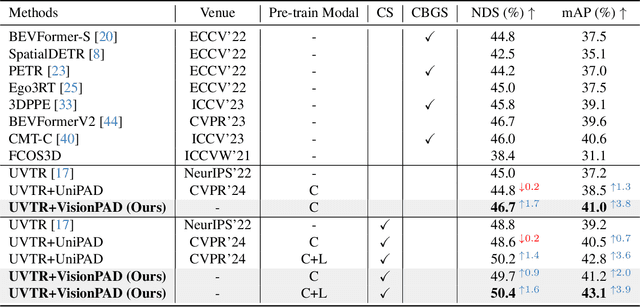
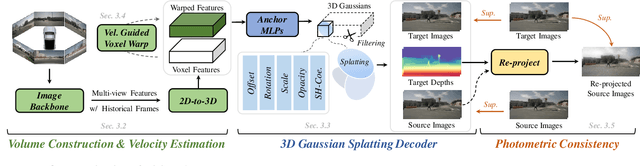
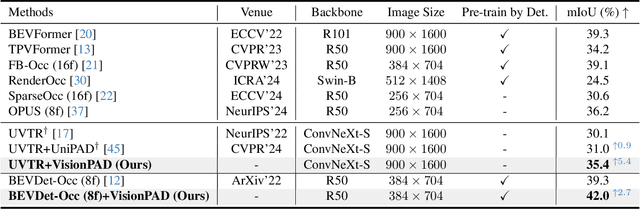
This paper introduces VisionPAD, a novel self-supervised pre-training paradigm designed for vision-centric algorithms in autonomous driving. In contrast to previous approaches that employ neural rendering with explicit depth supervision, VisionPAD utilizes more efficient 3D Gaussian Splatting to reconstruct multi-view representations using only images as supervision. Specifically, we introduce a self-supervised method for voxel velocity estimation. By warping voxels to adjacent frames and supervising the rendered outputs, the model effectively learns motion cues in the sequential data. Furthermore, we adopt a multi-frame photometric consistency approach to enhance geometric perception. It projects adjacent frames to the current frame based on rendered depths and relative poses, boosting the 3D geometric representation through pure image supervision. Extensive experiments on autonomous driving datasets demonstrate that VisionPAD significantly improves performance in 3D object detection, occupancy prediction and map segmentation, surpassing state-of-the-art pre-training strategies by a considerable margin.
OmniBooth: Learning Latent Control for Image Synthesis with Multi-modal Instruction
Oct 07, 2024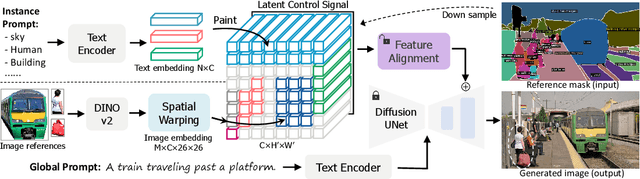
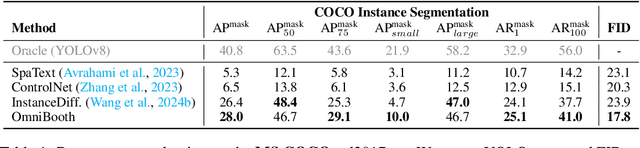
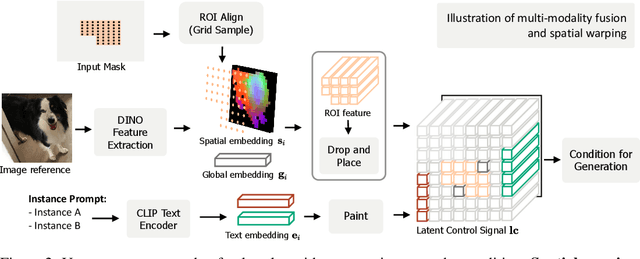
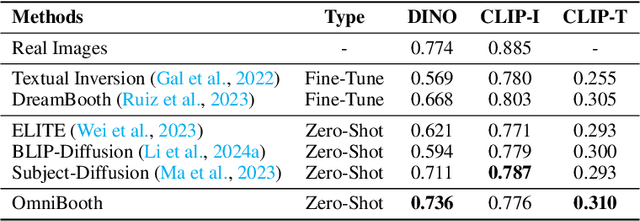
We present OmniBooth, an image generation framework that enables spatial control with instance-level multi-modal customization. For all instances, the multimodal instruction can be described through text prompts or image references. Given a set of user-defined masks and associated text or image guidance, our objective is to generate an image, where multiple objects are positioned at specified coordinates and their attributes are precisely aligned with the corresponding guidance. This approach significantly expands the scope of text-to-image generation, and elevates it to a more versatile and practical dimension in controllability. In this paper, our core contribution lies in the proposed latent control signals, a high-dimensional spatial feature that provides a unified representation to integrate the spatial, textual, and image conditions seamlessly. The text condition extends ControlNet to provide instance-level open-vocabulary generation. The image condition further enables fine-grained control with personalized identity. In practice, our method empowers users with more flexibility in controllable generation, as users can choose multi-modal conditions from text or images as needed. Furthermore, thorough experiments demonstrate our enhanced performance in image synthesis fidelity and alignment across different tasks and datasets. Project page: https://len-li.github.io/omnibooth-web/
DisEnvisioner: Disentangled and Enriched Visual Prompt for Customized Image Generation
Oct 02, 2024
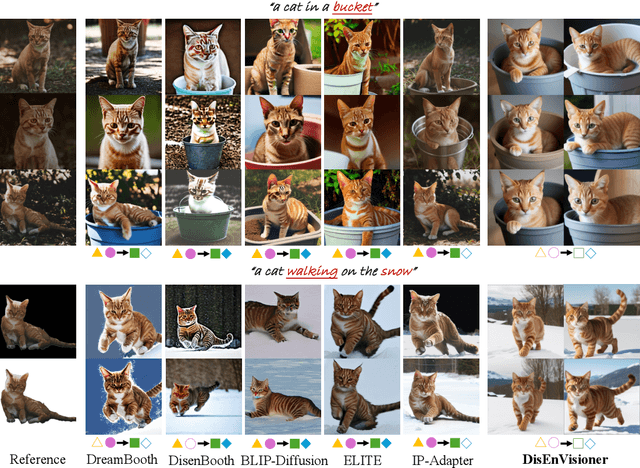
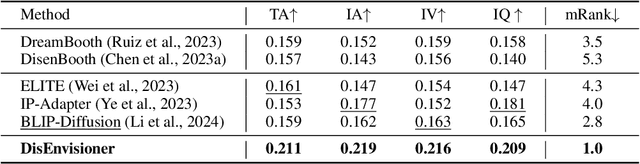
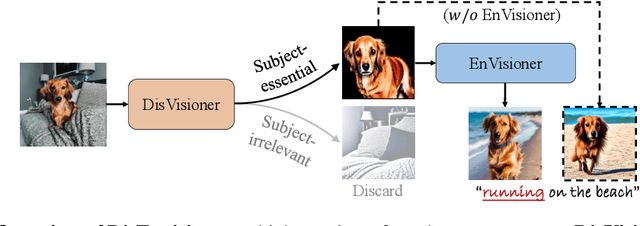
In the realm of image generation, creating customized images from visual prompt with additional textual instruction emerges as a promising endeavor. However, existing methods, both tuning-based and tuning-free, struggle with interpreting the subject-essential attributes from the visual prompt. This leads to subject-irrelevant attributes infiltrating the generation process, ultimately compromising the personalization quality in both editability and ID preservation. In this paper, we present DisEnvisioner, a novel approach for effectively extracting and enriching the subject-essential features while filtering out -irrelevant information, enabling exceptional customization performance, in a tuning-free manner and using only a single image. Specifically, the feature of the subject and other irrelevant components are effectively separated into distinctive visual tokens, enabling a much more accurate customization. Aiming to further improving the ID consistency, we enrich the disentangled features, sculpting them into more granular representations. Experiments demonstrate the superiority of our approach over existing methods in instruction response (editability), ID consistency, inference speed, and the overall image quality, highlighting the effectiveness and efficiency of DisEnvisioner. Project page: https://disenvisioner.github.io/.