 Add to Chrome
 Add to Firefox
 Add to Edge
Seeing through boxes: Non-Line-of-Sight 3D Reconstruction from Radar Signals
May 27, 2026
Reconstructing object geometry from radio frequency (RF) signals is fundamentally challenging due to the lensless imaging nature of RF sensing, which leads to low spatial resolution and high noise. Unlike light signals, RF signals can penetrate occlusions and thus capture information about hidden scenes. Existing Non-Line-of-Sight (NLoS) 3D neural reconstruction methods can recover coarse surfaces inside enclosed environments but often suffer from unstable optimization, noisy surface geometry, and surface ambiguity, failing to produce accurate zero-level sets from the signed distance field (SDF). These limitations largely stem from neglecting the role of Line-of-Sight (LoS) geometry outside the enclosed region, which provides valuable physical constraints for modeling signal propagation. In this paper, we introduce a Unified LoS and NLoS neural geometry reconstruction framework GeRaF 2.0 that leverages the outside LoS geometry to model and guide RF propagation from the LoS region into the NLoS region. By integrating visual LoS priors into the neural field formulation, GeRaF 2.0 achieves stable training and physically consistent reconstruction of both visible and hidden geometry, setting a new state-of-the-art in RF-based geometry reconstruction.

GeRaF: Neural Geometry Reconstruction from Radio Frequency Signals
May 27, 2026GeRaF is the first method to use neural implicit learning for near-range 3D geometry reconstruction from radio frequency (RF) signals. Unlike RGB or LiDAR-based methods, RF sensing can see through occlusion but suffers from low resolution and noise due to its lensless imaging nature. While lenses in RGB imaging constrain sampling to 1D rays, RF signals propagate through the entire space, introducing significant noise and leading to cubic complexity in volumetric rendering. Moreover, RF signals interact with surfaces via specular reflections, requiring fundamentally different modeling. To address these challenges, GeRaF (1) introduces filter-based rendering to suppress irrelevant signals, (2) implements a physics-based RF volumetric rendering pipeline, and (3) proposes a novel lensless sampling and lensless alpha blending strategy that makes full-space sampling feasible during training. By learning signed distance functions, reflectiveness, and signal power through MLPs and trainable parameters, GeRaF takes the first step towards reconstructing millimeter-level geometry from RF signals in real-world settings.
* Accepted at NeurIPS 2025 (Spotlight)
Sketch2MinSurf: Vision-Language Guided Generation of Editable Minimal Surfaces from Hand-Drawn Sketches
May 20, 2026Converting hand-drawn sketches into structured 3D geometries remains challenging due to the difficulty of representing non-Euclidean surfaces and maintaining topological consistency. Existing generative models such as GANs, NeRFs, and diffusion architectures often fail to produce editable manifolds directly usable in downstream design workflows. We present Sketch2MinSurf, a hybrid vision-language and geometric optimization framework that integrates vision-language guidance with minimal-surface theory to generate smooth and editable 3D surfaces from hand-drawn sketches. The core of our approach is a spatial-topological encoding that represents geometry as tuples of node coordinates and real/virtual edge skeletons, enabling stable topological control during generation. We further introduce the Sketch2MinSurf Structural Loss (S2MS-Loss), a reward-modulated objective that jointly constrains geometric reconstruction and topological coherence. On a test set of 100 sketches, Sketch2MinSurf achieves a topological similarity score of 0.844, outperforming existing sketch-to-shape baselines. The generated manifolds are directly editable and free from non-manifold artifacts. A public art installation at a university showcases the method's potential for human-intent-driven 3D form generation. The dataset and code are available at https://anonymous.4open.science/r/Sketch2MinSurf/.
ArchSIBench: Benchmarking the Architectural Spatial Intelligence of Vision-Language Models
May 20, 2026Architectural spatial intelligence, the ability to recognize and infer architectural space, is fundamental to tasks such as robot navigation, embodied interaction, and 3D scene understanding and generation. Although extensive research has evaluated the basic spatial skills of Vision-Language Models (VLMs) such as relative orientation, distance comparison, and object counting, these tasks cover only the most elementary levels of spatial cognition and largely overlook higher-level cognition of architectural space, including layout understanding, circulation patterns, and functional zoning. In this work, we present ArchSIBench, a Benchmark for Architectural Spatial Intelligence based on the perspectives from architecture, cognitive science, and psychology. ArchSIBench covers five core dimensions: perception, reasoning, navigation, transformation, and configuration, comprising 17 fine-grained subtasks. Through careful manual annotation by experts with architectural backgrounds, we construct 3,000 question-answer pairs to enable comprehensive evaluation of architectural spatial intelligence. Based on ArchSIBench, we evaluate various VLMs and find that the architectural spatial intelligence of most models shows significant differences from human baselines; additionally, models exhibit substantial variability across capability dimensions. Some state-of-the-art models can approach the level of human evaluators without architectural training. However, a clear gap remains compared to human evaluators with architectural training, particularly in spatial transformation and configuration reasoning. We believe that ArchSIBench will provide important insights and systematic resources for measuring and advancing the architectural spatial intelligence of VLMs. The dataset and code are available at https://huggingface.co/datasets/ArchSIBench/ArchSIBench.
Enhancing 3D Semantic Scene Completion with a Refinement Module
Dec 20, 2025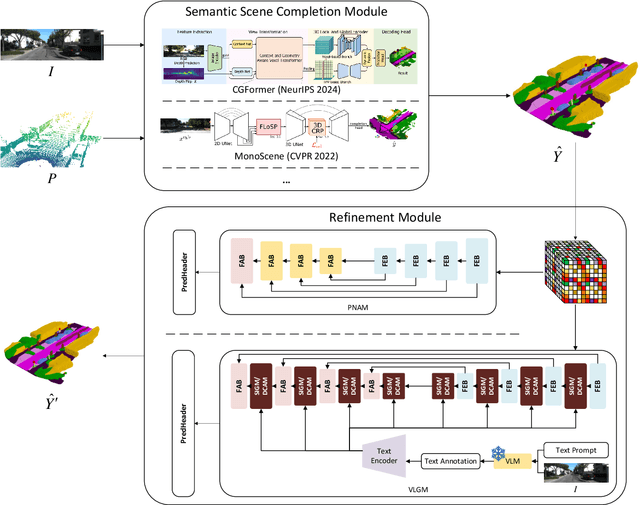
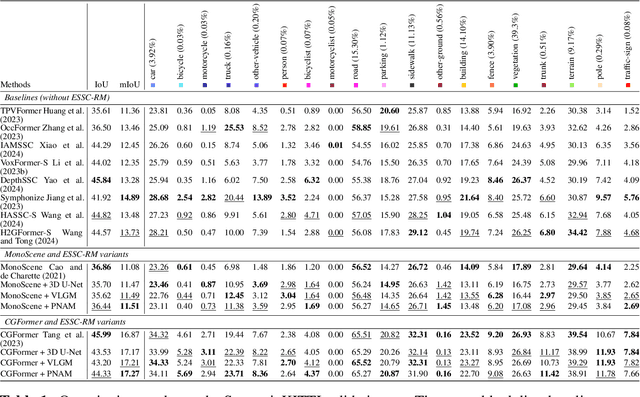
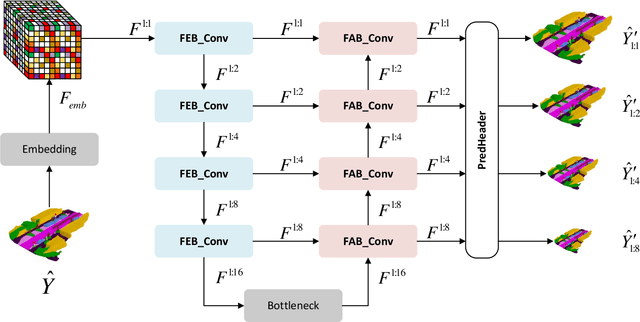

We propose ESSC-RM, a plug-and-play Enhancing framework for Semantic Scene Completion with a Refinement Module, which can be seamlessly integrated into existing SSC models. ESSC-RM operates in two phases: a baseline SSC network first produces a coarse voxel prediction, which is subsequently refined by a 3D U-Net-based Prediction Noise-Aware Module (PNAM) and Voxel-level Local Geometry Module (VLGM) under multiscale supervision. Experiments on SemanticKITTI show that ESSC-RM consistently improves semantic prediction performance. When integrated into CGFormer and MonoScene, the mean IoU increases from 16.87% to 17.27% and from 11.08% to 11.51%, respectively. These results demonstrate that ESSC-RM serves as a general refinement framework applicable to a wide range of SSC models.
Translating Images to Road Network:A Non-Autoregressive Sequence-to-Sequence Approach
Feb 13, 2024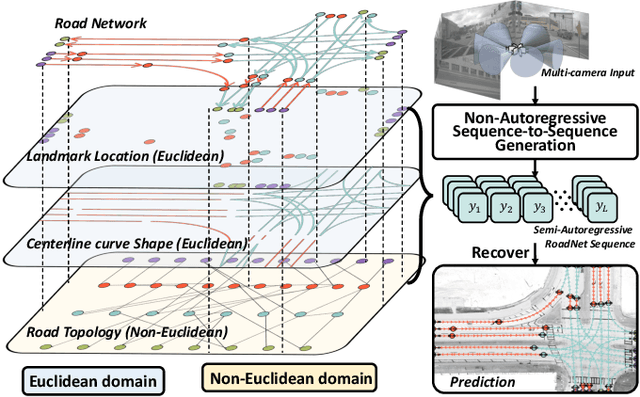
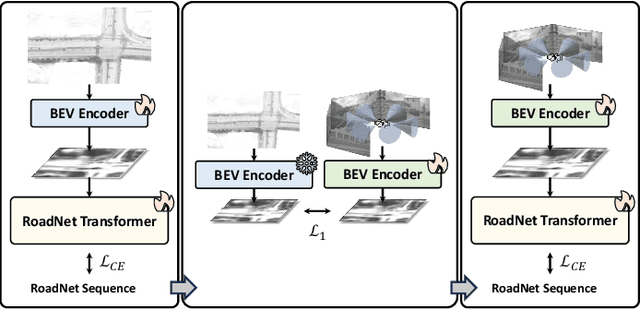
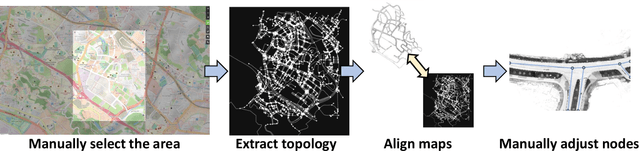
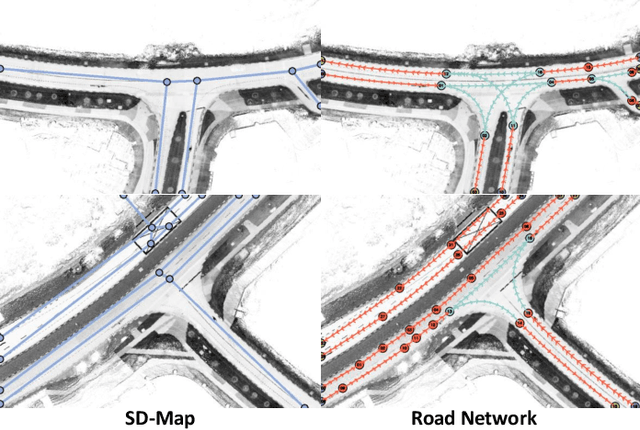
The extraction of road network is essential for the generation of high-definition maps since it enables the precise localization of road landmarks and their interconnections. However, generating road network poses a significant challenge due to the conflicting underlying combination of Euclidean (e.g., road landmarks location) and non-Euclidean (e.g., road topological connectivity) structures. Existing methods struggle to merge the two types of data domains effectively, but few of them address it properly. Instead, our work establishes a unified representation of both types of data domain by projecting both Euclidean and non-Euclidean data into an integer series called RoadNet Sequence. Further than modeling an auto-regressive sequence-to-sequence Transformer model to understand RoadNet Sequence, we decouple the dependency of RoadNet Sequence into a mixture of auto-regressive and non-autoregressive dependency. Building on this, our proposed non-autoregressive sequence-to-sequence approach leverages non-autoregressive dependencies while fixing the gap towards auto-regressive dependencies, resulting in success on both efficiency and accuracy. Extensive experiments on nuScenes dataset demonstrate the superiority of RoadNet Sequence representation and the non-autoregressive approach compared to existing state-of-the-art alternatives. The code is open-source on https://github.com/fudan-zvg/RoadNetworkTRansformer.
S-Agents: self-organizing agents in open-ended environment
Feb 08, 2024


Leveraging large language models (LLMs), autonomous agents have significantly improved, gaining the ability to handle a variety of tasks. In open-ended settings, optimizing collaboration for efficiency and effectiveness demands flexible adjustments. Despite this, current research mainly emphasizes fixed, task-oriented workflows and overlooks agent-centric organizational structures. Drawing inspiration from human organizational behavior, we introduce a self-organizing agent system (S-Agents) with a "tree of agents" structure for dynamic workflow, an "hourglass agent architecture" for balancing information priorities, and a "non-obstructive collaboration" method to allow asynchronous task execution among agents. This structure can autonomously coordinate a group of agents, efficiently addressing the challenges of an open and dynamic environment without human intervention. Our experiments demonstrate that S-Agents proficiently execute collaborative building tasks and resource collection in the Minecraft environment, validating their effectiveness.
S-NeRF++: Autonomous Driving Simulation via Neural Reconstruction and Generation
Feb 03, 2024
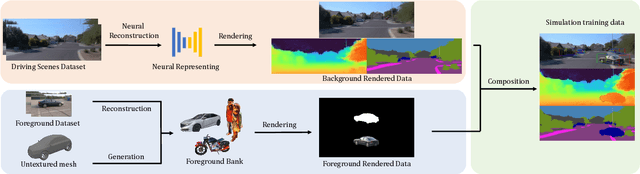


Autonomous driving simulation system plays a crucial role in enhancing self-driving data and simulating complex and rare traffic scenarios, ensuring navigation safety. However, traditional simulation systems, which often heavily rely on manual modeling and 2D image editing, struggled with scaling to extensive scenes and generating realistic simulation data. In this study, we present S-NeRF++, an innovative autonomous driving simulation system based on neural reconstruction. Trained on widely-used self-driving datasets such as nuScenes and Waymo, S-NeRF++ can generate a large number of realistic street scenes and foreground objects with high rendering quality as well as offering considerable flexibility in manipulation and simulation. Specifically, S-NeRF++ is an enhanced neural radiance field for synthesizing large-scale scenes and moving vehicles, with improved scene parameterization and camera pose learning. The system effectively utilizes noisy and sparse LiDAR data to refine training and address depth outliers, ensuring high quality reconstruction and novel-view rendering. It also provides a diverse foreground asset bank through reconstructing and generating different foreground vehicles to support comprehensive scenario creation. Moreover, we have developed an advanced foreground-background fusion pipeline that skillfully integrates illumination and shadow effects, further enhancing the realism of our simulations. With the high-quality simulated data provided by our S-NeRF++, we found the perception methods enjoy performance boost on several autonomous driving downstream tasks, which further demonstrate the effectiveness of our proposed simulator.
LaneGraph2Seq: Lane Topology Extraction with Language Model via Vertex-Edge Encoding and Connectivity Enhancement
Jan 31, 2024Understanding road structures is crucial for autonomous driving. Intricate road structures are often depicted using lane graphs, which include centerline curves and connections forming a Directed Acyclic Graph (DAG). Accurate extraction of lane graphs relies on precisely estimating vertex and edge information within the DAG. Recent research highlights Transformer-based language models' impressive sequence prediction abilities, making them effective for learning graph representations when graph data are encoded as sequences. However, existing studies focus mainly on modeling vertices explicitly, leaving edge information simply embedded in the network. Consequently, these approaches fall short in the task of lane graph extraction. To address this, we introduce LaneGraph2Seq, a novel approach for lane graph extraction. It leverages a language model with vertex-edge encoding and connectivity enhancement. Our serialization strategy includes a vertex-centric depth-first traversal and a concise edge-based partition sequence. Additionally, we use classifier-free guidance combined with nucleus sampling to improve lane connectivity. We validate our method on prominent datasets, nuScenes and Argoverse 2, showcasing consistent and compelling results. Our LaneGraph2Seq approach demonstrates superior performance compared to state-of-the-art techniques in lane graph extraction.
WoVoGen: World Volume-aware Diffusion for Controllable Multi-camera Driving Scene Generation
Dec 06, 2023
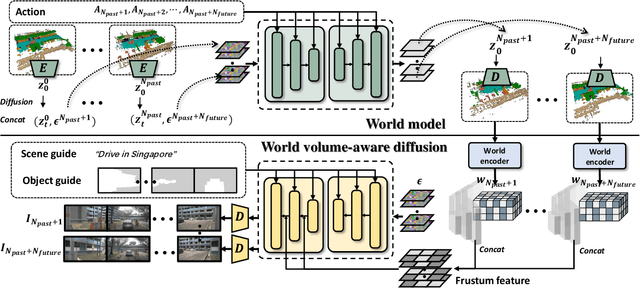

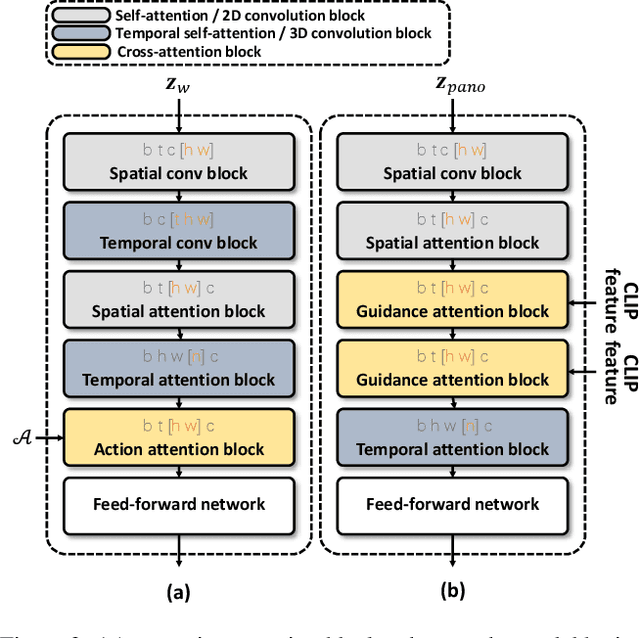
Generating multi-camera street-view videos is critical for augmenting autonomous driving datasets, addressing the urgent demand for extensive and varied data. Due to the limitations in diversity and challenges in handling lighting conditions, traditional rendering-based methods are increasingly being supplanted by diffusion-based methods. However, a significant challenge in diffusion-based methods is ensuring that the generated sensor data preserve both intra-world consistency and inter-sensor coherence. To address these challenges, we combine an additional explicit world volume and propose the World Volume-aware Multi-camera Driving Scene Generator (WoVoGen). This system is specifically designed to leverage 4D world volume as a foundational element for video generation. Our model operates in two distinct phases: (i) envisioning the future 4D temporal world volume based on vehicle control sequences, and (ii) generating multi-camera videos, informed by this envisioned 4D temporal world volume and sensor interconnectivity. The incorporation of the 4D world volume empowers WoVoGen not only to generate high-quality street-view videos in response to vehicle control inputs but also to facilitate scene editing tasks.