 Add to Chrome
 Add to Firefox
 Add to Edge
EO-VGGT: Orbital Ray-Conditioned 3D Foundation Models for Satellite Multi-View Reconstruction
Jul 01, 2026
In the era of satellite constellations, multi-view optical satellite imagery is pivotal for Earth Observation (EO) and high-quality Digital Surface Model (DSM) reconstruction. Although feed-forward 3D foundation models have transformed computer vision, their deployment in satellite remote sensing is inherently constrained by the structural discrepancy between implicit perspective assumptions and explicit orbital pushbroom geometry. This geometric incongruity is further compounded by pronounced view-set heterogeneity. We present EO-VGGT, a framework that adapts a frozen perspective-driven model to orbital observations via explicit physical geometry embedding.First, the Geometry-Correlation Constrained Selection (GCCS) strategy prunes sub-optimal observations by balancing geometric diversity and radiometric consistency to optimize the input sequence. Second, a Sensor-Ray Encoder (SRE) parameterizes pixel-level pushbroom lines of sight derived from the Rational Function Model (RFM) into high-dimensional space-geometric tokens, reconciling the mathematical discrepancy between central projection and orbital kinematics. Third, a lightweight Ray-Pointing-Aware Adapter (RPAA) employs gated residual blocks to integrate these tokens directly into the frozen transformer backbone. Our findings underscore that integrating explicit physical geometry with optimized view selection is essential for robust feed-forward satellite 3D reconstruction.

AnyScene: Towards Highly Controllable Driving Scene Generation at Anywhere and Beyond
May 25, 2026Generating high-fidelity and controllable synthetic data is critical for advancing end-to-end autonomous driving, particularly for addressing the long tail of rare safety-critical scenarios. Existing occupancy-guided methods typically rely on shallow conditioning mechanisms and reference-frame-dependent video synthesis, which limits fine-grained controllability from arbitrary BEV layouts and restricts their applicability for scalable simulation. In this paper, we propose AnyScene, a unified occupancy-centric framework for driving scene generation. AnyScene generates semantic occupancy sequences from BEV layouts through a Spatial-Temporal Occupancy Diffusion Transformer that jointly tokenizes BEV and occupancy features in an autoregressive manner. This design enables precise controllability from cross-dataset and user-defined BEV inputs while naturally supporting long-horizon generation. Building upon the generated occupancy, a Geometry-Grounded View Expansion module treats occupancy as the canonical spatial representation and synthesizes temporally consistent multi-view driving videos in a reference-free and autoregressive fashion, supporting flexible camera configurations at inference time. Extensive experiments demonstrate that AnyScene achieves state-of-the-art performance in both occupancy and video generation. It exhibits strong generalization to unseen and customized layouts, and provides measurable benefits for downstream tasks such as sparse-view 3D reconstruction.
MindVLA-U1: VLA Beats VA with Unified Streaming Architecture for Autonomous Driving
May 14, 2026Autonomous driving has progressed from modular pipelines toward end-to-end unification, and Vision-Language-Action (VLA) models are a natural extension of this journey beyond Vision-to-Action (VA). In practice, driving VLAs have often trailed VA on planning quality, suggesting that the difficulty is not simply model scale but the interface through which semantic reasoning, temporal context, and continuous control are combined. We argue that this gap reflects how VLA has been built -- as isolated subtask improvements that fail to compose coherent driving capabilities -- rather than what VLA is. We present MindVLA-U1, the first unified streaming VLA architecture for autonomous driving. A unified VLM backbone produces AR language tokens (optional) and flow-matching continuous action trajectories in a single forward pass over one shared representation, preserving the natural output form of each modality. A full streaming design processes the driving video framewise rather than as fixed video-action chunks under costly temporal VLM modeling. Planned trajectories evolve smoothly across frames while a learned streaming memory channel carries temporal context and updates. The unified architecture enables fast/slow systems on dense & sparse MoT backbones via flexible self-attention context management, and exposes a measurable language-control path for action: language-predicted driving intents steers the action diffusion via classifier-free guidance (CFG), turning language-side intent into control signals for continuous action planning. On the long-tail WOD-E2E benchmark, MindVLA-U1 surpasses experienced human drivers for the first time (8.20 RFS vs. 8.13 GT RFS) with 2 diffusion steps, achieves state-of-the-art planning ADEs over prior VA/VLA by large margins, and matches VA latency (16 FPS vs. RAP's 18 FPS at 1B scale) while preserving natural language interfaces for human-vehicle interaction.
DLWM: Dual Latent World Models enable Holistic Gaussian-centric Pre-training in Autonomous Driving
Apr 01, 2026Vision-based autonomous driving has gained much attention due to its low costs and excellent performance. Compared with dense BEV (Bird's Eye View) or sparse query models, Gaussian-centric method is a comprehensive yet sparse representation by describing scene with 3D semantic Gaussians. In this paper, we introduce DLWM, a novel paradigm with Dual Latent World Models specifically designed to enable holistic gaussian-centric pre-training in autonomous driving using two stages. In the first stage, DLWM predicts 3D Gaussians from queries by self-supervised reconstructing multi-view semantic and depth images. Equipped with fine-grained contextual features, in the second stage, two latent world models are trained separately for temporal feature learning, including Gaussian-flow-guided latent prediction for downstream occupancy perception and forecasting tasks, and ego-planning-guided latent prediction for motion planning. Extensive experiments in SurroundOcc and nuScenes benchmarks demonstrate that DLWM shows significant performance gains across Gaussian-centric 3D occupancy perception, 4D occupancy forecasting and motion planning tasks.
An Efficient Occupancy World Model via Decoupled Dynamic Flow and Image-assisted Training
Dec 18, 2024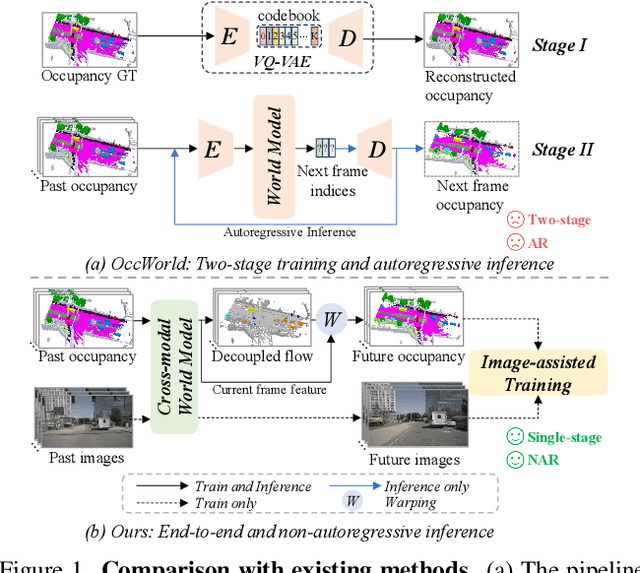
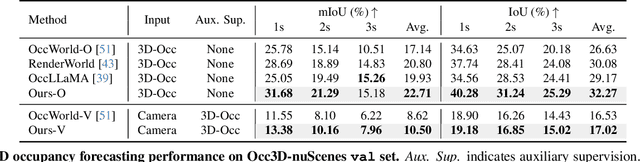
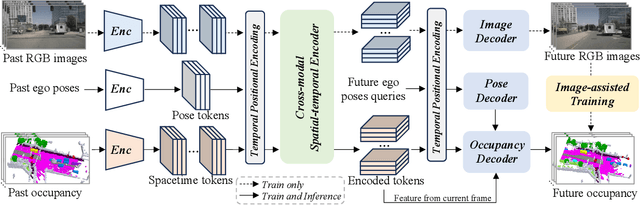
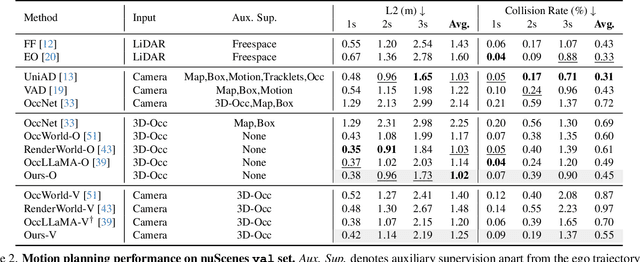
The field of autonomous driving is experiencing a surge of interest in world models, which aim to predict potential future scenarios based on historical observations. In this paper, we introduce DFIT-OccWorld, an efficient 3D occupancy world model that leverages decoupled dynamic flow and image-assisted training strategy, substantially improving 4D scene forecasting performance. To simplify the training process, we discard the previous two-stage training strategy and innovatively reformulate the occupancy forecasting problem as a decoupled voxels warping process. Our model forecasts future dynamic voxels by warping existing observations using voxel flow, whereas static voxels are easily obtained through pose transformation. Moreover, our method incorporates an image-assisted training paradigm to enhance prediction reliability. Specifically, differentiable volume rendering is adopted to generate rendered depth maps through predicted future volumes, which are adopted in render-based photometric consistency. Experiments demonstrate the effectiveness of our approach, showcasing its state-of-the-art performance on the nuScenes and OpenScene benchmarks for 4D occupancy forecasting, end-to-end motion planning and point cloud forecasting. Concretely, it achieves state-of-the-art performances compared to existing 3D world models while incurring substantially lower computational costs.
D$^2$-World: An Efficient World Model through Decoupled Dynamic Flow
Nov 26, 2024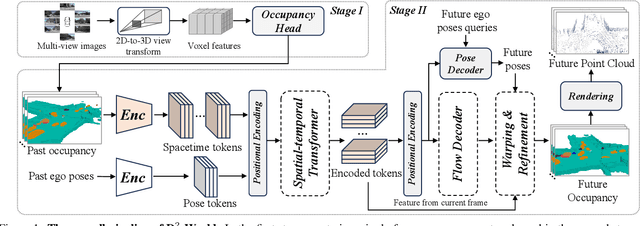
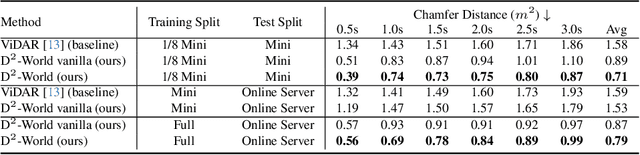
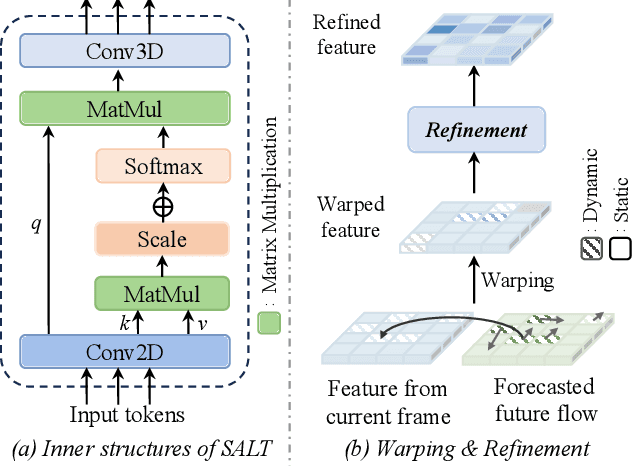
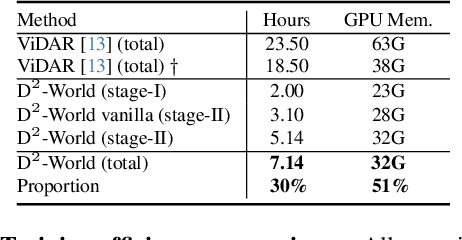
This technical report summarizes the second-place solution for the Predictive World Model Challenge held at the CVPR-2024 Workshop on Foundation Models for Autonomous Systems. We introduce D$^2$-World, a novel World model that effectively forecasts future point clouds through Decoupled Dynamic flow. Specifically, the past semantic occupancies are obtained via existing occupancy networks (e.g., BEVDet). Following this, the occupancy results serve as the input for a single-stage world model, generating future occupancy in a non-autoregressive manner. To further simplify the task, dynamic voxel decoupling is performed in the world model. The model generates future dynamic voxels by warping the existing observations through voxel flow, while remaining static voxels can be easily obtained through pose transformation. As a result, our approach achieves state-of-the-art performance on the OpenScene Predictive World Model benchmark, securing second place, and trains more than 300% faster than the baseline model. Code is available at https://github.com/zhanghm1995/D2-World.
VisionPAD: A Vision-Centric Pre-training Paradigm for Autonomous Driving
Nov 22, 2024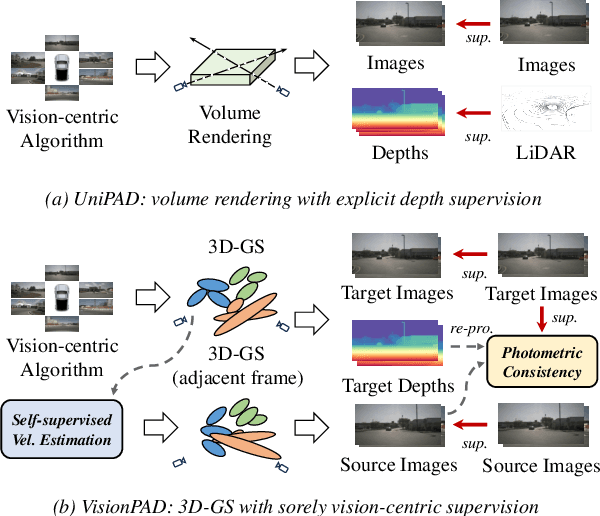
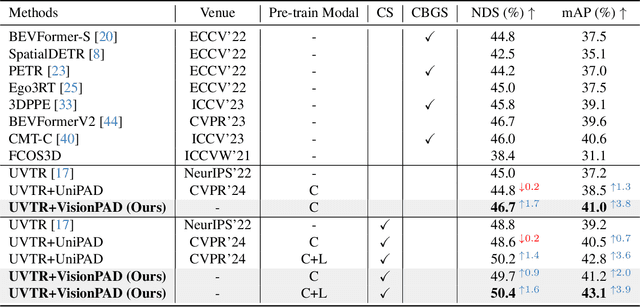
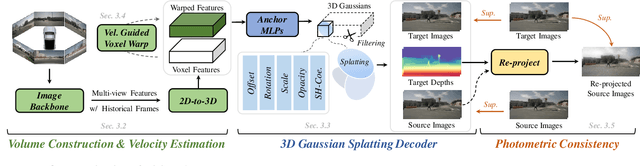
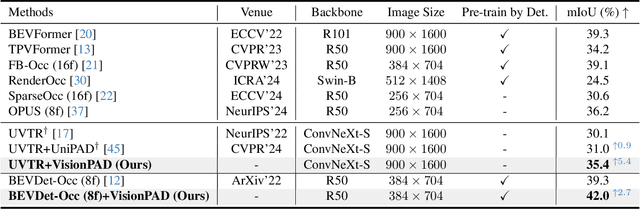
This paper introduces VisionPAD, a novel self-supervised pre-training paradigm designed for vision-centric algorithms in autonomous driving. In contrast to previous approaches that employ neural rendering with explicit depth supervision, VisionPAD utilizes more efficient 3D Gaussian Splatting to reconstruct multi-view representations using only images as supervision. Specifically, we introduce a self-supervised method for voxel velocity estimation. By warping voxels to adjacent frames and supervising the rendered outputs, the model effectively learns motion cues in the sequential data. Furthermore, we adopt a multi-frame photometric consistency approach to enhance geometric perception. It projects adjacent frames to the current frame based on rendered depths and relative poses, boosting the 3D geometric representation through pure image supervision. Extensive experiments on autonomous driving datasets demonstrate that VisionPAD significantly improves performance in 3D object detection, occupancy prediction and map segmentation, surpassing state-of-the-art pre-training strategies by a considerable margin.
KAN-AD: Time Series Anomaly Detection with Kolmogorov-Arnold Networks
Nov 01, 2024


Time series anomaly detection (TSAD) has become an essential component of large-scale cloud services and web systems because it can promptly identify anomalies, providing early warnings to prevent greater losses. Deep learning-based forecasting methods have become very popular in TSAD due to their powerful learning capabilities. However, accurate predictions don't necessarily lead to better anomaly detection. Due to the common occurrence of noise, i.e., local peaks and drops in time series, existing black-box learning methods can easily learn these unintended patterns, significantly affecting anomaly detection performance. Kolmogorov-Arnold Networks (KAN) offers a potential solution by decomposing complex temporal sequences into a combination of multiple univariate functions, making the training process more controllable. However, KAN optimizes univariate functions using spline functions, which are also susceptible to the influence of local anomalies. To address this issue, we present KAN-AD, which leverages the Fourier series to emphasize global temporal patterns, thereby mitigating the influence of local peaks and drops. KAN-AD improves both effectiveness and efficiency by transforming the existing black-box learning approach into learning the weights preceding univariate functions. Experimental results show that, compared to the current state-of-the-art, we achieved an accuracy increase of 15% while boosting inference speed by 55 times.
TimeSeriesBench: An Industrial-Grade Benchmark for Time Series Anomaly Detection Models
Feb 26, 2024Driven by the proliferation of real-world application scenarios and scales, time series anomaly detection (TSAD) has attracted considerable scholarly and industrial interest. However, existing algorithms exhibit a gap in terms of training paradigm, online detection paradigm, and evaluation criteria when compared to the actual needs of real-world industrial systems. Firstly, current algorithms typically train a specific model for each individual time series. In a large-scale online system with tens of thousands of curves, maintaining such a multitude of models is impractical. The performance of using merely one single unified model to detect anomalies remains unknown. Secondly, most TSAD models are trained on the historical part of a time series and are tested on its future segment. In distributed systems, however, there are frequent system deployments and upgrades, with new, previously unseen time series emerging daily. The performance of testing newly incoming unseen time series on current TSAD algorithms remains unknown. Lastly, although some papers have conducted detailed surveys, the absence of an online evaluation platform prevents answering questions like "Who is the best at anomaly detection at the current stage?" In this paper, we propose TimeSeriesBench, an industrial-grade benchmark that we continuously maintain as a leaderboard. On this leaderboard, we assess the performance of existing algorithms across more than 168 evaluation settings combining different training and testing paradigms, evaluation metrics and datasets. Through our comprehensive analysis of the results, we provide recommendations for the future design of anomaly detection algorithms. To address known issues with existing public datasets, we release an industrial dataset to the public together with TimeSeriesBench. All code, data, and the online leaderboard have been made publicly available.
Revisiting VAE for Unsupervised Time Series Anomaly Detection: A Frequency Perspective
Feb 05, 2024Time series Anomaly Detection (AD) plays a crucial role for web systems. Various web systems rely on time series data to monitor and identify anomalies in real time, as well as to initiate diagnosis and remediation procedures. Variational Autoencoders (VAEs) have gained popularity in recent decades due to their superior de-noising capabilities, which are useful for anomaly detection. However, our study reveals that VAE-based methods face challenges in capturing long-periodic heterogeneous patterns and detailed short-periodic trends simultaneously. To address these challenges, we propose Frequency-enhanced Conditional Variational Autoencoder (FCVAE), a novel unsupervised AD method for univariate time series. To ensure an accurate AD, FCVAE exploits an innovative approach to concurrently integrate both the global and local frequency features into the condition of Conditional Variational Autoencoder (CVAE) to significantly increase the accuracy of reconstructing the normal data. Together with a carefully designed "target attention" mechanism, our approach allows the model to pick the most useful information from the frequency domain for better short-periodic trend construction. Our FCVAE has been evaluated on public datasets and a large-scale cloud system, and the results demonstrate that it outperforms state-of-the-art methods. This confirms the practical applicability of our approach in addressing the limitations of current VAE-based anomaly detection models.