 Add to Chrome
 Add to Firefox
 Add to Edge
Relating CNN-Transformer Fusion Network for Change Detection
Jul 03, 2024
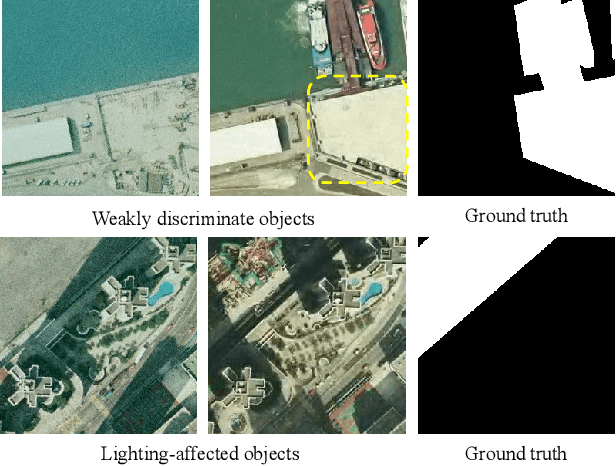
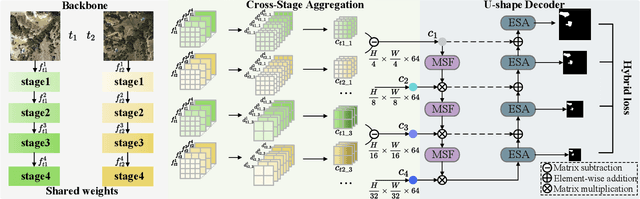
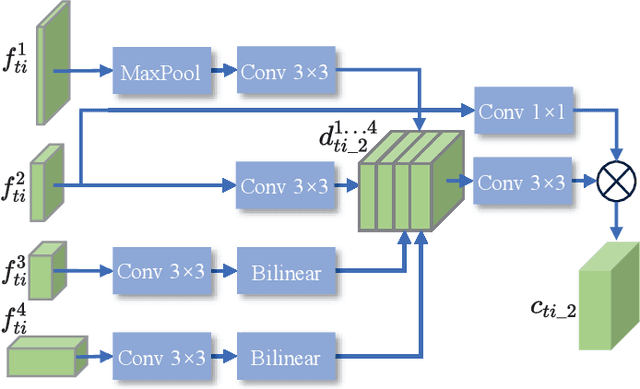
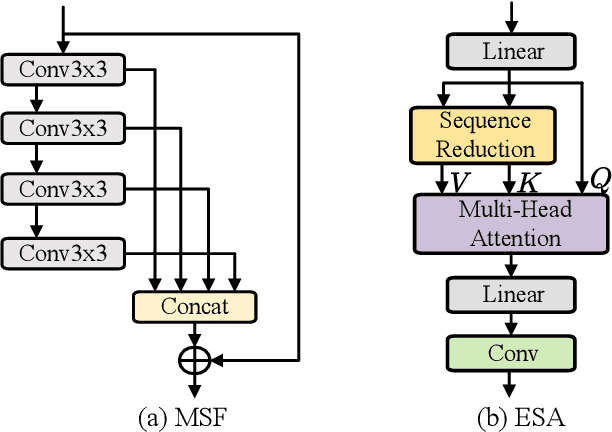
While deep learning, particularly convolutional neural networks (CNNs), has revolutionized remote sensing (RS) change detection (CD), existing approaches often miss crucial features due to neglecting global context and incomplete change learning. Additionally, transformer networks struggle with low-level details. RCTNet addresses these limitations by introducing \textbf{(1)} an early fusion backbone to exploit both spatial and temporal features early on, \textbf{(2)} a Cross-Stage Aggregation (CSA) module for enhanced temporal representation, \textbf{(3)} a Multi-Scale Feature Fusion (MSF) module for enriched feature extraction in the decoder, and \textbf{(4)} an Efficient Self-deciphering Attention (ESA) module utilizing transformers to capture global information and fine-grained details for accurate change detection. Extensive experiments demonstrate RCTNet's clear superiority over traditional RS image CD methods, showing significant improvement and an optimal balance between accuracy and computational cost.

Knowledge Transfer with Simulated Inter-Image Erasing for Weakly Supervised Semantic Segmentation
Jul 03, 2024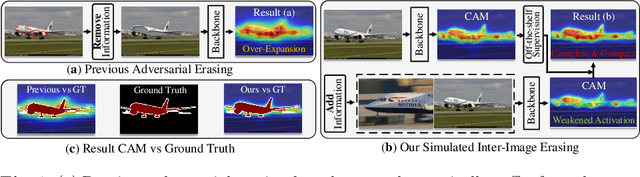
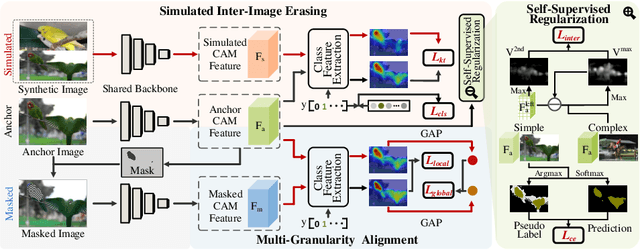
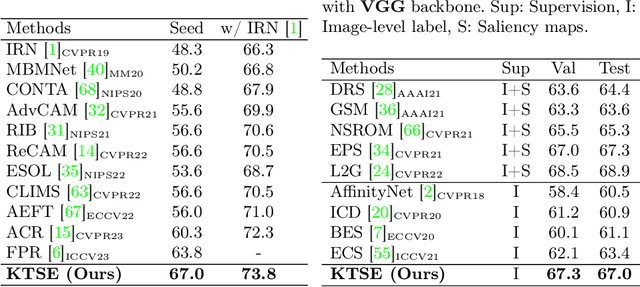
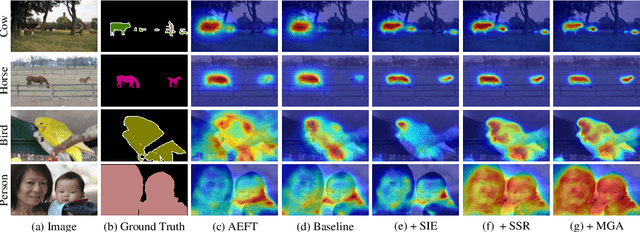
Though adversarial erasing has prevailed in weakly supervised semantic segmentation to help activate integral object regions, existing approaches still suffer from the dilemma of under-activation and over-expansion due to the difficulty in determining when to stop erasing. In this paper, we propose a \textbf{K}nowledge \textbf{T}ransfer with \textbf{S}imulated Inter-Image \textbf{E}rasing (KTSE) approach for weakly supervised semantic segmentation to alleviate the above problem. In contrast to existing erasing-based methods that remove the discriminative part for more object discovery, we propose a simulated inter-image erasing scenario to weaken the original activation by introducing extra object information. Then, object knowledge is transferred from the anchor image to the consequent less activated localization map to strengthen network localization ability. Considering the adopted bidirectional alignment will also weaken the anchor image activation if appropriate constraints are missing, we propose a self-supervised regularization module to maintain the reliable activation in discriminative regions and improve the inter-class object boundary recognition for complex images with multiple categories of objects. In addition, we resort to intra-image erasing and propose a multi-granularity alignment module to gently enlarge the object activation to boost the object knowledge transfer. Extensive experiments and ablation studies on PASCAL VOC 2012 and COCO datasets demonstrate the superiority of our proposed approach. Source codes and models are available at https://github.com/NUST-Machine-Intelligence-Laboratory/KTSE.
Lightweight Model Pre-training via Language Guided Knowledge Distillation
Jun 17, 2024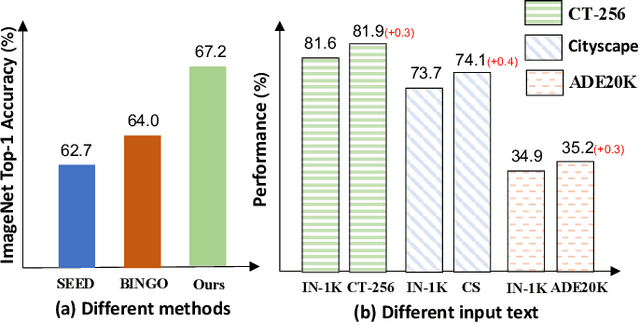
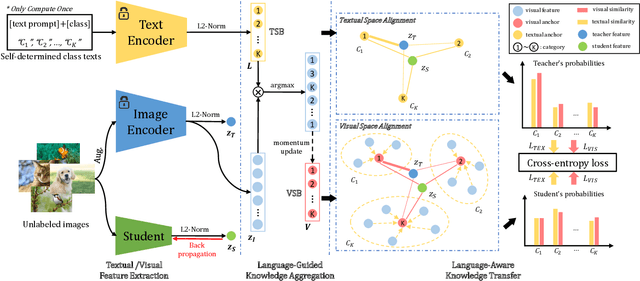
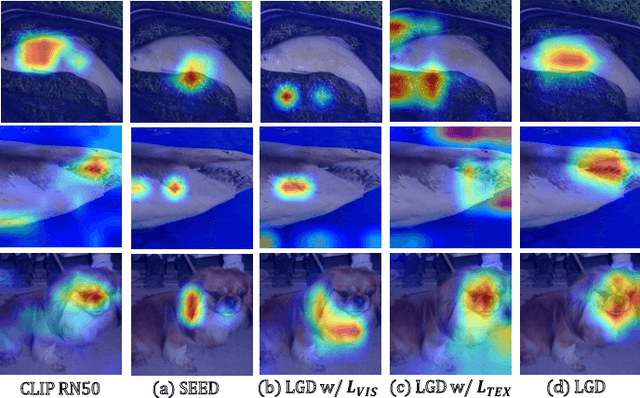
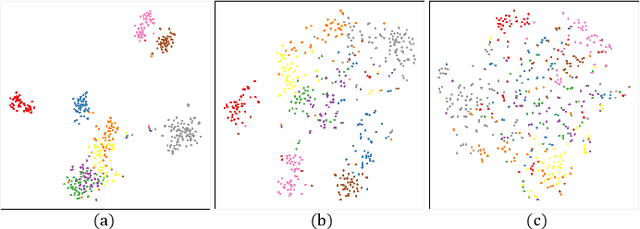
This paper studies the problem of pre-training for small models, which is essential for many mobile devices. Current state-of-the-art methods on this problem transfer the representational knowledge of a large network (as a Teacher) into a smaller model (as a Student) using self-supervised distillation, improving the performance of the small model on downstream tasks. However, existing approaches are insufficient in extracting the crucial knowledge that is useful for discerning categories in downstream tasks during the distillation process. In this paper, for the first time, we introduce language guidance to the distillation process and propose a new method named Language-Guided Distillation (LGD) system, which uses category names of the target downstream task to help refine the knowledge transferred between the teacher and student. To this end, we utilize a pre-trained text encoder to extract semantic embeddings from language and construct a textual semantic space called Textual Semantics Bank (TSB). Furthermore, we design a Language-Guided Knowledge Aggregation (LGKA) module to construct the visual semantic space, also named Visual Semantics Bank (VSB). The task-related knowledge is transferred by driving a student encoder to mimic the similarity score distribution inferred by a teacher over TSB and VSB. Compared with other small models obtained by either ImageNet pre-training or self-supervised distillation, experiment results show that the distilled lightweight model using the proposed LGD method presents state-of-the-art performance and is validated on various downstream tasks, including classification, detection, and segmentation. We have made the code available at https://github.com/mZhenz/LGD.
Adapter-X: A Novel General Parameter-Efficient Fine-Tuning Framework for Vision
Jun 06, 2024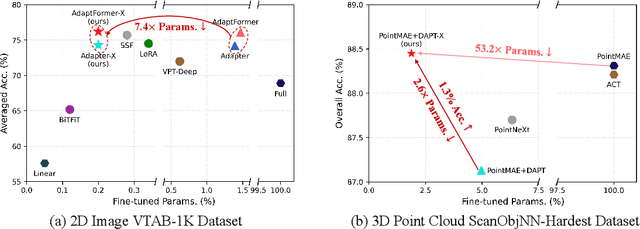

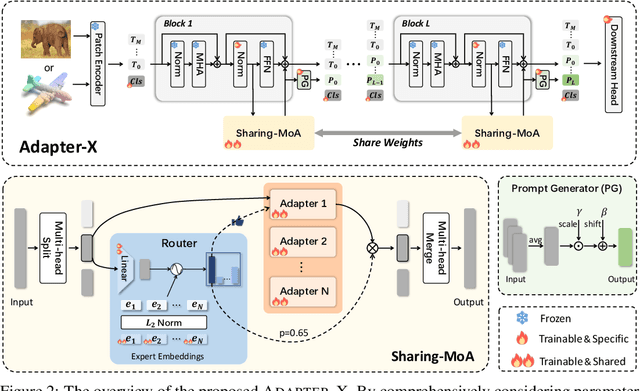

Parameter-efficient fine-tuning (PEFT) has become increasingly important as foundation models continue to grow in both popularity and size. Adapter has been particularly well-received due to their potential for parameter reduction and adaptability across diverse tasks. However, striking a balance between high efficiency and robust generalization across tasks remains a challenge for adapter-based methods. We analyze existing methods and find that: 1) parameter sharing is the key to reducing redundancy; 2) more tunable parameters, dynamic allocation, and block-specific design are keys to improving performance. Unfortunately, no previous work considers all these factors. Inspired by this insight, we introduce a novel framework named Adapter-X. First, a Sharing Mixture of Adapters (SMoA) module is proposed to fulfill token-level dynamic allocation, increased tunable parameters, and inter-block sharing at the same time. Second, some block-specific designs like Prompt Generator (PG) are introduced to further enhance the ability of adaptation. Extensive experiments across 2D image and 3D point cloud modalities demonstrate that Adapter-X represents a significant milestone as it is the first to outperform full fine-tuning in both 2D image and 3D point cloud modalities with significantly fewer parameters, i.e., only 0.20% and 1.88% of original trainable parameters for 2D and 3D classification tasks. Our code will be publicly available.
$Δ$-DiT: A Training-Free Acceleration Method Tailored for Diffusion Transformers
Jun 03, 2024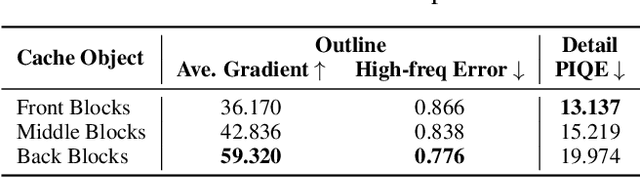
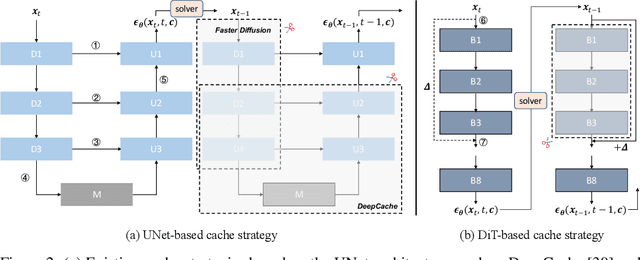
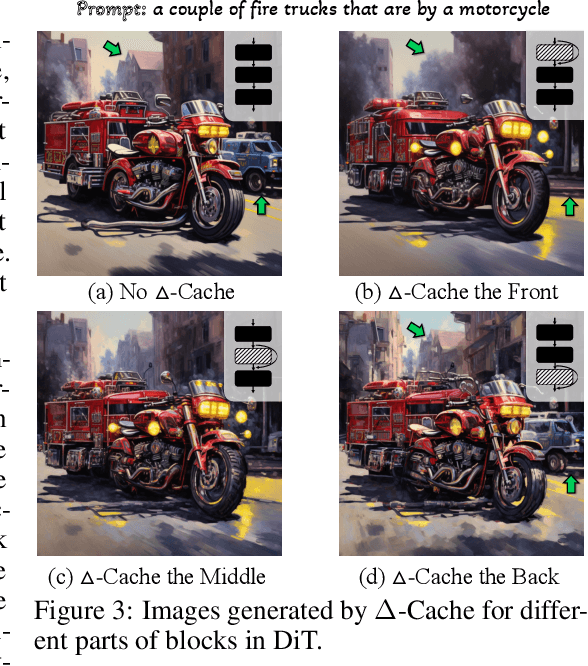
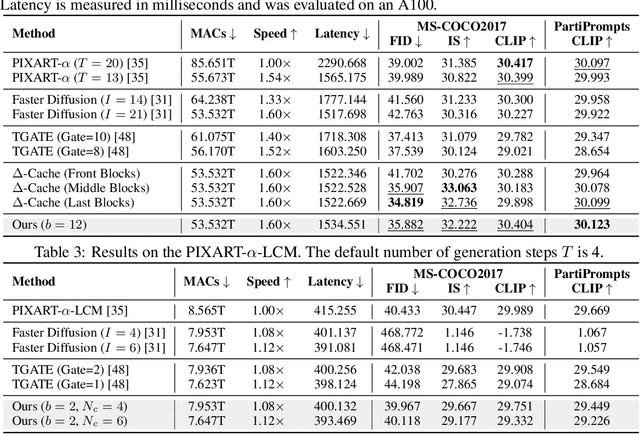
Diffusion models are widely recognized for generating high-quality and diverse images, but their poor real-time performance has led to numerous acceleration works, primarily focusing on UNet-based structures. With the more successful results achieved by diffusion transformers (DiT), there is still a lack of exploration regarding the impact of DiT structure on generation, as well as the absence of an acceleration framework tailored to the DiT architecture. To tackle these challenges, we conduct an investigation into the correlation between DiT blocks and image generation. Our findings reveal that the front blocks of DiT are associated with the outline of the generated images, while the rear blocks are linked to the details. Based on this insight, we propose an overall training-free inference acceleration framework $\Delta$-DiT: using a designed cache mechanism to accelerate the rear DiT blocks in the early sampling stages and the front DiT blocks in the later stages. Specifically, a DiT-specific cache mechanism called $\Delta$-Cache is proposed, which considers the inputs of the previous sampling image and reduces the bias in the inference. Extensive experiments on PIXART-$\alpha$ and DiT-XL demonstrate that the $\Delta$-DiT can achieve a $1.6\times$ speedup on the 20-step generation and even improves performance in most cases. In the scenario of 4-step consistent model generation and the more challenging $1.12\times$ acceleration, our method significantly outperforms existing methods. Our code will be publicly available.
FNP: Fourier Neural Processes for Arbitrary-Resolution Data Assimilation
Jun 03, 2024Data assimilation is a vital component in modern global medium-range weather forecasting systems to obtain the best estimation of the atmospheric state by combining the short-term forecast and observations. Recently, AI-based data assimilation approaches have attracted increasing attention for their significant advantages over traditional techniques in terms of computational consumption. However, existing AI-based data assimilation methods can only handle observations with a specific resolution, lacking the compatibility and generalization ability to assimilate observations with other resolutions. Considering that complex real-world observations often have different resolutions, we propose the \textit{\textbf{Fourier Neural Processes}} (FNP) for \textit{arbitrary-resolution data assimilation} in this paper. Leveraging the efficiency of the designed modules and flexible structure of neural processes, FNP achieves state-of-the-art results in assimilating observations with varying resolutions, and also exhibits increasing advantages over the counterparts as the resolution and the amount of observations increase. Moreover, our FNP trained on a fixed resolution can directly handle the assimilation of observations with out-of-distribution resolutions and the observational information reconstruction task without additional fine-tuning, demonstrating its excellent generalization ability across data resolutions as well as across tasks.
Learning Multimodal Behaviors from Scratch with Diffusion Policy Gradient
Jun 02, 2024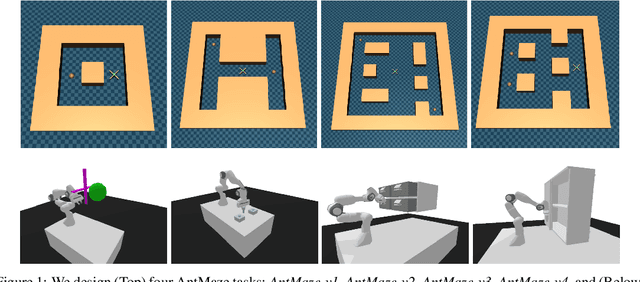


Deep reinforcement learning (RL) algorithms typically parameterize the policy as a deep network that outputs either a deterministic action or a stochastic one modeled as a Gaussian distribution, hence restricting learning to a single behavioral mode. Meanwhile, diffusion models emerged as a powerful framework for multimodal learning. However, the use of diffusion policies in online RL is hindered by the intractability of policy likelihood approximation, as well as the greedy objective of RL methods that can easily skew the policy to a single mode. This paper presents Deep Diffusion Policy Gradient (DDiffPG), a novel actor-critic algorithm that learns from scratch multimodal policies parameterized as diffusion models while discovering and maintaining versatile behaviors. DDiffPG explores and discovers multiple modes through off-the-shelf unsupervised clustering combined with novelty-based intrinsic motivation. DDiffPG forms a multimodal training batch and utilizes mode-specific Q-learning to mitigate the inherent greediness of the RL objective, ensuring the improvement of the diffusion policy across all modes. Our approach further allows the policy to be conditioned on mode-specific embeddings to explicitly control the learned modes. Empirical studies validate DDiffPG's capability to master multimodal behaviors in complex, high-dimensional continuous control tasks with sparse rewards, also showcasing proof-of-concept dynamic online replanning when navigating mazes with unseen obstacles.
MeshXL: Neural Coordinate Field for Generative 3D Foundation Models
May 31, 2024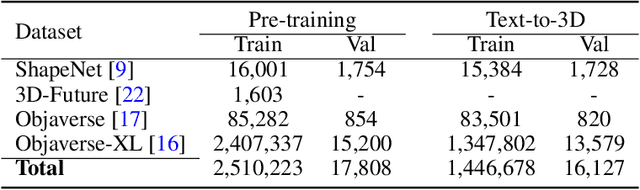


The polygon mesh representation of 3D data exhibits great flexibility, fast rendering speed, and storage efficiency, which is widely preferred in various applications. However, given its unstructured graph representation, the direct generation of high-fidelity 3D meshes is challenging. Fortunately, with a pre-defined ordering strategy, 3D meshes can be represented as sequences, and the generation process can be seamlessly treated as an auto-regressive problem. In this paper, we validate the Neural Coordinate Field (NeurCF), an explicit coordinate representation with implicit neural embeddings, is a simple-yet-effective representation for large-scale sequential mesh modeling. After that, we present MeshXL, a family of generative pre-trained auto-regressive models, which addresses the process of 3D mesh generation with modern large language model approaches. Extensive experiments show that MeshXL is able to generate high-quality 3D meshes, and can also serve as foundation models for various down-stream applications.
EMR-Merging: Tuning-Free High-Performance Model Merging
May 23, 2024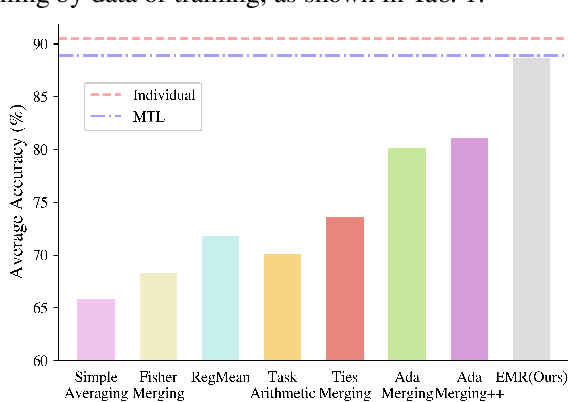
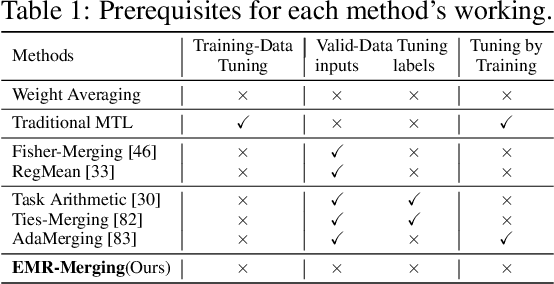
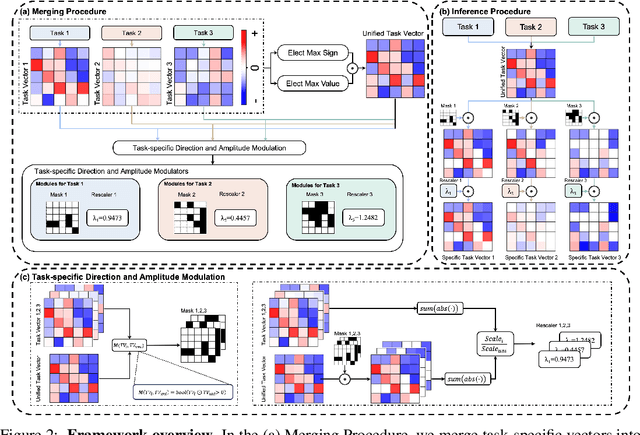
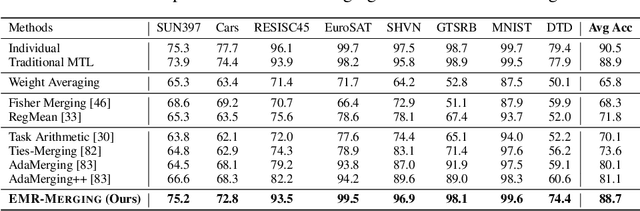
The success of pretrain-finetune paradigm brings about the release of numerous model weights. In this case, merging models finetuned on different tasks to enable a single model with multi-task capabilities is gaining increasing attention for its practicability. Existing model merging methods usually suffer from (1) significant performance degradation or (2) requiring tuning by additional data or training. In this paper, we rethink and analyze the existing model merging paradigm. We discover that using a single model's weights can hardly simulate all the models' performance. To tackle this issue, we propose Elect, Mask & Rescale-Merging (EMR-Merging). We first (a) elect a unified model from all the model weights and then (b) generate extremely lightweight task-specific modulators, including masks and rescalers, to align the direction and magnitude between the unified model and each specific model, respectively. EMR-Merging is tuning-free, thus requiring no data availability or any additional training while showing impressive performance. We find that EMR-Merging shows outstanding performance compared to existing merging methods under different classical and newly-established settings, including merging different numbers of vision models (up to 30), NLP models, PEFT models, and multi-modal models.
FLDM-VTON: Faithful Latent Diffusion Model for Virtual Try-on
Apr 22, 2024Despite their impressive generative performance, latent diffusion model-based virtual try-on (VTON) methods lack faithfulness to crucial details of the clothes, such as style, pattern, and text. To alleviate these issues caused by the diffusion stochastic nature and latent supervision, we propose a novel Faithful Latent Diffusion Model for VTON, termed FLDM-VTON. FLDM-VTON improves the conventional latent diffusion process in three major aspects. First, we propose incorporating warped clothes as both the starting point and local condition, supplying the model with faithful clothes priors. Second, we introduce a novel clothes flattening network to constrain generated try-on images, providing clothes-consistent faithful supervision. Third, we devise a clothes-posterior sampling for faithful inference, further enhancing the model performance over conventional clothes-agnostic Gaussian sampling. Extensive experimental results on the benchmark VITON-HD and Dress Code datasets demonstrate that our FLDM-VTON outperforms state-of-the-art baselines and is able to generate photo-realistic try-on images with faithful clothing details.