 Add to Chrome
 Add to Firefox
 Add to Edge
TOOD: Task-Aware Out-of-Distribution Score Calibration for Continual Learners
Jul 31, 2026
The primary challenge of continual learning (CL) systems is to learn new tasks while remaining performant on previously learned tasks. A similarly important though less well-studied aspect of CL systems is their ability to distinguish inputs that are unlikely to come from within the set of tasks the system has already encountered, often called out-of-distribution (OOD) detection. This paper presents several findings related to the dynamics of OOD detection in CL systems, causes of performance degradation over time which we call OOD forgetting (OODF), and proposed mitigation strategies for this degradation. Chiefly, we find the unintuitive result that OODF is only weakly anti-correlated with classification performance on previous tasks, suggesting that the underlying mechanisms producing OODF are distinct. Moreover, this effect is observed for both energy-based and feature-based OOD detection methods. Energy-based detectors suffer a drop in logit scale as additional tasks are learned, which we term the Confidence Gap, while feature-based detectors also degrade under a complementary effect we call Manifold Crowding. Motivated by these observations, we propose TOOD, a training-free post-hoc method that decomposes logits into per-task energy scores and re-calibrates them using replay-buffer statistics. Experiments on CIFAR-10, CIFAR-100, and a 100-task ImageNet-1K stream show that TOOD improves OOD detection performance over uncalibrated energy in most settings and ranks first or second in nine of ten CIFAR configurations, with the largest gains when the confidence gap is most severe. These results suggest that a substantial portion of OOD deterioration in continual learning arises from score miscalibration rather than from a complete loss of discriminative structure.

FlowMaps: Modeling Long-Term Multimodal Object Dynamics with Flow Matching
Jun 18, 2026Joint spatial and temporal understanding of 3D scenes is a crucial requirement for robots deployed in everyday household environments. Such agents must not only comprehend and navigate spatial layouts, but also reason about how these spaces evolve over time. In particular, humans interact with objects daily, causing them to change position throughout the environment and making it difficult for robots to reliably associate current observations with previously seen objects. However, these interactions are not random: human habits and routines induce spatio-temporally consistent patterns in object locations, which robotic agents can potentially learn and then exploit for downstream tasks such as navigation. To this end, we introduce FlowMaps, a latent flow matching model for estimating multimodal distributions over the future locations of dynamic objects in a continuous 3D space. By learning the implicit dependencies among objects and their temporal evolution, FlowMaps predicts likely changes in object locations conditioned on past human interactions, while supporting generalization across previously unseen environments that share similar object routines. To demonstrate the utility of this method, we deploy FlowMaps in a downstream dynamic Object Navigation task in both simulated and real-world environments. Across more than 600 episodes, FlowMaps outperforms state-of-the-art approaches, showing that modeling object dynamics through continuous, multimodal spatio-temporal distributions improves robotic search and navigation in changing household environments. Code and additional material is available at https://fra-tsuna.github.io/flowmaps/.
Scaling Self-Play for End-to-End Driving
Jun 17, 2026End-to-end autonomous driving models are typically trained on offline human-demonstration datasets that provide limited state coverage and often no closed-loop feedback, making them prone to compounding errors when deployed in closed-loop and brittle to long-tail agent interactions. To overcome these limitations, we propose an alternative strategy for training end-to-end driving models: large-scale self-play directly from pixels in simulation. While prior self-play approaches have shown promising transfer to real-world driving, they typically assume vectorized Bird's-Eye-View (BEV) observations that are incompatible with end-to-end policies operating directly on sensor observations. To this end, we introduce Gigapixel, a high-throughput batched driving simulator with perspective rendering, enabling scalable self-play directly from pixel observations. Rather than targeting compute-costly photorealistic sensor simulation, Gigapixel renders a simplified bounding-box world that preserves essential scene structure while achieving throughput at 50k agent steps per second. Since direct pixel-space self-play RL is prohibitively sample-inefficient at end-to-end model scale, we propose self-play DAgger training: we train pixel-based policies in self-play via on-policy distillation from a privileged RL teacher. To bridge the sim-to-real gap, we subsequently transfer the self-play trained policies to real-world sensor data through lightweight perception adaptation. Policies trained in Gigapixel and adapted to real-world sensor data achieve competitive performance on the HUGSIM and NAVSIM-v2 benchmarks without human trajectory supervision. Moreover, scaling self-play training yields proportional gains in policy performance, establishing self-play as a practical and scalable strategy for training end-to-end models.
3D Scene Graphs: Open Challenges and Future Directions
Jun 15, 20263D Scene Graphs (3DSGs) have emerged as a powerful representation for spatial AI by combining geometric grounding with semantic and relational abstractions of the environment. Their expressiveness has made them relevant to a broad range of problems in robotics and computer vision, including manipulation, navigation, task planning, scene understanding, and many others. However, the field remains fragmented: different communities adopt distinct formulations, construction pipelines, and evaluation protocols, making it difficult to compare methods, identify common assumptions, and assess remaining challenges for robust real-world deployment. This survey provides a unified and critical review of 3DSGs, with particular emphasis on open challenges and future directions. We first formalize 3DSGs under a common definition and analyze the principal modeling choices that characterize existing formulations, including node and edge attributes, hierarchical structure, dynamic scene representations, and affordance-aware extensions. We then review how 3DSGs are built from raw sensory observations, discussing the most common terminologies, conventions, and techniques. Finally, we examine downstream applications and evaluation strategies, from intrinsic graph quality to task-level performance. To support the community, we also provide a dedicated website that organizes and extends the surveyed content, accessible at https://3dscenegraphs.com/.
SHAPO: Sharpness-Aware Policy Optimization for Safe Exploration
Jun 08, 2026Safe exploration is a prerequisite for deploying reinforcement learning (RL) agents in safety-critical domains. In this paper, we approach safe exploration through the lens of epistemic uncertainty, where the actor's sensitivity to parameter perturbations serves as a practical proxy for regions of high uncertainty. We propose Sharpness-Aware Policy Optimization (SHAPO), a sharpness-aware policy update rule that evaluates gradients at perturbed parameters, making policy updates pessimistic with respect to the actor's epistemic uncertainty. Analytically we show that this adjustment implicitly reweighs policy gradients, amplifying the influence of rare unsafe actions while tempering contributions from already safe ones, thereby biasing learning toward conservative behavior in under-explored regions. Across several continuous-control tasks, our method consistently improves both safety and task performance over existing baselines, significantly expanding their Pareto frontiers.
PerceptTwin: Semantic Scene Reconstruction for Iterative LLM Planning and Verification
Jun 02, 2026Simulation environments are useful for both robot policy learning and planning verification and validation. Traditionally, the process of creating a simulation was onerous. Creating a bespoke simulation environment for each individual environment that a robot would operate in was simply infeasible. In this work, we introduce PerceptTwin, a fully automatic pipeline that constructs interactive simulations directly from semantic scene representations produced by a robot's perception stack. PerceptTwin combines open-vocabulary object maps with 3D asset generation, affordance prediction, and commonsense condition checking. These interactive simulations can be used to validate and refine plans before they are executed on the robot hardware. Borrowing from the AI alignment literature, we also introduce an LLM judge that verifies plan correctness and alignment with human preferences. Experiments show that PerceptTwin feedback allows LLM planners to refine plans, enhance safety, and resist harmful black-box prompting attacks. In our suite of tasks, PerceptTwin improves plan success by an average of approximately 39% for GPT5, GPT5Mini, and GPT5Nano planners. Additionally, PerceptTwin also improves human plan verification by up to 18% on average for plans that fail due to unfilled skill preconditions. Our results demonstrate the potential of open-vocabulary scene simulation from robot perception as a foundation for safer, more reliable robot planning.
Constrained Group Relative Policy Optimization
Feb 05, 2026While Group Relative Policy Optimization (GRPO) has emerged as a scalable framework for critic-free policy learning, extending it to settings with explicit behavioral constraints remains underexplored. We introduce Constrained GRPO, a Lagrangian-based extension of GRPO for constrained policy optimization. Constraints are specified via indicator cost functions, enabling direct optimization of violation rates through a Lagrangian relaxation. We show that a naive multi-component treatment in advantage estimation can break constrained learning: mismatched component-wise standard deviations distort the relative importance of the different objective terms, which in turn corrupts the Lagrangian signal and prevents meaningful constraint enforcement. We formally derive this effect to motivate our scalarized advantage construction that preserves the intended trade-off between reward and constraint terms. Experiments in a toy gridworld confirm the predicted optimization pathology and demonstrate that scalarizing advantages restores stable constraint control. In addition, we evaluate Constrained GRPO on robotics tasks, where it improves constraint satisfaction while increasing task success, establishing a simple and effective recipe for constrained policy optimization in embodied AI domains that increasingly rely on large multimodal foundation models.
Poutine: Vision-Language-Trajectory Pre-Training and Reinforcement Learning Post-Training Enable Robust End-to-End Autonomous Driving
Jun 12, 2025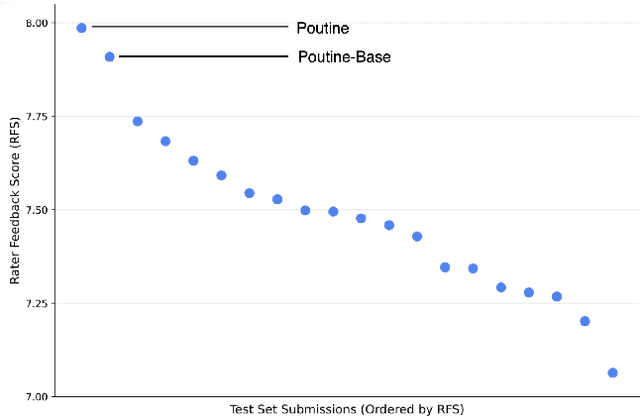
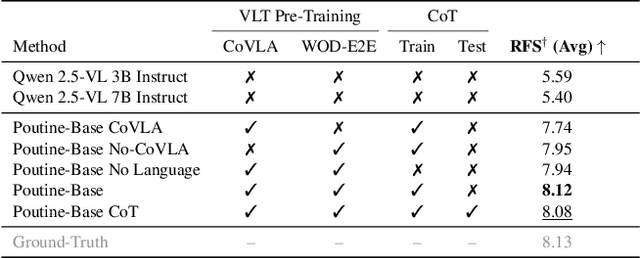
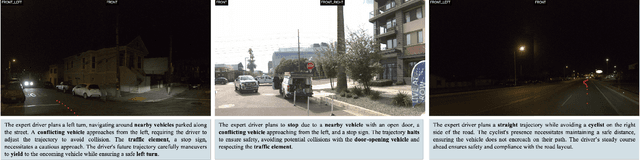
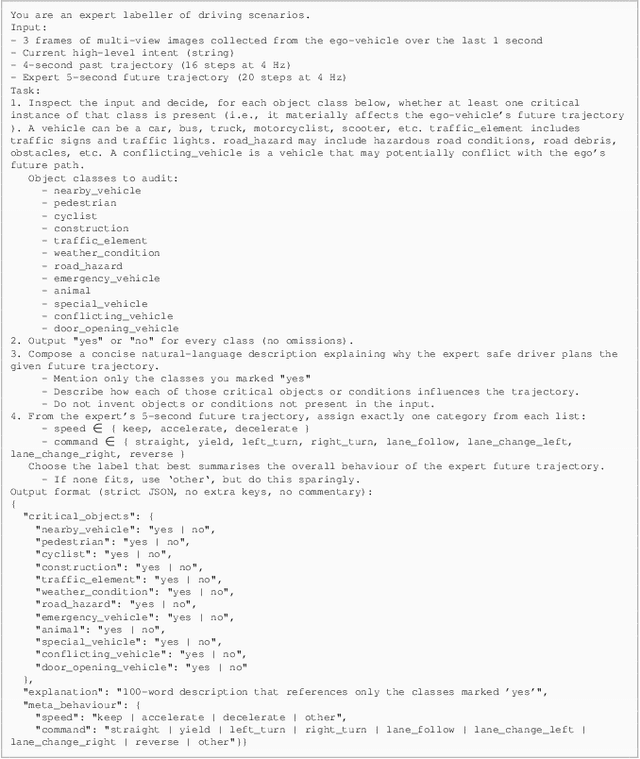
We present Poutine, a 3B-parameter vision-language model (VLM) tailored for end-to-end autonomous driving in long-tail driving scenarios. Poutine is trained in two stages. To obtain strong base driving capabilities, we train Poutine-Base in a self-supervised vision-language-trajectory (VLT) next-token prediction fashion on 83 hours of CoVLA nominal driving and 11 hours of Waymo long-tail driving. Accompanying language annotations are auto-generated with a 72B-parameter VLM. Poutine is obtained by fine-tuning Poutine-Base with Group Relative Policy Optimization (GRPO) using less than 500 preference-labeled frames from the Waymo validation set. We show that both VLT pretraining and RL fine-tuning are critical to attain strong driving performance in the long-tail. Poutine-Base achieves a rater-feedback score (RFS) of 8.12 on the validation set, nearly matching Waymo's expert ground-truth RFS. The final Poutine model achieves an RFS of 7.99 on the official Waymo test set, placing 1st in the 2025 Waymo Vision-Based End-to-End Driving Challenge by a significant margin. These results highlight the promise of scalable VLT pre-training and lightweight RL fine-tuning to enable robust and generalizable autonomy.
Scenario Dreamer: Vectorized Latent Diffusion for Generating Driving Simulation Environments
Mar 28, 2025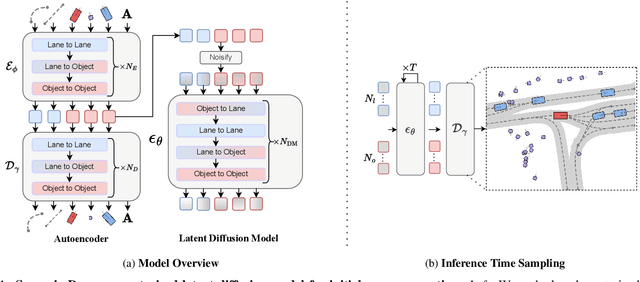

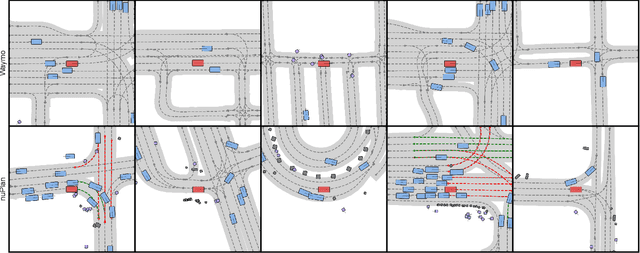
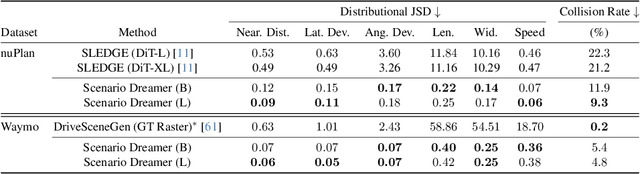
We introduce Scenario Dreamer, a fully data-driven generative simulator for autonomous vehicle planning that generates both the initial traffic scene - comprising a lane graph and agent bounding boxes - and closed-loop agent behaviours. Existing methods for generating driving simulation environments encode the initial traffic scene as a rasterized image and, as such, require parameter-heavy networks that perform unnecessary computation due to many empty pixels in the rasterized scene. Moreover, we find that existing methods that employ rule-based agent behaviours lack diversity and realism. Scenario Dreamer instead employs a novel vectorized latent diffusion model for initial scene generation that directly operates on the vectorized scene elements and an autoregressive Transformer for data-driven agent behaviour simulation. Scenario Dreamer additionally supports scene extrapolation via diffusion inpainting, enabling the generation of unbounded simulation environments. Extensive experiments show that Scenario Dreamer outperforms existing generative simulators in realism and efficiency: the vectorized scene-generation base model achieves superior generation quality with around 2x fewer parameters, 6x lower generation latency, and 10x fewer GPU training hours compared to the strongest baseline. We confirm its practical utility by showing that reinforcement learning planning agents are more challenged in Scenario Dreamer environments than traditional non-generative simulation environments, especially on long and adversarial driving environments.
OpenLex3D: A New Evaluation Benchmark for Open-Vocabulary 3D Scene Representations
Mar 25, 2025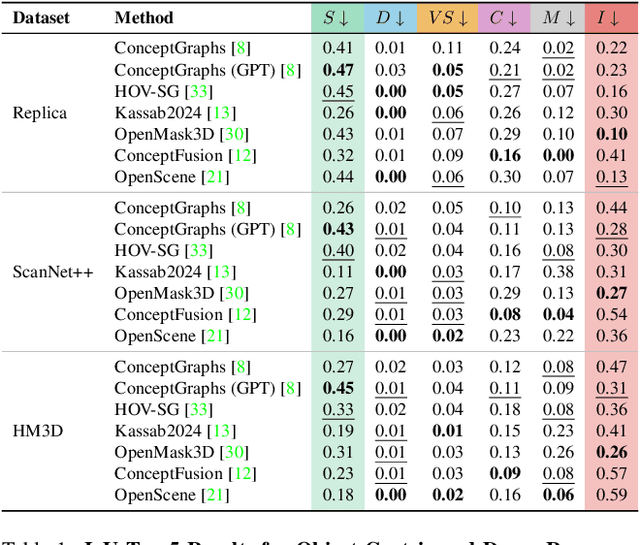
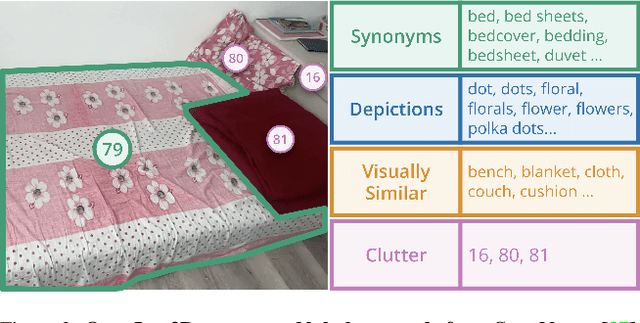
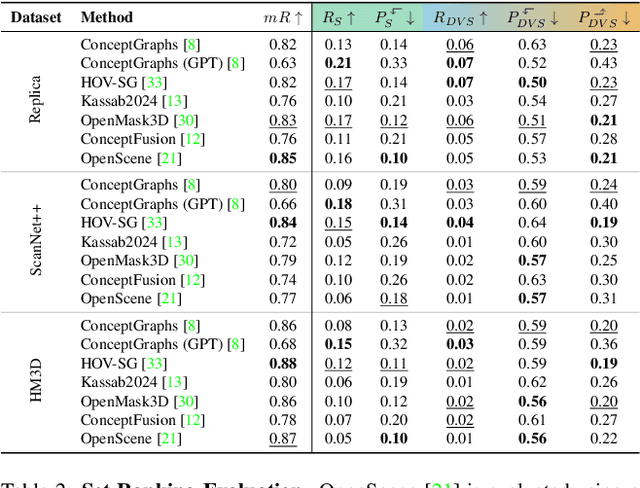
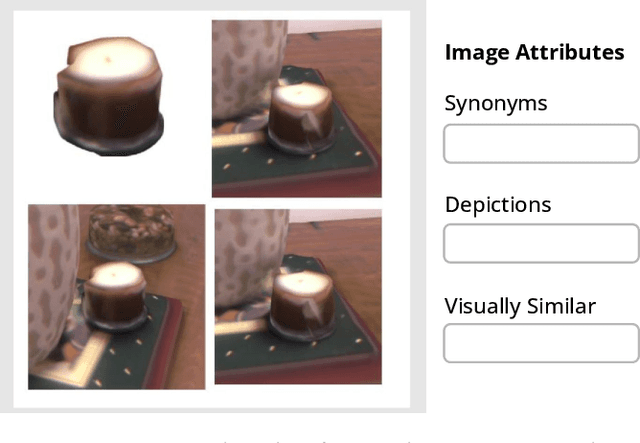
3D scene understanding has been transformed by open-vocabulary language models that enable interaction via natural language. However, the evaluation of these representations is limited to closed-set semantics that do not capture the richness of language. This work presents OpenLex3D, a dedicated benchmark to evaluate 3D open-vocabulary scene representations. OpenLex3D provides entirely new label annotations for 23 scenes from Replica, ScanNet++, and HM3D, which capture real-world linguistic variability by introducing synonymical object categories and additional nuanced descriptions. By introducing an open-set 3D semantic segmentation task and an object retrieval task, we provide insights on feature precision, segmentation, and downstream capabilities. We evaluate various existing 3D open-vocabulary methods on OpenLex3D, showcasing failure cases, and avenues for improvement. The benchmark is publicly available at: https://openlex3d.github.io/.