 Add to Chrome
 Add to Firefox
 Add to Edge
Beyond Frontiers: Scene-Anomaly Guided Autonomous Exploration
Jul 17, 2026
Autonomous exploration of unknown 3D environments is traditionally driven by coverage-maximizing geometric heuristics. However, these methods typically determine exploration targets without considering the underlying structural context. This leads to inefficient trajectories often limiting the fidelity of the final 3D reconstruction. To bridge the gap between spatial coverage and reconstruction quality, we introduce a novel paradigm: reframing exploration as a geometric anomaly minimization problem. We present SCAGE: SCene Anomaly Guided Exploration, a novel autonomous exploration framework that operates directly on unstructured 3D point clouds. Instead of blindly chasing volumetric boundaries, we equip the robot with a foundational understanding of standard indoor architecture. As the robot navigates, it continuously evaluates its live 3D observations against these learned expectations. When the incoming geometry contradicts the learned priors of a typical indoor environment, such as a fragmented wall or a partial table, the system flags these regions as scene anomalies. These geometric inconsistencies act as a guiding signal, naturally drawing the robot to investigate and resolve these structural anomalies from optimal vantage points. By actively targeting poorly reconstructed regions rather than just empty space, our approach seamlessly couples spatial discovery with high-fidelity mapping. Extensive evaluations demonstrate that SCAGE achieves superior volumetric coverage (~90% in all scenes) and higher 3D reconstruction quality compared to state-of-the-art baselines.

PixelLoop: Shortcut Topological Navigation with Pixel-Level Loops
Jul 14, 2026Although topological mapping and navigation have been studied extensively, the specific role and downstream effect of loop closures in purely topological representations has received relatively little attention. Importantly, loop closure over topological maps is distinct from loop closure over globally referenced trajectories and metric maps. Building on recent denser topologies grounded in pixel-level, relative 3D geometry, we propose PixelLoop which introduces loop closures directly in pixel space. Unlike sparse image-level edges or pose-graph corrections in SLAM, our pixel-level closures act as dense topological shortcuts that alter planning connectivity and cost propagation rather than merely aligning coordinates. This dense connectivity enables stable any-point-to-any-point navigation and produces costmaps that align accurately with geometric shortest paths. In particular, we showcase the distinct advantage of applying loop closures to fine-grained pixel topologies rather than image-level topologies. Across extensive simulated experiments, PixelLoop achieves over 35% absolute improvement in both Success Rate and SPL compared to image-relative baselines, with the largest gains in scenarios requiring shortcut exploitation. Results are further validated through real-world mobile robot deployments, demonstrating that dense pixel-level loop closures provide a practical and robust foundation for topological visual navigation. Project Page: https://pixelloop-nav.github.io/
MASt3R-Nav: WayPixel Navigation in Relative 3D Maps
May 22, 2026Visual navigation ability is strongly tied to its underlying representation of the world. Unlike classical 3D maps that require globally-consistent geometry, image- or object-relative topological graphs almost entirely do away with geometric understanding. But, this comes at the cost of navigation capability, often limiting it to merely teach-and-repeat. In this work, we propose a novel map representation in the form of pixel-relative connectivity, which is geometrically accurate but does not require global geometric consistency. Inspired by recent progress in 3D grounded image matching, we construct a map from an image sequence through inter-image connectivity based on pixel correspondences in the relative 3D coordinate systems of individual image pairs. We then use this pixel-level graph to perform global path planning by approximating and sparsifying intra-image pixel connectivity. Through this, we derive a ''WayPixel Costmap'' representation and train a controller conditioned on it to predict a trajectory rollout. We show that this dense pixel-level costmap based on relative geometry is a more accurate conditioning variable for control prediction than its image- and object-level counterparts. This enables a highly capable navigation system, as validated on four types of navigation tasks in the simulator and through real world demonstrations.
DART: Learning-Enhanced Model Predictive Control for Dual-Arm Non-Prehensile Manipulation
Apr 20, 2026What appears effortless to a human waiter remains a major challenge for robots. Manipulating objects nonprehensilely on a tray is inherently difficult, and the complexity is amplified in dual-arm settings. Such tasks are highly relevant to service robotics in domains such as hotels and hospitality, where robots must transport and reposition diverse objects with precision. We present DART, a novel dual-arm framework that integrates nonlinear Model Predictive Control (MPC) with an optimization-based impedance controller to achieve accurate object motion relative to a dynamically controlled tray. The framework systematically evaluates three complementary strategies for modeling tray-object dynamics as the state transition function within our MPC formulation: (i) a physics-based analytical model, (ii) an online regression based identification model that adapts in real-time, and (iii) a reinforcement learning-based dynamics model that generalizes across object properties. Our pipeline is validated in simulation with objects of varying mass, geometry, and friction coefficients. Extensive evaluations highlight the trade-offs among the three modeling strategies in terms of settling time, steady-state error, control effort, and generalization across objects. To the best of our knowledge, DART constitutes the first framework for non-prehensile dual-arm manipulation of objects on a tray. Project Link: https://dart-icra.github.io/dart/
SPOT: Spatio-Temporal Obstacle-free Trajectory Planning for UAVs in an Unknown Dynamic Environment
Feb 01, 2026We address the problem of reactive motion planning for quadrotors operating in unknown environments with dynamic obstacles. Our approach leverages a 4-dimensional spatio-temporal planner, integrated with vision-based Safe Flight Corridor (SFC) generation and trajectory optimization. Unlike prior methods that rely on map fusion, our framework is mapless, enabling collision avoidance directly from perception while reducing computational overhead. Dynamic obstacles are detected and tracked using a vision-based object segmentation and tracking pipeline, allowing robust classification of static versus dynamic elements in the scene. To further enhance robustness, we introduce a backup planning module that reactively avoids dynamic obstacles when no direct path to the goal is available, mitigating the risk of collisions during deadlock situations. We validate our method extensively in both simulation and real-world hardware experiments, and benchmark it against state-of-the-art approaches, showing significant advantages for reactive UAV navigation in dynamic, unknown environments.
SegMASt3R: Geometry Grounded Segment Matching
Oct 06, 2025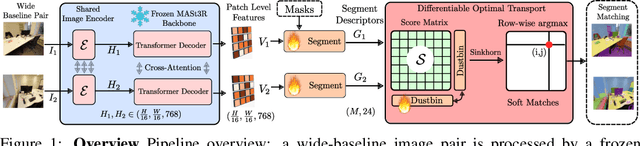
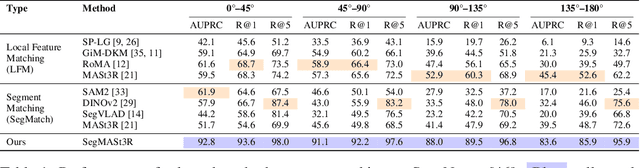

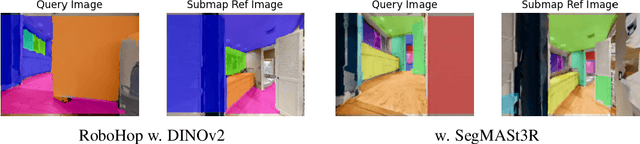
Segment matching is an important intermediate task in computer vision that establishes correspondences between semantically or geometrically coherent regions across images. Unlike keypoint matching, which focuses on localized features, segment matching captures structured regions, offering greater robustness to occlusions, lighting variations, and viewpoint changes. In this paper, we leverage the spatial understanding of 3D foundation models to tackle wide-baseline segment matching, a challenging setting involving extreme viewpoint shifts. We propose an architecture that uses the inductive bias of these 3D foundation models to match segments across image pairs with up to 180 degree view-point change. Extensive experiments show that our approach outperforms state-of-the-art methods, including the SAM2 video propagator and local feature matching methods, by upto 30% on the AUPRC metric, on ScanNet++ and Replica datasets. We further demonstrate benefits of the proposed model on relevant downstream tasks, including 3D instance segmentation and image-goal navigation. Project Page: https://segmast3r.github.io/
ObjectReact: Learning Object-Relative Control for Visual Navigation
Sep 11, 2025Visual navigation using only a single camera and a topological map has recently become an appealing alternative to methods that require additional sensors and 3D maps. This is typically achieved through an "image-relative" approach to estimating control from a given pair of current observation and subgoal image. However, image-level representations of the world have limitations because images are strictly tied to the agent's pose and embodiment. In contrast, objects, being a property of the map, offer an embodiment- and trajectory-invariant world representation. In this work, we present a new paradigm of learning "object-relative" control that exhibits several desirable characteristics: a) new routes can be traversed without strictly requiring to imitate prior experience, b) the control prediction problem can be decoupled from solving the image matching problem, and c) high invariance can be achieved in cross-embodiment deployment for variations across both training-testing and mapping-execution settings. We propose a topometric map representation in the form of a "relative" 3D scene graph, which is used to obtain more informative object-level global path planning costs. We train a local controller, dubbed "ObjectReact", conditioned directly on a high-level "WayObject Costmap" representation that eliminates the need for an explicit RGB input. We demonstrate the advantages of learning object-relative control over its image-relative counterpart across sensor height variations and multiple navigation tasks that challenge the underlying spatial understanding capability, e.g., navigating a map trajectory in the reverse direction. We further show that our sim-only policy is able to generalize well to real-world indoor environments. Code and supplementary material are accessible via project page: https://object-react.github.io/
AdaptBot: Combining LLM with Knowledge Graphs and Human Input for Generic-to-Specific Task Decomposition and Knowledge Refinement
Feb 04, 2025Embodied agents assisting humans are often asked to complete a new task in a new scenario. An agent preparing a particular dish in the kitchen based on a known recipe may be asked to prepare a new dish or to perform cleaning tasks in the storeroom. There may not be sufficient resources, e.g., time or labeled examples, to train the agent for these new situations. Large Language Models (LLMs) trained on considerable knowledge across many domains are able to predict a sequence of abstract actions for such new tasks and scenarios, although it may not be possible for the agent to execute this action sequence due to task-, agent-, or domain-specific constraints. Our framework addresses these challenges by leveraging the generic predictions provided by LLM and the prior domain-specific knowledge encoded in a Knowledge Graph (KG), enabling an agent to quickly adapt to new tasks and scenarios. The robot also solicits and uses human input as needed to refine its existing knowledge. Based on experimental evaluation over cooking and cleaning tasks in simulation domains, we demonstrate that the interplay between LLM, KG, and human input leads to substantial performance gains compared with just using the LLM output.
Anticipate & Act : Integrating LLMs and Classical Planning for Efficient Task Execution in Household Environments
Feb 04, 2025


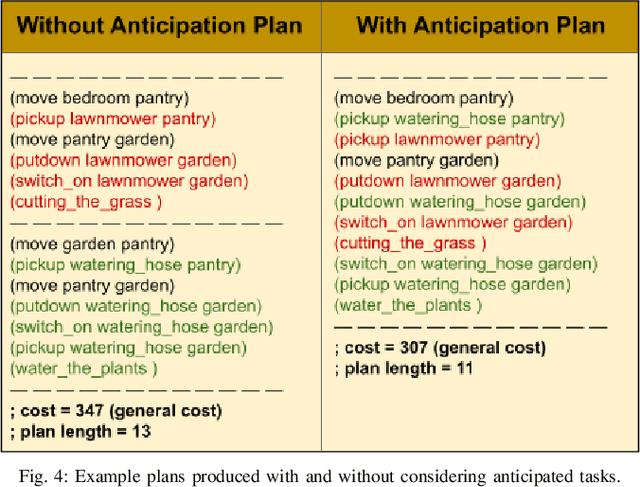
Assistive agents performing household tasks such as making the bed or cooking breakfast often compute and execute actions that accomplish one task at a time. However, efficiency can be improved by anticipating upcoming tasks and computing an action sequence that jointly achieves these tasks. State-of-the-art methods for task anticipation use data-driven deep networks and Large Language Models (LLMs), but they do so at the level of high-level tasks and/or require many training examples. Our framework leverages the generic knowledge of LLMs through a small number of prompts to perform high-level task anticipation, using the anticipated tasks as goals in a classical planning system to compute a sequence of finer-granularity actions that jointly achieve these goals. We ground and evaluate our framework's abilities in realistic scenarios in the VirtualHome environment and demonstrate a 31% reduction in execution time compared with a system that does not consider upcoming tasks.
GPD: Guided Polynomial Diffusion for Motion Planning
Jan 30, 2025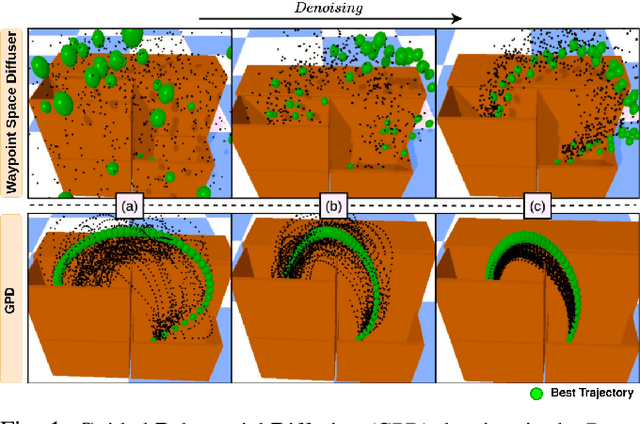
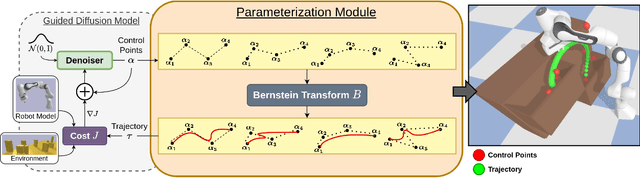
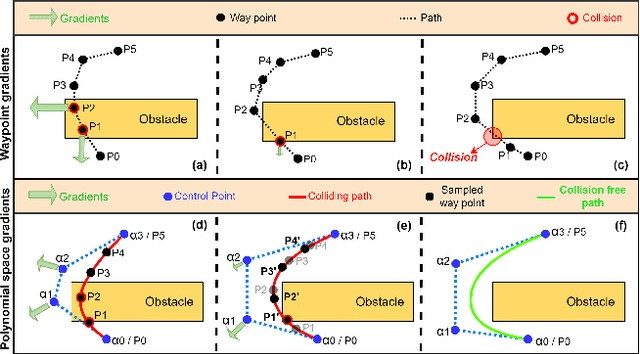
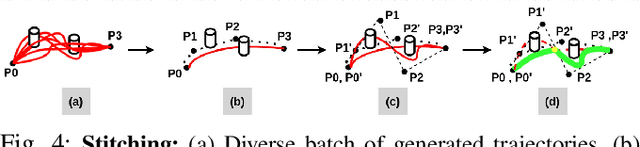
Diffusion-based motion planners are becoming popular due to their well-established performance improvements, stemming from sample diversity and the ease of incorporating new constraints directly during inference. However, a primary limitation of the diffusion process is the requirement for a substantial number of denoising steps, especially when the denoising process is coupled with gradient-based guidance. In this paper, we introduce, diffusion in the parametric space of trajectories, where the parameters are represented as Bernstein coefficients. We show that this representation greatly improves the effectiveness of the cost function guidance and the inference speed. We also introduce a novel stitching algorithm that leverages the diversity in diffusion-generated trajectories to produce collision-free trajectories with just a single cost function-guided model. We demonstrate that our approaches outperform current SOTA diffusion-based motion planners for manipulators and provide an ablation study on key components.