 Add to Chrome
 Add to Firefox
 Add to Edge
Token-Operations-Oriented Inference Optimization Techniques for Large Models
Jun 18, 2026
Large model inference optimization serves as a key foundation for supporting the scalable, low-cost, and highly stable operation of large model services. Centered on token-oriented inference optimization technology, this paper proposes for the first time a four-layer technical architecture consisting of Multi-model Fusion, Model Optimization, Compute-Model Fusion, and Compute-Network-Model Fusion. It systematically reviews the key technologies and current industry status across these four levels and analyzes the application value of related technologies in real-world business scenarios. This paper provides a practical technical path for reducing token production costs, improving token service efficiency, ensuring the stability of token supply, and driving the transition of large model services from being merely callable to being operable.

UniAI-GraphRAG: Synergizing Ontology-Guided Extraction, Multi-Dimensional Clustering, and Dual-Channel Fusion for Robust Multi-Hop Reasoning
Mar 26, 2026Retrieval-Augmented Generation (RAG) systems face significant challenges in complex reasoning, multi-hop queries, and domain-specific QA. While existing GraphRAG frameworks have made progress in structural knowledge organization, they still have limitations in cross-industry adaptability, community report integrity, and retrieval performance. This paper proposes UniAI-GraphRAG, an enhanced framework built upon open-source GraphRAG. The framework introduces three core innovations: (1) Ontology-Guided Knowledge Extraction that uses predefined Schema to guide LLMs in accurately identifying domain-specific entities and relations; (2) Multi-Dimensional Community Clustering Strategy that improves community completeness through alignment completion, attribute-based clustering, and multi-hop relationship clustering; (3) Dual-Channel Graph Retrieval Fusion that balances QA accuracy and performance through hybrid graph and community retrieval. Evaluation results on MultiHopRAG benchmark show that UniAI-GraphRAG outperforms mainstream open source solutions (e.g.LightRAG) in comprehensive F1 scores, particularly in inference and temporal queries. The code is available at https://github.com/UnicomAI/wanwu/tree/main/rag/rag_open_source/rag_core/graph.
RTD-Guard: A Black-Box Textual Adversarial Detection Framework via Replacement Token Detection
Mar 13, 2026Textual adversarial attacks pose a serious security threat to Natural Language Processing (NLP) systems by introducing imperceptible perturbations that mislead deep learning models. While adversarial example detection offers a lightweight alternative to robust training, existing methods typically rely on prior knowledge of attacks, white-box access to the victim model, or numerous queries, which severely limits their practical deployment. This paper introduces RTD-Guard, a novel black-box framework for detecting textual adversarial examples. Our key insight is that word-substitution perturbations in adversarial attacks closely resemble the "replaced tokens" that a Replaced Token Detection (RTD) discriminator is pre-trained to identify. Leveraging this, RTD-Guard employs an off-the-shelf RTD discriminator-without fine-tuning-to localize suspicious tokens, masks them, and detects adversarial examples by observing the prediction confidence shift of the victim model before and after intervention. The entire process requires no adversarial data, model tuning, or internal model access, and uses only two black-box queries. Comprehensive experiments on multiple benchmark datasets demonstrate that RTD-Guard effectively detects adversarial texts generated by diverse state-of-the-art attack methods. It surpasses existing detection baselines across multiple metrics, offering a highly efficient, practical, and resource-light defense mechanism-particularly suited for real-world deployment in resource-constrained or privacy-sensitive environments.
Pointer-CAD: Unifying B-Rep and Command Sequences via Pointer-based Edges & Faces Selection
Mar 04, 2026Constructing computer-aided design (CAD) models is labor-intensive but essential for engineering and manufacturing. Recent advances in Large Language Models (LLMs) have inspired the LLM-based CAD generation by representing CAD as command sequences. But these methods struggle in practical scenarios because command sequence representation does not support entity selection (e.g. faces or edges), limiting its ability to support complex editing operations such as chamfer or fillet. Further, the discretization of a continuous variable during sketch and extrude operations may result in topological errors. To address these limitations, we present Pointer-CAD, a novel LLM-based CAD generation framework that leverages a pointer-based command sequence representation to explicitly incorporate the geometric information of B-rep models into sequential modeling. In particular, Pointer-CAD decomposes CAD model generation into steps, conditioning the generation of each subsequent step on both the textual description and the B-rep generated from previous steps. Whenever an operation requires the selection of a specific geometric entity, the LLM predicts a Pointer that selects the most feature-consistent candidate from the available set. Such a selection operation also reduces the quantization error in the command sequence-based representation. To support the training of Pointer-CAD, we develop a data annotation pipeline that produces expert-level natural language descriptions and apply it to build a dataset of approximately 575K CAD models. Extensive experimental results demonstrate that Pointer-CAD effectively supports the generation of complex geometric structures and reduces segmentation error to an extremely low level, achieving a significant improvement over prior command sequence methods, thereby significantly mitigating the topological inaccuracies introduced by quantization error.
JoyAgent-JDGenie: Technical Report on the GAIA
Oct 01, 2025Large Language Models are increasingly deployed as autonomous agents for complex real-world tasks, yet existing systems often focus on isolated improvements without a unifying design for robustness and adaptability. We propose a generalist agent architecture that integrates three core components: a collective multi-agent framework combining planning and execution agents with critic model voting, a hierarchical memory system spanning working, semantic, and procedural layers, and a refined tool suite for search, code execution, and multimodal parsing. Evaluated on a comprehensive benchmark, our framework consistently outperforms open-source baselines and approaches the performance of proprietary systems. These results demonstrate the importance of system-level integration and highlight a path toward scalable, resilient, and adaptive AI assistants capable of operating across diverse domains and tasks.
P/D-Device: Disaggregated Large Language Model between Cloud and Devices
Aug 12, 2025Serving disaggregated large language models has been widely adopted in industrial practice for enhanced performance. However, too many tokens generated in decoding phase, i.e., occupying the resources for a long time, essentially hamper the cloud from achieving a higher throughput. Meanwhile, due to limited on-device resources, the time to first token (TTFT), i.e., the latency of prefill phase, increases dramatically with the growth on prompt length. In order to concur with such a bottleneck on resources, i.e., long occupation in cloud and limited on-device computing capacity, we propose to separate large language model between cloud and devices. That is, the cloud helps a portion of the content for each device, only in its prefill phase. Specifically, after receiving the first token from the cloud, decoupling with its own prefill, the device responds to the user immediately for a lower TTFT. Then, the following tokens from cloud are presented via a speed controller for smoothed TPOT (the time per output token), until the device catches up with the progress. On-device prefill is then amortized using received tokens while the resource usage in cloud is controlled. Moreover, during cloud prefill, the prompt can be refined, using those intermediate data already generated, to further speed up on-device inference. We implement such a scheme P/D-Device, and confirm its superiority over other alternatives. We further propose an algorithm to decide the best settings. Real-trace experiments show that TTFT decreases at least 60%, maximum TPOT is about tens of milliseconds, and cloud throughput increases by up to 15x.
Enhancing Subject-Independent Accuracy in fNIRS-based Brain-Computer Interfaces with Optimized Channel Selection
Feb 26, 2025Achieving high subject-independent accuracy in functional near-infrared spectroscopy (fNIRS)-based brain-computer interfaces (BCIs) remains a challenge, particularly when minimizing the number of channels. This study proposes a novel feature extraction scheme and a Pearson correlation-based channel selection algorithm to enhance classification accuracy while reducing hardware complexity. Using an open-access fNIRS dataset, our method improved average accuracy by 28.09% compared to existing approaches, achieving a peak subject-independent accuracy of 95.98% with only two channels. These results demonstrate the potential of our optimized feature extraction and channel selection methods for developing efficient, subject-independent fNIRS-based BCI systems.
Janus-Pro: Unified Multimodal Understanding and Generation with Data and Model Scaling
Jan 29, 2025In this work, we introduce Janus-Pro, an advanced version of the previous work Janus. Specifically, Janus-Pro incorporates (1) an optimized training strategy, (2) expanded training data, and (3) scaling to larger model size. With these improvements, Janus-Pro achieves significant advancements in both multimodal understanding and text-to-image instruction-following capabilities, while also enhancing the stability of text-to-image generation. We hope this work will inspire further exploration in the field. Code and models are publicly available.
DeepSeek-V3 Technical Report
Dec 27, 2024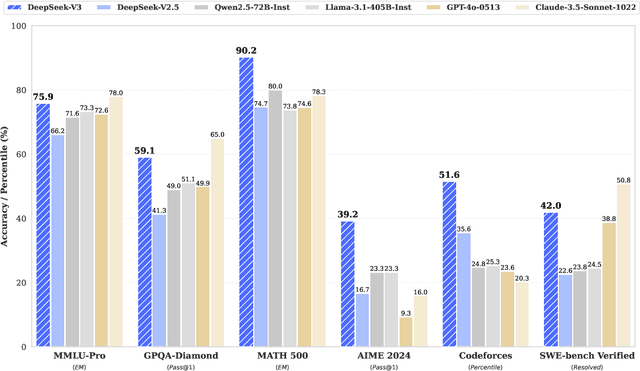


We present DeepSeek-V3, a strong Mixture-of-Experts (MoE) language model with 671B total parameters with 37B activated for each token. To achieve efficient inference and cost-effective training, DeepSeek-V3 adopts Multi-head Latent Attention (MLA) and DeepSeekMoE architectures, which were thoroughly validated in DeepSeek-V2. Furthermore, DeepSeek-V3 pioneers an auxiliary-loss-free strategy for load balancing and sets a multi-token prediction training objective for stronger performance. We pre-train DeepSeek-V3 on 14.8 trillion diverse and high-quality tokens, followed by Supervised Fine-Tuning and Reinforcement Learning stages to fully harness its capabilities. Comprehensive evaluations reveal that DeepSeek-V3 outperforms other open-source models and achieves performance comparable to leading closed-source models. Despite its excellent performance, DeepSeek-V3 requires only 2.788M H800 GPU hours for its full training. In addition, its training process is remarkably stable. Throughout the entire training process, we did not experience any irrecoverable loss spikes or perform any rollbacks. The model checkpoints are available at https://github.com/deepseek-ai/DeepSeek-V3.
DeepSeek-VL2: Mixture-of-Experts Vision-Language Models for Advanced Multimodal Understanding
Dec 13, 2024


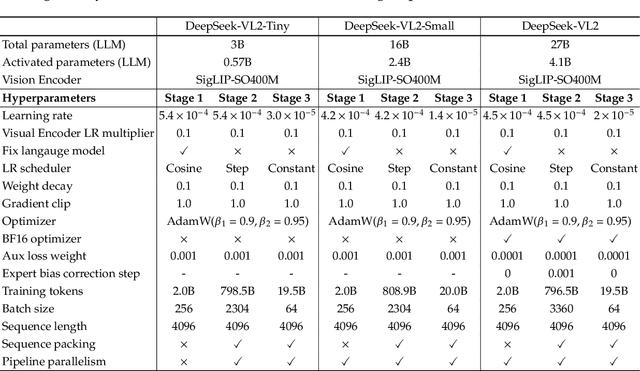
We present DeepSeek-VL2, an advanced series of large Mixture-of-Experts (MoE) Vision-Language Models that significantly improves upon its predecessor, DeepSeek-VL, through two key major upgrades. For the vision component, we incorporate a dynamic tiling vision encoding strategy designed for processing high-resolution images with different aspect ratios. For the language component, we leverage DeepSeekMoE models with the Multi-head Latent Attention mechanism, which compresses Key-Value cache into latent vectors, to enable efficient inference and high throughput. Trained on an improved vision-language dataset, DeepSeek-VL2 demonstrates superior capabilities across various tasks, including but not limited to visual question answering, optical character recognition, document/table/chart understanding, and visual grounding. Our model series is composed of three variants: DeepSeek-VL2-Tiny, DeepSeek-VL2-Small and DeepSeek-VL2, with 1.0B, 2.8B and 4.5B activated parameters respectively. DeepSeek-VL2 achieves competitive or state-of-the-art performance with similar or fewer activated parameters compared to existing open-source dense and MoE-based models. Codes and pre-trained models are publicly accessible at https://github.com/deepseek-ai/DeepSeek-VL2.