 Add to Chrome
 Add to Firefox
 Add to Edge
Deformation-based In-Context Learning for Point Cloud Understanding
Apr 03, 2026
Recent advances in point cloud In-Context Learning (ICL) have demonstrated strong multitask capabilities. Existing approaches typically adopt a Masked Point Modeling (MPM)-based paradigm for point cloud ICL. However, MPM-based methods directly predict the target point cloud from masked tokens without leveraging geometric priors, requiring the model to infer spatial structure and geometric details solely from token-level correlations via transformers. Additionally, these methods suffer from a training-inference objective mismatch, as the model learns to predict the target point cloud using target-side information that is unavailable at inference time. To address these challenges, we propose DeformPIC, a deformation-based framework for point cloud ICL. Unlike existing approaches that rely on masked reconstruction, DeformPIC learns to deform the query point cloud under task-specific guidance from prompts, enabling explicit geometric reasoning and consistent objectives. Extensive experiments demonstrate that DeformPIC consistently outperforms previous state-of-the-art methods, achieving reductions of 1.6, 1.8, and 4.7 points in average Chamfer Distance on reconstruction, denoising, and registration tasks, respectively. Furthermore, we introduce a new out-of-domain benchmark to evaluate generalization across unseen data distributions, where DeformPIC achieves state-of-the-art performance.

Training-free Motion Factorization for Compositional Video Generation
Mar 10, 2026Compositional video generation aims to synthesize multiple instances with diverse appearance and motion, which is widely applicable in real-world scenarios. However, current approaches mainly focus on binding semantics, neglecting to understand diverse motion categories specified in prompts. In this paper, we propose a motion factorization framework that decomposes complex motion into three primary categories: motionlessness, rigid motion, and non-rigid motion. Specifically, our framework follows a planning before generation paradigm. (1) During planning, we reason about motion laws on the motion graph to obtain frame-wise changes in the shape and position of each instance. This alleviates semantic ambiguities in the user prompt by organizing it into a structured representation of instances and their interactions. (2) During generation, we modulate the synthesis of distinct motion categories in a disentangled manner. Conditioned on the motion cues, guidance branches stabilize appearance in motionless regions, preserve rigid-body geometry, and regularize local non-rigid deformations. Crucially, our two modules are model-agnostic, which can be seamlessly incorporated into various diffusion model architectures. Extensive experiments demonstrate that our framework achieves impressive performance in motion synthesis on real-world benchmarks. Our code will be released soon.
Chain of Event-Centric Causal Thought for Physically Plausible Video Generation
Mar 10, 2026Physically Plausible Video Generation (PPVG) has emerged as a promising avenue for modeling real-world physical phenomena. PPVG requires an understanding of commonsense knowledge, which remains a challenge for video diffusion models. Current approaches leverage commonsense reasoning capability of large language models to embed physical concepts into prompts. However, generation models often render physical phenomena as a single moment defined by prompts, due to the lack of conditioning mechanisms for modeling causal progression. In this paper, we view PPVG as generating a sequence of causally connected and dynamically evolving events. To realize this paradigm, we design two key modules: (1) Physics-driven Event Chain Reasoning. This module decomposes the physical phenomena described in prompts into multiple elementary event units, leveraging chain-of-thought reasoning. To mitigate causal ambiguity, we embed physical formulas as constraints to impose deterministic causal dependencies during reasoning. (2) Transition-aware Cross-modal Prompting (TCP). To maintain continuity between events, this module transforms causal event units into temporally aligned vision-language prompts. It summarizes discrete event descriptions to obtain causally consistent narratives, while progressively synthesizing visual keyframes of individual events by interactive editing. Comprehensive experiments on PhyGenBench and VideoPhy benchmarks demonstrate that our framework achieves superior performance in generating physically plausible videos across diverse physical domains. Our code will be released soon.
Training-free Dense-Aligned Diffusion Guidance for Modular Conditional Image Synthesis
Apr 03, 2025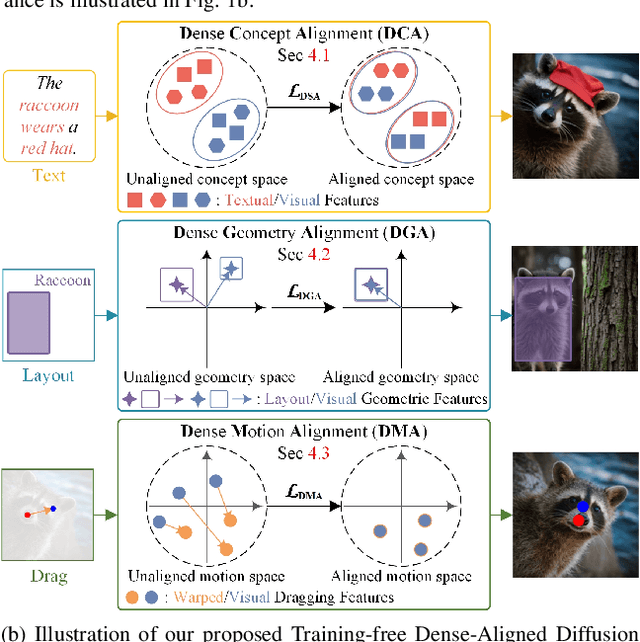
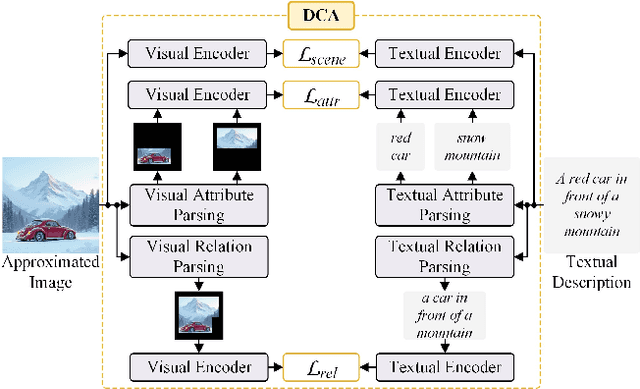
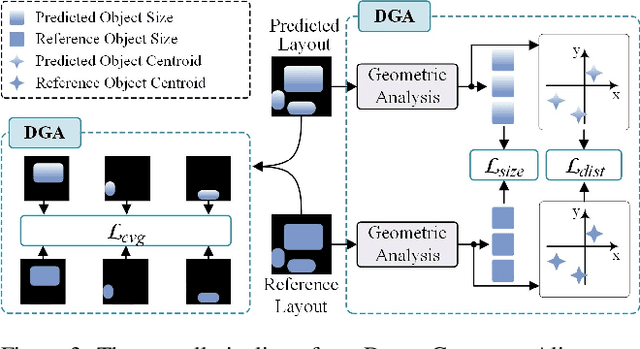
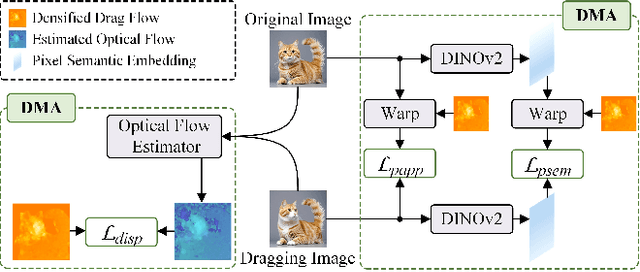
Conditional image synthesis is a crucial task with broad applications, such as artistic creation and virtual reality. However, current generative methods are often task-oriented with a narrow scope, handling a restricted condition with constrained applicability. In this paper, we propose a novel approach that treats conditional image synthesis as the modular combination of diverse fundamental condition units. Specifically, we divide conditions into three primary units: text, layout, and drag. To enable effective control over these conditions, we design a dedicated alignment module for each. For the text condition, we introduce a Dense Concept Alignment (DCA) module, which achieves dense visual-text alignment by drawing on diverse textual concepts. For the layout condition, we propose a Dense Geometry Alignment (DGA) module to enforce comprehensive geometric constraints that preserve the spatial configuration. For the drag condition, we introduce a Dense Motion Alignment (DMA) module to apply multi-level motion regularization, ensuring that each pixel follows its desired trajectory without visual artifacts. By flexibly inserting and combining these alignment modules, our framework enhances the model's adaptability to diverse conditional generation tasks and greatly expands its application range. Extensive experiments demonstrate the superior performance of our framework across a variety of conditions, including textual description, segmentation mask (bounding box), drag manipulation, and their combinations. Code is available at https://github.com/ZixuanWang0525/DADG.
LSceneLLM: Enhancing Large 3D Scene Understanding Using Adaptive Visual Preferences
Dec 02, 2024


Research on 3D Vision-Language Models (3D-VLMs) is gaining increasing attention, which is crucial for developing embodied AI within 3D scenes, such as visual navigation and embodied question answering. Due to the high density of visual features, especially in large 3D scenes, accurately locating task-relevant visual information is challenging. Existing works attempt to segment all objects and consider their features as scene representations. However, these task-agnostic object features include much redundant information and missing details for the task-relevant area. To tackle these problems, we propose LSceneLLM, an adaptive framework that automatically identifies task-relevant areas by leveraging LLM's visual preference for different tasks, followed by a plug-and-play scene magnifier module to capture fine-grained details in focused areas. Specifically, a dense token selector examines the attention map of LLM to identify visual preferences for the instruction input. It then magnifies fine-grained details of the focusing area. An adaptive self-attention module is leveraged to fuse the coarse-grained and selected fine-grained visual information. To comprehensively evaluate the large scene understanding ability of 3D-VLMs, we further introduce a cross-room understanding benchmark, XR-Scene, which contains a series of large scene understanding tasks including XR-QA, XR-EmbodiedPlanning, and XR-SceneCaption. Experiments show that our method surpasses existing methods on both large scene understanding and existing scene understanding benchmarks. Plunging our scene magnifier module into the existing 3D-VLMs also brings significant improvement.
Recent Advances in Multi-modal 3D Scene Understanding: A Comprehensive Survey and Evaluation
Oct 24, 2023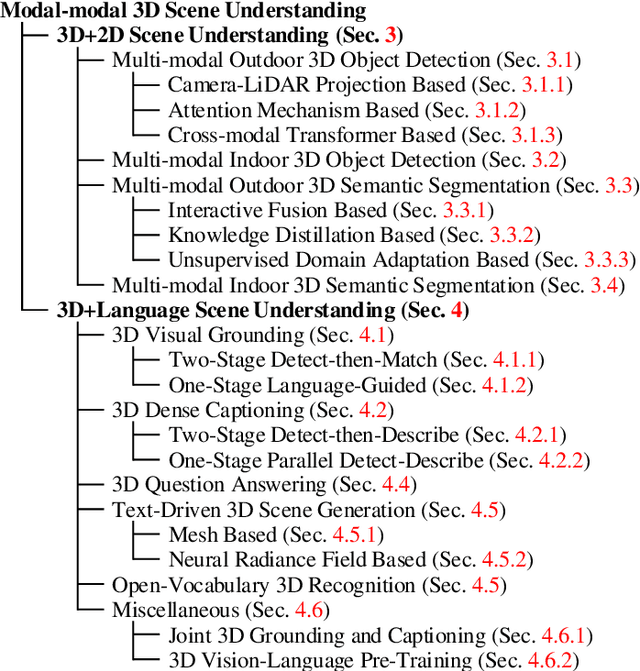
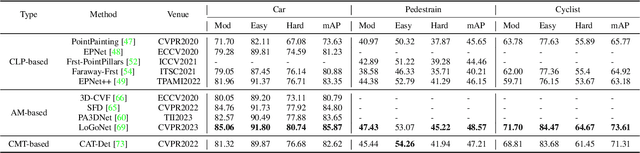
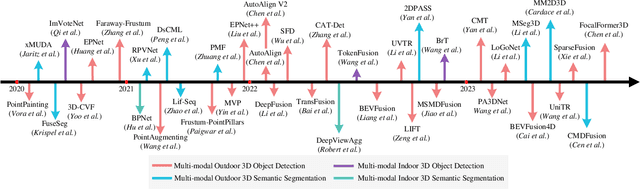
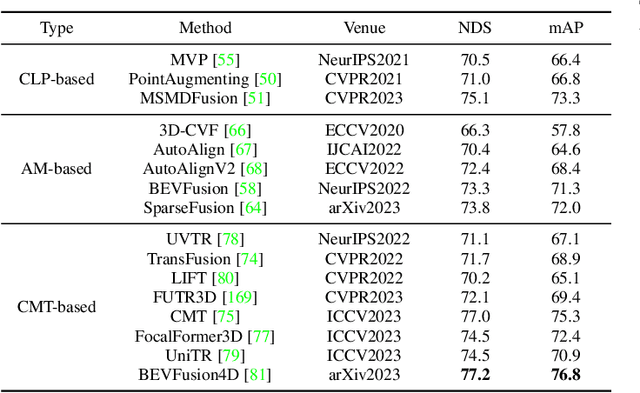
Multi-modal 3D scene understanding has gained considerable attention due to its wide applications in many areas, such as autonomous driving and human-computer interaction. Compared to conventional single-modal 3D understanding, introducing an additional modality not only elevates the richness and precision of scene interpretation but also ensures a more robust and resilient understanding. This becomes especially crucial in varied and challenging environments where solely relying on 3D data might be inadequate. While there has been a surge in the development of multi-modal 3D methods over past three years, especially those integrating multi-camera images (3D+2D) and textual descriptions (3D+language), a comprehensive and in-depth review is notably absent. In this article, we present a systematic survey of recent progress to bridge this gap. We begin by briefly introducing a background that formally defines various 3D multi-modal tasks and summarizes their inherent challenges. After that, we present a novel taxonomy that delivers a thorough categorization of existing methods according to modalities and tasks, exploring their respective strengths and limitations. Furthermore, comparative results of recent approaches on several benchmark datasets, together with insightful analysis, are offered. Finally, we discuss the unresolved issues and provide several potential avenues for future research.
Vote2Cap-DETR++: Decoupling Localization and Describing for End-to-End 3D Dense Captioning
Sep 06, 2023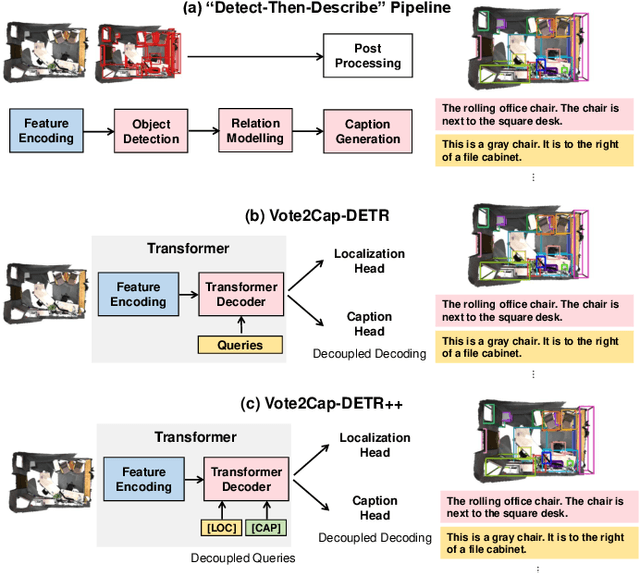
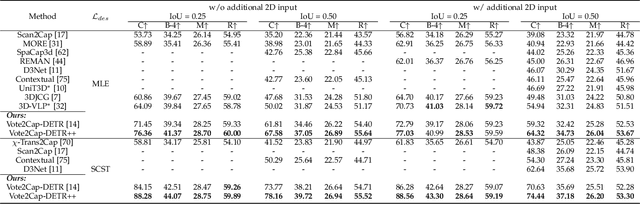
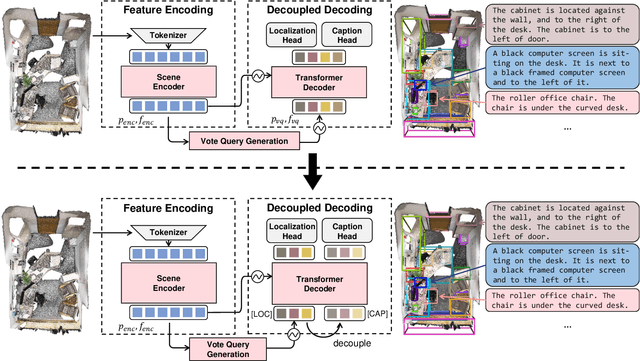
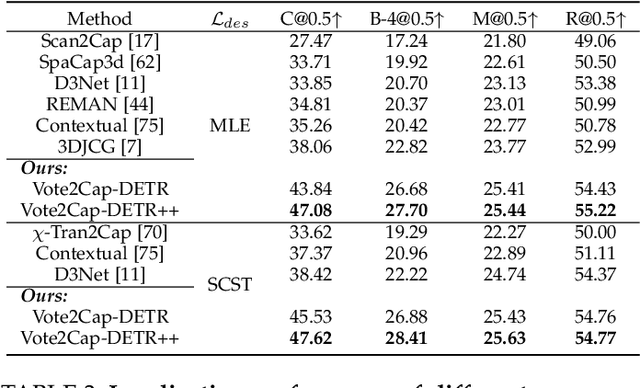
3D dense captioning requires a model to translate its understanding of an input 3D scene into several captions associated with different object regions. Existing methods adopt a sophisticated "detect-then-describe" pipeline, which builds explicit relation modules upon a 3D detector with numerous hand-crafted components. While these methods have achieved initial success, the cascade pipeline tends to accumulate errors because of duplicated and inaccurate box estimations and messy 3D scenes. In this paper, we first propose Vote2Cap-DETR, a simple-yet-effective transformer framework that decouples the decoding process of caption generation and object localization through parallel decoding. Moreover, we argue that object localization and description generation require different levels of scene understanding, which could be challenging for a shared set of queries to capture. To this end, we propose an advanced version, Vote2Cap-DETR++, which decouples the queries into localization and caption queries to capture task-specific features. Additionally, we introduce the iterative spatial refinement strategy to vote queries for faster convergence and better localization performance. We also insert additional spatial information to the caption head for more accurate descriptions. Without bells and whistles, extensive experiments on two commonly used datasets, ScanRefer and Nr3D, demonstrate Vote2Cap-DETR and Vote2Cap-DETR++ surpass conventional "detect-then-describe" methods by a large margin. Codes will be made available at https://github.com/ch3cook-fdu/Vote2Cap-DETR.
Unsupervised Domain Adaptation via Domain-Adaptive Diffusion
Aug 26, 2023Unsupervised Domain Adaptation (UDA) is quite challenging due to the large distribution discrepancy between the source domain and the target domain. Inspired by diffusion models which have strong capability to gradually convert data distributions across a large gap, we consider to explore the diffusion technique to handle the challenging UDA task. However, using diffusion models to convert data distribution across different domains is a non-trivial problem as the standard diffusion models generally perform conversion from the Gaussian distribution instead of from a specific domain distribution. Besides, during the conversion, the semantics of the source-domain data needs to be preserved for classification in the target domain. To tackle these problems, we propose a novel Domain-Adaptive Diffusion (DAD) module accompanied by a Mutual Learning Strategy (MLS), which can gradually convert data distribution from the source domain to the target domain while enabling the classification model to learn along the domain transition process. Consequently, our method successfully eases the challenge of UDA by decomposing the large domain gap into small ones and gradually enhancing the capacity of classification model to finally adapt to the target domain. Our method outperforms the current state-of-the-arts by a large margin on three widely used UDA datasets.
Unsupervised Image Denoising in Real-World Scenarios via Self-Collaboration Parallel Generative Adversarial Branches
Aug 13, 2023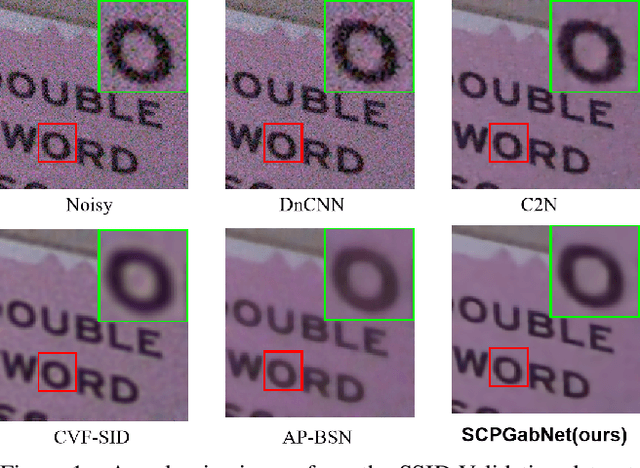
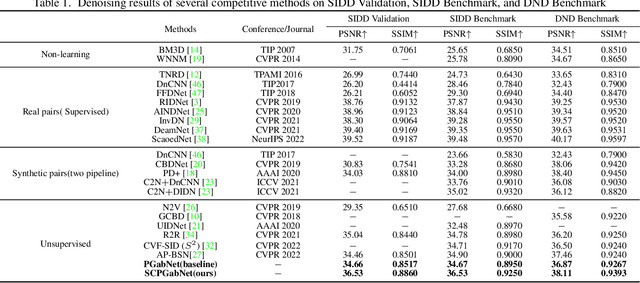
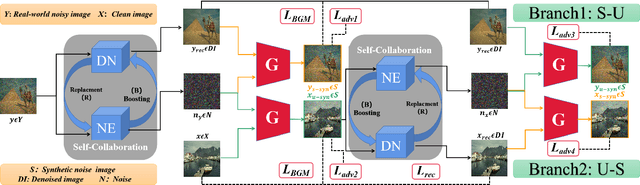
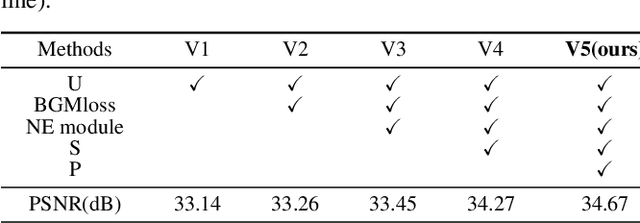
Deep learning methods have shown remarkable performance in image denoising, particularly when trained on large-scale paired datasets. However, acquiring such paired datasets for real-world scenarios poses a significant challenge. Although unsupervised approaches based on generative adversarial networks offer a promising solution for denoising without paired datasets, they are difficult in surpassing the performance limitations of conventional GAN-based unsupervised frameworks without significantly modifying existing structures or increasing the computational complexity of denoisers. To address this problem, we propose a SC strategy for multiple denoisers. This strategy can achieve significant performance improvement without increasing the inference complexity of the GAN-based denoising framework. Its basic idea is to iteratively replace the previous less powerful denoiser in the filter-guided noise extraction module with the current powerful denoiser. This process generates better synthetic clean-noisy image pairs, leading to a more powerful denoiser for the next iteration. This baseline ensures the stability and effectiveness of the training network. The experimental results demonstrate the superiority of our method over state-of-the-art unsupervised methods.
End-to-End 3D Dense Captioning with Vote2Cap-DETR
Jan 06, 2023
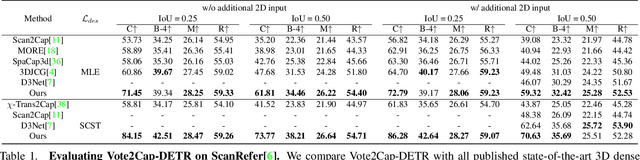
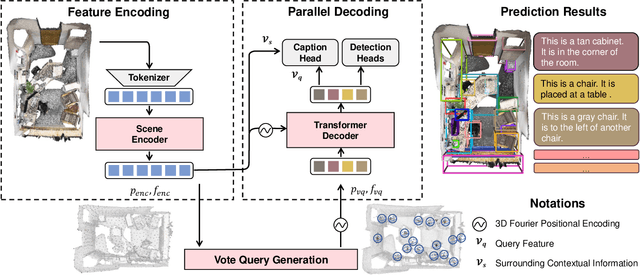
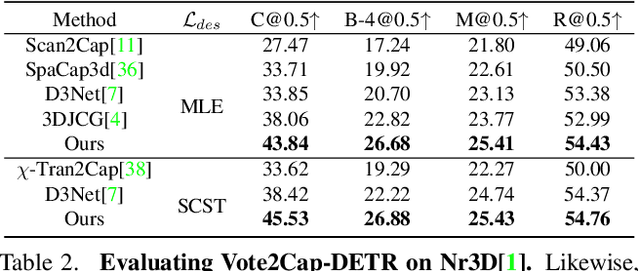
3D dense captioning aims to generate multiple captions localized with their associated object regions. Existing methods follow a sophisticated ``detect-then-describe'' pipeline equipped with numerous hand-crafted components. However, these hand-crafted components would yield suboptimal performance given cluttered object spatial and class distributions among different scenes. In this paper, we propose a simple-yet-effective transformer framework Vote2Cap-DETR based on recent popular \textbf{DE}tection \textbf{TR}ansformer (DETR). Compared with prior arts, our framework has several appealing advantages: 1) Without resorting to numerous hand-crafted components, our method is based on a full transformer encoder-decoder architecture with a learnable vote query driven object decoder, and a caption decoder that produces the dense captions in a set-prediction manner. 2) In contrast to the two-stage scheme, our method can perform detection and captioning in one-stage. 3) Without bells and whistles, extensive experiments on two commonly used datasets, ScanRefer and Nr3D, demonstrate that our Vote2Cap-DETR surpasses current state-of-the-arts by 11.13\% and 7.11\% in CIDEr@0.5IoU, respectively. Codes will be released soon.