 Add to Chrome
 Add to Firefox
 Add to Edge
PALoc: Advancing SLAM Benchmarking with Prior-Assisted 6-DoF Trajectory Generation and Uncertainty Estimation
Feb 06, 2024
Accurately generating ground truth (GT) trajectories is essential for Simultaneous Localization and Mapping (SLAM) evaluation, particularly under varying environmental conditions. This study introduces a systematic approach employing a prior map-assisted framework for generating dense six-degree-of-freedom (6-DoF) GT poses for the first time, enhancing the fidelity of both indoor and outdoor SLAM datasets. Our method excels in handling degenerate and stationary conditions frequently encountered in SLAM datasets, thereby increasing robustness and precision. A significant aspect of our approach is the detailed derivation of covariances within the factor graph, enabling an in-depth analysis of pose uncertainty propagation. This analysis crucially contributes to demonstrating specific pose uncertainties and enhancing trajectory reliability from both theoretical and empirical perspectives. Additionally, we provide an open-source toolbox (https://github.com/JokerJohn/Cloud_Map_Evaluation) for map evaluation criteria, facilitating the indirect assessment of overall trajectory precision. Experimental results show at least a 30\% improvement in map accuracy and a 20\% increase in direct trajectory accuracy compared to the Iterative Closest Point (ICP) \cite{sharp2002icp} algorithm across diverse campus environments, with substantially enhanced robustness. Our open-source solution (https://github.com/JokerJohn/PALoc), extensively applied in the FusionPortable\cite{Jiao2022Mar} dataset, is geared towards SLAM benchmark dataset augmentation and represents a significant advancement in SLAM evaluations.

Online Robot Navigation and and Manipulation with Distilled Vision-Language Models
Jan 30, 2024
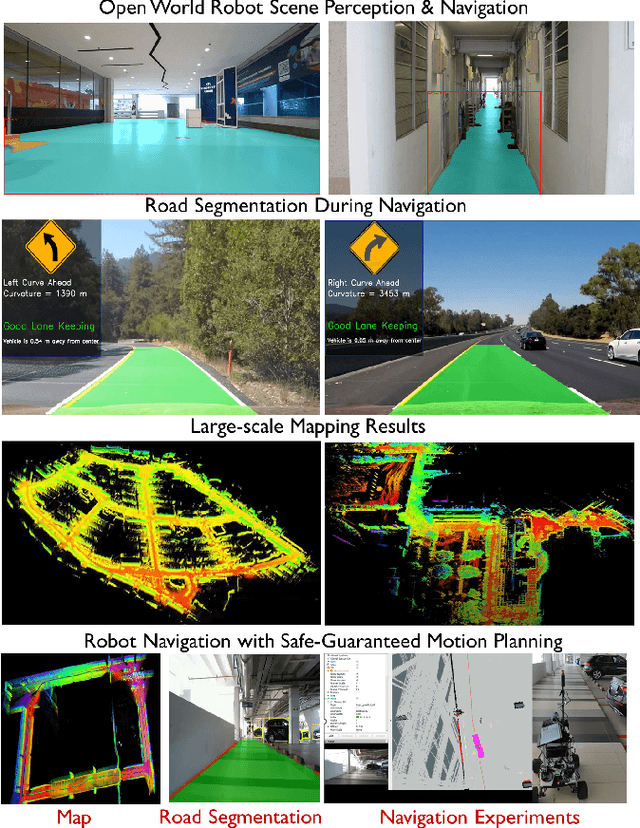
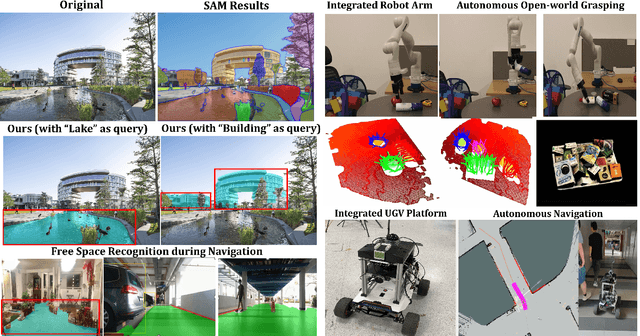
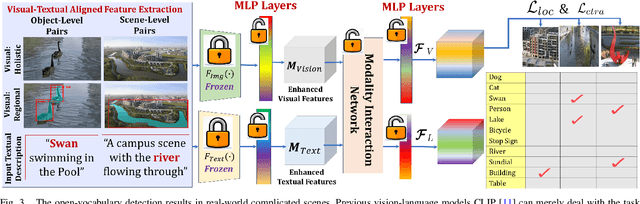
Autonomous robot navigation within the dynamic unknown environment is of crucial significance for mobile robotic applications including robot navigation in last-mile delivery and robot-enabled automated supplies in industrial and hospital delivery applications. Current solutions still suffer from limitations, such as the robot cannot recognize unknown objects in real time and cannot navigate freely in a dynamic, narrow, and complex environment. We propose a complete software framework for autonomous robot perception and navigation within very dense obstacles and dense human crowds. First, we propose a framework that accurately detects and segments open-world object categories in a zero-shot manner, which overcomes the over-segmentation limitation of the current SAM model. Second, we proposed the distillation strategy to distill the knowledge to segment the free space of the walkway for robot navigation without the label. In the meantime, we design the trimming strategy that works collaboratively with distillation to enable lightweight inference to deploy the neural network on edge devices such as NVIDIA-TX2 or Xavier NX during autonomous navigation. Integrated into the robot navigation system, extensive experiments demonstrate that our proposed framework has achieved superior performance in terms of both accuracy and efficiency in robot scene perception and autonomous robot navigation.
Enhancing Campus Mobility: Achievements and Challenges of Autonomous Shuttle "Snow Lion''
Jan 17, 2024The rapid evolution of autonomous vehicles (AVs) has significantly influenced global transportation systems. In this context, we present ``Snow Lion'', an autonomous shuttle meticulously designed to revolutionize on-campus transportation, offering a safer and more efficient mobility solution for students, faculty, and visitors. The primary objective of this research is to enhance campus mobility by providing a reliable, efficient, and eco-friendly transportation solution that seamlessly integrates with existing infrastructure and meets the diverse needs of a university setting. To achieve this goal, we delve into the intricacies of the system design, encompassing sensing, perception, localization, planning, and control aspects. We evaluate the autonomous shuttle's performance in real-world scenarios, involving a 1146-kilometer road haul and the transportation of 442 passengers over a two-month period. These experiments demonstrate the effectiveness of our system and offer valuable insights into the intricate process of integrating an autonomous vehicle within campus shuttle operations. Furthermore, a thorough analysis of the lessons derived from this experience furnishes a valuable real-world case study, accompanied by recommendations for future research and development in the field of autonomous driving.
Hi-Map: Hierarchical Factorized Radiance Field for High-Fidelity Monocular Dense Mapping
Jan 06, 2024In this paper, we introduce Hi-Map, a novel monocular dense mapping approach based on Neural Radiance Field (NeRF). Hi-Map is exceptional in its capacity to achieve efficient and high-fidelity mapping using only posed RGB inputs. Our method eliminates the need for external depth priors derived from e.g., a depth estimation model. Our key idea is to represent the scene as a hierarchical feature grid that encodes the radiance and then factorizes it into feature planes and vectors. As such, the scene representation becomes simpler and more generalizable for fast and smooth convergence on new observations. This allows for efficient computation while alleviating noise patterns by reducing the complexity of the scene representation. Buttressed by the hierarchical factorized representation, we leverage the Sign Distance Field (SDF) as a proxy of rendering for inferring the volume density, demonstrating high mapping fidelity. Moreover, we introduce a dual-path encoding strategy to strengthen the photometric cues and further boost the mapping quality, especially for the distant and textureless regions. Extensive experiments demonstrate our method's superiority in geometric and textural accuracy over the state-of-the-art NeRF-based monocular mapping methods.
A unified multichannel far-field speech recognition system: combining neural beamforming with attention based end-to-end model
Jan 05, 2024Far-field speech recognition is a challenging task that conventionally uses signal processing beamforming to attack noise and interference problem. But the performance has been found usually limited due to heavy reliance on environmental assumption. In this paper, we propose a unified multichannel far-field speech recognition system that combines the neural beamforming and transformer-based Listen, Spell, Attend (LAS) speech recognition system, which extends the end-to-end speech recognition system further to include speech enhancement. Such framework is then jointly trained to optimize the final objective of interest. Specifically, factored complex linear projection (fCLP) has been adopted to form the neural beamforming. Several pooling strategies to combine look directions are then compared in order to find the optimal approach. Moreover, information of the source direction is also integrated in the beamforming to explore the usefulness of source direction as a prior, which is usually available especially in multi-modality scenario. Experiments on different microphone array geometry are conducted to evaluate the robustness against spacing variance of microphone array. Large in-house databases are used to evaluate the effectiveness of the proposed framework and the proposed method achieve 19.26\% improvement when compared with a strong baseline.
Black-Box Tuning of Vision-Language Models with Effective Gradient Approximation
Dec 26, 2023Parameter-efficient fine-tuning (PEFT) methods have provided an effective way for adapting large vision-language models to specific tasks or scenarios. Typically, they learn a very small scale of parameters for pre-trained models in a white-box formulation, which assumes model architectures to be known and parameters to be accessible. However, large models are often not open-source due to considerations of preventing abuse or commercial factors, hence posing a barrier to the deployment of white-box PEFT methods. To alleviate the dependence on model accessibility, we introduce collaborative black-box tuning (CBBT) for both textual prompt optimization and output feature adaptation for black-box models. Specifically, considering that the backpropagation gradients are blocked, we approximate the gradients of textual prompts by analyzing the predictions with perturbed prompts. Secondly, a lightweight adapter is deployed over the output feature of the inaccessible model, further facilitating the model adaptation process. Empowered with these designs, our CBBT is extensively evaluated on eleven downstream benchmarks and achieves remarkable improvements compared to existing black-box VL adaptation methods. Code is released at https://github.com/guozix/cbbt.
U2-KWS: Unified Two-pass Open-vocabulary Keyword Spotting with Keyword Bias
Dec 15, 2023Open-vocabulary keyword spotting (KWS), which allows users to customize keywords, has attracted increasingly more interest. However, existing methods based on acoustic models and post-processing train the acoustic model with ASR training criteria to model all phonemes, making the acoustic model under-optimized for the KWS task. To solve this problem, we propose a novel unified two-pass open-vocabulary KWS (U2-KWS) framework inspired by the two-pass ASR model U2. Specifically, we employ the CTC branch as the first stage model to detect potential keyword candidates and the decoder branch as the second stage model to validate candidates. In order to enhance any customized keywords, we redesign the U2 training procedure for U2-KWS and add keyword information by audio and text cross-attention into both branches. We perform experiments on our internal dataset and Aishell-1. The results show that U2-KWS can achieve a significant relative wake-up rate improvement of 41% compared to the traditional customized KWS systems when the false alarm rate is fixed to 0.5 times per hour.
Random resistive memory-based deep extreme point learning machine for unified visual processing
Dec 14, 2023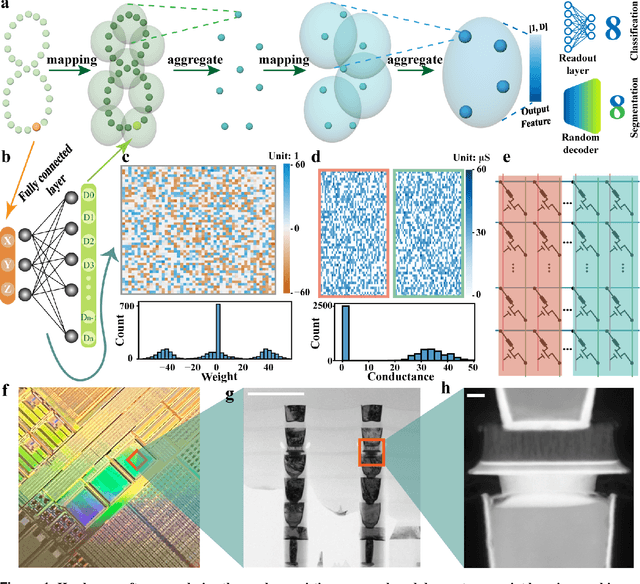
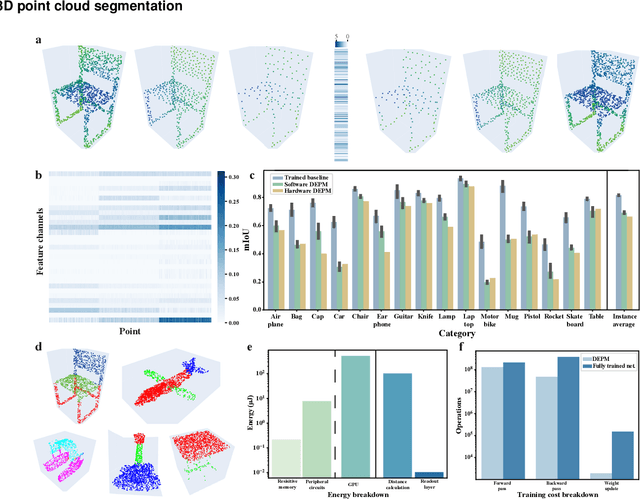


Visual sensors, including 3D LiDAR, neuromorphic DVS sensors, and conventional frame cameras, are increasingly integrated into edge-side intelligent machines. Realizing intensive multi-sensory data analysis directly on edge intelligent machines is crucial for numerous emerging edge applications, such as augmented and virtual reality and unmanned aerial vehicles, which necessitates unified data representation, unprecedented hardware energy efficiency and rapid model training. However, multi-sensory data are intrinsically heterogeneous, causing significant complexity in the system development for edge-side intelligent machines. In addition, the performance of conventional digital hardware is limited by the physically separated processing and memory units, known as the von Neumann bottleneck, and the physical limit of transistor scaling, which contributes to the slowdown of Moore's law. These limitations are further intensified by the tedious training of models with ever-increasing sizes. We propose a novel hardware-software co-design, random resistive memory-based deep extreme point learning machine (DEPLM), that offers efficient unified point set analysis. We show the system's versatility across various data modalities and two different learning tasks. Compared to a conventional digital hardware-based system, our co-design system achieves huge energy efficiency improvements and training cost reduction when compared to conventional systems. Our random resistive memory-based deep extreme point learning machine may pave the way for energy-efficient and training-friendly edge AI across various data modalities and tasks.
KwaiAgents: Generalized Information-seeking Agent System with Large Language Models
Dec 08, 2023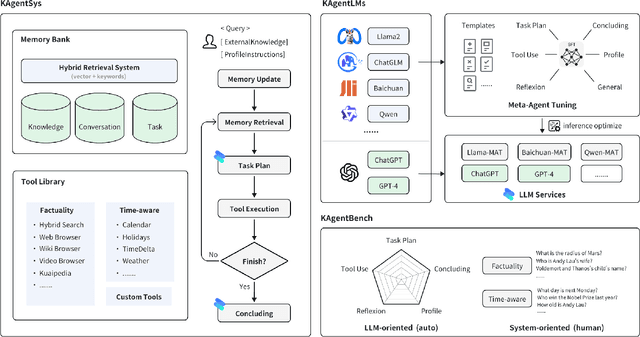
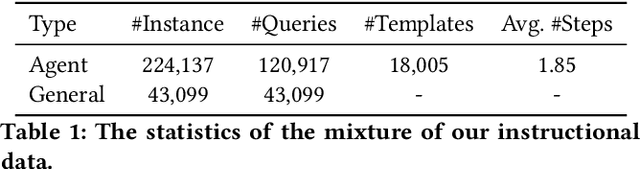
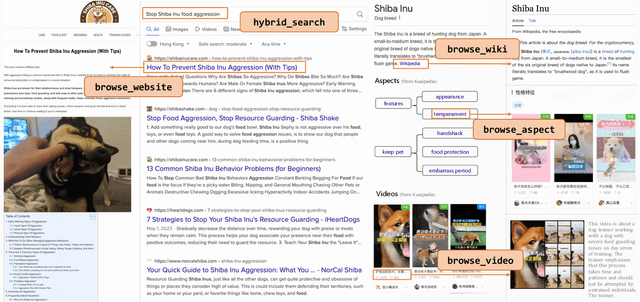

Driven by curiosity, humans have continually sought to explore and understand the world around them, leading to the invention of various tools to satiate this inquisitiveness. Despite not having the capacity to process and memorize vast amounts of information in their brains, humans excel in critical thinking, planning, reflection, and harnessing available tools to interact with and interpret the world, enabling them to find answers efficiently. The recent advancements in large language models (LLMs) suggest that machines might also possess the aforementioned human-like capabilities, allowing them to exhibit powerful abilities even with a constrained parameter count. In this paper, we introduce KwaiAgents, a generalized information-seeking agent system based on LLMs. Within KwaiAgents, we propose an agent system that employs LLMs as its cognitive core, which is capable of understanding a user's query, behavior guidelines, and referencing external documents. The agent can also update and retrieve information from its internal memory, plan and execute actions using a time-aware search-browse toolkit, and ultimately provide a comprehensive response. We further investigate the system's performance when powered by LLMs less advanced than GPT-4, and introduce the Meta-Agent Tuning (MAT) framework, designed to ensure even an open-sourced 7B or 13B model performs well among many agent systems. We exploit both benchmark and human evaluations to systematically validate these capabilities. Extensive experiments show the superiority of our agent system compared to other autonomous agents and highlight the enhanced generalized agent-abilities of our fine-tuned LLMs.
Generalized Label-Efficient 3D Scene Parsing via Hierarchical Feature Aligned Pre-Training and Region-Aware Fine-tuning
Dec 01, 2023
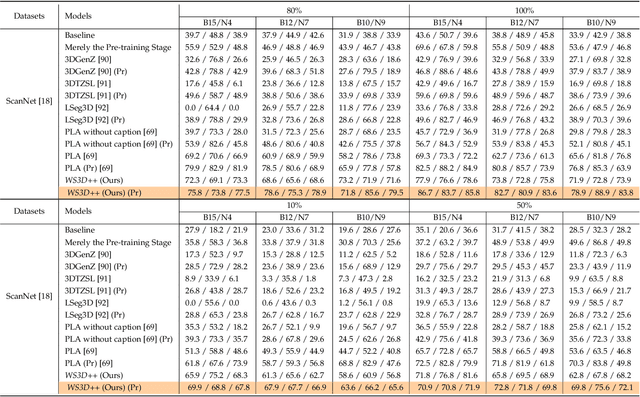
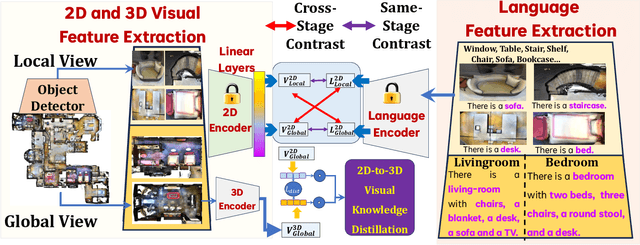
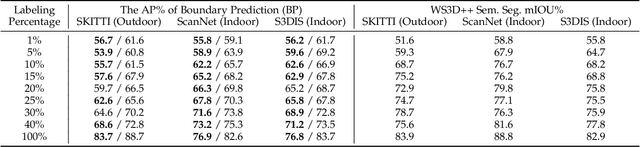
Deep neural network models have achieved remarkable progress in 3D scene understanding while trained in the closed-set setting and with full labels. However, the major bottleneck for current 3D recognition approaches is that they do not have the capacity to recognize any unseen novel classes beyond the training categories in diverse kinds of real-world applications. In the meantime, current state-of-the-art 3D scene understanding approaches primarily require high-quality labels to train neural networks, which merely perform well in a fully supervised manner. This work presents a generalized and simple framework for dealing with 3D scene understanding when the labeled scenes are quite limited. To extract knowledge for novel categories from the pre-trained vision-language models, we propose a hierarchical feature-aligned pre-training and knowledge distillation strategy to extract and distill meaningful information from large-scale vision-language models, which helps benefit the open-vocabulary scene understanding tasks. To leverage the boundary information, we propose a novel energy-based loss with boundary awareness benefiting from the region-level boundary predictions. To encourage latent instance discrimination and to guarantee efficiency, we propose the unsupervised region-level semantic contrastive learning scheme for point clouds, using confident predictions of the neural network to discriminate the intermediate feature embeddings at multiple stages. Extensive experiments with both indoor and outdoor scenes demonstrated the effectiveness of our approach in both data-efficient learning and open-world few-shot learning. All codes, models, and data are made publicly available at: https://drive.google.com/drive/folders/1M58V-PtR8DBEwD296zJkNg_m2qq-MTAP?usp=sharing.