 Add to Chrome
 Add to Firefox
 Add to Edge
TCATSeg: A Tooth Center-Wise Attention Network for 3D Dental Model Semantic Segmentation
Mar 17, 2026
Accurate semantic segmentation of 3D dental models is essential for digital dentistry applications such as orthodontics and dental implants. However, due to complex tooth arrangements and similarities in shape among adjacent teeth, existing methods struggle with accurate segmentation, because they often focus on local geometry while neglecting global contextual information. To address this, we propose TCATSeg, a novel framework that combines local geometric features with global semantic context. We introduce a set of sparse yet physically meaningful superpoints to capture global semantic relationships and enhance segmentation accuracy. Additionally, we present a new dataset of 400 dental models, including pre-orthodontic samples, to evaluate the generalization of our method. Extensive experiments demonstrate that TCATSeg outperforms state-of-the-art approaches.

SemGS: Feed-Forward Semantic 3D Gaussian Splatting from Sparse Views for Generalizable Scene Understanding
Mar 03, 2026Semantic understanding of 3D scenes is essential for robots to operate effectively and safely in complex environments. Existing methods for semantic scene reconstruction and semantic-aware novel view synthesis often rely on dense multi-view inputs and require scene-specific optimization, limiting their practicality and scalability in real-world applications. To address these challenges, we propose SemGS, a feed-forward framework for reconstructing generalizable semantic fields from sparse image inputs. SemGS uses a dual-branch architecture to extract color and semantic features, where the two branches share shallow CNN layers, allowing semantic reasoning to leverage textural and structural cues in color appearance. We also incorporate a camera-aware attention mechanism into the feature extractor to explicitly model geometric relationships between camera viewpoints. The extracted features are decoded into dual-Gaussians that share geometric consistency while preserving branch-specific attributes, and further rasterized to synthesize semantic maps under novel viewpoints. Additionally, we introduce a regional smoothness loss to enhance semantic coherence. Experiments show that SemGS achieves state-of-the-art performance on benchmark datasets, while providing rapid inference and strong generalization capabilities across diverse synthetic and real-world scenarios.
VAGNet: Grounding 3D Affordance from Human-Object Interactions in Videos
Feb 24, 20263D object affordance grounding aims to identify regions on 3D objects that support human-object interaction (HOI), a capability essential to embodied visual reasoning. However, most existing approaches rely on static visual or textual cues, neglecting that affordances are inherently defined by dynamic actions. As a result, they often struggle to localize the true contact regions involved in real interactions. We take a different perspective. Humans learn how to use objects by observing and imitating actions, not just by examining shapes. Motivated by this intuition, we introduce video-guided 3D affordance grounding, which leverages dynamic interaction sequences to provide functional supervision. To achieve this, we propose VAGNet, a framework that aligns video-derived interaction cues with 3D structure to resolve ambiguities that static cues cannot address. To support this new setting, we introduce PVAD, the first HOI video-3D pairing affordance dataset, providing functional supervision unavailable in prior works. Extensive experiments on PVAD show that VAGNet achieves state-of-the-art performance, significantly outperforming static-based baselines. The code and dataset will be open publicly.
Memory-guided Prototypical Co-occurrence Learning for Mixed Emotion Recognition
Feb 24, 2026Emotion recognition from multi-modal physiological and behavioral signals plays a pivotal role in affective computing, yet most existing models remain constrained to the prediction of singular emotions in controlled laboratory settings. Real-world human emotional experiences, by contrast, are often characterized by the simultaneous presence of multiple affective states, spurring recent interest in mixed emotion recognition as an emotion distribution learning problem. Current approaches, however, often neglect the valence consistency and structured correlations inherent among coexisting emotions. To address this limitation, we propose a Memory-guided Prototypical Co-occurrence Learning (MPCL) framework that explicitly models emotion co-occurrence patterns. Specifically, we first fuse multi-modal signals via a multi-scale associative memory mechanism. To capture cross-modal semantic relationships, we construct emotion-specific prototype memory banks, yielding rich physiological and behavioral representations, and employ prototype relation distillation to ensure cross-modal alignment in the latent prototype space. Furthermore, inspired by human cognitive memory systems, we introduce a memory retrieval strategy to extract semantic-level co-occurrence associations across emotion categories. Through this bottom-up hierarchical abstraction process, our model learns affectively informative representations for accurate emotion distribution prediction. Comprehensive experiments on two public datasets demonstrate that MPCL consistently outperforms state-of-the-art methods in mixed emotion recognition, both quantitatively and qualitatively.
StdGEN++: A Comprehensive System for Semantic-Decomposed 3D Character Generation
Jan 12, 2026We present StdGEN++, a novel and comprehensive system for generating high-fidelity, semantically decomposed 3D characters from diverse inputs. Existing 3D generative methods often produce monolithic meshes that lack the structural flexibility required by industrial pipelines in gaming and animation. Addressing this gap, StdGEN++ is built upon a Dual-branch Semantic-aware Large Reconstruction Model (Dual-Branch S-LRM), which jointly reconstructs geometry, color, and per-component semantics in a feed-forward manner. To achieve production-level fidelity, we introduce a novel semantic surface extraction formalism compatible with hybrid implicit fields. This mechanism is accelerated by a coarse-to-fine proposal scheme, which significantly reduces memory footprint and enables high-resolution mesh generation. Furthermore, we propose a video-diffusion-based texture decomposition module that disentangles appearance into editable layers (e.g., separated iris and skin), resolving semantic confusion in facial regions. Experiments demonstrate that StdGEN++ achieves state-of-the-art performance, significantly outperforming existing methods in geometric accuracy and semantic disentanglement. Crucially, the resulting structural independence unlocks advanced downstream capabilities, including non-destructive editing, physics-compliant animation, and gaze tracking, making it a robust solution for automated character asset production.
StreamAvatar: Streaming Diffusion Models for Real-Time Interactive Human Avatars
Dec 26, 2025Real-time, streaming interactive avatars represent a critical yet challenging goal in digital human research. Although diffusion-based human avatar generation methods achieve remarkable success, their non-causal architecture and high computational costs make them unsuitable for streaming. Moreover, existing interactive approaches are typically limited to head-and-shoulder region, limiting their ability to produce gestures and body motions. To address these challenges, we propose a two-stage autoregressive adaptation and acceleration framework that applies autoregressive distillation and adversarial refinement to adapt a high-fidelity human video diffusion model for real-time, interactive streaming. To ensure long-term stability and consistency, we introduce three key components: a Reference Sink, a Reference-Anchored Positional Re-encoding (RAPR) strategy, and a Consistency-Aware Discriminator. Building on this framework, we develop a one-shot, interactive, human avatar model capable of generating both natural talking and listening behaviors with coherent gestures. Extensive experiments demonstrate that our method achieves state-of-the-art performance, surpassing existing approaches in generation quality, real-time efficiency, and interaction naturalness. Project page: https://streamavatar.github.io .
HGS: Hybrid Gaussian Splatting with Static-Dynamic Decomposition for Compact Dynamic View Synthesis
Dec 16, 2025Dynamic novel view synthesis (NVS) is essential for creating immersive experiences. Existing approaches have advanced dynamic NVS by introducing 3D Gaussian Splatting (3DGS) with implicit deformation fields or indiscriminately assigned time-varying parameters, surpassing NeRF-based methods. However, due to excessive model complexity and parameter redundancy, they incur large model sizes and slow rendering speeds, making them inefficient for real-time applications, particularly on resource-constrained devices. To obtain a more efficient model with fewer redundant parameters, in this paper, we propose Hybrid Gaussian Splatting (HGS), a compact and efficient framework explicitly designed to disentangle static and dynamic regions of a scene within a unified representation. The core innovation of HGS lies in our Static-Dynamic Decomposition (SDD) strategy, which leverages Radial Basis Function (RBF) modeling for Gaussian primitives. Specifically, for dynamic regions, we employ time-dependent RBFs to effectively capture temporal variations and handle abrupt scene changes, while for static regions, we reduce redundancy by sharing temporally invariant parameters. Additionally, we introduce a two-stage training strategy tailored for explicit models to enhance temporal coherence at static-dynamic boundaries. Experimental results demonstrate that our method reduces model size by up to 98% and achieves real-time rendering at up to 125 FPS at 4K resolution on a single RTX 3090 GPU. It further sustains 160 FPS at 1352 * 1014 on an RTX 3050 and has been integrated into the VR system. Moreover, HGS achieves comparable rendering quality to state-of-the-art methods while providing significantly improved visual fidelity for high-frequency details and abrupt scene changes.
EEGDM: Learning EEG Representation with Latent Diffusion Model
Aug 28, 2025While electroencephalography (EEG) signal analysis using deep learning has shown great promise, existing approaches still face significant challenges in learning generalizable representations that perform well across diverse tasks, particularly when training data is limited. Current EEG representation learning methods including EEGPT and LaBraM typically rely on simple masked reconstruction objective, which may not fully capture the rich semantic information and complex patterns inherent in EEG signals. In this paper, we propose EEGDM, a novel self-supervised EEG representation learning method based on the latent diffusion model, which leverages EEG signal generation as a self-supervised objective, turning the diffusion model into a strong representation learner capable of capturing EEG semantics. EEGDM incorporates an EEG encoder that distills EEG signals and their channel augmentations into a compact representation, acting as conditional information to guide the diffusion model for generating EEG signals. This design endows EEGDM with a compact latent space, which not only offers ample control over the generative process but also can be leveraged for downstream tasks. Experimental results show that EEGDM (1) can reconstruct high-quality EEG signals, (2) effectively learns robust representations, and (3) achieves competitive performance with modest pre-training data size across diverse downstream tasks, underscoring its generalizability and practical utility.
PrimitiveAnything: Human-Crafted 3D Primitive Assembly Generation with Auto-Regressive Transformer
May 07, 2025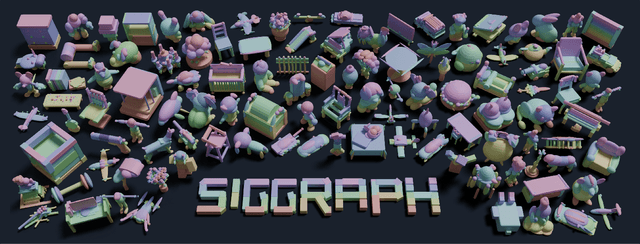
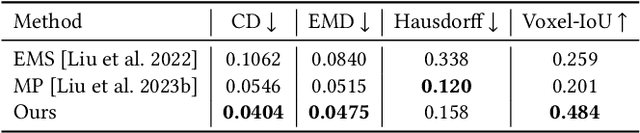
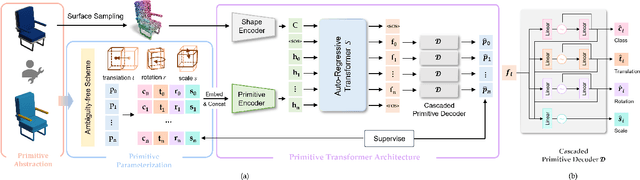
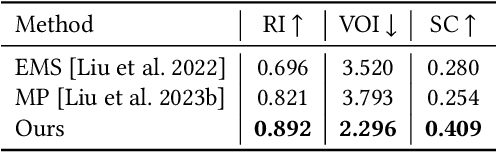
Shape primitive abstraction, which decomposes complex 3D shapes into simple geometric elements, plays a crucial role in human visual cognition and has broad applications in computer vision and graphics. While recent advances in 3D content generation have shown remarkable progress, existing primitive abstraction methods either rely on geometric optimization with limited semantic understanding or learn from small-scale, category-specific datasets, struggling to generalize across diverse shape categories. We present PrimitiveAnything, a novel framework that reformulates shape primitive abstraction as a primitive assembly generation task. PrimitiveAnything includes a shape-conditioned primitive transformer for auto-regressive generation and an ambiguity-free parameterization scheme to represent multiple types of primitives in a unified manner. The proposed framework directly learns the process of primitive assembly from large-scale human-crafted abstractions, enabling it to capture how humans decompose complex shapes into primitive elements. Through extensive experiments, we demonstrate that PrimitiveAnything can generate high-quality primitive assemblies that better align with human perception while maintaining geometric fidelity across diverse shape categories. It benefits various 3D applications and shows potential for enabling primitive-based user-generated content (UGC) in games. Project page: https://primitiveanything.github.io
Tailor: An Integrated Text-Driven CG-Ready Human and Garment Generation System
Mar 15, 2025Creating detailed 3D human avatars with garments typically requires specialized expertise and labor-intensive processes. Although recent advances in generative AI have enabled text-to-3D human/clothing generation, current methods fall short in offering accessible, integrated pipelines for producing ready-to-use clothed avatars. To solve this, we introduce Tailor, an integrated text-to-avatar system that generates high-fidelity, customizable 3D humans with simulation-ready garments. Our system includes a three-stage pipeline. We first employ a large language model to interpret textual descriptions into parameterized body shapes and semantically matched garment templates. Next, we develop topology-preserving deformation with novel geometric losses to adapt garments precisely to body geometries. Furthermore, an enhanced texture diffusion module with a symmetric local attention mechanism ensures both view consistency and photorealistic details. Quantitative and qualitative evaluations demonstrate that Tailor outperforms existing SoTA methods in terms of fidelity, usability, and diversity. Code will be available for academic use.