 Add to Chrome
 Add to Firefox
 Add to Edge
Staying VIGILant: Mitigating Visual Laziness via Counterfactual Visual Alignment in MLLMs
Jun 24, 2026
Multimodal large language models (MLLMs) extend large language models (LLMs) with visual perception, enabling joint reasoning over images and text. Despite inheriting strong reasoning capabilities from LLMs, they remain prone to hallucinations that contradict their visual inputs. Mechanistic studies indicate that this weakness stems from visual laziness: MLLMs encode the correct visual evidence internally, but overly rely on strong language priors during response. Existing alignment methods, such as direct preference optimization, primarily optimize outcome-level rewards based on text. This introduces an optimization bias toward linguistic shortcuts, leading to responses that often contradict the visual evidence. To address this, we propose Visual Information Gain In aLignment (VIGIL), a reinforcement-learning (RL) post-training framework that shifts the focus from numerical reward fitting to causal visual grounding. VIGIL introduces a geometric constraint that explicitly maximizes the mutual information between the visual input and the generated response. We achieve this by penalizing "blind confidence" instances where the model remains improperly certain even when textual-visual attention is masked to create a counterfactual blind state. Extensive experiments show that VIGIL consistently outperforms recent alignment methods across hallucination and reasoning benchmarks without compromising text-only capabilities. Our approach matches the full-data performance of state-of-the-art methods using only 25% of the preference data and even demonstrates emergent spatial grounding capabilities without explicit bounding box supervision.

DreamLite: A Lightweight On-Device Unified Model for Image Generation and Editing
Mar 30, 2026Diffusion models have made significant progress in both text-to-image (T2I) generation and text-guided image editing. However, these models are typically built with billions of parameters, leading to high latency and increased deployment challenges. While on-device diffusion models improve efficiency, they largely focus on T2I generation and lack support for image editing. In this paper, we propose DreamLite, a compact unified on-device diffusion model (0.39B) that supports both T2I generation and text-guided image editing within a single network. DreamLite is built on a pruned mobile U-Net backbone and unifies conditioning through in-context spatial concatenation in the latent space. It concatenates images horizontally as input, using a (target | blank) configuration for generation tasks and (target | source) for editing tasks. To stabilize the training of this compact model, we introduce a task-progressive joint pretraining strategy that sequentially targets T2I, editing, and joint tasks. After high-quality SFT and reinforcement learning, DreamLite achieves GenEval (0.72) for image generation and ImgEdit (4.11) for image editing, outperforming existing on-device models and remaining competitive with several server-side models. By employing step distillation, we further reduce denoising processing to just 4 steps, enabling our DreamLite could generate or edit a 1024 x 1024 image in less than 1s on a Xiaomi 14 smartphone. To the best of our knowledge, DreamLite is the first unified on-device diffusion model that supports both image generation and image editing.
CREval: An Automated Interpretable Evaluation for Creative Image Manipulation under Complex Instructions
Mar 27, 2026Instruction-based multimodal image manipulation has recently made rapid progress. However, existing evaluation methods lack a systematic and human-aligned framework for assessing model performance on complex and creative editing tasks. To address this gap, we propose CREval, a fully automated question-answer (QA)-based evaluation pipeline that overcomes the incompleteness and poor interpretability of opaque Multimodal Large Language Models (MLLMs) scoring. Simultaneously, we introduce CREval-Bench, a comprehensive benchmark specifically designed for creative image manipulation under complex instructions. CREval-Bench covers three categories and nine creative dimensions, comprising over 800 editing samples and 13K evaluation queries. Leveraging this pipeline and benchmark, we systematically evaluate a diverse set of state-of-the-art open and closed-source models. The results reveal that while closed-source models generally outperform open-source ones on complex and creative tasks, all models still struggle to complete such edits effectively. In addition, user studies demonstrate strong consistency between CREval's automated metrics and human judgments. Therefore, CREval provides a reliable foundation for evaluating image editing models on complex and creative image manipulation tasks, and highlights key challenges and opportunities for future research.
Premier: Personalized Preference Modulation with Learnable User Embedding in Text-to-Image Generation
Mar 21, 2026Text-to-image generation has advanced rapidly, yet it still struggles to capture the nuanced user preferences. Existing approaches typically rely on multimodal large language models to infer user preferences, but the derived prompts or latent codes rarely reflect them faithfully, leading to suboptimal personalization. We present Premier, a novel preference modulation framework for personalized image generation. Premier represents each user's preference as a learnable embedding and introduces a preference adapter that fuses the user embedding with the text prompt. To enable accurate and fine-grained preference control, the fused preference embedding is further used to modulate the generative process. To enhance the distinctness of individual preference and improve alignment between outputs and user-specific styles, we incorporate a dispersion loss that enforces separation among user embeddings. When user data are scarce, new users are represented as linear combinations of existing preference embeddings learned during training, enabling effective generalization. Experiments show that Premier outperforms prior methods under the same history length, achieving stronger preference alignment and superior performance on text consistency, ViPer proxy metrics, and expert evaluations.
CloneMem: Benchmarking Long-Term Memory for AI Clones
Jan 11, 2026AI Clones aim to simulate an individual's thoughts and behaviors to enable long-term, personalized interaction, placing stringent demands on memory systems to model experiences, emotions, and opinions over time. Existing memory benchmarks primarily rely on user-agent conversational histories, which are temporally fragmented and insufficient for capturing continuous life trajectories. We introduce CloneMem, a benchmark for evaluating longterm memory in AI Clone scenarios grounded in non-conversational digital traces, including diaries, social media posts, and emails, spanning one to three years. CloneMem adopts a hierarchical data construction framework to ensure longitudinal coherence and defines tasks that assess an agent's ability to track evolving personal states. Experiments show that current memory mechanisms struggle in this setting, highlighting open challenges for life-grounded personalized AI. Code and dataset are available at https://github.com/AvatarMemory/CloneMemBench
Does Memory Need Graphs? A Unified Framework and Empirical Analysis for Long-Term Dialog Memory
Jan 07, 2026Graph structures are increasingly used in dialog memory systems, but empirical findings on their effectiveness remain inconsistent, making it unclear which design choices truly matter. We present an experimental, system-oriented analysis of long-term dialog memory architectures. We introduce a unified framework that decomposes dialog memory systems into core components and supports both graph-based and non-graph approaches. Under this framework, we conduct controlled, stage-wise experiments on LongMemEval and HaluMem, comparing common design choices in memory representation, organization, maintenance, and retrieval. Our results show that many performance differences are driven by foundational system settings rather than specific architectural innovations. Based on these findings, we identify stable and reliable strong baselines for future dialog memory research.
Toward Training Superintelligent Software Agents through Self-Play SWE-RL
Dec 21, 2025While current software agents powered by large language models (LLMs) and agentic reinforcement learning (RL) can boost programmer productivity, their training data (e.g., GitHub issues and pull requests) and environments (e.g., pass-to-pass and fail-to-pass tests) heavily depend on human knowledge or curation, posing a fundamental barrier to superintelligence. In this paper, we present Self-play SWE-RL (SSR), a first step toward training paradigms for superintelligent software agents. Our approach takes minimal data assumptions, only requiring access to sandboxed repositories with source code and installed dependencies, with no need for human-labeled issues or tests. Grounded in these real-world codebases, a single LLM agent is trained via reinforcement learning in a self-play setting to iteratively inject and repair software bugs of increasing complexity, with each bug formally specified by a test patch rather than a natural language issue description. On the SWE-bench Verified and SWE-Bench Pro benchmarks, SSR achieves notable self-improvement (+10.4 and +7.8 points, respectively) and consistently outperforms the human-data baseline over the entire training trajectory, despite being evaluated on natural language issues absent from self-play. Our results, albeit early, suggest a path where agents autonomously gather extensive learning experiences from real-world software repositories, ultimately enabling superintelligent systems that exceed human capabilities in understanding how systems are constructed, solving novel challenges, and autonomously creating new software from scratch.
Live-SWE-agent: Can Software Engineering Agents Self-Evolve on the Fly?
Nov 17, 2025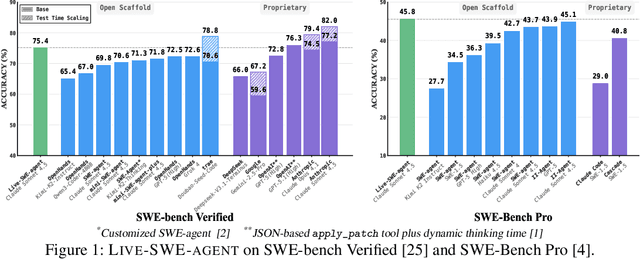
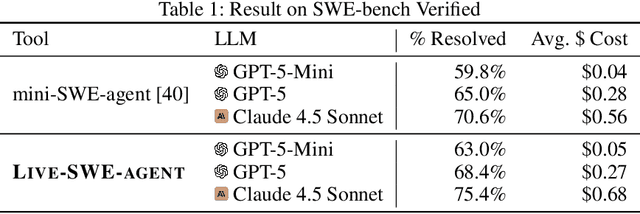
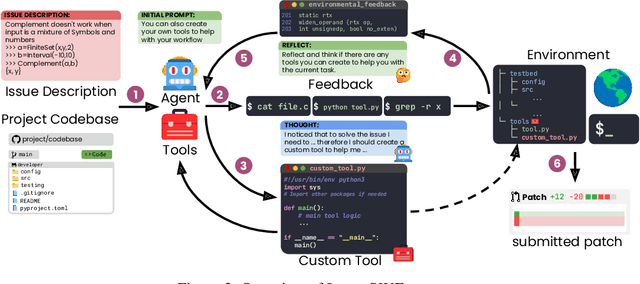
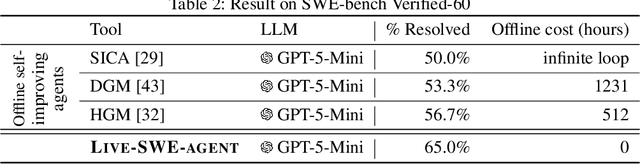
Large Language Models (LLMs) are reshaping almost all industries, including software engineering. In recent years, a number of LLM agents have been proposed to solve real-world software problems. Such software agents are typically equipped with a suite of coding tools and can autonomously decide the next actions to form complete trajectories to solve end-to-end software tasks. While promising, they typically require dedicated design and may still be suboptimal, since it can be extremely challenging and costly to exhaust the entire agent scaffold design space. Recognizing that software agents are inherently software themselves that can be further refined/modified, researchers have proposed a number of self-improving software agents recently, including the Darwin-Gödel Machine (DGM). Meanwhile, such self-improving agents require costly offline training on specific benchmarks and may not generalize well across different LLMs or benchmarks. In this paper, we propose Live-SWE-agent, the first live software agent that can autonomously and continuously evolve itself on-the-fly during runtime when solving real-world software problems. More specifically, Live-SWE-agent starts with the most basic agent scaffold with only access to bash tools (e.g., mini-SWE-agent), and autonomously evolves its own scaffold implementation while solving real-world software problems. Our evaluation on the widely studied SWE-bench Verified benchmark shows that Live-SWE-agent can achieve an impressive solve rate of 75.4% without test-time scaling, outperforming all existing open-source software agents and approaching the performance of the best proprietary solution. Moreover, Live-SWE-agent outperforms state-of-the-art manually crafted software agents on the recent SWE-Bench Pro benchmark, achieving the best-known solve rate of 45.8%.
Visual Instance-aware Prompt Tuning
Jul 10, 2025Visual Prompt Tuning (VPT) has emerged as a parameter-efficient fine-tuning paradigm for vision transformers, with conventional approaches utilizing dataset-level prompts that remain the same across all input instances. We observe that this strategy results in sub-optimal performance due to high variance in downstream datasets. To address this challenge, we propose Visual Instance-aware Prompt Tuning (ViaPT), which generates instance-aware prompts based on each individual input and fuses them with dataset-level prompts, leveraging Principal Component Analysis (PCA) to retain important prompting information. Moreover, we reveal that VPT-Deep and VPT-Shallow represent two corner cases based on a conceptual understanding, in which they fail to effectively capture instance-specific information, while random dimension reduction on prompts only yields performance between the two extremes. Instead, ViaPT overcomes these limitations by balancing dataset-level and instance-level knowledge, while reducing the amount of learnable parameters compared to VPT-Deep. Extensive experiments across 34 diverse datasets demonstrate that our method consistently outperforms state-of-the-art baselines, establishing a new paradigm for analyzing and optimizing visual prompts for vision transformers.
MoRE-Brain: Routed Mixture of Experts for Interpretable and Generalizable Cross-Subject fMRI Visual Decoding
May 21, 2025Decoding visual experiences from fMRI offers a powerful avenue to understand human perception and develop advanced brain-computer interfaces. However, current progress often prioritizes maximizing reconstruction fidelity while overlooking interpretability, an essential aspect for deriving neuroscientific insight. To address this gap, we propose MoRE-Brain, a neuro-inspired framework designed for high-fidelity, adaptable, and interpretable visual reconstruction. MoRE-Brain uniquely employs a hierarchical Mixture-of-Experts architecture where distinct experts process fMRI signals from functionally related voxel groups, mimicking specialized brain networks. The experts are first trained to encode fMRI into the frozen CLIP space. A finetuned diffusion model then synthesizes images, guided by expert outputs through a novel dual-stage routing mechanism that dynamically weighs expert contributions across the diffusion process. MoRE-Brain offers three main advancements: First, it introduces a novel Mixture-of-Experts architecture grounded in brain network principles for neuro-decoding. Second, it achieves efficient cross-subject generalization by sharing core expert networks while adapting only subject-specific routers. Third, it provides enhanced mechanistic insight, as the explicit routing reveals precisely how different modeled brain regions shape the semantic and spatial attributes of the reconstructed image. Extensive experiments validate MoRE-Brain's high reconstruction fidelity, with bottleneck analyses further demonstrating its effective utilization of fMRI signals, distinguishing genuine neural decoding from over-reliance on generative priors. Consequently, MoRE-Brain marks a substantial advance towards more generalizable and interpretable fMRI-based visual decoding. Code will be publicly available soon: https://github.com/yuxiangwei0808/MoRE-Brain.