 Add to Chrome
 Add to Firefox
 Add to Edge
Graph Set Transformer
Jun 03, 2026
We introduce the Graph Set Transformer (GST), a neural network architecture for learning on sets of graphs, designed for tasks in which per-element predictions depend on set-wide context as well as local structure. Existing architectures, including DeepSets and SetTransformer, require pre-encoded graph embeddings from a separate GNN, creating a bottleneck between feature extraction and set-level contextualisation. In contrast, GST interleaves node-level feature propagation and cross-graph contextual modelling at every layer, fusing the two levels of information through a gating mechanism. We evaluate GST on a controlled synthetic suite designed to isolate set-conditional structural reasoning and on three real-data benchmarks spanning per-atom reaction-centre identification, reaction yield prediction, and image classification. Under matched parameter budgets, GST performs better than the baselines across these settings. An architectural ablation strongly suggests that the interleaving of local and set context contributes substantially to this advantage.

MuGen: Multi-Skill Generative Locomotion Controller for Humanoid Robots
May 23, 2026This paper presents MuGen, a data-driven framework for learning and deploying multi-skill locomotion on humanoid robots. MuGen enables a robot to perform expressive motions like humans under the guidance of example motion sequences. To achieve this, we employ vector-quantized autoencoders (VQ-VAEs) trained with model-based reinforcement learning, resulting in a generative representation of locomotion that captures key patterns of human motion from hours of heterogeneous human performance data. We employ a teacher-student learning framework and develop a new policy distillation strategy to enable a deployable student policy learning this efficient latent representation. This policy allows the robot to track and mimic unseen human motions and further enables the robot to reuse the learned latent space for other tasks. We demonstrate the effectiveness of our framework through a diverse set of motions and accurate execution.
LagrangianSplats: Divergence-Free Transport of Gaussian Primitives for Fluid Reconstruction
May 10, 2026Reconstructing 3D fluid velocity fields from sparse 2D video observations is a highly ill-posed inverse problem, demanding both transport consistency with observed motion and physical validity under fluid laws. Existing methods typically impose these constraints through soft penalties, often leading to compromised accuracy and convergence issues. We introduce a reconstruction framework that structurally enforces both constraints. Specifically, we parameterize the reconstructed velocity using a continuous Divergence-Free Kernel representation, driving the advection of a Lagrangian 3D Gaussian Splatting representation. This formulation intrinsically guarantees both flow incompressibility and long-range transport coherence by construction. To enable the efficient optimization of such a constrained system, we introduce a novel Sliding Window scheme that propagates gradients over meaningful temporal horizons while maintaining tractable training costs. Experiments on synthetic and real-world datasets demonstrate that our method outperforms state-of-the-art baselines in both transport consistency and physical accuracy, enabling applications such as high-quality re-simulation and flow analysis.
RefracGS: Novel View Synthesis Through Refractive Water Surfaces with 3D Gaussian Ray Tracing
Mar 23, 2026Novel view synthesis (NVS) through non-planar refractive surfaces presents fundamental challenges due to severe, spatially varying optical distortions. While recent representations like NeRF and 3D Gaussian Splatting (3DGS) excel at NVS, their assumption of straight-line ray propagation fails under these conditions, leading to significant artifacts. To overcome this limitation, we introduce RefracGS, a framework that jointly reconstructs the refractive water surface and the scene beneath the interface. Our key insight is to explicitly decouple the refractive boundary from the target objects: the refractive surface is modeled via a neural height field, capturing wave geometry, while the underlying scene is represented as a 3D Gaussian field. We formulate a refraction-aware Gaussian ray tracing approach that accurately computes non-linear ray trajectories using Snell's law and efficiently renders the underlying Gaussian field while backpropagating the loss gradients to the parameterized refractive surface. Through end-to-end joint optimization of both representations, our method ensures high-fidelity NVS and view-consistent surface recovery. Experiments on both synthetic and real-world scenes with complex waves demonstrate that RefracGS outperforms prior refractive methods in visual quality, while achieving 15x faster training and real-time rendering at 200 FPS. The project page for RefracGS is available at https://yimgshao.github.io/refracgs/.
GraspADMM: Improving Dexterous Grasp Synthesis via ADMM Optimization
Mar 14, 2026Synthesizing high-quality dexterous grasps is a fundamental challenge in robot manipulation, requiring adherence to diversity, kinematic feasibility (valid hand-object contact without penetration), and dynamic stability (secure multi-contact forces). The recent framework Dexonomy successfully ensures broad grasp diversity through dense sampling and improves kinematic feasibility via a simulator-based refinement method that excels at resolving exact collisions. However, its reliance on fixed contact points restricts the hand's reachability and prevents the optimization of grasp metrics for dynamic stability. Conversely, purely gradient-based optimizers can maximize dynamic stability but rely on simplified contact approximations that inevitably cause physical penetrations. To bridge this gap, we propose GraspADMM, a novel grasp synthesis framework that preserves sampling-based diversity while improving kinematic feasibility and dynamic stability. By formulating the refinement stage using the Alternating Direction Method of Multipliers (ADMM), we decouple the target contact points on the object from the actual contact locations on the hand. This decomposition allows the pipeline to alternate between updating the target object points to directly maximize dynamic grasp metrics, and adjusting the hand pose to physically reach these targets while strictly respecting collision boundaries. Extensive experiments demonstrate that GraspADMM significantly outperforms state-of-the-art baselines, achieving a nearly 15\% absolute improvement in grasp success rate for type-unaware synthesis and roughly a 100\% relative improvement in type-aware synthesis. Furthermore, our approach maintains robust, physically plausible grasp generation even under extreme low-friction conditions.
Robust Single-shot Structured Light 3D Imaging via Neural Feature Decoding
Dec 16, 2025We consider the problem of active 3D imaging using single-shot structured light systems, which are widely employed in commercial 3D sensing devices such as Apple Face ID and Intel RealSense. Traditional structured light methods typically decode depth correspondences through pixel-domain matching algorithms, resulting in limited robustness under challenging scenarios like occlusions, fine-structured details, and non-Lambertian surfaces. Inspired by recent advances in neural feature matching, we propose a learning-based structured light decoding framework that performs robust correspondence matching within feature space rather than the fragile pixel domain. Our method extracts neural features from the projected patterns and captured infrared (IR) images, explicitly incorporating their geometric priors by building cost volumes in feature space, achieving substantial performance improvements over pixel-domain decoding approaches. To further enhance depth quality, we introduce a depth refinement module that leverages strong priors from large-scale monocular depth estimation models, improving fine detail recovery and global structural coherence. To facilitate effective learning, we develop a physically-based structured light rendering pipeline, generating nearly one million synthetic pattern-image pairs with diverse objects and materials for indoor settings. Experiments demonstrate that our method, trained exclusively on synthetic data with multiple structured light patterns, generalizes well to real-world indoor environments, effectively processes various pattern types without retraining, and consistently outperforms both commercial structured light systems and passive stereo RGB-based depth estimation methods. Project page: https://namisntimpot.github.io/NSLweb/.
From Orbit to Ground: Generative City Photogrammetry from Extreme Off-Nadir Satellite Images
Dec 09, 2025City-scale 3D reconstruction from satellite imagery presents the challenge of extreme viewpoint extrapolation, where our goal is to synthesize ground-level novel views from sparse orbital images with minimal parallax. This requires inferring nearly $90^\circ$ viewpoint gaps from image sources with severely foreshortened facades and flawed textures, causing state-of-the-art reconstruction engines such as NeRF and 3DGS to fail. To address this problem, we propose two design choices tailored for city structures and satellite inputs. First, we model city geometry as a 2.5D height map, implemented as a Z-monotonic signed distance field (SDF) that matches urban building layouts from top-down viewpoints. This stabilizes geometry optimization under sparse, off-nadir satellite views and yields a watertight mesh with crisp roofs and clean, vertically extruded facades. Second, we paint the mesh appearance from satellite images via differentiable rendering techniques. While the satellite inputs may contain long-range, blurry captures, we further train a generative texture restoration network to enhance the appearance, recovering high-frequency, plausible texture details from degraded inputs. Our method's scalability and robustness are demonstrated through extensive experiments on large-scale urban reconstruction. For example, in our teaser figure, we reconstruct a $4\,\mathrm{km}^2$ real-world region from only a few satellite images, achieving state-of-the-art performance in synthesizing photorealistic ground views. The resulting models are not only visually compelling but also serve as high-fidelity, application-ready assets for downstream tasks like urban planning and simulation. Project page can be found at https://pku-vcl-geometry.github.io/Orbit2Ground/.
Robust Differentiable Collision Detection for General Objects
Nov 09, 2025Collision detection is a core component of robotics applications such as simulation, control, and planning. Traditional algorithms like GJK+EPA compute witness points (i.e., the closest or deepest-penetration pairs between two objects) but are inherently non-differentiable, preventing gradient flow and limiting gradient-based optimization in contact-rich tasks such as grasping and manipulation. Recent work introduced efficient first-order randomized smoothing to make witness points differentiable; however, their direction-based formulation is restricted to convex objects and lacks robustness for complex geometries. In this work, we propose a robust and efficient differentiable collision detection framework that supports both convex and concave objects across diverse scales and configurations. Our method introduces distance-based first-order randomized smoothing, adaptive sampling, and equivalent gradient transport for robust and informative gradient computation. Experiments on complex meshes from DexGraspNet and Objaverse show significant improvements over existing baselines. Finally, we demonstrate a direct application of our method for dexterous grasp synthesis to refine the grasp quality. The code is available at https://github.com/JYChen18/DiffCollision.
The Less You Depend, The More You Learn: Synthesizing Novel Views from Sparse, Unposed Images without Any 3D Knowledge
Jun 11, 2025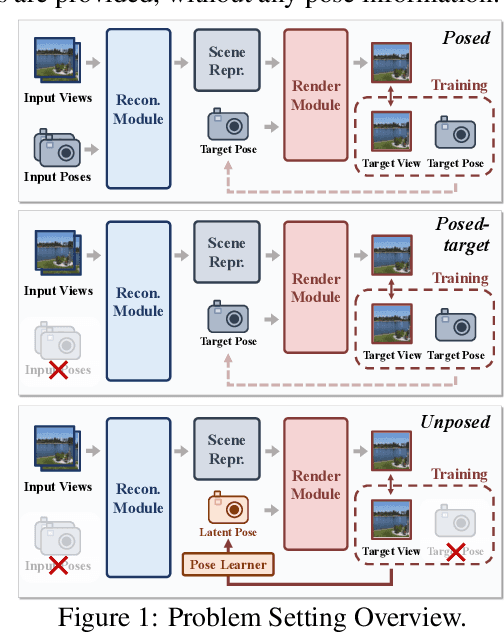
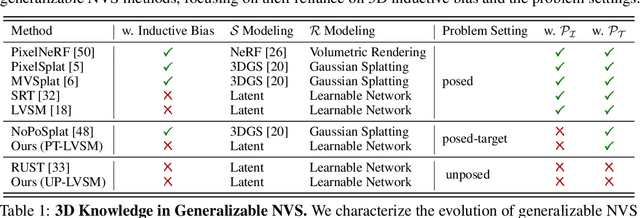
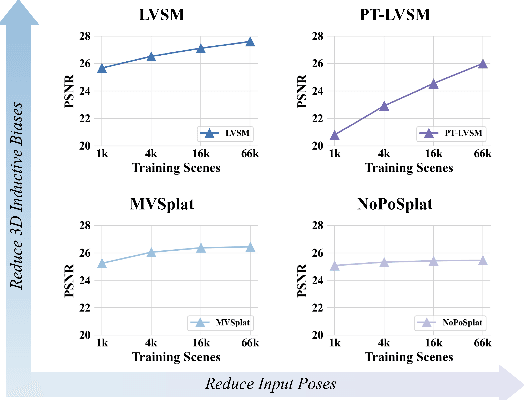
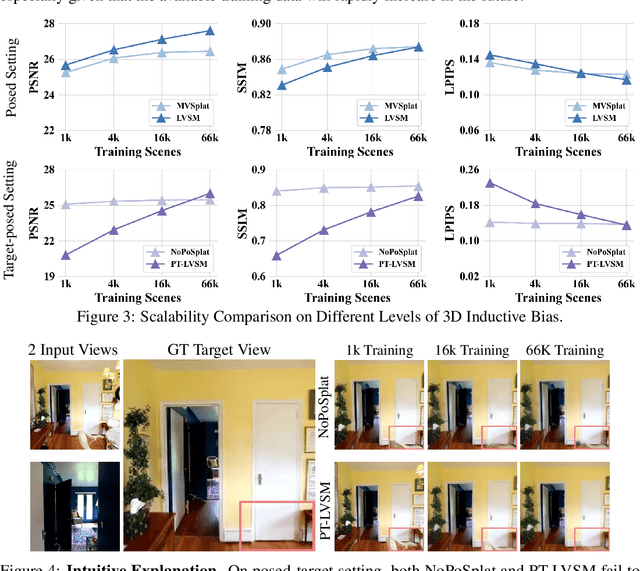
We consider the problem of generalizable novel view synthesis (NVS), which aims to generate photorealistic novel views from sparse or even unposed 2D images without per-scene optimization. This task remains fundamentally challenging, as it requires inferring 3D structure from incomplete and ambiguous 2D observations. Early approaches typically rely on strong 3D knowledge, including architectural 3D inductive biases (e.g., embedding explicit 3D representations, such as NeRF or 3DGS, into network design) and ground-truth camera poses for both input and target views. While recent efforts have sought to reduce the 3D inductive bias or the dependence on known camera poses of input views, critical questions regarding the role of 3D knowledge and the necessity of circumventing its use remain under-explored. In this work, we conduct a systematic analysis on the 3D knowledge and uncover a critical trend: the performance of methods that requires less 3D knowledge accelerates more as data scales, eventually achieving performance on par with their 3D knowledge-driven counterparts, which highlights the increasing importance of reducing dependence on 3D knowledge in the era of large-scale data. Motivated by and following this trend, we propose a novel NVS framework that minimizes 3D inductive bias and pose dependence for both input and target views. By eliminating this 3D knowledge, our method fully leverages data scaling and learns implicit 3D awareness directly from sparse 2D images, without any 3D inductive bias or pose annotation during training. Extensive experiments demonstrate that our model generates photorealistic and 3D-consistent novel views, achieving even comparable performance with methods that rely on posed inputs, thereby validating the feasibility and effectiveness of our data-centric paradigm. Project page: https://pku-vcl-geometry.github.io/Less3Depend/ .
OctGPT: Octree-based Multiscale Autoregressive Models for 3D Shape Generation
Apr 15, 2025Autoregressive models have achieved remarkable success across various domains, yet their performance in 3D shape generation lags significantly behind that of diffusion models. In this paper, we introduce OctGPT, a novel multiscale autoregressive model for 3D shape generation that dramatically improves the efficiency and performance of prior 3D autoregressive approaches, while rivaling or surpassing state-of-the-art diffusion models. Our method employs a serialized octree representation to efficiently capture the hierarchical and spatial structures of 3D shapes. Coarse geometry is encoded via octree structures, while fine-grained details are represented by binary tokens generated using a vector quantized variational autoencoder (VQVAE), transforming 3D shapes into compact multiscale binary sequences suitable for autoregressive prediction. To address the computational challenges of handling long sequences, we incorporate octree-based transformers enhanced with 3D rotary positional encodings, scale-specific embeddings, and token-parallel generation schemes. These innovations reduce training time by 13 folds and generation time by 69 folds, enabling the efficient training of high-resolution 3D shapes, e.g.,$1024^3$, on just four NVIDIA 4090 GPUs only within days. OctGPT showcases exceptional versatility across various tasks, including text-, sketch-, and image-conditioned generation, as well as scene-level synthesis involving multiple objects. Extensive experiments demonstrate that OctGPT accelerates convergence and improves generation quality over prior autoregressive methods, offering a new paradigm for high-quality, scalable 3D content creation. Our code and trained models are available at https://github.com/octree-nn/octgpt.