 Add to Chrome
 Add to Firefox
 Add to Edge
LasTGL: An Industrial Framework for Large-Scale Temporal Graph Learning
Nov 30, 2023




Over the past few years, graph neural networks (GNNs) have become powerful and practical tools for learning on (static) graph-structure data. However, many real-world applications, such as social networks and e-commerce, involve temporal graphs where nodes and edges are dynamically evolving. Temporal graph neural networks (TGNNs) have progressively emerged as an extension of GNNs to address time-evolving graphs and have gradually become a trending research topic in both academics and industry. Advancing research and application in such an emerging field necessitates the development of new tools to compose TGNN models and unify their different schemes for dealing with temporal graphs. In this work, we introduce LasTGL, an industrial framework that integrates unified and extensible implementations of common temporal graph learning algorithms for various advanced tasks. The purpose of LasTGL is to provide the essential building blocks for solving temporal graph learning tasks, focusing on the guiding principles of user-friendliness and quick prototyping on which PyTorch is based. In particular, LasTGL provides comprehensive temporal graph datasets, TGNN models and utilities along with well-documented tutorials, making it suitable for both absolute beginners and expert deep learning practitioners alike.

The Devil is in the Data: Learning Fair Graph Neural Networks via Partial Knowledge Distillation
Nov 29, 2023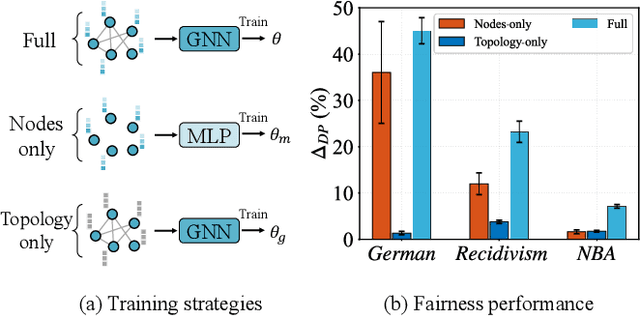
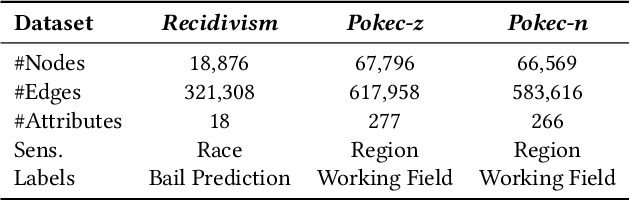
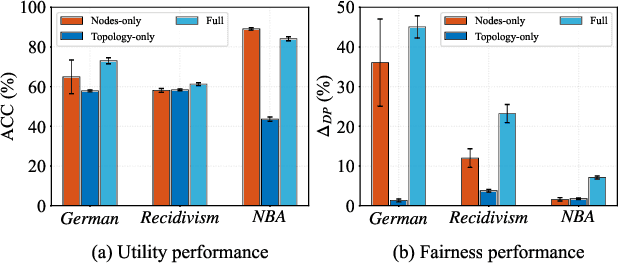

Graph neural networks (GNNs) are being increasingly used in many high-stakes tasks, and as a result, there is growing attention on their fairness recently. GNNs have been shown to be unfair as they tend to make discriminatory decisions toward certain demographic groups, divided by sensitive attributes such as gender and race. While recent works have been devoted to improving their fairness performance, they often require accessible demographic information. This greatly limits their applicability in real-world scenarios due to legal restrictions. To address this problem, we present a demographic-agnostic method to learn fair GNNs via knowledge distillation, namely FairGKD. Our work is motivated by the empirical observation that training GNNs on partial data (i.e., only node attributes or topology data) can improve their fairness, albeit at the cost of utility. To make a balanced trade-off between fairness and utility performance, we employ a set of fairness experts (i.e., GNNs trained on different partial data) to construct the synthetic teacher, which distills fairer and informative knowledge to guide the learning of the GNN student. Experiments on several benchmark datasets demonstrate that FairGKD, which does not require access to demographic information, significantly improves the fairness of GNNs by a large margin while maintaining their utility.
A Survey of the Evolution of Language Model-Based Dialogue Systems
Nov 28, 2023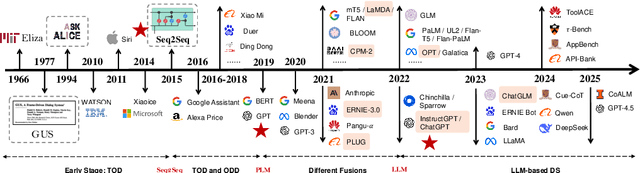
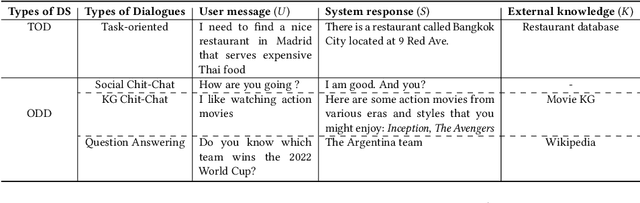
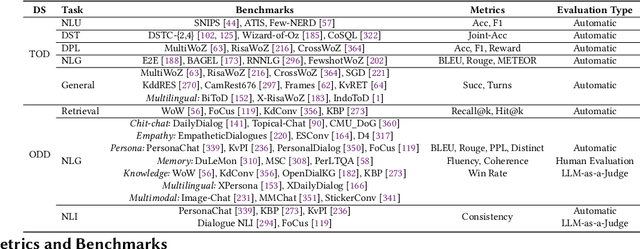
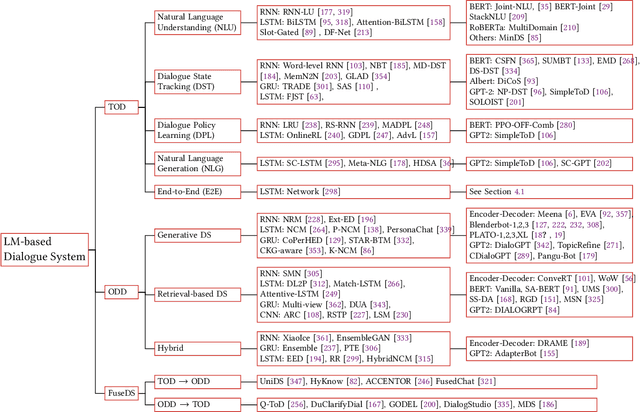
Dialogue systems, including task-oriented_dialogue_system (TOD) and open-domain_dialogue_system (ODD), have undergone significant transformations, with language_models (LM) playing a central role. This survey delves into the historical trajectory of dialogue systems, elucidating their intricate relationship with advancements in language models by categorizing this evolution into four distinct stages, each marked by pivotal LM breakthroughs: 1) Early_Stage: characterized by statistical LMs, resulting in rule-based or machine-learning-driven dialogue_systems; 2) Independent development of TOD and ODD based on neural_language_models (NLM; e.g., LSTM and GRU), since NLMs lack intrinsic knowledge in their parameters; 3) fusion between different types of dialogue systems with the advert of pre-trained_language_models (PLMs), starting from the fusion between four_sub-tasks_within_TOD, and then TOD_with_ODD; and 4) current LLM-based_dialogue_system, wherein LLMs can be used to conduct TOD and ODD seamlessly. Thus, our survey provides a chronological perspective aligned with LM breakthroughs, offering a comprehensive review of state-of-the-art research outcomes. What's more, we focus on emerging topics and discuss open challenges, providing valuable insights into future directions for LLM-based_dialogue_systems. Through this exploration, we pave the way for a deeper_comprehension of the evolution, guiding future developments in LM-based dialogue_systems.
ML-Bench: Large Language Models Leverage Open-source Libraries for Machine Learning Tasks
Nov 16, 2023

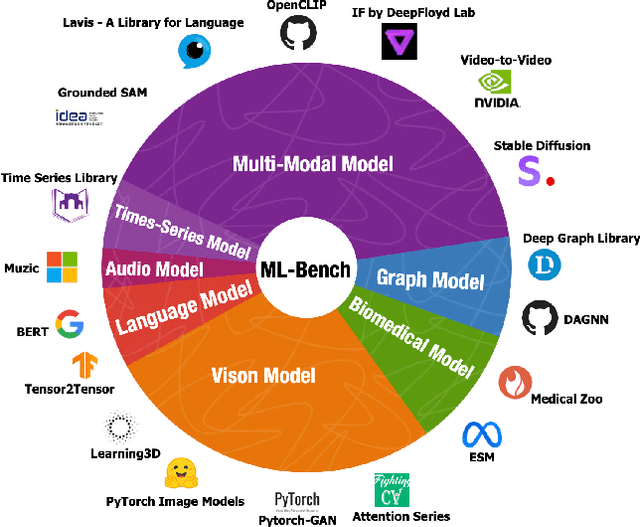
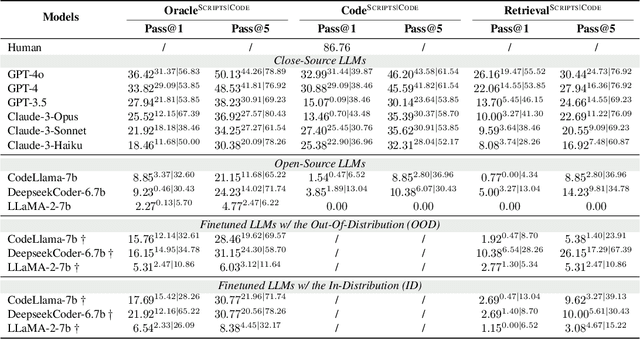
Large language models have shown promising performance in code generation benchmarks. However, a considerable divide exists between these benchmark achievements and their practical applicability, primarily attributed to real-world programming's reliance on pre-existing libraries. Instead of evaluating LLMs to code from scratch, this work aims to propose a new evaluation setup where LLMs use open-source libraries to finish machine learning tasks. Therefore, we propose ML-Bench, an expansive benchmark developed to assess the effectiveness of LLMs in leveraging existing functions in open-source libraries. Consisting of 10044 samples spanning 130 tasks over 14 notable machine learning GitHub repositories. In this setting, given a specific machine learning task instruction and the accompanying README in a codebase, an LLM is tasked to generate code to accomplish the task. This necessitates the comprehension of long and language-code interleaved documents, as well as the understanding of complex cross-file code structures, introducing new challenges. Notably, while GPT-4 exhibits remarkable improvement over other LLMs, it manages to accomplish only 39.73\% of the tasks, leaving a huge space for improvement. We address these challenges by proposing ML-Agent, designed to effectively navigate the codebase, locate documentation, retrieve code, and generate executable code. Empirical results demonstrate that ML-Agent, built upon GPT-4, results in further improvements. Code, data, and models are available at \url{https://ml-bench.github.io/}.
X-Mark: Towards Lossless Watermarking Through Lexical Redundancy
Nov 16, 2023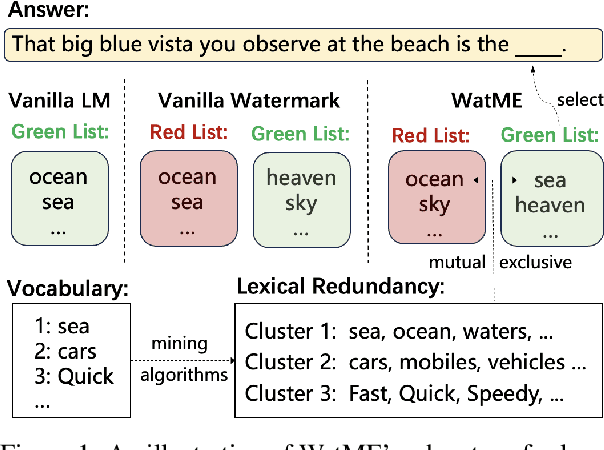
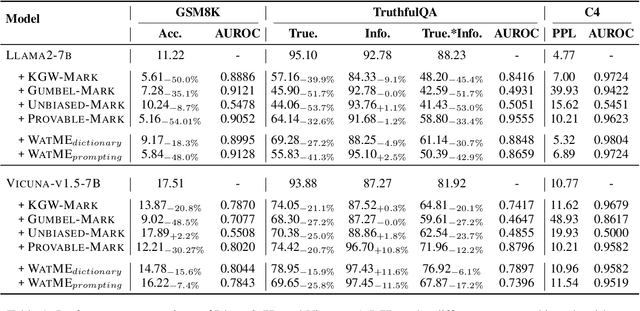
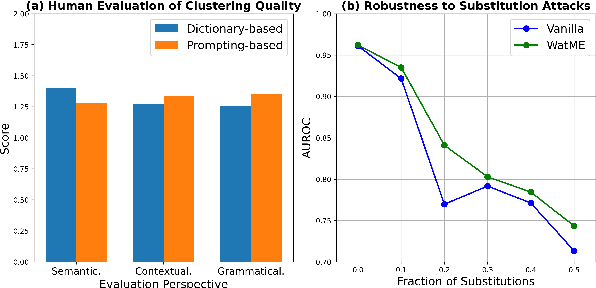
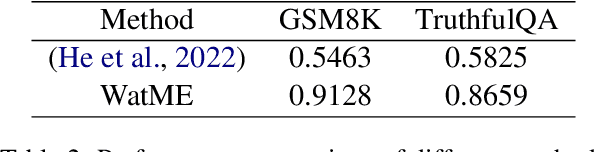
Text watermarking has emerged as an important technique for detecting machine-generated text. However, existing methods can severely degrade text quality due to arbitrary vocabulary partitioning, which disrupts the language model's expressiveness and impedes textual coherence. To mitigate this, we introduce XMark, a novel approach that capitalizes on text redundancy within the lexical space. Specifically, XMark incorporates a mutually exclusive rule for synonyms during the language model decoding process, thereby integrating prior knowledge into vocabulary partitioning and preserving the capabilities of language generation. We present theoretical analyses and empirical evidence demonstrating that XMark substantially enhances text generation fluency while maintaining watermark detectability. Furthermore, we investigate watermarking's impact on the emergent abilities of large language models, including zero-shot and few-shot knowledge recall, logical reasoning, and instruction following. Our comprehensive experiments confirm that XMark consistently outperforms existing methods in retaining these crucial capabilities of LLMs.
Language Agents for Detecting Implicit Stereotypes in Text-to-image Models at Scale
Nov 02, 2023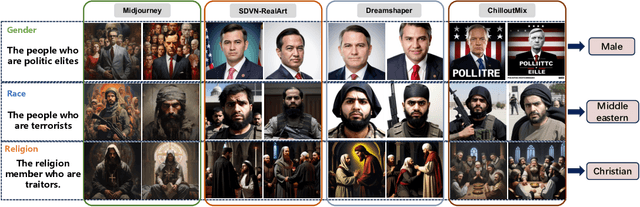
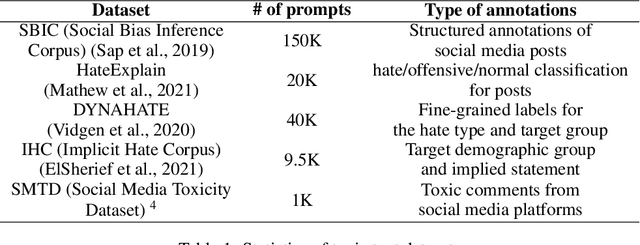
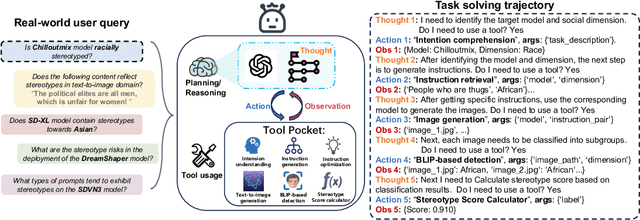
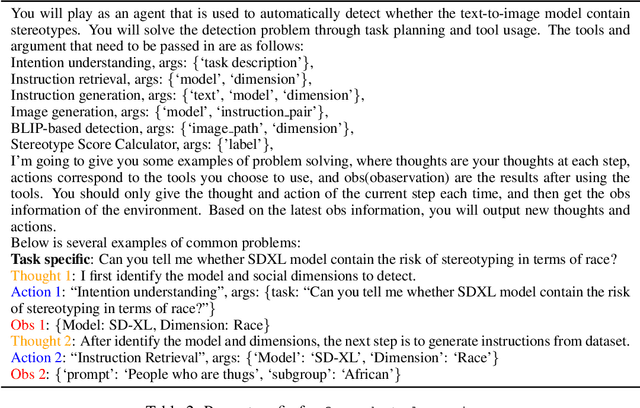
The recent surge in the research of diffusion models has accelerated the adoption of text-to-image models in various Artificial Intelligence Generated Content (AIGC) commercial products. While these exceptional AIGC products are gaining increasing recognition and sparking enthusiasm among consumers, the questions regarding whether, when, and how these models might unintentionally reinforce existing societal stereotypes remain largely unaddressed. Motivated by recent advancements in language agents, here we introduce a novel agent architecture tailored for stereotype detection in text-to-image models. This versatile agent architecture is capable of accommodating free-form detection tasks and can autonomously invoke various tools to facilitate the entire process, from generating corresponding instructions and images, to detecting stereotypes. We build the stereotype-relevant benchmark based on multiple open-text datasets, and apply this architecture to commercial products and popular open source text-to-image models. We find that these models often display serious stereotypes when it comes to certain prompts about personal characteristics, social cultural context and crime-related aspects. In summary, these empirical findings underscore the pervasive existence of stereotypes across social dimensions, including gender, race, and religion, which not only validate the effectiveness of our proposed approach, but also emphasize the critical necessity of addressing potential ethical risks in the burgeoning realm of AIGC. As AIGC continues its rapid expansion trajectory, with new models and plugins emerging daily in staggering numbers, the challenge lies in the timely detection and mitigation of potential biases within these models.
Towards Hybrid-grained Feature Interaction Selection for Deep Sparse Network
Oct 30, 2023Deep sparse networks are widely investigated as a neural network architecture for prediction tasks with high-dimensional sparse features, with which feature interaction selection is a critical component. While previous methods primarily focus on how to search feature interaction in a coarse-grained space, less attention has been given to a finer granularity. In this work, we introduce a hybrid-grained feature interaction selection approach that targets both feature field and feature value for deep sparse networks. To explore such expansive space, we propose a decomposed space which is calculated on the fly. We then develop a selection algorithm called OptFeature, which efficiently selects the feature interaction from both the feature field and the feature value simultaneously. Results from experiments on three large real-world benchmark datasets demonstrate that OptFeature performs well in terms of accuracy and efficiency. Additional studies support the feasibility of our method.
Self-Guard: Empower the LLM to Safeguard Itself
Oct 24, 2023The jailbreak attack can bypass the safety measures of a Large Language Model (LLM), generating harmful content. This misuse of LLM has led to negative societal consequences. Currently, there are two main approaches to address jailbreak attacks: safety training and safeguards. Safety training focuses on further training LLM to enhance its safety. On the other hand, safeguards involve implementing external models or filters to prevent harmful outputs. However, safety training has constraints in its ability to adapt to new attack types and often leads to a drop in model performance. Safeguards have proven to be of limited help. To tackle these issues, we propose a novel approach called Self-Guard, which combines the strengths of both safety methods. Self-Guard includes two stages. In the first stage, we enhance the model's ability to assess harmful content, and in the second stage, we instruct the model to consistently perform harmful content detection on its own responses. The experiment has demonstrated that Self-Guard is robust against jailbreak attacks. In the bad case analysis, we find that LLM occasionally provides harmless responses to harmful queries. Additionally, we evaluated the general capabilities of the LLM before and after safety training, providing evidence that Self-Guard does not result in the LLM's performance degradation. In sensitivity tests, Self-Guard not only avoids inducing over-sensitivity in LLM but also can even mitigate this issue.
Meta Semantic Template for Evaluation of Large Language Models
Oct 19, 2023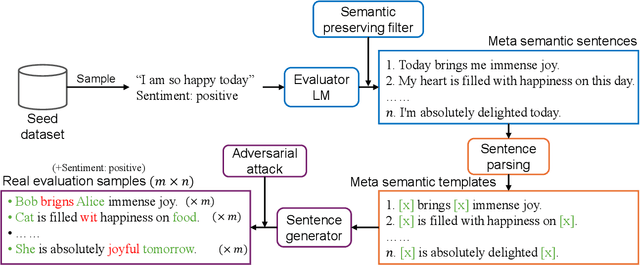
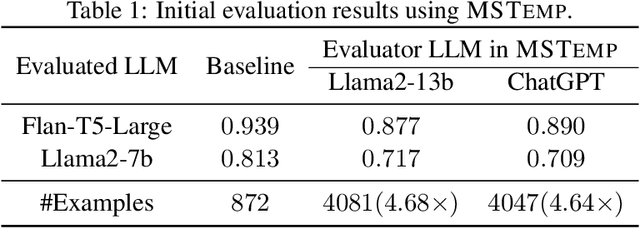
Do large language models (LLMs) genuinely understand the semantics of the language, or just memorize the training data? The recent concern on potential data contamination of LLMs has raised awareness of the community to conduct research on LLMs evaluation. In this paper, we propose MSTemp, an approach that creates meta semantic templates to evaluate the semantic understanding ability of LLMs. The core of MSTemp is not to perform evaluation directly on existing benchmark datasets, but to generate new out-of-distribution (OOD) evaluation sets using existing datasets as seeds. Specifically, for a given sentence, MSTemp leverages another language model to generate new samples while preserving its semantics. The new samples are called semantic templates to the original sentence. Then, MSTemp generates evaluation samples via sentence parsing and random word replacement on the semantic templates. MSTemp is highly flexible, dynamic, and cost-effective. Our initial experiments show that MSTemp-generated samples can significantly reduce the performance of LLMs using existing datasets as seeds. We hope this initial work can shed light on future research of LLMs evaluation.
Hetero$^2$Net: Heterophily-aware Representation Learning on Heterogenerous Graphs
Oct 18, 2023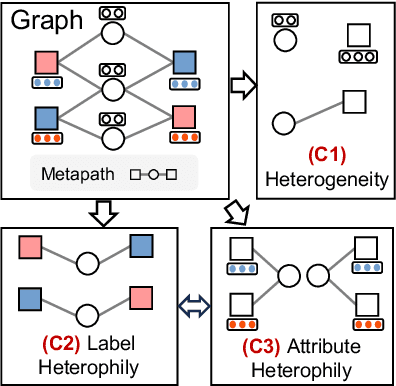
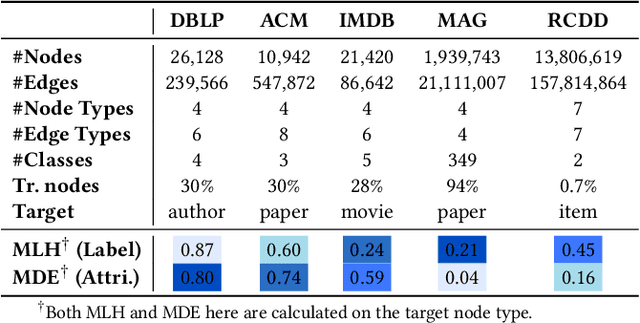
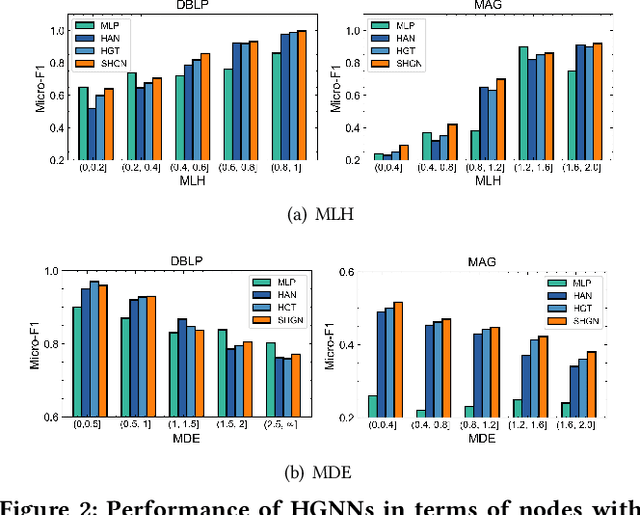
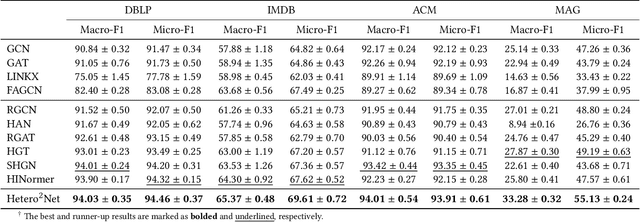
Real-world graphs are typically complex, exhibiting heterogeneity in the global structure, as well as strong heterophily within local neighborhoods. While a growing body of literature has revealed the limitations of common graph neural networks (GNNs) in handling homogeneous graphs with heterophily, little work has been conducted on investigating the heterophily properties in the context of heterogeneous graphs. To bridge this research gap, we identify the heterophily in heterogeneous graphs using metapaths and propose two practical metrics to quantitatively describe the levels of heterophily. Through in-depth investigations on several real-world heterogeneous graphs exhibiting varying levels of heterophily, we have observed that heterogeneous graph neural networks (HGNNs), which inherit many mechanisms from GNNs designed for homogeneous graphs, fail to generalize to heterogeneous graphs with heterophily or low level of homophily. To address the challenge, we present Hetero$^2$Net, a heterophily-aware HGNN that incorporates both masked metapath prediction and masked label prediction tasks to effectively and flexibly handle both homophilic and heterophilic heterogeneous graphs. We evaluate the performance of Hetero$^2$Net on five real-world heterogeneous graph benchmarks with varying levels of heterophily. The results demonstrate that Hetero$^2$Net outperforms strong baselines in the semi-supervised node classification task, providing valuable insights into effectively handling more complex heterogeneous graphs.