 Add to Chrome
 Add to Firefox
 Add to Edge
HSUGA: LLM-Enhanced Recommendation with Hierarchical Semantic Understanding and Group-Aware Alignment
May 12, 2026
Large language model (LLM)-enhanced sequential recommendation typically aims to improve two core components: user semantic embedding extraction and utilization. Despite promising results, existing methods still have two limitations: 1) In the extraction stage, most methods directly input long interaction sequence fragments into LLM for preference summarization. However, excessively long sequences increase inference difficulty, making it challenging to reliably infer accurate user embeddings. 2) In the utilization stage, most methods employ the same semantic embedding utilization strategy for all users, neglecting the differences caused by user activity levels, leading to suboptimal performance. To address these issues, we propose HSUGA, which introduces a simple yet effective plugin for each of the two core components: Hierarchical Semantic Understanding (HSU) and Group-Aware Alignment (GAA). HSU performs a staged two-phase preference mining and models preference evolution through constrained editing operations, thereby improving the reliability of user semantic extraction. GAA adjusts the intensity of semantic utilization based on user activity levels, providing weaker alignment for active users and stronger guidance for users with sparse historical data. Finally, extensive experiments on three benchmark datasets demonstrate the effectiveness and compatibility of HSUGA.

Intelligent Approval of Access Control Flow in Office Automation Systems via Relational Modeling
Apr 13, 2026Office automation (OA) systems play a crucial role in enterprise operations and management, with access control flow approval (ACFA) being a key component that manages the accessibility of various resources. However, traditional ACFA requires approval from the person in charge at each step, which consumes a significant amount of manpower and time. Its intelligence is a crucial issue that needs to be addressed urgently by all companies. In this paper, we propose a novel relational modeling-driven intelligent approval (RMIA) framework to automate ACFA. Specifically, our RMIA consists of two core modules: (1) The binary relation modeling module aims to characterize the coupling relation between applicants and approvers and provide reliable basic information for ACFA decision-making from a coarse-grained perspective. (2) The ternary relation modeling module utilizes specific resource information as its core, characterizing the complex relations between applicants, resources, and approvers, and thus provides fine-grained gain information for informed decision-making. Then, our RMIA effectively fuses these two kinds of information to form the final decision. Finally, extensive experiments are conducted on two product datasets and an online A/B test to verify the effectiveness of RMIA.
Retrieve-then-Adapt: Retrieval-Augmented Test-Time Adaptation for Sequential Recommendation
Apr 07, 2026The sequential recommendation (SR) task aims to predict the next item based on users' historical interaction sequences. Typically trained on historical data, SR models often struggle to adapt to real-time preference shifts during inference due to challenges posed by distributional divergence and parameterized constraints. Existing approaches to address this issue include test-time training, test-time augmentation, and retrieval-augmented fine-tuning. However, these methods either introduce significant computational overhead, rely on random augmentation strategies, or require a carefully designed two-stage training paradigm. In this paper, we argue that the key to effective test-time adaptation lies in achieving both effective augmentation and efficient adaptation. To this end, we propose Retrieve-then-Adapt (ReAd), a novel framework that dynamically adapts a deployed SR model to the test distribution through retrieved user preference signals. Specifically, given a trained SR model, ReAd first retrieves collaboratively similar items for a test user from a constructed collaborative memory database. A lightweight retrieval learning module then integrates these items into an informative augmentation embedding that captures both collaborative signals and prediction-refinement cues. Finally, the initial SR prediction is refined via a fusion mechanism that incorporates this embedding. Extensive experiments across five benchmark datasets demonstrate that ReAd consistently outperforms existing SR methods.
Data-Driven Function Calling Improvements in Large Language Model for Online Financial QA
Apr 07, 2026Large language models (LLMs) have been incorporated into numerous industrial applications. Meanwhile, a vast array of API assets is scattered across various functions in the financial domain. An online financial question-answering system can leverage both LLMs and private APIs to provide timely financial analysis and information. The key is equipping the LLM model with function calling capability tailored to a financial scenario. However, a generic LLM requires customized financial APIs to call and struggles to adapt to the financial domain. Additionally, online user queries are diverse and contain out-of-distribution parameters compared with the required function input parameters, which makes it more difficult for a generic LLM to serve online users. In this paper, we propose a data-driven pipeline to enhance function calling in LLM for our online, deployed financial QA, comprising dataset construction, data augmentation, and model training. Specifically, we construct a dataset based on a previous study and update it periodically, incorporating queries and an augmentation method named AugFC. The addition of user query-related samples will \textit{exploit} our financial toolset in a data-driven manner, and AugFC explores the possible parameter values to enhance the diversity of our updated dataset. Then, we train an LLM with a two-step method, which enables the use of our financial functions. Extensive experiments on existing offline datasets, as well as the deployment of an online scenario, illustrate the superiority of our pipeline. The related pipeline has been adopted in the financial QA of YuanBao\footnote{https://yuanbao.tencent.com/chat/}, one of the largest chat platforms in China.
Evaluating Uplift Modeling under Structural Biases: Insights into Metric Stability and Model Robustness
Mar 21, 2026In personalized marketing, uplift models estimate incremental effects by modeling how customer behavior changes under alternative treatments. However, real-world data often exhibit biases - such as selection bias, spillover effects, and unobserved confounding - which adversely affect both estimation accuracy and metric validity. Despite the importance of bias-aware assessment, a lack of systematic studies persists. To bridge this gap, we design a systematic benchmarking framework. Unlike standard predictive tasks, real-world uplift datasets lack counterfactual ground truth, rendering direct metric validation infeasible. Therefore, a semi-synthetic approach serves as a critical enabler for systematic benchmarking, effectively bridging the gap by retaining real-world feature dependencies while providing the ground truth needed to isolate structural biases. Our investigations reveal that: (i) uplift targeting and prediction can manifest as distinct objectives, where proficiency in one does not ensure efficacy in the other; (ii) while many models exhibit inconsistent performance under diverse biases, TARNet shows notable robustness, providing insights for subsequent model design; (iii) evaluation metric stability is linked to mathematical alignment with the ATE, suggesting that ATE-approximating metrics yield more consistent model rankings under structural data imperfections. These findings suggest the need for more robust uplift models and metrics. Code will be released upon acceptance.
Enhancing guidance for missing data in diffusion-based sequential recommendation
Jan 22, 2026Contemporary sequential recommendation methods are becoming more complex, shifting from classification to a diffusion-guided generative paradigm. However, the quality of guidance in the form of user information is often compromised by missing data in the observed sequences, leading to suboptimal generation quality. Existing methods address this by removing locally similar items, but overlook ``critical turning points'' in user interest, which are crucial for accurately predicting subsequent user intent. To address this, we propose a novel Counterfactual Attention Regulation Diffusion model (CARD), which focuses on amplifying the signal from key interest-turning-point items while concurrently identifying and suppressing noise within the user sequence. CARD consists of (1) a Dual-side Thompson Sampling method to identify sequences undergoing significant interest shift, and (2) a counterfactual attention mechanism for these sequences to quantify the importance of each item. In this manner, CARD provides the diffusion model with a high-quality guidance signal composed of dynamically re-weighted interaction vectors to enable effective generation. Experiments show our method works well on real-world data without being computationally expensive. Our code is available at https://github.com/yanqilong3321/CARD.
Automated Information Flow Selection for Multi-scenario Multi-task Recommendation
Dec 15, 2025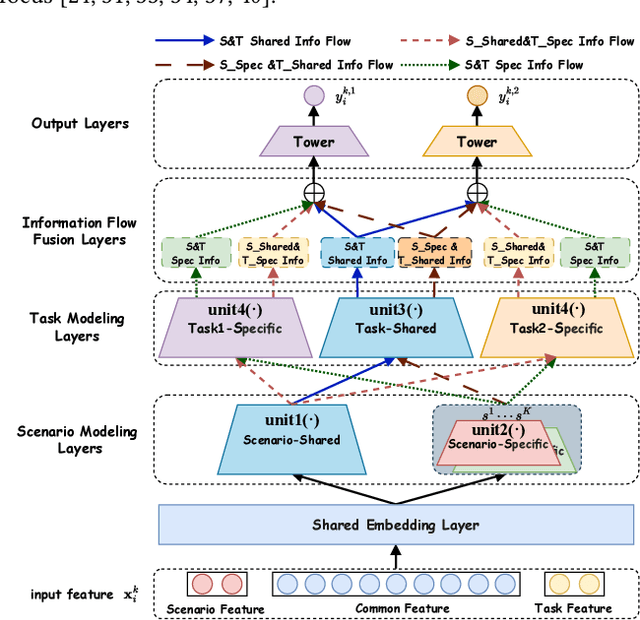
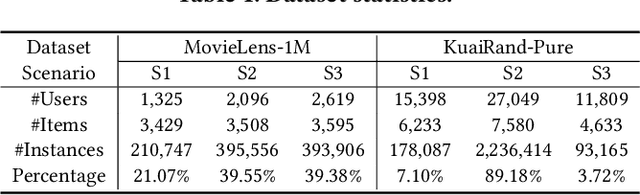
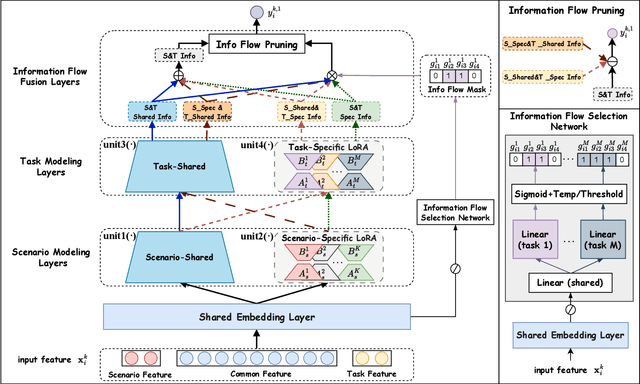
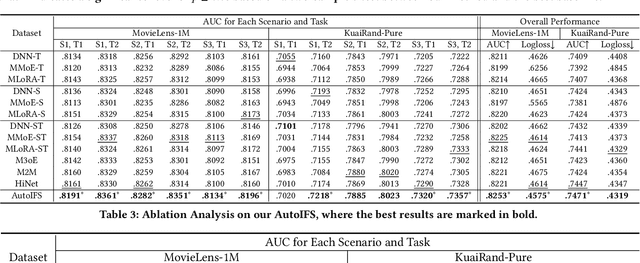
Multi-scenario multi-task recommendation (MSMTR) systems must address recommendation demands across diverse scenarios while simultaneously optimizing multiple objectives, such as click-through rate and conversion rate. Existing MSMTR models typically consist of four information units: scenario-shared, scenario-specific, task-shared, and task-specific networks. These units interact to generate four types of relationship information flows, directed from scenario-shared or scenario-specific networks to task-shared or task-specific networks. However, these models face two main limitations: 1) They often rely on complex architectures, such as mixture-of-experts (MoE) networks, which increase the complexity of information fusion, model size, and training cost. 2) They extract all available information flows without filtering out irrelevant or even harmful content, introducing potential noise. Regarding these challenges, we propose a lightweight Automated Information Flow Selection (AutoIFS) framework for MSMTR. To tackle the first issue, AutoIFS incorporates low-rank adaptation (LoRA) to decouple the four information units, enabling more flexible and efficient information fusion with minimal parameter overhead. To address the second issue, AutoIFS introduces an information flow selection network that automatically filters out invalid scenario-task information flows based on model performance feedback. It employs a simple yet effective pruning function to eliminate useless information flows, thereby enhancing the impact of key relationships and improving model performance. Finally, we evaluate AutoIFS and confirm its effectiveness through extensive experiments on two public benchmark datasets and an online A/B test.
Beyond Higher Rank: Token-wise Input-Output Projections for Efficient Low-Rank Adaptation
Oct 27, 2025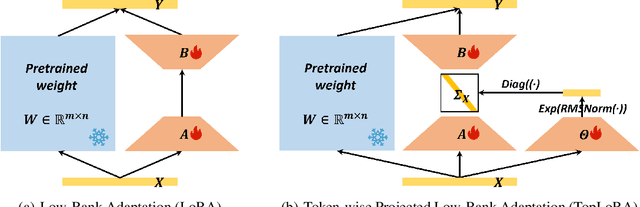
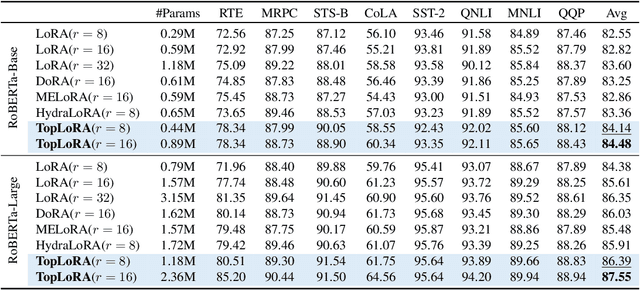
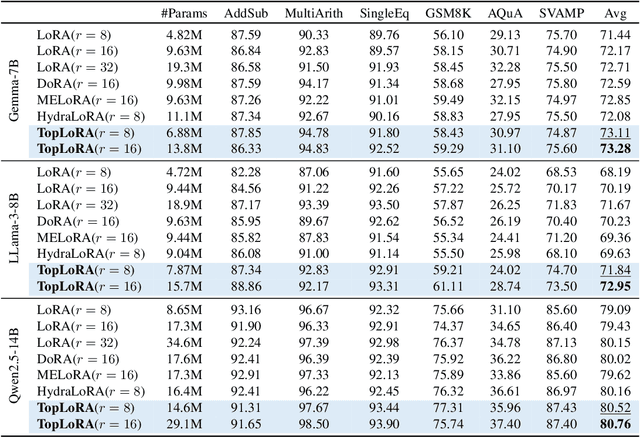
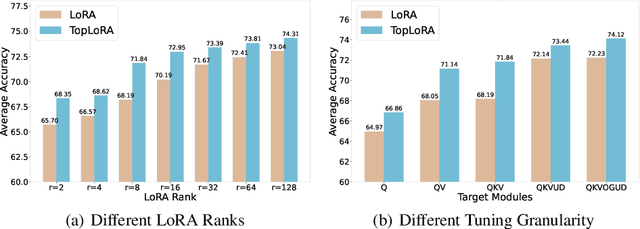
Low-rank adaptation (LoRA) is a parameter-efficient fine-tuning (PEFT) method widely used in large language models (LLMs). LoRA essentially describes the projection of an input space into a low-dimensional output space, with the dimensionality determined by the LoRA rank. In standard LoRA, all input tokens share the same weights and undergo an identical input-output projection. This limits LoRA's ability to capture token-specific information due to the inherent semantic differences among tokens. To address this limitation, we propose Token-wise Projected Low-Rank Adaptation (TopLoRA), which dynamically adjusts LoRA weights according to the input token, thereby learning token-wise input-output projections in an end-to-end manner. Formally, the weights of TopLoRA can be expressed as $B\Sigma_X A$, where $A$ and $B$ are low-rank matrices (as in standard LoRA), and $\Sigma_X$ is a diagonal matrix generated from each input token $X$. Notably, TopLoRA does not increase the rank of LoRA weights but achieves more granular adaptation by learning token-wise LoRA weights (i.e., token-wise input-output projections). Extensive experiments across multiple models and datasets demonstrate that TopLoRA consistently outperforms LoRA and its variants. The code is available at https://github.com/Leopold1423/toplora-neurips25.
See&Trek: Training-Free Spatial Prompting for Multimodal Large Language Model
Sep 19, 2025We introduce SEE&TREK, the first training-free prompting framework tailored to enhance the spatial understanding of Multimodal Large Language Models (MLLMS) under vision-only constraints. While prior efforts have incorporated modalities like depth or point clouds to improve spatial reasoning, purely visualspatial understanding remains underexplored. SEE&TREK addresses this gap by focusing on two core principles: increasing visual diversity and motion reconstruction. For visual diversity, we conduct Maximum Semantic Richness Sampling, which employs an off-the-shell perception model to extract semantically rich keyframes that capture scene structure. For motion reconstruction, we simulate visual trajectories and encode relative spatial positions into keyframes to preserve both spatial relations and temporal coherence. Our method is training&GPU-free, requiring only a single forward pass, and can be seamlessly integrated into existing MLLM'S. Extensive experiments on the VSI-B ENCH and STI-B ENCH show that S EE &T REK consistently boosts various MLLM S performance across diverse spatial reasoning tasks with the most +3.5% improvement, offering a promising path toward stronger spatial intelligence.
BoRA: Towards More Expressive Low-Rank Adaptation with Block Diversity
Aug 09, 2025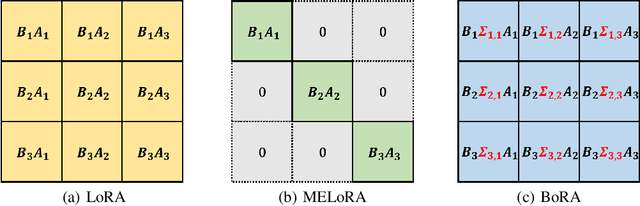
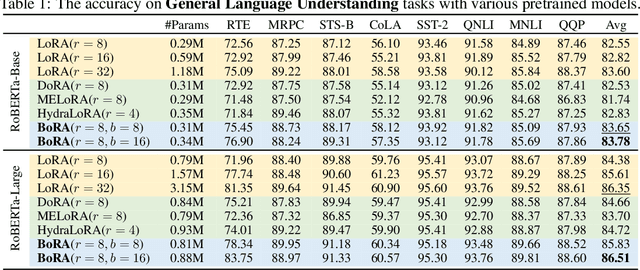
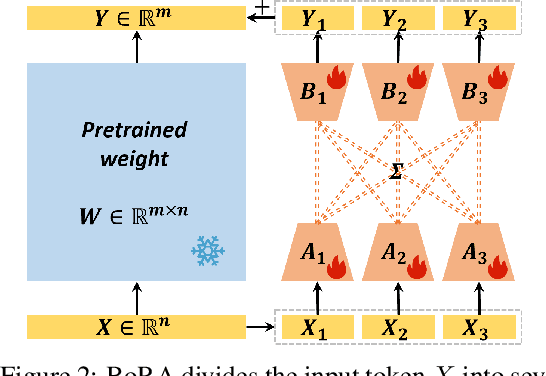
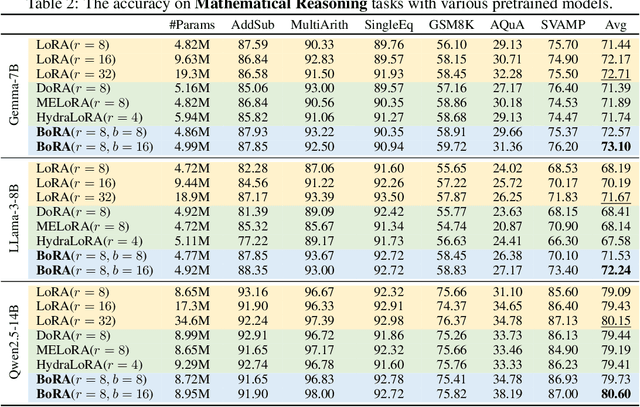
Low-rank adaptation (LoRA) is a parameter-efficient fine-tuning (PEFT) method widely used in large language models (LLMs). It approximates the update of a pretrained weight matrix $W\in\mathbb{R}^{m\times n}$ by the product of two low-rank matrices, $BA$, where $A \in\mathbb{R}^{r\times n}$ and $B\in\mathbb{R}^{m\times r} (r\ll\min\{m,n\})$. Increasing the dimension $r$ can raise the rank of LoRA weights (i.e., $BA$), which typically improves fine-tuning performance but also significantly increases the number of trainable parameters. In this paper, we propose Block Diversified Low-Rank Adaptation (BoRA), which improves the rank of LoRA weights with a small number of additional parameters. Specifically, BoRA treats the product $BA$ as a block matrix multiplication, where $A$ and $B$ are partitioned into $b$ blocks along the columns and rows, respectively (i.e., $A=[A_1,\dots,A_b]$ and $B=[B_1,\dots,B_b]^\top$). Consequently, the product $BA$ becomes the concatenation of the block products $B_iA_j$ for $i,j\in[b]$. To enhance the diversity of different block products, BoRA introduces a unique diagonal matrix $\Sigma_{i,j} \in \mathbb{R}^{r\times r}$ for each block multiplication, resulting in $B_i \Sigma_{i,j} A_j$. By leveraging these block-wise diagonal matrices, BoRA increases the rank of LoRA weights by a factor of $b$ while only requiring $b^2r$ additional parameters. Extensive experiments across multiple datasets and models demonstrate the superiority of BoRA, and ablation studies further validate its scalability.