 Add to Chrome
 Add to Firefox
 Add to Edge
Write, Execute, Refine: From Skill Followers to Skill Optimizers via Reinforcement Learning from Execution Feedback
Aug 18, 2026
Expert-written natural language skills can improve tool-using agents, yet agent-authored skills perform 8-11 points worse than using no skill. This gap suggests that following procedural guidance and improving it from execution evidence are distinct capabilities. Inference time loops can repair skills but do not improve the model that writes the next one. We study how to organize execution experience from intermediate skills into training states for an optimizer. We introduce WER (Write, Execute, and Refine), a multi-phase framework that trains a Skill Optimizer outside a frozen executor. The optimizer proposes skills, a frozen agent executes each repeatedly, and a programmatic verifier scores the outcomes. The scores provide relative credit and select mixed-outcome records. Matched successful and failed trajectories from these records form the next phase's refinement states, so the optimizer learns from the consequences of its earlier outputs. On BFCL v4 multi-turn and tau2-bench, WER improves average Pass@1 over the no-skill baseline by 7.80 and 3.85 points, respectively. Under an identical refinement workflow, it outperforms the same backbone without optimizer training by 9.35 and 10.29 points. The trained 4B optimizer reaches 76.63 percent on BFCL v4, outperforming all evaluated off-the-shelf general-purpose models used as skill optimizers on average.

LEGO-RL: Harness-Native Reinforcement Learning for Coding Agents
Aug 18, 2026Reinforcement learning for coding agents increasingly relies on long-running agent harnesses to manage tool integration, repository contexts, and execution feedback. However, the native execution environments of these harnesses are inherently misaligned with policy-gradient training: environmental crashes and reward hacking corrupt outcome signals, while train-inference discrepancies decouple rollout behavior from policy updates. To address this, we present LEGO-RL, a framework that bridges native coding-agent harnesses with scalable policy-gradient optimization without modifying their internal control flow. LEGO-RL is built upon three pillars: (1) faithful optimization via in-process LLM proxying that captures raw generation streams for token-level alignment and robust trainer-side log-probability recomputation, even under harness-side compaction or re-serialization; (2) reliable execution via scalable sandbox orchestration featuring image caching and stage-wise defenses to mitigate reward hacking; and (3) observable training through an integrated plugin that automates validation and monitoring, paired with a Live UI for granular trajectory diagnostics. We evaluate LEGO-RL by training the sparse MoE model Qwen3.5-35B-A3B with GSPO across three native coding-agent harnesses. LEGO-RL improves Qwen3.5-35B-A3B across OpenHands SDK (64.0% to 70.4%), Claude Code (62.4% to 68.2%), and OpenCode (57.2% to 66.6%) on SWE-bench Verified, while maintaining a rollout-training probability correlation above 0.99.
Mitigating Context Interference for Reliable and Efficient Search Agents
Aug 11, 2026Recent research empowers Large Language Models (LLMs) as multi-turn search agents to iteratively retrieve and generate outputs until complex tasks are solved. However, the contexts of multi-turn search agents are lengthy and complex. For example, the retrieved set of documents in each turn would inevitably introduce irrelevant information that distracts LLMs, referring to \textit{context interference}, potentially hindering the reliability and efficiency of search agents. Therefore, we conduct a systematic study on context interference in multi-turn search agents, focusing on investigating i) which parts of the context of search agents will contribute to the context interference, ii) how to refine the contexts of search agents to mitigate the interference, and iii) can incorporating context refinement into search agent training yield further improvements. We reveal that interference primarily arises from the latest retrieved documents. Based on the explored findings, we then introduce a distill-based context refiner to dynamically mitigate context interference for multi-turn search agents. Finally, we validate that incorporating context refinement into RL training pipelines of search agents can significantly enhance both reliability and efficiency. This study highlights the importance of mitigating context interference of search agents, inspiring a novel paradigm of ``refine context and then generate'' for AI agents.
What Makes Interaction Trajectories Effective for Training Terminal Agents?
Jun 02, 2026Stronger code agents are commonly assumed to be superior teachers for post-training, yet this assumption remains poorly disentangled from task difficulty, harness design, and student capacity. We investigate this pedagogical link using Terminal-Lego, a scalable pipeline that transforms multi-domain real-world issues into environment-verified agentic tasks. Surprisingly, standalone performance does not dictate teaching efficacy: while Claude Opus 4.6 achieves higher scores on Terminal-Bench 2.0, students fine-tuned on trajectories from DeepSeek-V3.2, a lower-scoring agent, exhibit significantly stronger generalization. We attribute this "pedagogical paradox" to Environment-Grounded Supervision (EGS): trajectories that explicitly expose inspect-act-verify behaviors through harness-visible interactions allow students to internalize robust problem-solving routines rather than fragile action sequences. Scaling analysis reveals exceptional data efficiency: with only 15.3k Terminal-Lego trajectories, for example, Qwen3-32B achieves a 24.3% score on Terminal-Bench 2.0, rivaling previous SOTA performance established with over 30x the data volume. Our results suggest that the frontier of agent post-training lies beyond mere outcome-matching, shifting the focus toward "Harness Engineering", where the systematic design of environment-grounded interaction structures serves as the primary catalyst for reproducible and generalizable agentic intelligence.
Can Retrieval Heads See Images? Multimodal Retrieval Heads in Long-Context Vision-Language Models
May 26, 2026Large vision-language models increasingly rely on long-context modeling to reason over documents, hour-level videos, and long-horizon agent trajectories, requiring them to locate relevant evidence across interleaved text and images. Prior work has studied this behavior using retrieval heads in large language models, but its copy-based criterion does not directly apply when evidence appears in images. We introduce a multimodal retrieval head detection method that scores attention from question tokens to textual or visual evidence. With this method, we show that multimodal retrieval heads are sparse, intrinsic, and causally important: only 4.4-10.2% of attention heads account for 50% of the positive retrieval-score mass, and masking the top-5% selected heads drops MMLongBench-Doc from 48.2% to 5.7% and SlideVQA from 71.2% to 8.9%, while random-head masking is far less damaging. Further analysis shows that these heads are partly shared across modalities yet remain dynamic within each modality, with image retrieval heads changing more than text retrieval heads as context length and haystack modality change. Without further training, we find that these heads can also be used directly to rank visually rich documents: on MMDocIR, Qwen3-VL-8B selected-head scoring improves Recall@1 by 7.7/7.4 macro/micro points for page retrieval and 6.3/6.8 points for layout retrieval over the strongest reported baseline.
MemLens: Benchmarking Multimodal Long-Term Memory in Large Vision-Language Models
May 14, 2026Memory is essential for large vision-language models (LVLMs) to handle long, multimodal interactions, with two method directions providing this capability: long-context LVLMs and memory-augmented agents. However, no existing benchmark conducts a systematic comparison of the two on questions that genuinely require multimodal evidence. To close this gap, we introduce MEMLENS, a comprehensive benchmark for memory in multimodal multi-session conversations, comprising 789 questions across five memory abilities (information extraction, multi-session reasoning, temporal reasoning, knowledge update, and answer refusal) at four standard context lengths (32K-256K tokens) under a cross-modal token-counting scheme. An image-ablation study confirms that solving MEMLENS requires visual evidence: removing evidence images drops two frontier LVLMs below 2% accuracy on the 80.4% of questions whose evidence includes images. Evaluating 27 LVLMs and 7 memory-augmented agents, we find that long-context LVLMs achieve high short-context accuracy through direct visual grounding but degrade as conversations grow, whereas memory agents are length-stable but lose visual fidelity under storage-time compression. Multi-session reasoning caps most systems below 30%, and neither approach alone solves the task. These results motivate hybrid architectures that combine long-context attention with structured multimodal retrieval. Our code is available at https://github.com/xrenaf/MEMLENS.
Deep Incomplete Multi-View Clustering via Hierarchical Imputation and Alignment
Jan 14, 2026Incomplete multi-view clustering (IMVC) aims to discover shared cluster structures from multi-view data with partial observations. The core challenges lie in accurately imputing missing views without introducing bias, while maintaining semantic consistency across views and compactness within clusters. To address these challenges, we propose DIMVC-HIA, a novel deep IMVC framework that integrates hierarchical imputation and alignment with four key components: (1) view-specific autoencoders for latent feature extraction, coupled with a view-shared clustering predictor to produce soft cluster assignments; (2) a hierarchical imputation module that first estimates missing cluster assignments based on cross-view contrastive similarity, and then reconstructs missing features using intra-view, intra-cluster statistics; (3) an energy-based semantic alignment module, which promotes intra-cluster compactness by minimizing energy variance around low-energy cluster anchors; and (4) a contrastive assignment alignment module, which enhances cross-view consistency and encourages confident, well-separated cluster predictions. Experiments on benchmarks demonstrate that our framework achieves superior performance under varying levels of missingness.
SWE-Lego: Pushing the Limits of Supervised Fine-tuning for Software Issue Resolving
Jan 07, 2026We present SWE-Lego, a supervised fine-tuning (SFT) recipe designed to achieve state-ofthe-art performance in software engineering (SWE) issue resolving. In contrast to prevalent methods that rely on complex training paradigms (e.g., mid-training, SFT, reinforcement learning, and their combinations), we explore how to push the limits of a lightweight SFT-only approach for SWE tasks. SWE-Lego comprises three core building blocks, with key findings summarized as follows: 1) the SWE-Lego dataset, a collection of 32k highquality task instances and 18k validated trajectories, combining real and synthetic data to complement each other in both quality and quantity; 2) a refined SFT procedure with error masking and a difficulty-based curriculum, which demonstrably improves action quality and overall performance. Empirical results show that with these two building bricks alone,the SFT can push SWE-Lego models to state-of-the-art performance among open-source models of comparable size on SWE-bench Verified: SWE-Lego-Qwen3-8B reaches 42.2%, and SWE-Lego-Qwen3-32B attains 52.6%. 3) We further evaluate and improve test-time scaling (TTS) built upon the SFT foundation. Based on a well-trained verifier, SWE-Lego models can be significantly boosted--for example, 42.2% to 49.6% and 52.6% to 58.8% under TTS@16 for the 8B and 32B models, respectively.
Memory-T1: Reinforcement Learning for Temporal Reasoning in Multi-session Agents
Dec 23, 2025Temporal reasoning over long, multi-session dialogues is a critical capability for conversational agents. However, existing works and our pilot study have shown that as dialogue histories grow in length and accumulate noise, current long-context models struggle to accurately identify temporally pertinent information, significantly impairing reasoning performance. To address this, we introduce Memory-T1, a framework that learns a time-aware memory selection policy using reinforcement learning (RL). It employs a coarse-to-fine strategy, first pruning the dialogue history into a candidate set using temporal and relevance filters, followed by an RL agent that selects the precise evidence sessions. The RL training is guided by a multi-level reward function optimizing (i) answer accuracy, (ii) evidence grounding, and (iii) temporal consistency. In particular, the temporal consistency reward provides a dense signal by evaluating alignment with the query time scope at both the session-level (chronological proximity) and the utterance-level (chronological fidelity), enabling the agent to resolve subtle chronological ambiguities. On the Time-Dialog benchmark, Memory-T1 boosts a 7B model to an overall score of 67.0\%, establishing a new state-of-the-art performance for open-source models and outperforming a 14B baseline by 10.2\%. Ablation studies show temporal consistency and evidence grounding rewards jointly contribute to a 15.0\% performance gain. Moreover, Memory-T1 maintains robustness up to 128k tokens, where baseline models collapse, proving effectiveness against noise in extensive dialogue histories. The code and datasets are publicly available at https://github.com/Elvin-Yiming-Du/Memory-T1/
ReSURE: Regularizing Supervision Unreliability for Multi-turn Dialogue Fine-tuning
Aug 27, 2025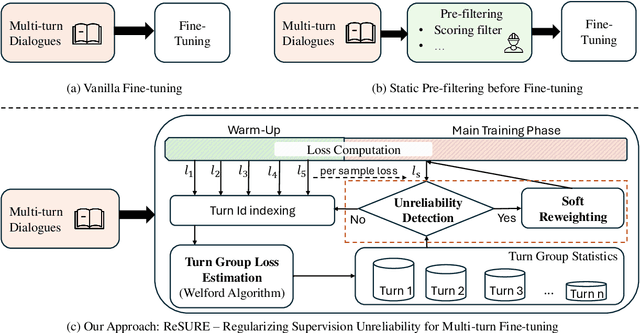
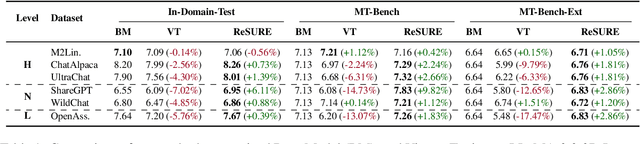
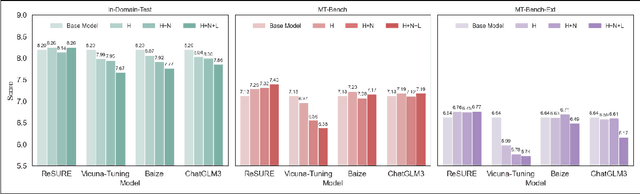
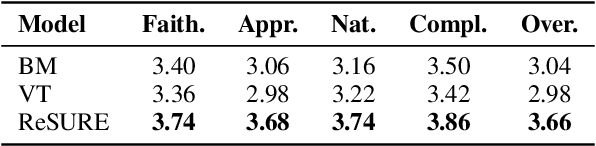
Fine-tuning multi-turn dialogue systems requires high-quality supervision but often suffers from degraded performance when exposed to low-quality data. Supervision errors in early turns can propagate across subsequent turns, undermining coherence and response quality. Existing methods typically address data quality via static prefiltering, which decouples quality control from training and fails to mitigate turn-level error propagation. In this context, we propose ReSURE (Regularizing Supervision UnREliability), an adaptive learning method that dynamically down-weights unreliable supervision without explicit filtering. ReSURE estimates per-turn loss distributions using Welford's online statistics and reweights sample losses on the fly accordingly. Experiments on both single-source and mixed-quality datasets show improved stability and response quality. Notably, ReSURE enjoys positive Spearman correlations (0.21 ~ 1.0 across multiple benchmarks) between response scores and number of samples regardless of data quality, which potentially paves the way for utilizing large-scale data effectively. Code is publicly available at https://github.com/Elvin-Yiming-Du/ReSURE_Multi_Turn_Training.