 Add to Chrome
 Add to Firefox
 Add to Edge
Echo-Aware Modulation for Compact-Latent Frequency-Time Modeling in Lightweight Acoustic Echo Cancellation
Aug 04, 2026
Existing lightweight acoustic echo cancellation (AEC) systems often combine linear AEC with Bark-domain DNN-based suppression to lower the computational footprint. In such systems, downsampling layers further compress the input features into a compact bottleneck representation, but this compression weakens frequency-time modeling capacity and degrades performance. To mitigate this limitation, we propose MSA-EchoLite, a lightweight Bark-domain AEC framework with an asymmetric dual-branch encoder and an echo-aware frequency-time modulation (EAM) module. The EAM module enriches the compressed bottleneck representation by modeling discrepancy and correlation cues between the dual-branch microphone and echo-related latent features. Experimental results show that the Bark-domain variant of MSA-EchoLite offers a better performance-complexity trade-off than its frequency-domain counterpart but is more sensitive to feature compression. With only 26.1% additional FLOPs over its non-EAM Bark-domain variant, its EAM-enhanced version achieves 99.1% of the PESQ of the frequency-domain counterpart, which requires nearly twice the FLOPs, and even surpasses it in SDR. Overall, MSA-EchoLite outperforms state-of-the-art lightweight AEC models while using only 0.2 M parameters and 100 M FLOPs/s.

Budget-Aware LLM Discovery via Cost-Calibrated Frontier Utility
Jul 29, 2026Large language models increasingly support scientific and algorithmic discovery through inference-time search over evaluated candidates. Existing adaptive discovery controllers assign credit based only on score progress, even though prompt length, retries, and guidance calls cause search actions to incur different token costs. We prove that cost-blind credit can forfeit all but a vanishing fraction of attainable quality as frontiers multiply and costs diverge. Under a fixed search-side token budget, the controller must decide which frontier is improving and whether its gain justifies the realized cost before the budget is exhausted. We introduce \textbf{CostAda}, a cost-calibrated adaptive controller built around \emph{cost-calibrated frontier utility}. The utility values frontier progress relative to realized action cost and conditions that credit on the remaining budget. CostAda uses this signal to control local exploration intensity, frontier allocation, and budgeted tactic intervention. Cost and remaining budget therefore shape the search rather than serving only as accounting variables or a stopping rule. CostAda reaches the strongest baseline's full-budget quality with at most half the budget on twelve of sixteen benchmark--backbone pairs while achieving the strongest mean final quality on all eight benchmarks under GLM-5 and GPT-5.4.
DSWAM: A Dual-System World Action Foundation Model for Fine-Grained Robot Manipulation
Jul 06, 2026World Action Models (WAMs) provide a promising alternative to Vision-Language-Action (VLA) policies by using video-based world modeling as dense supervision for robot action learning. Existing WAMs excel at physically grounded execution, but typically lack the explicit language-level planning interface in VLM-based VLAs for decomposing coarse instructions. Such decomposition becomes important when household tasks involve complex multi-step goals, where coarse user commands need to be converted into sequences of fine-grained executable subtasks. Meanwhile, the field still lacks a fair real-robot comparison between VLA and WAM execution capabilities, since existing systems often differ in data, robot embodiments, and task protocols. To address both the decomposition gap and the need for a controlled WAM-VLA comparison, we introduce DSWAM, a Dual-System World Action Foundation Model for fine-grained robot manipulation. DSWAM keeps a System 1 WAM executor as the default control path and optionally activates a System 2 vision-language subtask planner only when task decomposition is useful. The planner predicts executable subtasks from short-term visual history and a global task prompt, while the WAM executor performs world-aware action generation for each instruction or subtask. The executor is trained with action prediction and video co-training, but inference directly predicts action chunks without explicit future video generation. To make this execution path practical on real robots, we further integrate TensorRT acceleration, asynchronous execution, and real-time chunking (RTC) so that policy queries do not block robot control. To provide a fair real-robot comparison with VLA policies, we build and evaluate DSWAM under the DeMaVLA real-world deformable manipulation setting with matched robot platform, pretraining data, post-training data, and evaluation criteria.
ICME 2026 Grand Challenge on Cross-Scenario Defect Detection and Fine-Grained Severity Grading for High-Precision Manufacturing
Jul 06, 2026This paper presents the IEEE International Conference on Multimedia and Expo (ICME) 2026 Grand Challenge on Cross-Scenario Defect Detection and Fine-Grained Severity Grading for High-Precision Manufacturing. The challenge is motivated by two key limitations of existing industrial defect inspection systems: (1) current deep learning-based methods often suffer significant performance degradation when deployed in unseen production scenarios, and (2) most benchmarks neglect severity-aware assessment, which is critical for risk control and yield optimization. To address these limitations, we design two complementary tracks: Track 1 (Cross-Scenario Defect Detection) targets accurate defect detection, localization, and classification across diverse unseen production environments; Track 2 (Fine-Grained Severity Grading) requires assigning each detected defect an industry-standard severity level, including Acceptable, Marginal NG, NG, and Gross NG. We construct a large-scale industrial dataset of high-resolution microscopic images spanning seven representative defect categories, comprising over 3,800 images with pixel-level instance annotations for Track 1 and over 2,600 images with severity-grade labels for Track 2. The challenge attracted 86 registered participants with 130 submissions; during the final testing phase, 21 teams submitted results and 12 teams provided models with technical reports. The resulting benchmark, together with the diverse and effective solutions contributed by participating teams, sets a new standard for industrial defect analysis research.
Deep CSI Feedback for FDD Massive MIMO Systems: A Curvelet Learning Approach
Jun 16, 2026Downlink channel state information (CSI) feedback plays a key role in frequency division duplex (FDD) massive multiple-input multiple-output (mMIMO) systems. The growth of antennas in ultra-massive MIMO increases the difficulty and overhead of CSI feedback, which poses significant challenges for conventional downlink CSI feedback mechanisms. To address the limitations of existing CSI feedback approaches, this paper proposes a novel curvelet learning based framework termed SwinCANet, comprising a frequency-domain information processing module and a denoising module. The frequency-domain information processing module employs curvelet transform to decompose CSI into low-frequency and high-frequency components. Subsequently, Swin Transformer and channel-wise attention block are utilized for extracting the low-frequency and high-frequency representations, respectively, thereby enhancing reconstruction quality. Notably, an additional Swin Transformer facilitates the fusion of multi-scale frequency components, enhancing capabilities across different angular resolutions and spatial directions. Furthermore, we develop a variant (De-SwinCANet), which employs a Sigmoid threshold function to effectively suppress noise coefficients, thereby mitigating various channel impairments and nonlinear distortions. Numerical simulation results demonstrate that the proposed methodology achieves superior performance compared to existing benchmarks while maintaining robust performance under challenging propagation conditions.
Mozi: Governed Autonomy for Drug Discovery LLM Agents
Mar 04, 2026Tool-augmented large language model (LLM) agents promise to unify scientific reasoning with computation, yet their deployment in high-stakes domains like drug discovery is bottlenecked by two critical barriers: unconstrained tool-use governance and poor long-horizon reliability. In dependency-heavy pharmaceutical pipelines, autonomous agents often drift into irreproducible trajectories, where early-stage hallucinations multiplicatively compound into downstream failures. To overcome this, we present Mozi, a dual-layer architecture that bridges the flexibility of generative AI with the deterministic rigor of computational biology. Layer A (Control Plane) establishes a governed supervisor--worker hierarchy that enforces role-based tool isolation, limits execution to constrained action spaces, and drives reflection-based replanning. Layer B (Workflow Plane) operationalizes canonical drug discovery stages -- from Target Identification to Lead Optimization -- as stateful, composable skill graphs. This layer integrates strict data contracts and strategic human-in-the-loop (HITL) checkpoints to safeguard scientific validity at high-uncertainty decision boundaries. Operating on the design principle of ``free-form reasoning for safe tasks, structured execution for long-horizon pipelines,'' Mozi provides built-in robustness mechanisms and trace-level audibility to completely mitigate error accumulation. We evaluate Mozi on PharmaBench, a curated benchmark for biomedical agents, demonstrating superior orchestration accuracy over existing baselines. Furthermore, through end-to-end therapeutic case studies, we demonstrate Mozi's ability to navigate massive chemical spaces, enforce stringent toxicity filters, and generate highly competitive in silico candidates, effectively transforming the LLM from a fragile conversationalist into a reliable, governed co-scientist.
LEMAS: Large A 150K-Hour Large-scale Extensible Multilingual Audio Suite with Generative Speech Models
Jan 04, 2026We present the LEMAS-Dataset, which, to our knowledge, is currently the largest open-source multilingual speech corpus with word-level timestamps. Covering over 150,000 hours across 10 major languages, LEMAS-Dataset is constructed via a efficient data processing pipeline that ensures high-quality data and annotations. To validate the effectiveness of LEMAS-Dataset across diverse generative paradigms, we train two benchmark models with distinct architectures and task specializations on this dataset. LEMAS-TTS, built upon a non-autoregressive flow-matching framework, leverages the dataset's massive scale and linguistic diversity to achieve robust zero-shot multilingual synthesis. Our proposed accent-adversarial training and CTC loss mitigate cross-lingual accent issues, enhancing synthesis stability. Complementarily, LEMAS-Edit employs an autoregressive decoder-only architecture that formulates speech editing as a masked token infilling task. By exploiting precise word-level alignments to construct training masks and adopting adaptive decoding strategies, it achieves seamless, smooth-boundary speech editing with natural transitions. Experimental results demonstrate that models trained on LEMAS-Dataset deliver high-quality synthesis and editing performance, confirming the dataset's quality. We envision that this richly timestamp-annotated, fine-grained multilingual corpus will drive future advances in prompt-based speech generation systems.
Integrating Plug-and-Play Data Priors with Weighted Prediction Error for Speech Dereverberation
Dec 05, 2023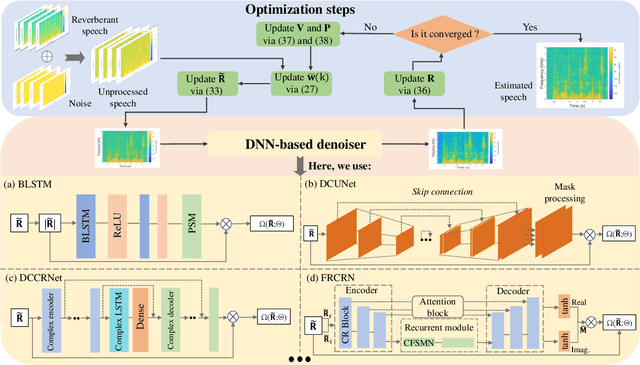
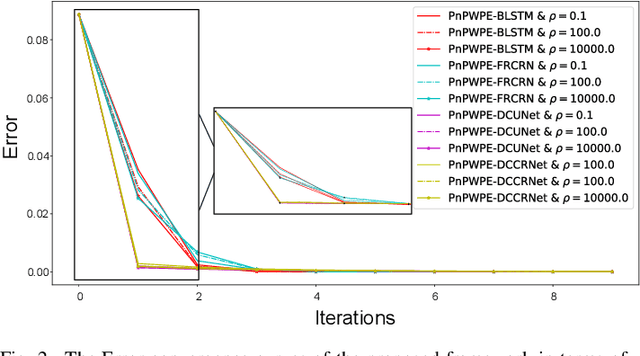
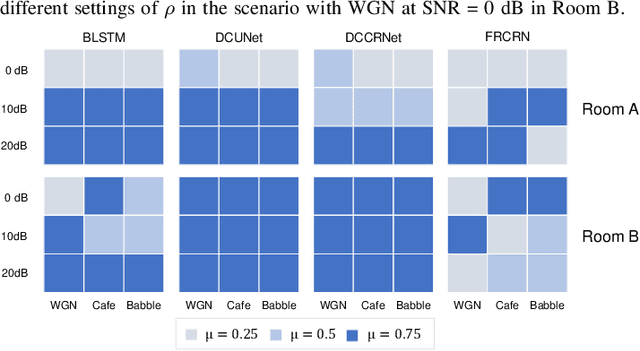
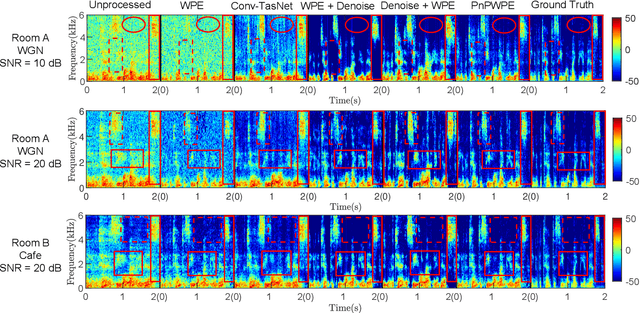
Speech dereverberation aims to alleviate the detrimental effects of late-reverberant components. While the weighted prediction error (WPE) method has shown superior performance in dereverberation, there is still room for further improvement in terms of performance and robustness in complex and noisy environments. Recent research has highlighted the effectiveness of integrating physics-based and data-driven methods, enhancing the performance of various signal processing tasks while maintaining interpretability. Motivated by these advancements, this paper presents a novel dereverberation frame-work, which incorporates data-driven methods for capturing speech priors within the WPE framework. The plug-and-play strategy (PnP), specifically the regularization by denoising (RED) strategy, is utilized to incorporate speech prior information learnt from data during the optimization problem solving iterations. Experimental results validate the effectiveness of the proposed approach.
AcademicGPT: Empowering Academic Research
Nov 21, 2023

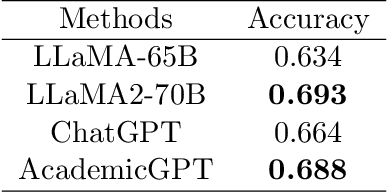

Large Language Models (LLMs) have demonstrated exceptional capabilities across various natural language processing tasks. Yet, many of these advanced LLMs are tailored for broad, general-purpose applications. In this technical report, we introduce AcademicGPT, designed specifically to empower academic research. AcademicGPT is a continual training model derived from LLaMA2-70B. Our training corpus mainly consists of academic papers, thesis, content from some academic domain, high-quality Chinese data and others. While it may not be extensive in data scale, AcademicGPT marks our initial venture into a domain-specific GPT tailored for research area. We evaluate AcademicGPT on several established public benchmarks such as MMLU and CEval, as well as on some specialized academic benchmarks like PubMedQA, SCIEval, and our newly-created ComputerScienceQA, to demonstrate its ability from general knowledge ability, to Chinese ability, and to academic ability. Building upon AcademicGPT's foundation model, we also developed several applications catered to the academic area, including General Academic Question Answering, AI-assisted Paper Reading, Paper Review, and AI-assisted Title and Abstract Generation.
CT-based Subchondral Bone Microstructural Analysis in Knee Osteoarthritis via MR-Guided Distillation Learning
Jul 11, 2023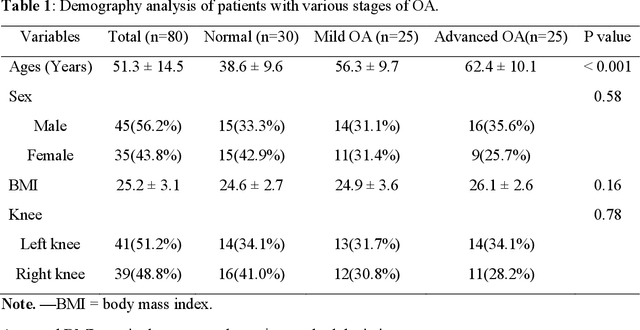

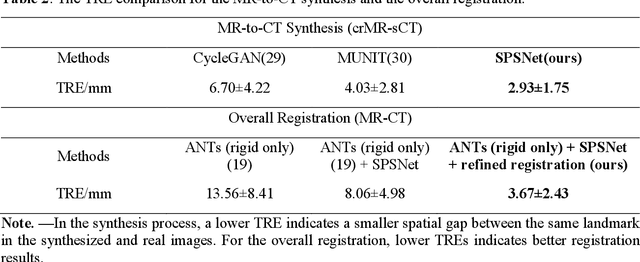

Background: MR-based subchondral bone effectively predicts knee osteoarthritis. However, its clinical application is limited by the cost and time of MR. Purpose: We aim to develop a novel distillation-learning-based method named SRRD for subchondral bone microstructural analysis using easily-acquired CT images, which leverages paired MR images to enhance the CT-based analysis model during training. Materials and Methods: Knee joint images of both CT and MR modalities were collected from October 2020 to May 2021. Firstly, we developed a GAN-based generative model to transform MR images into CT images, which was used to establish the anatomical correspondence between the two modalities. Next, we obtained numerous patches of subchondral bone regions of MR images, together with their trabecular parameters (BV / TV, Tb. Th, Tb. Sp, Tb. N) from the corresponding CT image patches via regression. The distillation-learning technique was used to train the regression model and transfer MR structural information to the CT-based model. The regressed trabecular parameters were further used for knee osteoarthritis classification. Results: A total of 80 participants were evaluated. CT-based regression results of trabecular parameters achieved intra-class correlation coefficients (ICCs) of 0.804, 0.773, 0.711, and 0.622 for BV / TV, Tb. Th, Tb. Sp, and Tb. N, respectively. The use of distillation learning significantly improved the performance of the CT-based knee osteoarthritis classification method using the CNN approach, yielding an AUC score of 0.767 (95% CI, 0.681-0.853) instead of 0.658 (95% CI, 0.574-0.742) (p<.001). Conclusions: The proposed SRRD method showed high reliability and validity in MR-CT registration, regression, and knee osteoarthritis classification, indicating the feasibility of subchondral bone microstructural analysis based on CT images.