 Add to Chrome
 Add to Firefox
 Add to Edge
$\varepsilon$-MemEvo: Adaptive Cross-Task Memory Transfer for LLM Program Evolution
Aug 12, 2026
LLM-based program evolution systems such as FunSearch and AlphaEvolve have shown strong ability to discover novel algorithms, but typically optimize each task in isolation, discarding search experience after completion. We introduce $\varepsilon$-MemEvo, a framework for cross-task knowledge transfer in LLM program evolution. $\varepsilon$-MemEvo stores prior experience as task-agnostic tactic memories: compact natural-language summaries of successful algorithmic strategies rather than raw code, enabling transfer across tasks with different APIs and evaluators. To avoid negative transfer from semantically mismatched memories, $\varepsilon$-MemEvo uses an adaptive injection gate that decides whether retrieved memories should be injected, and at what intensity. We evaluate $\varepsilon$-MemEvo on 8 diverse optimization benchmarks spanning mathematical optimization and systems engineering, using a content-level Leave-One-Out protocol that excludes target-task memory entries. On the primary GPT-5 backbone, $\varepsilon$-MemEvo improves AUCC over AdaEvolve on all 8 tasks, with a mean relative gain of +8.7%, and improves early-stage convergence by +9.4% on average. Ablations show that naive memory injection can fail catastrophically, while adaptive gating remains safe across all five ablation tasks. The data-updated posterior is interpretable in observed states: it favors skip during improving search and shifts from skip to hint across early and late plateaus. These gains incur less than 1% computational overhead.

DASH-OPD: Discrepancy-Aware Switching with Hysteresis for On-Policy Distillation
Jul 31, 2026On-policy distillation (OPD) trains student models on their own rollouts to reduce exposure bias. However, in multi-turn agent scenarios, early student errors can lead a trajectory away from the teacher's familiar domain. Existing curriculum learning methods regulate how much teacher support is used according to training progress, but cannot determine when it is needed. In light of this, we propose DASH-OPD, Discrepancy-Aware Switching with Hysteresis for OPD, a new agentic OPD method that can switch executors adaptively and bidirectionally. On each turn, DASH-OPD calculates a mean log-probability ratio between the two executors over action tokens as their discrepancy. Student-to-teacher ratios on student turns form drift signals, while teacher-to-student ratios on teacher turns form recovery signals. These signals are normalized and accumulated over multiple turns into drift and recovery evidence. DASH-OPD switches executors when the evidence exceeds its corresponding switching threshold. This multi turn accumulation makes the switching hysteretic, preventing high-frequency switches caused by transient fluctuations. On ALFWorld, DASH-OPD outperforms all the baselines and demonstrates superior training and deployment efficiency. This paper is a work in progress. Code, training logs, and model checkpoints will be released later.
Budget-Aware LLM Discovery via Cost-Calibrated Frontier Utility
Jul 29, 2026Large language models increasingly support scientific and algorithmic discovery through inference-time search over evaluated candidates. Existing adaptive discovery controllers assign credit based only on score progress, even though prompt length, retries, and guidance calls cause search actions to incur different token costs. We prove that cost-blind credit can forfeit all but a vanishing fraction of attainable quality as frontiers multiply and costs diverge. Under a fixed search-side token budget, the controller must decide which frontier is improving and whether its gain justifies the realized cost before the budget is exhausted. We introduce \textbf{CostAda}, a cost-calibrated adaptive controller built around \emph{cost-calibrated frontier utility}. The utility values frontier progress relative to realized action cost and conditions that credit on the remaining budget. CostAda uses this signal to control local exploration intensity, frontier allocation, and budgeted tactic intervention. Cost and remaining budget therefore shape the search rather than serving only as accounting variables or a stopping rule. CostAda reaches the strongest baseline's full-budget quality with at most half the budget on twelve of sixteen benchmark--backbone pairs while achieving the strongest mean final quality on all eight benchmarks under GLM-5 and GPT-5.4.
Demystifying Reinforcement Learning for Long-Horizon Tool-Using Agents: A Comprehensive Recipe
Mar 23, 2026Reinforcement Learning (RL) is essential for evolving Large Language Models (LLMs) into autonomous agents capable of long-horizon planning, yet a practical recipe for scaling RL in complex, multi-turn environments remains elusive. This paper presents a systematic empirical study using TravelPlanner, a challenging testbed requiring tool orchestration to satisfy multifaceted constraints. We decompose the agentic RL design space along 5 axes: reward shaping, model scaling, data composition, algorithm selection, and environmental stability. Our controlled experiments yield 7 key takeaways, e.g., (1) reward and algorithm choices are scale-dependent as smaller models benefit from staged rewards and enhanced exploration, whereas larger models converge efficiently with simpler dense rewards, (2) ~ 1K training samples with a balanced difficulty mixture mark a sweet spot for both in-domain and out-of-domain performance, and (3) environmental stability is critical to prevent policy degradation. Based on our distilled recipe, our RL-trained models achieve state-of-the-art performance on TravelPlanner, significantly outperforming leading LLMs.
VSearcher: Long-Horizon Multimodal Search Agent via Reinforcement Learning
Mar 03, 2026Large models are increasingly becoming autonomous agents that interact with real-world environments and use external tools to augment their static capabilities. However, most recent progress has focused on text-only large language models, which are limited to a single modality and therefore have narrower application scenarios. On the other hand, multimodal large models, while offering stronger perceptual capabilities, remain limited to static knowledge and lack the ability to access and leverage up-to-date web information. In this paper, we propose VSearcher, turning static multimodal model into multimodal search agent capable of long-horizon, multi-turn tool use in real-world web environments, including text search, image search, and web browsing, via reinforcement learning. Specifically, we introduce Iterative Injection Data Synthesis pipeline to generate large-scale, complex multimodal QA questions, which are further filtered with comprehensive metrics to ensure high quality and sufficient difficulty. We then adopt an SFT-then-RL training pipeline to turn base multimodal models to agent capable of multi-turn tool calling in real-world web environments. Besides, we propose a multimodal search benchmark MM-SearchExam dedicated to evaluating search capabilities of multimodal search agents, which proves highly challenging for recent proprietary models. Extensive evaluations across multiple multimodal search benchmarks reveal effectiveness of our method. VSearcher achieves superior performance compared to recent multimodal search agents and even surpasses several proprietary models on multimodal web search tasks.
ReAttn: Improving Attention-based Re-ranking via Attention Re-weighting
Feb 23, 2026The strong capabilities of recent Large Language Models (LLMs) have made them highly effective for zero-shot re-ranking task. Attention-based re-ranking methods, which derive relevance scores directly from attention weights, offer an efficient and interpretable alternative to generation-based re-ranking methods. However, they still face two major limitations. First, attention signals are highly concentrated a small subset of tokens within a few documents, making others indistinguishable. Second, attention often overemphasizes phrases lexically similar to the query, yielding biased rankings that irrelevant documents with mere lexical resemblance are regarded as relevant. In this paper, we propose \textbf{ReAttn}, a post-hoc re-weighting strategy for attention-based re-ranking methods. It first compute the cross-document IDF weighting to down-weight attention on query-overlapping tokens that frequently appear across the candidate documents, reducing lexical bias and emphasizing distinctive terms. It then employs entropy-based regularization to mitigate over-concentrated attention, encouraging a more balanced distribution across informative tokens. Both adjustments operate directly on existing attention weights without additional training or supervision. Extensive experiments demonstrate the effectiveness of our method.
Janus-Q: End-to-End Event-Driven Trading via Hierarchical-Gated Reward Modeling
Feb 23, 2026Financial market movements are often driven by discrete financial events conveyed through news, whose impacts are heterogeneous, abrupt, and difficult to capture under purely numerical prediction objectives. These limitations have motivated growing interest in using textual information as the primary source of trading signals in learning-based systems. Two key challenges hinder existing approaches: (1) the absence of large-scale, event-centric datasets that jointly model news semantics and statistically grounded market reactions, and (2) the misalignment between language model reasoning and financially valid trading behavior under dynamic market conditions. To address these challenges, we propose Janus-Q, an end-to-end event-driven trading framework that elevates financial news events from auxiliary signals to primary decision units. Janus-Q unifies event-centric data construction and model optimization under a two-stage paradigm. Stage I focuses on event-centric data construction, building a large-scale financial news event dataset comprising 62,400 articles annotated with 10 fine-grained event types, associated stocks, sentiment labels, and event-driven cumulative abnormal return (CAR). Stage II performs decision-oriented fine-tuning, combining supervised learning with reinforcement learning guided by a Hierarchical Gated Reward Model (HGRM), which explicitly captures trade-offs among multiple trading objectives. Extensive experiments demonstrate that Janus-Q achieves more consistent, interpretable, and profitable trading decisions than market indices and LLM baselines, improving the Sharpe Ratio by up to 102.0% while increasing direction accuracy by over 17.5% compared to the strongest competing strategies.
Learning Discriminative and Generalizable Anomaly Detector for Dynamic Graph with Limited Supervision
Feb 23, 2026Dynamic graph anomaly detection (DGAD) is critical for many real-world applications but remains challenging due to the scarcity of labeled anomalies. Existing methods are either unsupervised or semi-supervised: unsupervised methods avoid the need for labeled anomalies but often produce ambiguous boundary, whereas semi-supervised methods can overfit to the limited labeled anomalies and generalize poorly to unseen anomalies. To address this gap, we consider a largely underexplored problem in DGAD: learning a discriminative boundary from normal/unlabeled data, while leveraging limited labeled anomalies \textbf{when available} without sacrificing generalization to unseen anomalies. To this end, we propose an effective, generalizable, and model-agnostic framework with three main components: (i) residual representation encoding that capture deviations between current interactions and their historical context, providing anomaly-relevant signals; (ii) a restriction loss that constrain the normal representations within an interval bounded by two co-centered hyperspheres, ensuring consistent scales while keeping anomalies separable; (iii) a bi-boundary optimization strategy that learns a discriminative and robust boundary using the normal log-likelihood distribution modeled by a normalizing flow. Extensive experiments demonstrate the superiority of our framework across diverse evaluation settings.
QuantBench: Benchmarking AI Methods for Quantitative Investment
Apr 24, 2025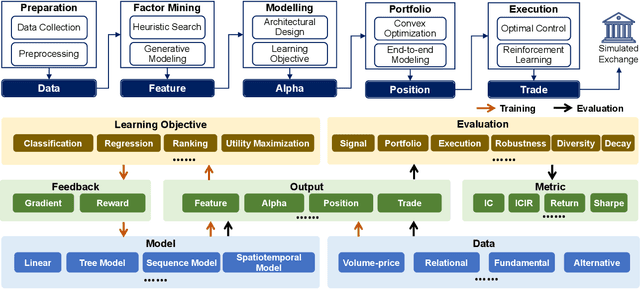

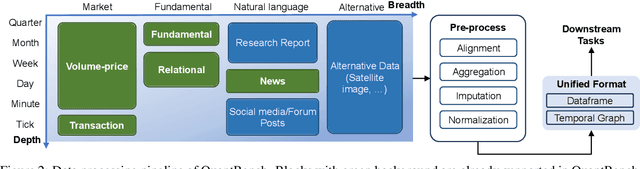
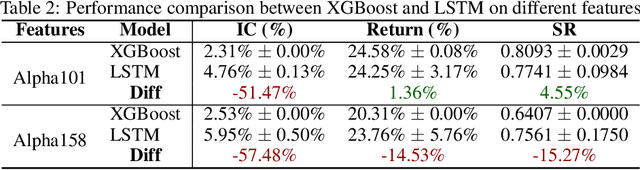
The field of artificial intelligence (AI) in quantitative investment has seen significant advancements, yet it lacks a standardized benchmark aligned with industry practices. This gap hinders research progress and limits the practical application of academic innovations. We present QuantBench, an industrial-grade benchmark platform designed to address this critical need. QuantBench offers three key strengths: (1) standardization that aligns with quantitative investment industry practices, (2) flexibility to integrate various AI algorithms, and (3) full-pipeline coverage of the entire quantitative investment process. Our empirical studies using QuantBench reveal some critical research directions, including the need for continual learning to address distribution shifts, improved methods for modeling relational financial data, and more robust approaches to mitigate overfitting in low signal-to-noise environments. By providing a common ground for evaluation and fostering collaboration between researchers and practitioners, QuantBench aims to accelerate progress in AI for quantitative investment, similar to the impact of benchmark platforms in computer vision and natural language processing.
Guided Learning: Lubricating End-to-End Modeling for Multi-stage Decision-making
Nov 15, 2024

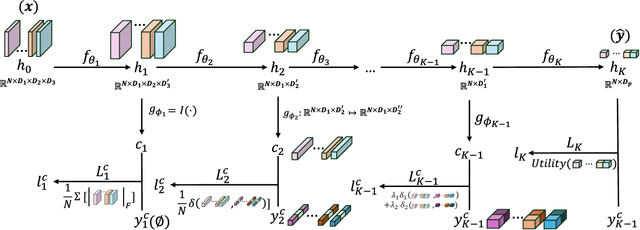

Multi-stage decision-making is crucial in various real-world artificial intelligence applications, including recommendation systems, autonomous driving, and quantitative investment systems. In quantitative investment, for example, the process typically involves several sequential stages such as factor mining, alpha prediction, portfolio optimization, and sometimes order execution. While state-of-the-art end-to-end modeling aims to unify these stages into a single global framework, it faces significant challenges: (1) training such a unified neural network consisting of multiple stages between initial inputs and final outputs often leads to suboptimal solutions, or even collapse, and (2) many decision-making scenarios are not easily reducible to standard prediction problems. To overcome these challenges, we propose Guided Learning, a novel methodological framework designed to enhance end-to-end learning in multi-stage decision-making. We introduce the concept of a ``guide'', a function that induces the training of intermediate neural network layers towards some phased goals, directing gradients away from suboptimal collapse. For decision scenarios lacking explicit supervisory labels, we incorporate a utility function that quantifies the ``reward'' of the throughout decision. Additionally, we explore the connections between Guided Learning and classic machine learning paradigms such as supervised, unsupervised, semi-supervised, multi-task, and reinforcement learning. Experiments on quantitative investment strategy building demonstrate that guided learning significantly outperforms both traditional stage-wise approaches and existing end-to-end methods.