 Add to Chrome
 Add to Firefox
 Add to Edge
Workflow-GYM: Towards Long-Horizon Evaluation of Computer-use Agentic tasks in Real-World Professional Fields
Jun 09, 2026
Recent years have witnessed the rapid evolution of AI agents toward handling increasingly complex, real-world tasks. However, existing benchmarks rarely evaluate whether agents can operate graphical user interfaces to complete long-horizon, high-value professional workflows across diverse domains. Current GUI benchmarks still predominantly focus on general-purpose software, relatively simple applications, and short-horizon tasks, leaving it largely unknown whether modern agents can follow user instructions to autonomously operate domain-specific professional software and accomplish economically valuable work in an end-to-end manner. To bridge this gap, we introduce Workflow-GYM, a benchmark for long-horizon GUI tasks centered on professional domains and specialized software environments. Through extensive experiments on state-of-the-art models, we find that even the strongest models achieve only slightly above 30% success rates, highlighting that professional long-horizon GUI workflows remain highly challenging for current GUI agents. Further analysis reveals that current agents struggle to maintain long-horizon workflow consistency, frequently exhibiting workflow stage omission, error propagation, objective drift, and insufficient understanding of professional software environments. Our findings provide important insights into the limitations of current agent systems and suggest key directions for the next generation of GUI-agent research.

SEAL: Can Saturated Benchmarks Be Revived by LLM-as-a-Meta-Judge?
May 28, 2026Widely used language-model benchmarks are increasingly saturated, with frontier systems often receiving near-tied scores that standard metrics cannot resolve. Rather than constructing harder alternatives, we ask whether existing tasks can be made informative again through improved evaluation over the same candidate outputs. Therefore, we present Seeded Elimination with Adaptive LLM-as-a-Meta-Judge, a self-improving evaluation protocol for extracting latent ranking signal from saturated benchmarks. SEAL seeds candidate outputs into a single elimination and evaluates each match with task-level principles plus self-improving checklist criteria. We evaluate SEAL on multiple saturated benchmarks covering code generation, mathematical reasoning, knowledge-intensive question answering, and tool-use agent task completion. Across these settings, SEAL improves the ranking-accuracy--latency trade-off over competing protocols, attaining 0.83--1.00 Spearman agreement with full pairwise judging and 4/4 top-1 agreement, while requiring only 11.89 calls per task compared with 28.00 for full pairwise evaluation.
DirectorBench: Diagnosing Long-Form Video Generation with Personalized Multi-Agent Evaluation
May 28, 2026Long-form video generation is rapidly moving from short, single-scene synthesis toward minute-long, multi-shot creation with narrative structure, cinematic control, audio, and cross-modal synchronization. However, evaluating such videos remains challenging, since existing benchmarks largely focus on local visual quality, short-horizon temporal consistency, or generic prompt alignment, and provide limited diagnosis of workflow failures and user-dependent preferences. We introduce DirectorBench, a personalized multi-agent diagnostic benchmark for long-form video generation. DirectorBench evaluates generated videos with respect to 80 structured metadata entries, 7 user profiles, and 40 checkpoint criteria across 5 dimensions: script, visual, audio, cross-modal, and stability. Instead of reducing quality to a single aggregate score, DirectorBench localizes checkpoint-level bottlenecks and supports profile-aware evaluation. We evaluate 4 long-form video generation workflows, 6 base LLMs, and 7 user profiles. Across workflows, DirectorBench reveals a between-unit bottleneck: transition quality averages only 0.256 and reaches 0.356 for the best workflow, while prompt-level user demand fulfillment averages 0.71. We further conduct human evaluation with 14 annotators to validate the alignment between DirectorBench and human judgment. The results show that DirectorBench captures human-perceptible quality differences and reveals workflow- and profile-dependent failure modes that are hidden by aggregate scoring. These findings highlight the importance of diagnostic and profile-aware benchmarking for long-form video generation.
EndPrompt: Efficient Long-Context Extension via Terminal Anchoring
May 14, 2026Extending the context window of large language models typically requires training on sequences at the target length, incurring quadratic memory and computational costs that make long-context adaptation expensive and difficult to reproduce. We propose EndPrompt, a method that achieves effective context extension using only short training sequences. The core insight is that exposing a model to long-range relative positional distances does not require constructing full-length inputs: we preserve the original short context as an intact first segment and append a brief terminal prompt as a second segment, assigning it positional indices near the target context length. This two-segment construction introduces both local and long-range relative distances within a short physical sequence while maintaining the semantic continuity of the training text--a property absent in chunk-based simulation approaches that split contiguous context. We provide a theoretical analysis grounded in Rotary Position Embedding and the Bernstein inequality, showing that position interpolation induces a rigorous smoothness constraint over the attention function, with shared Transformer parameters further suppressing unstable extrapolation to unobserved intermediate distances. Applied to LLaMA-family models extending the context window from 8K to 64K, EndPrompt achieves an average RULER score of 76.03 and the highest average on LongBench, surpassing LCEG (72.24), LongLoRA (72.95), and full-length fine-tuning (69.23) while requiring substantially less computation. These results demonstrate that long-context generalization can be induced from sparse positional supervision, challenging the prevailing assumption that dense long-sequence training is necessary for reliable context-window extension. The code is available at https://github.com/clx1415926/EndPrompt.
From Token to Item: Enhancing Large Language Models for Recommendation via Item-aware Attention Mechanism
Mar 20, 2026Large Language Models (LLMs) have recently gained increasing attention in the field of recommendation. Existing LLM-based methods typically represent items as token sequences, and apply attention layers on these tokens to generate recommendations. However, by inheriting the standard attention mechanism, these methods focus on modeling token-level relations. This token-centric focus overlooks the item as the fundamental unit of recommendation, preventing existing methods from effectively capturing collaborative relations at the item level. In this work, we revisit the role of tokens in LLM-driven recommendation and categorize their relations into two types: (1) intra-item token relations, which present the content semantics of an item, e.g., name, color, and size; and (2) inter-item token relations, which encode collaborative relations across items. Building on these insights, we propose a novel framework with an item-aware attention mechanism (IAM) to enhance LLMs for recommendation. Specifically, IAM devises two complementary attention layers: (1) an intra-item attention layer, which restricts attention to tokens within the same item, modeling item content semantics; and (2) an inter-item attention layer, which attends exclusively to token relations across items, capturing item collaborative relations. Through this stacked design, IAM explicitly emphasizes items as the fundamental units in recommendation, enabling LLMs to effectively exploit item-level collaborative relations. Extensive experiments on several public datasets demonstrate the effectiveness of IAM in enhancing LLMs for personalized recommendation.
ALinFiK: Learning to Approximate Linearized Future Influence Kernel for Scalable Third-Parity LLM Data Valuation
Mar 02, 2025Large Language Models (LLMs) heavily rely on high-quality training data, making data valuation crucial for optimizing model performance, especially when working within a limited budget. In this work, we aim to offer a third-party data valuation approach that benefits both data providers and model developers. We introduce a linearized future influence kernel (LinFiK), which assesses the value of individual data samples in improving LLM performance during training. We further propose ALinFiK, a learning strategy to approximate LinFiK, enabling scalable data valuation. Our comprehensive evaluations demonstrate that this approach surpasses existing baselines in effectiveness and efficiency, demonstrating significant scalability advantages as LLM parameters increase.
InstructOCR: Instruction Boosting Scene Text Spotting
Dec 20, 2024In the field of scene text spotting, previous OCR methods primarily relied on image encoders and pre-trained text information, but they often overlooked the advantages of incorporating human language instructions. To address this gap, we propose InstructOCR, an innovative instruction-based scene text spotting model that leverages human language instructions to enhance the understanding of text within images. Our framework employs both text and image encoders during training and inference, along with instructions meticulously designed based on text attributes. This approach enables the model to interpret text more accurately and flexibly. Extensive experiments demonstrate the effectiveness of our model and we achieve state-of-the-art results on widely used benchmarks. Furthermore, the proposed framework can be seamlessly applied to scene text VQA tasks. By leveraging instruction strategies during pre-training, the performance on downstream VQA tasks can be significantly improved, with a 2.6% increase on the TextVQA dataset and a 2.1% increase on the ST-VQA dataset. These experimental results provide insights into the benefits of incorporating human language instructions for OCR-related tasks.
Symbolic Learning Enables Self-Evolving Agents
Jun 26, 2024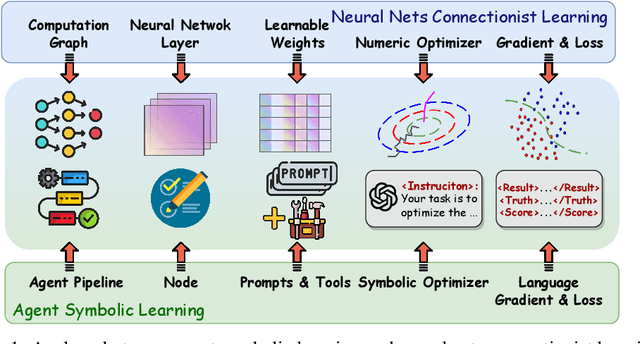
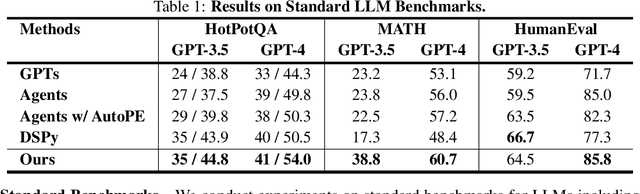

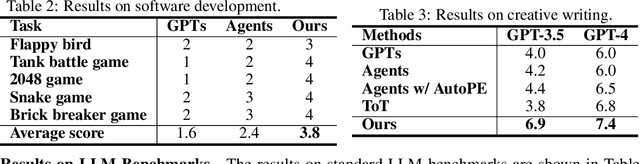
The AI community has been exploring a pathway to artificial general intelligence (AGI) by developing "language agents", which are complex large language models (LLMs) pipelines involving both prompting techniques and tool usage methods. While language agents have demonstrated impressive capabilities for many real-world tasks, a fundamental limitation of current language agents research is that they are model-centric, or engineering-centric. That's to say, the progress on prompts, tools, and pipelines of language agents requires substantial manual engineering efforts from human experts rather than automatically learning from data. We believe the transition from model-centric, or engineering-centric, to data-centric, i.e., the ability of language agents to autonomously learn and evolve in environments, is the key for them to possibly achieve AGI. In this work, we introduce agent symbolic learning, a systematic framework that enables language agents to optimize themselves on their own in a data-centric way using symbolic optimizers. Specifically, we consider agents as symbolic networks where learnable weights are defined by prompts, tools, and the way they are stacked together. Agent symbolic learning is designed to optimize the symbolic network within language agents by mimicking two fundamental algorithms in connectionist learning: back-propagation and gradient descent. Instead of dealing with numeric weights, agent symbolic learning works with natural language simulacrums of weights, loss, and gradients. We conduct proof-of-concept experiments on both standard benchmarks and complex real-world tasks and show that agent symbolic learning enables language agents to update themselves after being created and deployed in the wild, resulting in "self-evolving agents".
TIGER: Text-Instructed 3D Gaussian Retrieval and Coherent Editing
May 23, 2024Editing objects within a scene is a critical functionality required across a broad spectrum of applications in computer vision and graphics. As 3D Gaussian Splatting (3DGS) emerges as a frontier in scene representation, the effective modification of 3D Gaussian scenes has become increasingly vital. This process entails accurately retrieve the target objects and subsequently performing modifications based on instructions. Though available in pieces, existing techniques mainly embed sparse semantics into Gaussians for retrieval, and rely on an iterative dataset update paradigm for editing, leading to over-smoothing or inconsistency issues. To this end, this paper proposes a systematic approach, namely TIGER, for coherent text-instructed 3D Gaussian retrieval and editing. In contrast to the top-down language grounding approach for 3D Gaussians, we adopt a bottom-up language aggregation strategy to generate a denser language embedded 3D Gaussians that supports open-vocabulary retrieval. To overcome the over-smoothing and inconsistency issues in editing, we propose a Coherent Score Distillation (CSD) that aggregates a 2D image editing diffusion model and a multi-view diffusion model for score distillation, producing multi-view consistent editing with much finer details. In various experiments, we demonstrate that our TIGER is able to accomplish more consistent and realistic edits than prior work.
Weaver: Foundation Models for Creative Writing
Jan 30, 2024
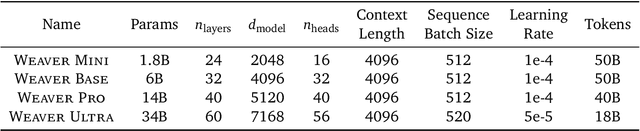
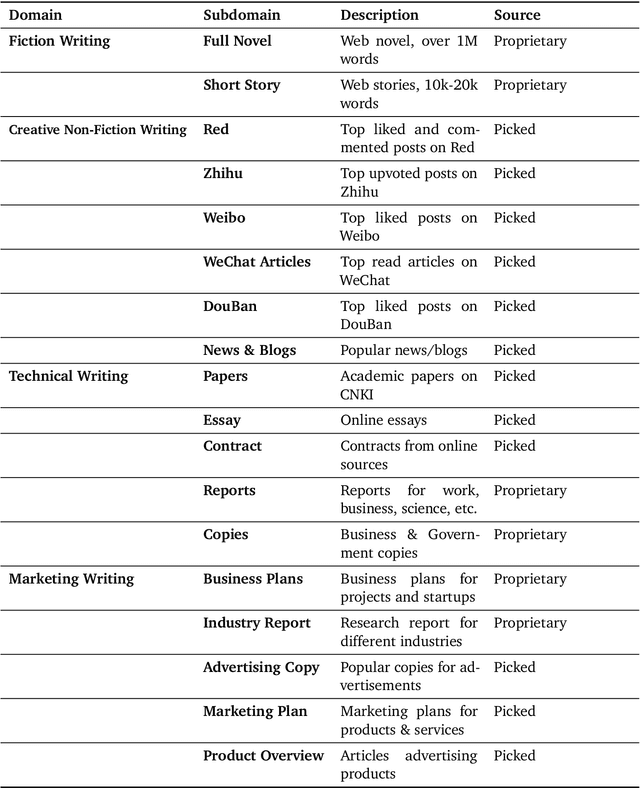
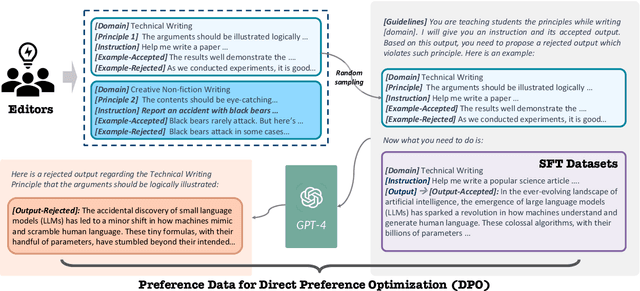
This work introduces Weaver, our first family of large language models (LLMs) dedicated to content creation. Weaver is pre-trained on a carefully selected corpus that focuses on improving the writing capabilities of large language models. We then fine-tune Weaver for creative and professional writing purposes and align it to the preference of professional writers using a suit of novel methods for instruction data synthesis and LLM alignment, making it able to produce more human-like texts and follow more diverse instructions for content creation. The Weaver family consists of models of Weaver Mini (1.8B), Weaver Base (6B), Weaver Pro (14B), and Weaver Ultra (34B) sizes, suitable for different applications and can be dynamically dispatched by a routing agent according to query complexity to balance response quality and computation cost. Evaluation on a carefully curated benchmark for assessing the writing capabilities of LLMs shows Weaver models of all sizes outperform generalist LLMs several times larger than them. Notably, our most-capable Weaver Ultra model surpasses GPT-4, a state-of-the-art generalist LLM, on various writing scenarios, demonstrating the advantage of training specialized LLMs for writing purposes. Moreover, Weaver natively supports retrieval-augmented generation (RAG) and function calling (tool usage). We present various use cases of these abilities for improving AI-assisted writing systems, including integration of external knowledge bases, tools, or APIs, and providing personalized writing assistance. Furthermore, we discuss and summarize a guideline and best practices for pre-training and fine-tuning domain-specific LLMs.