 Add to Chrome
 Add to Firefox
 Add to Edge
Bridging the Gap between Labeled and Unlabeled Data via Unified Flow with Feature Memory Bank
Aug 17, 2026
Although semi-supervised semantic segmentation ($\text{S}^4$) utilizes abundant unlabeled data to reduce manual labeling burdens, independent training of labeled and unlabeled data causes the former to dominate, which severely degrades pseudo-label quality. To address this challenges, we propose a novel remote sensing (RS) $\text{S}^4$ method via unified flow with feature memory bank (UFFM). Specifically, UFFM comprises two key innovations: unified flow (UF) and feature memory bank (FMB). The UF is a new training flow that generates less biased pseudo-labels by combining an external visual foundation model (VFM) with an RS domain teacher, and jointly optimizes labeled and pseudo-labeled data under a unified training objective. The FMB is a novel memory module for $\text{S}^4$ that dynamically updates class-specific features during training and reduces the feature discrepancy between labeled and unlabeled data through class-feature alignment. To verify the effectiveness of our model, we conduct extensive experiments on RS datasets. The experimental results show the superiority of our method over SOTA $\text{S}^4$ methods. Moreover, the results demonstrate the effectiveness of our contributions in bridging the optimization and feature representation gap between labeled and unlabeled data. Our code is released at \href{https://github.com/wangshanwen001/RS-UFFM}{https://github.com/wangshanwen001/RS-UFFM}.

FMReward: Aligning and Evaluating Audio-Driven 3D Facial Animation with Human Preferences
Aug 15, 2026Audio-driven 3D facial animation is essential for advancing immersion and interactivity in virtual experiences. Although recent advances have shown promising capabilities, the training and evaluation of existing methods typically rely on ground-truth-based errors, which fall short of aligning with human preferences. To address this, we present a comprehensive framework that learns an automatic perceptual model from human preference data and leverages it to improve and evaluate the perceptual quality of audio-driven 3D facial animation. To begin with, we construct FMPair (Facial Motion Pairwise preference), the first human preference dataset for audio-driven 3D facial animation, which is built through a systematic annotation pipeline and comprises 65,574 annotated 3D facial motion pairs from 8,834 distinct in-the-wild audio clips. Based on the pairwise comparison dataset, we propose a Facial Motion Reward model, termed FMReward, which takes audio and 3D facial motion as inputs and predicts a perceptual quality score aligned with human preferences. Building upon FMReward, we further introduce Facial Motion reward Feedback Learning (FMFL), a direct fine-tuning algorithm that leverages a pretrained reward model to optimize diffusion-based audio-driven 3D facial animation models for better alignment with human preferences. Extensive experiments demonstrate the superiority of FMReward over other metrics in aligning with human preferences and the effectiveness of FMFL in improving the perceptual quality of audio-driven 3D facial animation.
Global Attention-Fused Image Cropping with Attention-Guided and Global-Aligned Crop Evaluator
Aug 05, 2026Image cropping aims to improve image aesthetics by preserving important content within an appropriately composed region. However, most existing methods focus primarily on salient regions and therefore have limited sensitivity to the global relationships among the main image components. To address this limitation, we propose Global Attention-Fused Image Cropping (GAFIC), which consists of an Attention-Guided Feature Fusion (AGFF) and a Global-Aligned Crop Evaluator (GACE). AGFF aggregates the importance of local regions to construct a global representation that captures both image structure and local details. GACE aligns candidate crop features with this global representation, enabling crop evaluation to remain sensitive to boundary changes. We further combine three ranking losses across multiple scales to obtain accurate and stable crop scores. Extensive experiments on the GAIC and CPC datasets demonstrate that GAFIC outperforms existing image-cropping methods, particularly in terms of accuracy and stability. Unlike pixel-level retargeting methods such as seam carving, inpainting, and diffusion-based synthesis, GAFIC does not synthesize or modify the retained pixels; instead, it selects an aesthetically preferred crop from the source image, making it suitable for scenarios where pixel integrity and efficient batch processing are important. The source code is available at https://github.com/AIVRC/GAFIC.git.
FreeShadow: Training-Free Shadow Removal via Illumination Transfer and Selective Content Preservation in Diffusion Models
Jul 29, 2026Existing supervised and unsupervised shadow removal methods often suffer from limited generalization due to the insufficient diversity of available training datasets, while zero-shot methods tend to produce artifacts and require time-consuming test-time optimization. To address these issues, we propose FreeShadow, a training-free shadow removal method built upon pretrained diffusion models, which exploits diffusion priors for shadow removal without any training or optimization. For illumination recovery, we propose an illumination transfer attention (ITA), which re-weights the self-attention maps in diffusion model to transfer illumination cues from non-shadow to shadow regions. For content preservation, we analyze the effects of illumination variations on self-attention maps and latent high-frequency features in diffusion model, and selectively preserve illumination-invariant components to maintain content fidelity while suppressing residual shadows. We further propose local texture-preserving relighting (LTPR) to mitigate local texture misalignment caused by VAE compression. Extensive experiments demonstrate that our method achieves strong generalization and produces realistic shadow-free images.
Multi-Dimensional Quality Assessment for AI-Generated Human-Centric Videos: Dataset and Model
Jul 18, 2026AI-generated human-centric videos play a crucial role in a wide range of modern applications. However, they often suffer from quality issues and semantic mismatches, underscoring the importance of effective quality assessment for such videos. To this end, we extend our previous dataset HVEval with pairwise preference annotations, resulting in HVEval+, the largest holistic quality assessment dataset for AI-generated human-centric videos, which comprises 1k prompts based on a comprehensive taxonomy, 20k videos generated by 24 text-to-video (T2V) models, and extensive human annotations, including 60k mean opinion scores (MOSs) and 60k preference pairs across 3 dimensions (i.e., spatial quality, temporal quality, and text-video correspondence), as well as 20k category-specific question-answer (Q&A) pairs. Along with the HVEval+ dataset, we further propose MoE-Rater, a Mixture-of-Experts (MoE)-inspired and multimodal large language model (MLLM)-based all-in-one method that supports multi-dimensional quality rating, multi-dimensional pairwise comparison, and category-specific question answering within a single model. Specifically, we introduce Mixture of Projector Experts (MoPE) and Mixture of LoRA Experts (MoLE), together with a three-stage training strategy consisting of task-aware pre-training, task-specific adaptation, and adaptive routing optimization, to effectively unify multiple tasks, resulting in superior performance on both HVEval+ and Human-AGVQA datasets. Extensive experiments and comprehensive analysis demonstrate the significant potential of the HVEval+ dataset and the MoE-Rater method in advancing AI-generated video quality assessment and further facilitating the evaluation and optimization of T2V models.
ICME 2026 Grand Challenge on Cross-Scenario Defect Detection and Fine-Grained Severity Grading for High-Precision Manufacturing
Jul 06, 2026This paper presents the IEEE International Conference on Multimedia and Expo (ICME) 2026 Grand Challenge on Cross-Scenario Defect Detection and Fine-Grained Severity Grading for High-Precision Manufacturing. The challenge is motivated by two key limitations of existing industrial defect inspection systems: (1) current deep learning-based methods often suffer significant performance degradation when deployed in unseen production scenarios, and (2) most benchmarks neglect severity-aware assessment, which is critical for risk control and yield optimization. To address these limitations, we design two complementary tracks: Track 1 (Cross-Scenario Defect Detection) targets accurate defect detection, localization, and classification across diverse unseen production environments; Track 2 (Fine-Grained Severity Grading) requires assigning each detected defect an industry-standard severity level, including Acceptable, Marginal NG, NG, and Gross NG. We construct a large-scale industrial dataset of high-resolution microscopic images spanning seven representative defect categories, comprising over 3,800 images with pixel-level instance annotations for Track 1 and over 2,600 images with severity-grade labels for Track 2. The challenge attracted 86 registered participants with 130 submissions; during the final testing phase, 21 teams submitted results and 12 teams provided models with technical reports. The resulting benchmark, together with the diverse and effective solutions contributed by participating teams, sets a new standard for industrial defect analysis research.
ITIScore: An Image-to-Text-to-Image Rating Framework for the Image Captioning Ability of MLLMs
Apr 04, 2026Recent advances in multimodal large language models (MLLMs) have greatly improved image understanding and captioning capabilities. However, existing image captioning benchmarks typically suffer from limited diversity in caption length, the absence of recent advanced MLLMs, and insufficient human annotations, which potentially introduces bias and limits the ability to comprehensively assess the performance of modern MLLMs. To address these limitations, we present a new large-scale image captioning benchmark, termed, ICBench, which covers 12 content categories and consists of both short and long captions generated by 10 advanced MLLMs on 2K images, resulting in 40K captions in total. We conduct extensive human subjective studies to obtain mean opinion scores (MOSs) across fine-grained evaluation dimensions, where short captions are assessed in terms of fluency, relevance, and conciseness, while long captions are evaluated based on fluency, relevance, and completeness. Furthermore, we propose an automated evaluation metric, \textbf{ITIScore}, based on an image-to-text-to-image framework, which measures caption quality through reconstruction consistency. Experimental results demonstrate strong alignment between our automatic metric and human judgments, as well as robust zero-shot generalization ability on other public captioning datasets. Both the dataset and model will be released upon publication.
Is there a relationship between Mean Opinion Score (MOS) and Just Noticeable Difference (JND)?
Feb 19, 2026Evaluating perceived video quality is essential for ensuring high Quality of Experience (QoE) in modern streaming applications. While existing subjective datasets and Video Quality Metrics (VQMs) cover a broad quality range, many practical use cases especially for premium users focus on high quality scenarios requiring finer granularity. Just Noticeable Difference (JND) has emerged as a key concept for modeling perceptual thresholds in these high end regions and plays an important role in perceptual bitrate ladder construction. However, the relationship between JND and the more widely used Mean Opinion Score (MOS) remains unclear. In this paper, we conduct a Degradation Category Rating (DCR) subjective study based on an existing JND dataset to examine how MOS corresponds to the 75% Satisfied User Ratio (SUR) points of the 1st and 2nd JNDs. We find that while MOS values at JND points generally align with theoretical expectations (e.g., 4.75 for the 75% SUR of the 1st JND), the reverse mapping from MOS to JND is ambiguous due to overlapping confidence intervals across PVS indices. Statistical significance analysis further shows that DCR studies with limited participants may not detect meaningful differences between reference and JND videos.
Efficient Listener: Dyadic Facial Motion Synthesis via Action Diffusion
Apr 29, 2025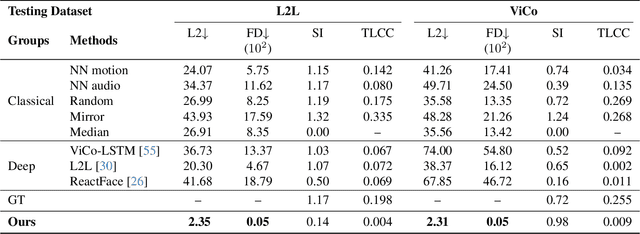
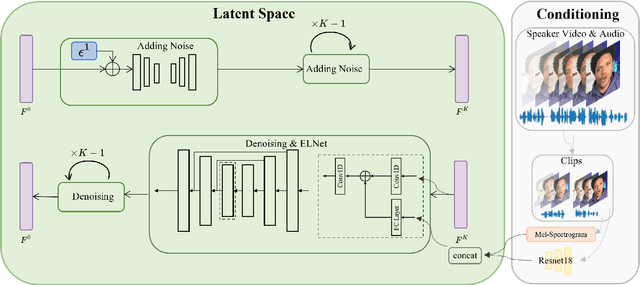
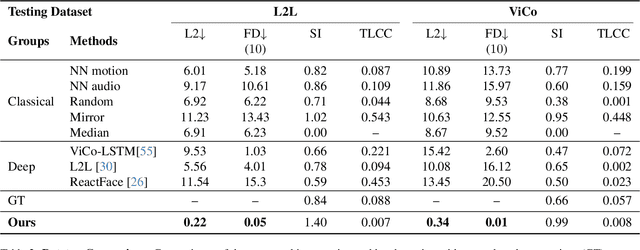
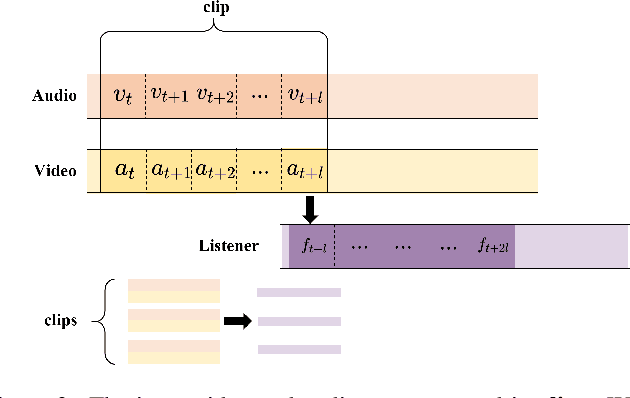
Generating realistic listener facial motions in dyadic conversations remains challenging due to the high-dimensional action space and temporal dependency requirements. Existing approaches usually consider extracting 3D Morphable Model (3DMM) coefficients and modeling in the 3DMM space. However, this makes the computational speed of the 3DMM a bottleneck, making it difficult to achieve real-time interactive responses. To tackle this problem, we propose Facial Action Diffusion (FAD), which introduces the diffusion methods from the field of image generation to achieve efficient facial action generation. We further build the Efficient Listener Network (ELNet) specially designed to accommodate both the visual and audio information of the speaker as input. Considering of FAD and ELNet, the proposed method learns effective listener facial motion representations and leads to improvements of performance over the state-of-the-art methods while reducing 99% computational time.
Omni$^2$: Unifying Omnidirectional Image Generation and Editing in an Omni Model
Apr 15, 2025$360^{\circ}$ omnidirectional images (ODIs) have gained considerable attention recently, and are widely used in various virtual reality (VR) and augmented reality (AR) applications. However, capturing such images is expensive and requires specialized equipment, making ODI synthesis increasingly important. While common 2D image generation and editing methods are rapidly advancing, these models struggle to deliver satisfactory results when generating or editing ODIs due to the unique format and broad 360$^{\circ}$ Field-of-View (FoV) of ODIs. To bridge this gap, we construct \textbf{\textit{Any2Omni}}, the first comprehensive ODI generation-editing dataset comprises 60,000+ training data covering diverse input conditions and up to 9 ODI generation and editing tasks. Built upon Any2Omni, we propose an \textbf{\underline{Omni}} model for \textbf{\underline{Omni}}-directional image generation and editing (\textbf{\textit{Omni$^2$}}), with the capability of handling various ODI generation and editing tasks under diverse input conditions using one model. Extensive experiments demonstrate the superiority and effectiveness of the proposed Omni$^2$ model for both the ODI generation and editing tasks.