 Add to Chrome
 Add to Firefox
 Add to Edge
TG-Field: Geometry-Aware Radiative Gaussian Fields for Tomographic Reconstruction
Feb 12, 2026
3D Gaussian Splatting (3DGS) has revolutionized 3D scene representation with superior efficiency and quality. While recent adaptations for computed tomography (CT) show promise, they struggle with severe artifacts under highly sparse-view projections and dynamic motions. To address these challenges, we propose Tomographic Geometry Field (TG-Field), a geometry-aware Gaussian deformation framework tailored for both static and dynamic CT reconstruction. A multi-resolution hash encoder is employed to capture local spatial priors, regularizing primitive parameters under ultra-sparse settings. We further extend the framework to dynamic reconstruction by introducing time-conditioned representations and a spatiotemporal attention block to adaptively aggregate features, thereby resolving spatiotemporal ambiguities and enforcing temporal coherence. In addition, a motion-flow network models fine-grained respiratory motion to track local anatomical deformations. Extensive experiments on synthetic and real-world datasets demonstrate that TG-Field consistently outperforms existing methods, achieving state-of-the-art reconstruction accuracy under highly sparse-view conditions.

AcademicGPT: Empowering Academic Research
Nov 21, 2023

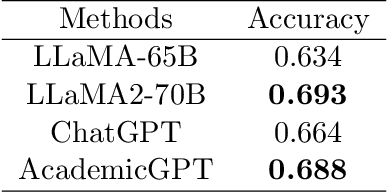

Large Language Models (LLMs) have demonstrated exceptional capabilities across various natural language processing tasks. Yet, many of these advanced LLMs are tailored for broad, general-purpose applications. In this technical report, we introduce AcademicGPT, designed specifically to empower academic research. AcademicGPT is a continual training model derived from LLaMA2-70B. Our training corpus mainly consists of academic papers, thesis, content from some academic domain, high-quality Chinese data and others. While it may not be extensive in data scale, AcademicGPT marks our initial venture into a domain-specific GPT tailored for research area. We evaluate AcademicGPT on several established public benchmarks such as MMLU and CEval, as well as on some specialized academic benchmarks like PubMedQA, SCIEval, and our newly-created ComputerScienceQA, to demonstrate its ability from general knowledge ability, to Chinese ability, and to academic ability. Building upon AcademicGPT's foundation model, we also developed several applications catered to the academic area, including General Academic Question Answering, AI-assisted Paper Reading, Paper Review, and AI-assisted Title and Abstract Generation.
1st Place Solution for ICDAR 2021 Competition on Mathematical Formula Detection
Jul 12, 2021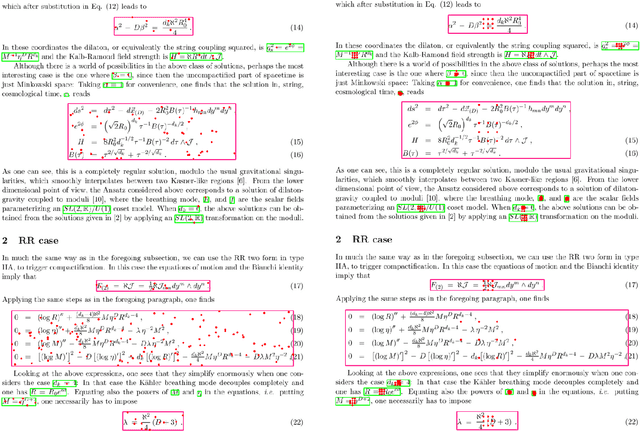
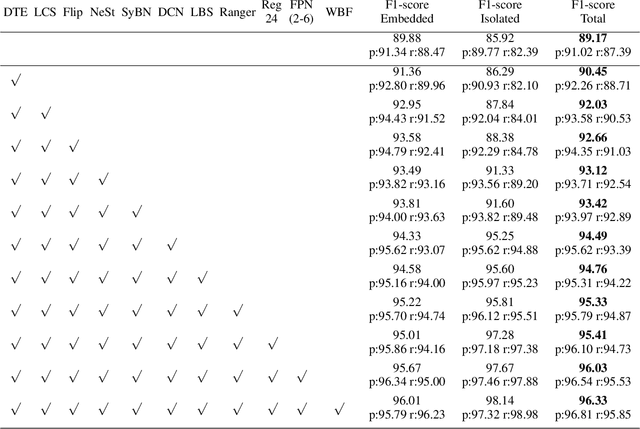
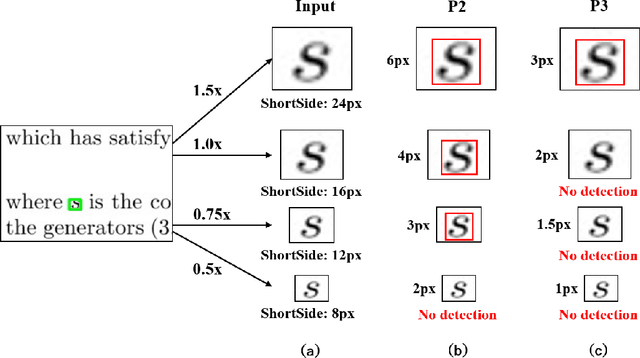
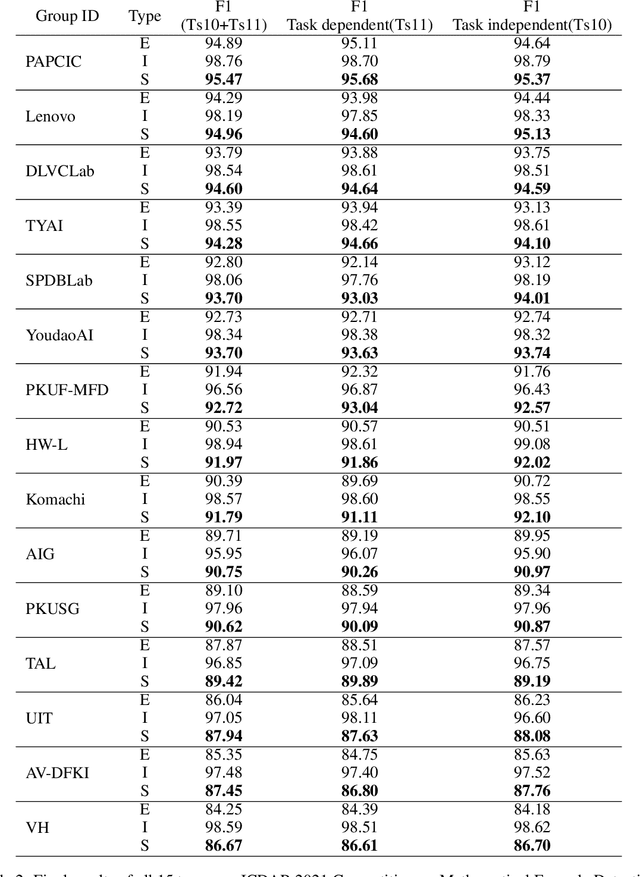
In this technical report, we present our 1st place solution for the ICDAR 2021 competition on mathematical formula detection (MFD). The MFD task has three key challenges including a large scale span, large variation of the ratio between height and width, and rich character set and mathematical expressions. Considering these challenges, we used Generalized Focal Loss (GFL), an anchor-free method, instead of the anchor-based method, and prove the Adaptive Training Sampling Strategy (ATSS) and proper Feature Pyramid Network (FPN) can well solve the important issue of scale variation. Meanwhile, we also found some tricks, e.g., Deformable Convolution Network (DCN), SyncBN, and Weighted Box Fusion (WBF), were effective in MFD task. Our proposed method ranked 1st in the final 15 teams.