 Add to Chrome
 Add to Firefox
 Add to Edge
Deep CSI Feedback for FDD Massive MIMO Systems: A Curvelet Learning Approach
Jun 16, 2026
Downlink channel state information (CSI) feedback plays a key role in frequency division duplex (FDD) massive multiple-input multiple-output (mMIMO) systems. The growth of antennas in ultra-massive MIMO increases the difficulty and overhead of CSI feedback, which poses significant challenges for conventional downlink CSI feedback mechanisms. To address the limitations of existing CSI feedback approaches, this paper proposes a novel curvelet learning based framework termed SwinCANet, comprising a frequency-domain information processing module and a denoising module. The frequency-domain information processing module employs curvelet transform to decompose CSI into low-frequency and high-frequency components. Subsequently, Swin Transformer and channel-wise attention block are utilized for extracting the low-frequency and high-frequency representations, respectively, thereby enhancing reconstruction quality. Notably, an additional Swin Transformer facilitates the fusion of multi-scale frequency components, enhancing capabilities across different angular resolutions and spatial directions. Furthermore, we develop a variant (De-SwinCANet), which employs a Sigmoid threshold function to effectively suppress noise coefficients, thereby mitigating various channel impairments and nonlinear distortions. Numerical simulation results demonstrate that the proposed methodology achieves superior performance compared to existing benchmarks while maintaining robust performance under challenging propagation conditions.

Coarse-to-Fine Semantic Communication Systems for Text Transmission
Apr 02, 2025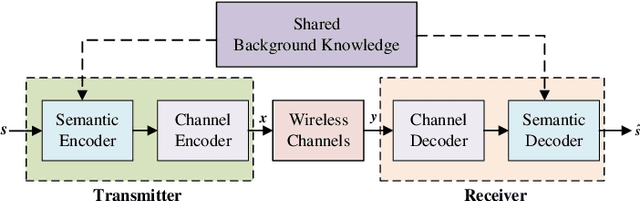
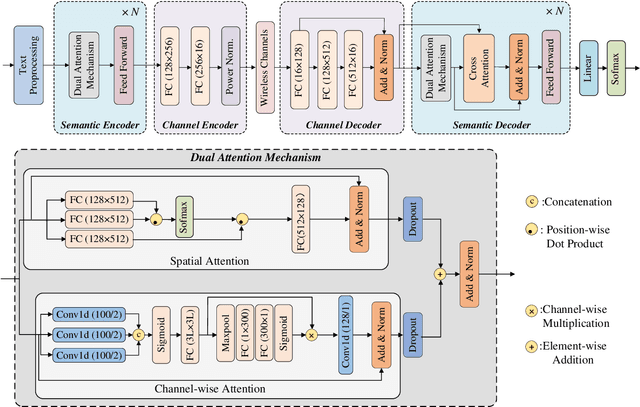
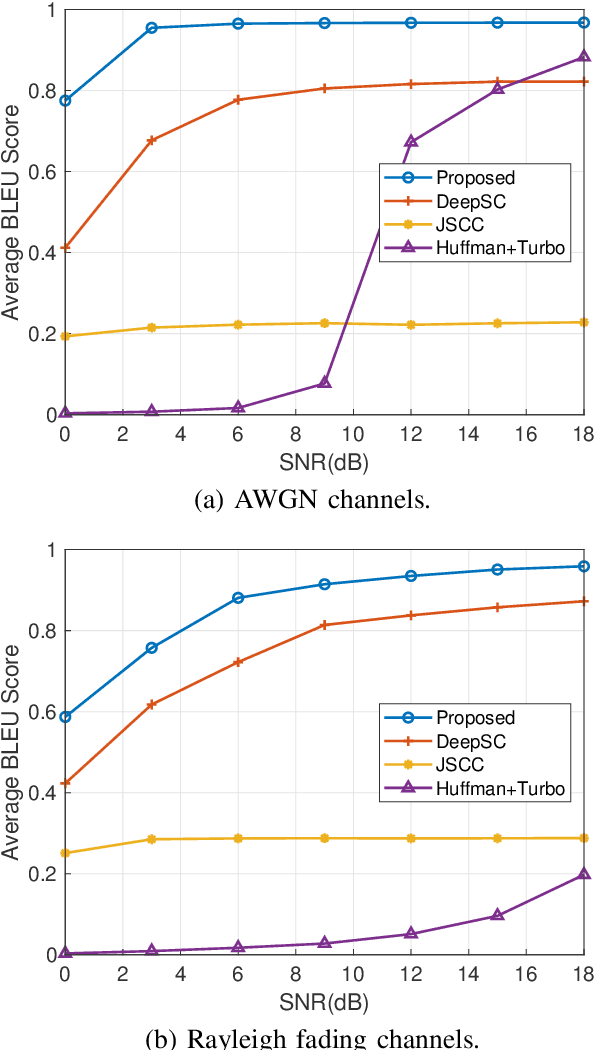
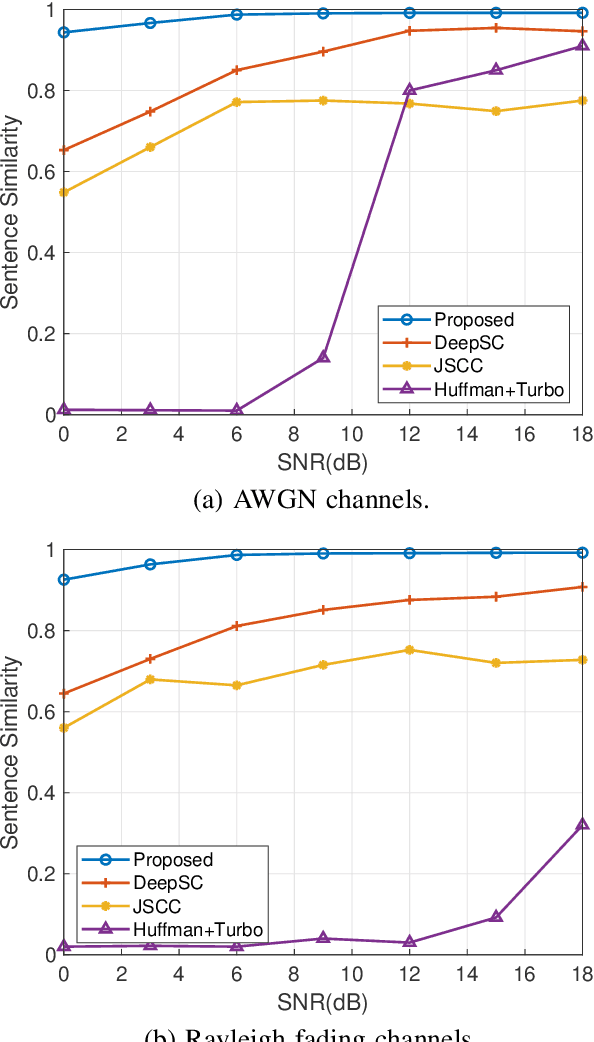
Achieving more powerful semantic representations and semantic understanding is one of the key problems in improving the performance of semantic communication systems. This work focuses on enhancing the semantic understanding of the text data to improve the effectiveness of semantic exchange. We propose a novel semantic communication system for text transmission, in which the semantic understanding is enhanced by coarse-to-fine processing. Especially, a dual attention mechanism is proposed to capture both the coarse and fine semantic information. Numerical experiments show the proposed system outperforms the benchmarks in terms of bilingual evaluation, sentence similarity, and robustness under various channel conditions.