 Add to Chrome
 Add to Firefox
 Add to Edge
Budget-Aware LLM Discovery via Cost-Calibrated Frontier Utility
Jul 29, 2026
Large language models increasingly support scientific and algorithmic discovery through inference-time search over evaluated candidates. Existing adaptive discovery controllers assign credit based only on score progress, even though prompt length, retries, and guidance calls cause search actions to incur different token costs. We prove that cost-blind credit can forfeit all but a vanishing fraction of attainable quality as frontiers multiply and costs diverge. Under a fixed search-side token budget, the controller must decide which frontier is improving and whether its gain justifies the realized cost before the budget is exhausted. We introduce \textbf{CostAda}, a cost-calibrated adaptive controller built around \emph{cost-calibrated frontier utility}. The utility values frontier progress relative to realized action cost and conditions that credit on the remaining budget. CostAda uses this signal to control local exploration intensity, frontier allocation, and budgeted tactic intervention. Cost and remaining budget therefore shape the search rather than serving only as accounting variables or a stopping rule. CostAda reaches the strongest baseline's full-budget quality with at most half the budget on twelve of sixteen benchmark--backbone pairs while achieving the strongest mean final quality on all eight benchmarks under GLM-5 and GPT-5.4.

Quality-Diversity Optimization as Multi-Objective Optimization
Jan 31, 2026The Quality-Diversity (QD) optimization aims to discover a collection of high-performing solutions that simultaneously exhibit diverse behaviors within a user-defined behavior space. This paradigm has stimulated significant research interest and demonstrated practical utility in domains including robot control, creative design, and adversarial sample generation. A variety of QD algorithms with distinct design principles have been proposed in recent years. Instead of proposing a new QD algorithm, this work introduces a novel reformulation by casting the QD optimization as a multi-objective optimization (MOO) problem with a huge number of optimization objectives. By establishing this connection, we enable the direct adoption of well-established MOO methods, particularly set-based scalarization techniques, to solve QD problems through a collaborative search process. We further provide a theoretical analysis demonstrating that our approach inherits theoretical guarantees from MOO while providing desirable properties for the QD optimization. Experimental studies across several QD applications confirm that our method achieves performance competitive with state-of-the-art QD algorithms.
Few for Many: Tchebycheff Set Scalarization for Many-Objective Optimization
May 30, 2024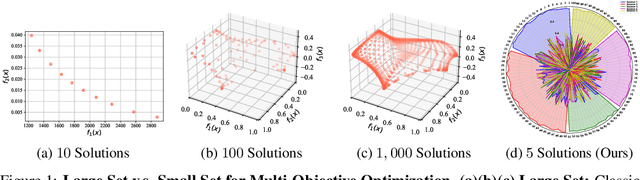
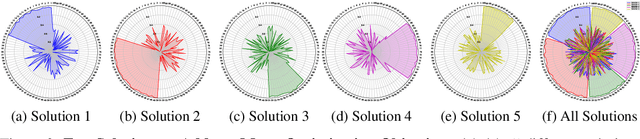
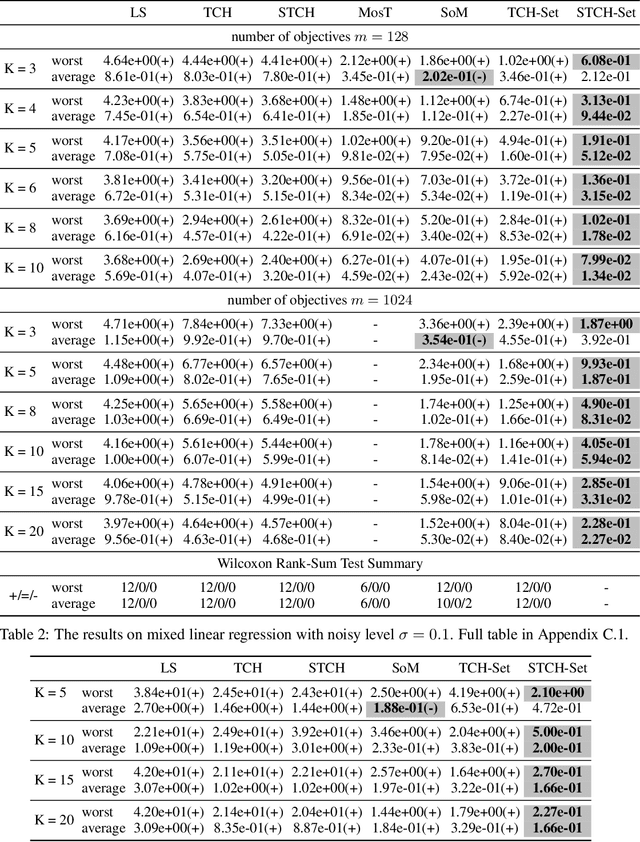
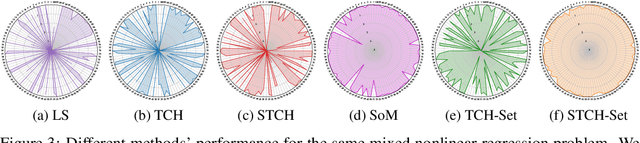
Multi-objective optimization can be found in many real-world applications where some conflicting objectives can not be optimized by a single solution. Existing optimization methods often focus on finding a set of Pareto solutions with different optimal trade-offs among the objectives. However, the required number of solutions to well approximate the whole Pareto optimal set could be exponentially large with respect to the number of objectives, which makes these methods unsuitable for handling many optimization objectives. In this work, instead of finding a dense set of Pareto solutions, we propose a novel Tchebycheff set scalarization method to find a few representative solutions (e.g., 5) to cover a large number of objectives (e.g., $>100$) in a collaborative and complementary manner. In this way, each objective can be well addressed by at least one solution in the small solution set. In addition, we further develop a smooth Tchebycheff set scalarization approach for efficient optimization with good theoretical guarantees. Experimental studies on different problems with many optimization objectives demonstrate the effectiveness of our proposed method.