 Add to Chrome
 Add to Firefox
 Add to Edge
The GaoYao Benchmark: A Comprehensive Framework for Evaluating Multilingual and Multicultural Abilities of Large Language Models
Apr 22, 2026
Evaluating the multilingual and multicultural capabilities of Large Language Models (LLMs) is essential for their global utility. However, current benchmarks face three critical limitations: (1) fragmented evaluation dimensions that often neglect deep cultural nuances; (2) insufficient language coverage in subjective tasks relying on low-quality machine translation; and (3) shallow analysis that lacks diagnostic depth beyond simple rankings. To address these, we introduce GaoYao, a comprehensive benchmark with 182.3k samples, 26 languages and 51 nations/areas. First, GaoYao proposes a unified framework categorizing evaluation tasks into three cultural layers (General Multilingual, Cross-cultural, Monocultural) and nine cognitive sub-layers. Second, we achieve native-quality expansion by leveraging experts to rigorously localize subjective benchmarks into 19 languages and synthesizing cross-cultural test sets for 34 cultures, surpassing prior coverage by up to 111%. Third, we conduct an in-depth diagnostic analysis on 20+ flagship and compact LLMs. Our findings reveal significant geographical performance disparities and distinct gaps between tasks, offering a reliable map for future work. We release the benchmark (https://github.com/lunyiliu/GaoYao).

DT2IT-MRM: Debiased Preference Construction and Iterative Training for Multimodal Reward Modeling
Apr 21, 2026Multimodal reward models (MRMs) play a crucial role in aligning Multimodal Large Language Models (MLLMs) with human preferences. Training a good MRM requires high-quality multimodal preference data. However, existing preference datasets face three key challenges: lack of granularity in preference strength, textual style bias, and unreliable preference signals. Besides, existing open-source multimodal preference datasets suffer from substantial noise, yet there is a lack of effective and scalable curation methods to enhance their quality. To address these limitations, we propose \textbf{DT2IT-MRM}, which integrates a \textbf{D}ebiased preference construction pipeline, a novel reformulation of text-to-image (\textbf{T2I}) preference data, and an \textbf{I}terative \textbf{T}raining framework that curates existing multimodal preference datasets for \textbf{M}ultimodal \textbf{R}eward \textbf{M}odeling. Our experimental results show that DT2IT-MRM achieves new \textbf{state-of-the-art} overall performance on three major benchmarks: VL-RewardBench, Multimodal RewardBench, and MM-RLHF-RewardBench.
MathAgent: Adversarial Evolution of Constraint Graphs for Mathematical Reasoning Data Synthesis
Apr 13, 2026Synthesizing high-quality mathematical reasoning data without human priors remains a significant challenge. Current approaches typically rely on seed data mutation or simple prompt engineering, often suffering from mode collapse and limited logical complexity. This paper proposes a hierarchical synthesis framework that formulates data synthesis as an unsupervised optimization problem over a constraint graph followed by semantic instantiation, rather than treating it as a direct text generation task. We introduce a Legislator-Executor paradigm: The Legislator adversarially evolves structured generation blueprints encoding the constraints of the problem, while the Executor instantiates these specifications into diverse natural language scenarios. This decoupling of skeleton design from linguistic realization enables a prioritized focus on constructing complex and diverse logical structures, thereby guiding high-quality data synthesis. Experiments conducted on a total of 10 models across the Qwen, Llama, Mistral, and Gemma series demonstrate that our method achieves notable results: models fine-tuned on 1K synthesized samples outperform widely-used datasets of comparable scale (LIMO, s1K) across eight mathematical benchmarks, exhibiting superior out-of-distribution generalization.
PACE: Defying the Scaling Hypothesis of Exploration in Iterative Alignment for Mathematical Reasoning
Feb 05, 2026Iterative Direct Preference Optimization has emerged as the state-of-the-art paradigm for aligning Large Language Models on reasoning tasks. Standard implementations (DPO-R1) rely on Best-of-N sampling (e.g., $N \ge 8$) to mine golden trajectories from the distribution tail. In this paper, we challenge this scaling hypothesis and reveal a counter-intuitive phenomenon: in mathematical reasoning, aggressive exploration yields diminishing returns and even catastrophic policy collapse. We theoretically demonstrate that scaling $N$ amplifies verifier noise and induces detrimental distribution shifts. To resolve this, we introduce \textbf{PACE} (Proximal Alignment via Corrective Exploration), which replaces brute-force mining with a generation-based corrective strategy. Operating with a minimal budget ($2<N<3$), PACE synthesizes high-fidelity preference pairs from failed explorations. Empirical evaluations show that PACE outperforms DPO-R1 $(N=16)$ while using only about $1/5$ of the compute, demonstrating superior robustness against reward hacking and label noise.
Dynamic Sampling that Adapts: Iterative DPO for Self-Aware Mathematical Reasoning
May 22, 2025In the realm of data selection for reasoning tasks, existing approaches predominantly rely on externally predefined static metrics such as difficulty and diversity, which are often designed for supervised fine-tuning (SFT) and lack adaptability to continuous training processes. A critical limitation of these methods is their inability to dynamically align with the evolving capabilities of models during online training, a gap that becomes increasingly pronounced with the rise of dynamic training paradigms and online reinforcement learning (RL) frameworks (e.g., R1 models). To address this, we introduce SAI-DPO, an algorithm that dynamically selects training data by continuously assessing a model's stage-specific reasoning abilities across different training phases. By integrating real-time model performance feedback, SAI-DPO adaptively adapts data selection to the evolving strengths and weaknesses of the model, thus enhancing both data utilization efficiency and final task performance. Extensive experiments on three state-of-the-art models and eight mathematical reasoning benchmarks, including challenging competition-level datasets (e.g., AIME24 and AMC23), demonstrate that SAI-DPO achieves an average performance boost of up to 21.3 percentage points, with particularly notable improvements of 10 and 15 points on AIME24 and AMC23, respectively. These results highlight the superiority of dynamic, model-adaptive data selection over static, externally defined strategies in advancing reasoning.
Pangu Ultra MoE: How to Train Your Big MoE on Ascend NPUs
May 07, 2025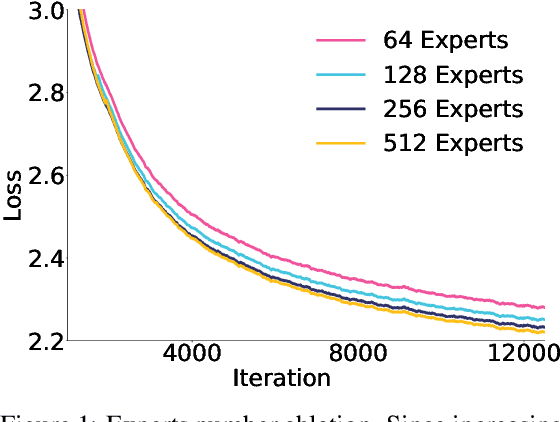

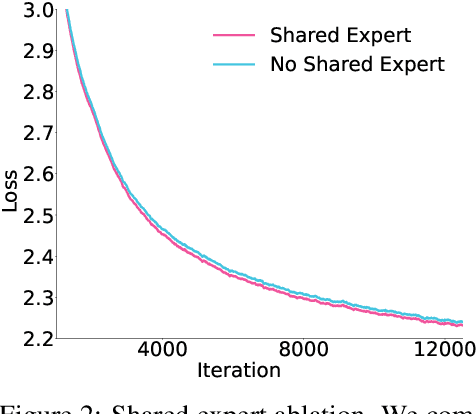

Sparse large language models (LLMs) with Mixture of Experts (MoE) and close to a trillion parameters are dominating the realm of most capable language models. However, the massive model scale poses significant challenges for the underlying software and hardware systems. In this paper, we aim to uncover a recipe to harness such scale on Ascend NPUs. The key goals are better usage of the computing resources under the dynamic sparse model structures and materializing the expected performance gain on the actual hardware. To select model configurations suitable for Ascend NPUs without repeatedly running the expensive experiments, we leverage simulation to compare the trade-off of various model hyperparameters. This study led to Pangu Ultra MoE, a sparse LLM with 718 billion parameters, and we conducted experiments on the model to verify the simulation results. On the system side, we dig into Expert Parallelism to optimize the communication between NPU devices to reduce the synchronization overhead. We also optimize the memory efficiency within the devices to further reduce the parameter and activation management overhead. In the end, we achieve an MFU of 30.0% when training Pangu Ultra MoE, with performance comparable to that of DeepSeek R1, on 6K Ascend NPUs, and demonstrate that the Ascend system is capable of harnessing all the training stages of the state-of-the-art language models. Extensive experiments indicate that our recipe can lead to efficient training of large-scale sparse language models with MoE. We also study the behaviors of such models for future reference.
Pangu Ultra: Pushing the Limits of Dense Large Language Models on Ascend NPUs
Apr 10, 2025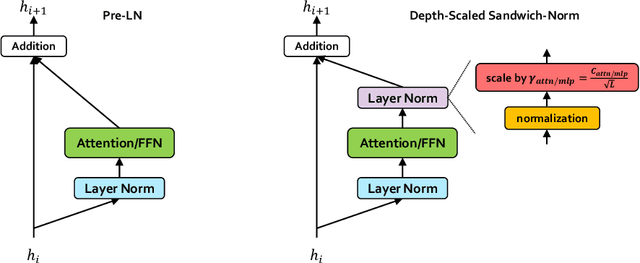
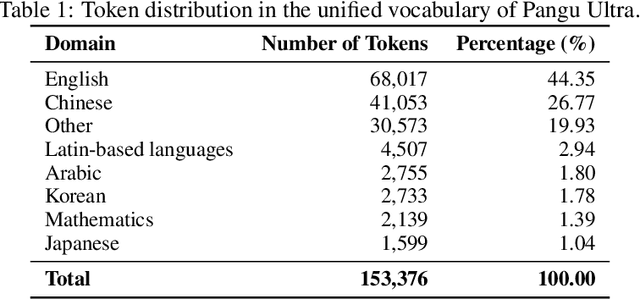
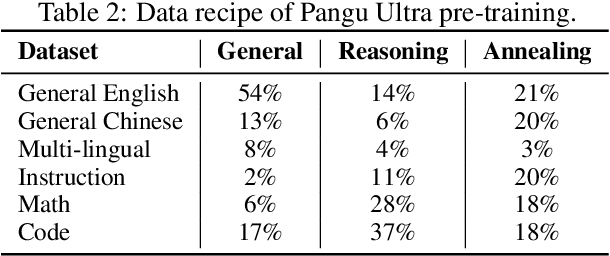
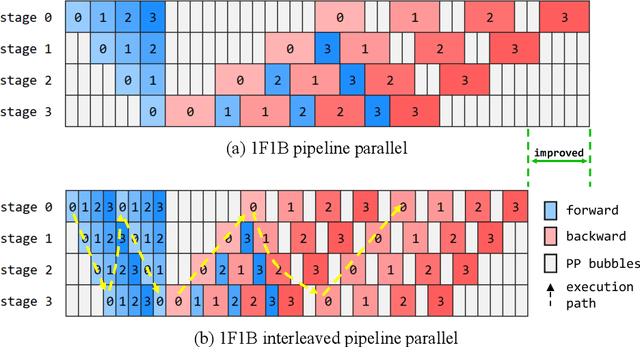
We present Pangu Ultra, a Large Language Model (LLM) with 135 billion parameters and dense Transformer modules trained on Ascend Neural Processing Units (NPUs). Although the field of LLM has been witnessing unprecedented advances in pushing the scale and capability of LLM in recent years, training such a large-scale model still involves significant optimization and system challenges. To stabilize the training process, we propose depth-scaled sandwich normalization, which effectively eliminates loss spikes during the training process of deep models. We pre-train our model on 13.2 trillion diverse and high-quality tokens and further enhance its reasoning capabilities during post-training. To perform such large-scale training efficiently, we utilize 8,192 Ascend NPUs with a series of system optimizations. Evaluations on multiple diverse benchmarks indicate that Pangu Ultra significantly advances the state-of-the-art capabilities of dense LLMs such as Llama 405B and Mistral Large 2, and even achieves competitive results with DeepSeek-R1, whose sparse model structure contains much more parameters. Our exploration demonstrates that Ascend NPUs are capable of efficiently and effectively training dense models with more than 100 billion parameters. Our model and system will be available for our commercial customers.
VideoLLM Knows When to Speak: Enhancing Time-Sensitive Video Comprehension with Video-Text Duet Interaction Format
Nov 27, 2024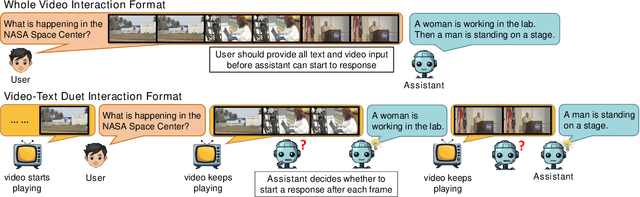
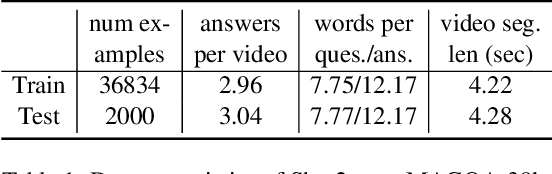
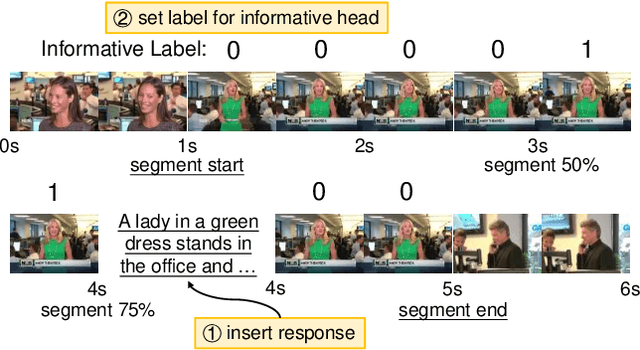
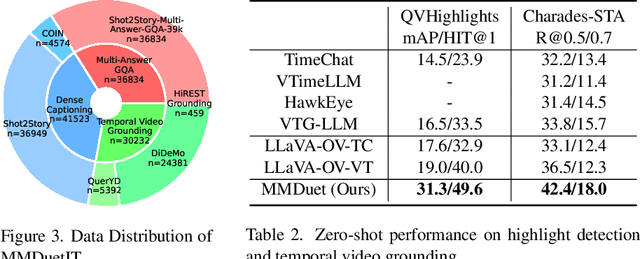
Recent researches on video large language models (VideoLLM) predominantly focus on model architectures and training datasets, leaving the interaction format between the user and the model under-explored. In existing works, users often interact with VideoLLMs by using the entire video and a query as input, after which the model generates a response. This interaction format constrains the application of VideoLLMs in scenarios such as live-streaming comprehension where videos do not end and responses are required in a real-time manner, and also results in unsatisfactory performance on time-sensitive tasks that requires localizing video segments. In this paper, we focus on a video-text duet interaction format. This interaction format is characterized by the continuous playback of the video, and both the user and the model can insert their text messages at any position during the video playback. When a text message ends, the video continues to play, akin to the alternative of two performers in a duet. We construct MMDuetIT, a video-text training dataset designed to adapt VideoLLMs to video-text duet interaction format. We also introduce the Multi-Answer Grounded Video Question Answering (MAGQA) task to benchmark the real-time response ability of VideoLLMs. Trained on MMDuetIT, MMDuet demonstrates that adopting the video-text duet interaction format enables the model to achieve significant improvements in various time-sensitive tasks (76% CIDEr on YouCook2 dense video captioning, 90\% mAP on QVHighlights highlight detection and 25% R@0.5 on Charades-STA temporal video grounding) with minimal training efforts, and also enable VideoLLMs to reply in a real-time manner as the video plays. Code, data and demo are available at: https://github.com/yellow-binary-tree/MMDuet.
Visually Guided Generative Text-Layout Pre-training for Document Intelligence
Mar 27, 2024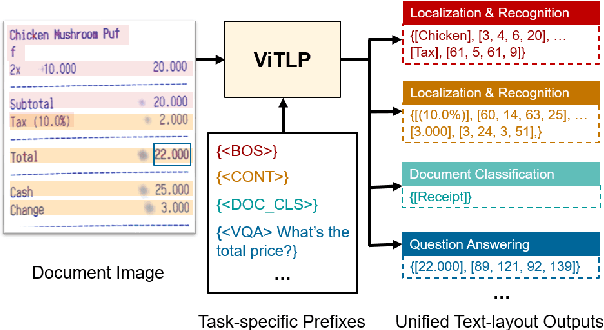

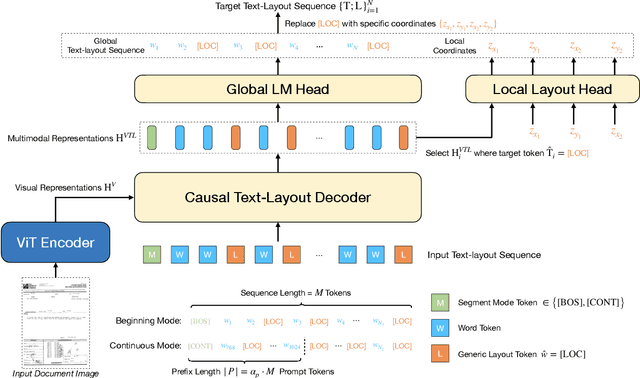
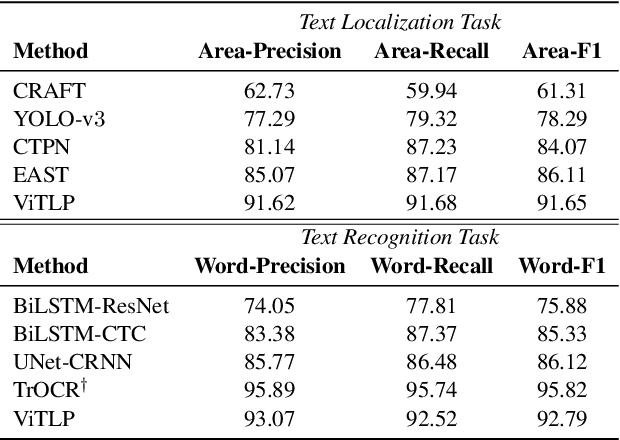
Prior study shows that pre-training techniques can boost the performance of visual document understanding (VDU), which typically requires models to gain abilities to perceive and reason both document texts and layouts (e.g., locations of texts and table-cells). To this end, we propose visually guided generative text-layout pre-training, named ViTLP. Given a document image, the model optimizes hierarchical language and layout modeling objectives to generate the interleaved text and layout sequence. In addition, to address the limitation of processing long documents by Transformers, we introduce a straightforward yet effective multi-segment generative pre-training scheme, facilitating ViTLP to process word-intensive documents of any length. ViTLP can function as a native OCR model to localize and recognize texts of document images. Besides, ViTLP can be effectively applied to various downstream VDU tasks. Extensive experiments show that ViTLP achieves competitive performance over existing baselines on benchmark VDU tasks, including information extraction, document classification, and document question answering.
PanGu-Σ: Towards Trillion Parameter Language Model with Sparse Heterogeneous Computing
Mar 20, 2023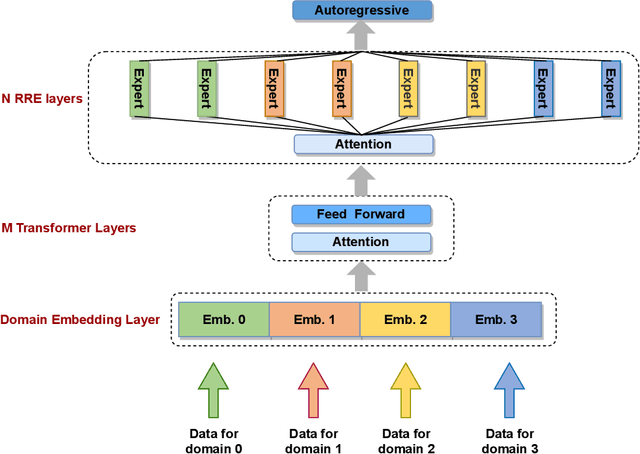
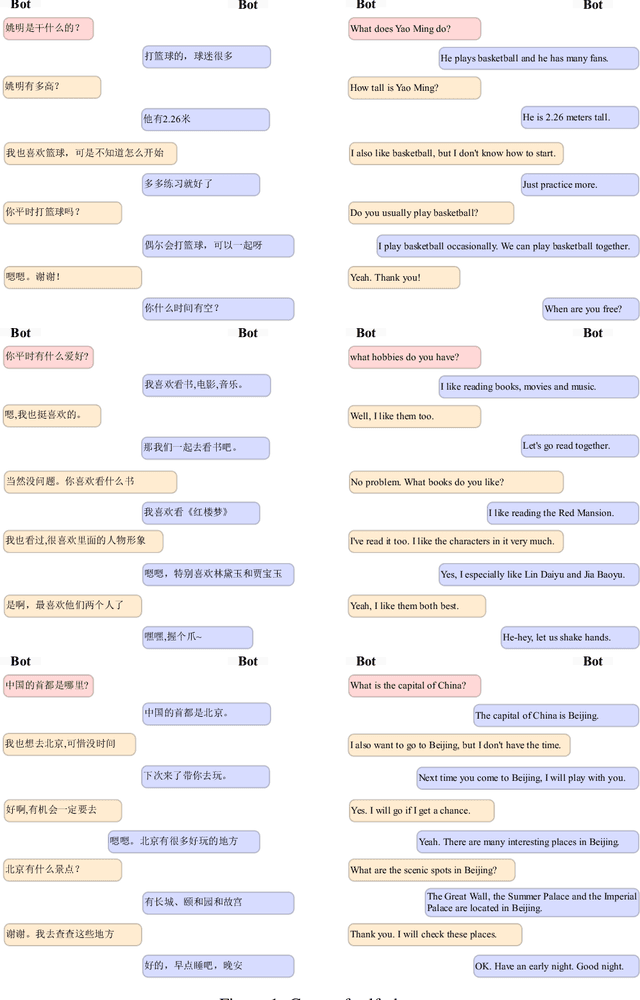
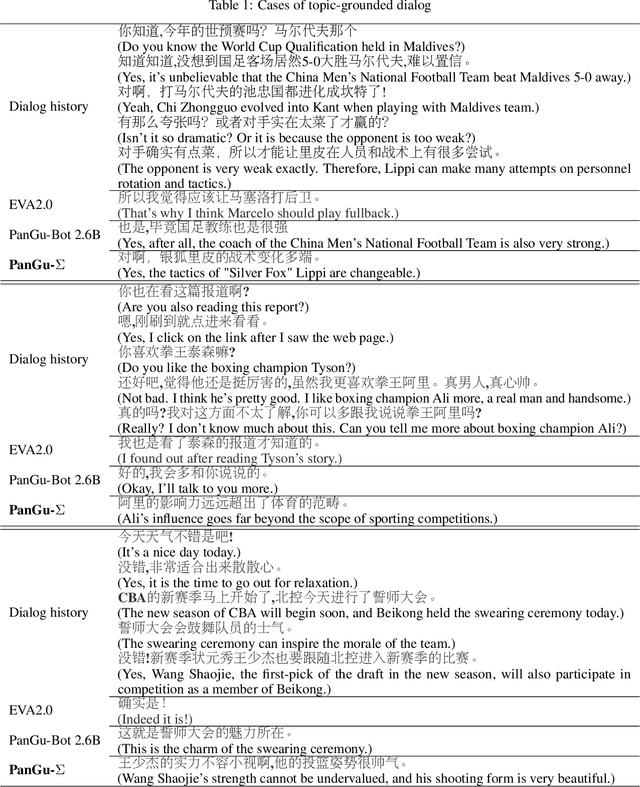
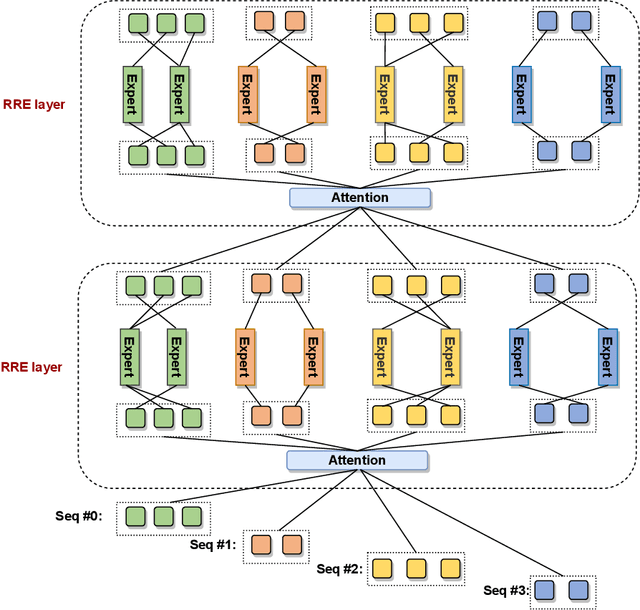
The scaling of large language models has greatly improved natural language understanding, generation, and reasoning. In this work, we develop a system that trained a trillion-parameter language model on a cluster of Ascend 910 AI processors and MindSpore framework, and present the language model with 1.085T parameters named PanGu-{\Sigma}. With parameter inherent from PanGu-{\alpha}, we extend the dense Transformer model to sparse one with Random Routed Experts (RRE), and efficiently train the model over 329B tokens by using Expert Computation and Storage Separation(ECSS). This resulted in a 6.3x increase in training throughput through heterogeneous computing. Our experimental findings show that PanGu-{\Sigma} provides state-of-the-art performance in zero-shot learning of various Chinese NLP downstream tasks. Moreover, it demonstrates strong abilities when fine-tuned in application data of open-domain dialogue, question answering, machine translation and code generation.