 Add to Chrome
 Add to Firefox
 Add to Edge
The GaoYao Benchmark: A Comprehensive Framework for Evaluating Multilingual and Multicultural Abilities of Large Language Models
Apr 22, 2026
Evaluating the multilingual and multicultural capabilities of Large Language Models (LLMs) is essential for their global utility. However, current benchmarks face three critical limitations: (1) fragmented evaluation dimensions that often neglect deep cultural nuances; (2) insufficient language coverage in subjective tasks relying on low-quality machine translation; and (3) shallow analysis that lacks diagnostic depth beyond simple rankings. To address these, we introduce GaoYao, a comprehensive benchmark with 182.3k samples, 26 languages and 51 nations/areas. First, GaoYao proposes a unified framework categorizing evaluation tasks into three cultural layers (General Multilingual, Cross-cultural, Monocultural) and nine cognitive sub-layers. Second, we achieve native-quality expansion by leveraging experts to rigorously localize subjective benchmarks into 19 languages and synthesizing cross-cultural test sets for 34 cultures, surpassing prior coverage by up to 111%. Third, we conduct an in-depth diagnostic analysis on 20+ flagship and compact LLMs. Our findings reveal significant geographical performance disparities and distinct gaps between tasks, offering a reliable map for future work. We release the benchmark (https://github.com/lunyiliu/GaoYao).

CB-Whisper: Contextual Biasing Whisper using TTS-based Keyword Spotting
Sep 18, 2023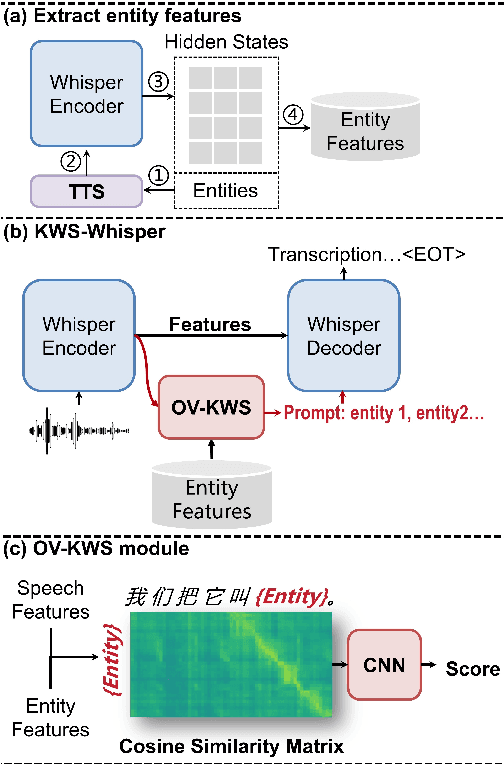

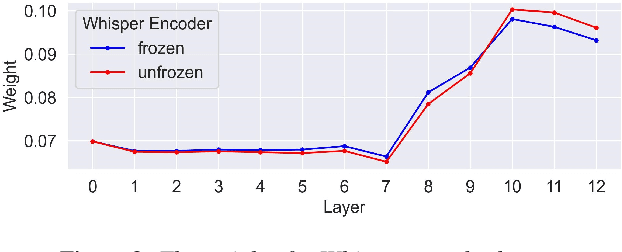
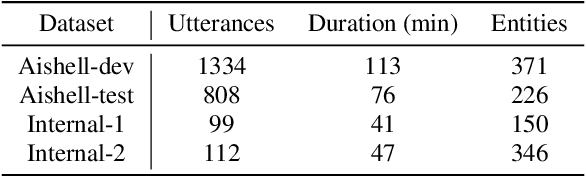
End-to-end automatic speech recognition (ASR) systems often struggle to recognize rare name entities, such as personal names, organizations, or technical terms that are not frequently encountered in the training data. This paper presents Contextual Biasing Whisper (CB-Whisper), a novel ASR system based on OpenAI's Whisper model that performs keyword-spotting (KWS) before the decoder. The KWS module leverages text-to-speech (TTS) techniques and a convolutional neural network (CNN) classifier to match the features between the entities and the utterances. Experiments demonstrate that by incorporating predicted entities into a carefully designed spoken form prompt, the mixed-error-rate (MER) and entity recall of the Whisper model is significantly improved on three internal datasets and two open-sourced datasets that cover English-only, Chinese-only, and code-switching scenarios.