 Add to Chrome
 Add to Firefox
 Add to Edge
LLaVA-NeXT-Interleave: Tackling Multi-image, Video, and 3D in Large Multimodal Models
Jul 10, 2024


Visual instruction tuning has made considerable strides in enhancing the capabilities of Large Multimodal Models (LMMs). However, existing open LMMs largely focus on single-image tasks, their applications to multi-image scenarios remains less explored. Additionally, prior LMM research separately tackles different scenarios, leaving it impossible to generalize cross scenarios with new emerging capabilities. To this end, we introduce LLaVA-NeXT-Interleave, which simultaneously tackles Multi-image, Multi-frame (video), Multi-view (3D), and Multi-patch (single-image) scenarios in LMMs. To enable these capabilities, we regard the interleaved data format as a general template and compile the M4-Instruct dataset with 1,177.6k samples, spanning 4 primary domains with 14 tasks and 41 datasets. We also curate the LLaVA-Interleave Bench to comprehensively evaluate the multi-image performance of LMMs. Through extensive experiments, LLaVA-NeXT-Interleave achieves leading results in multi-image, video, and 3D benchmarks, while maintaining the performance of single-image tasks. Besides, our model also exhibits several emerging capabilities, e.g., transferring tasks across different settings and modalities. Code is available at https://github.com/LLaVA-VL/LLaVA-NeXT

Empowering 1000 tokens/second on-device LLM prefilling with mllm-NPU
Jul 08, 2024


On-device large language models (LLMs) are catalyzing novel mobile applications such as UI task automation and personalized email auto-reply, without giving away users' private data. However, on-device LLMs still suffer from unacceptably long inference latency, especially the time to first token (prefill stage) due to the need of long context for accurate, personalized content generation, as well as the lack of parallel computing capacity of mobile CPU/GPU. To enable practical on-device LLM, we present mllm-NPU, the first-of-its-kind LLM inference system that efficiently leverages on-device Neural Processing Unit (NPU) offloading. Essentially, mllm-NPU is an algorithm-system co-design that tackles a few semantic gaps between the LLM architecture and contemporary NPU design. Specifically, it re-constructs the prompt and model in three levels: (1) At prompt level, it divides variable-length prompts into multiple fixed-sized chunks while maintaining data dependencies; (2) At tensor level, it identifies and extracts significant outliers to run on the CPU/GPU in parallel with minimal overhead; (3) At block level, it schedules Transformer blocks in an out-of-order manner to the CPU/GPU and NPU based on their hardware affinity and sensitivity to accuracy. Compared to competitive baselines, mllm-NPU achieves 22.4x faster prefill speed and 30.7x energy savings on average, and up to 32.8x speedup in an end-to-end real-world application. For the first time, mllm-NPU achieves more than 1,000 tokens/sec prefilling for a billion-sized model (Qwen1.5-1.8B), paving the way towards practical on-device LLM.
Tracking Reflected Objects: A Benchmark
Jul 07, 2024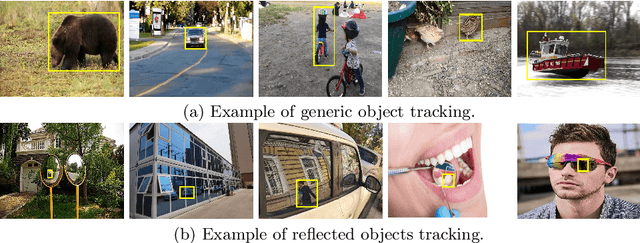

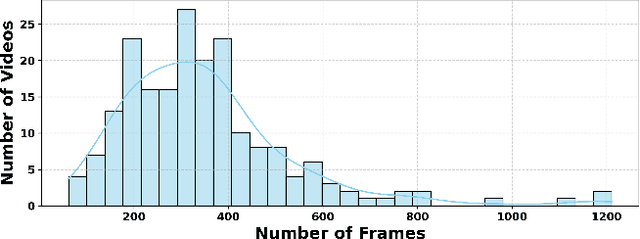
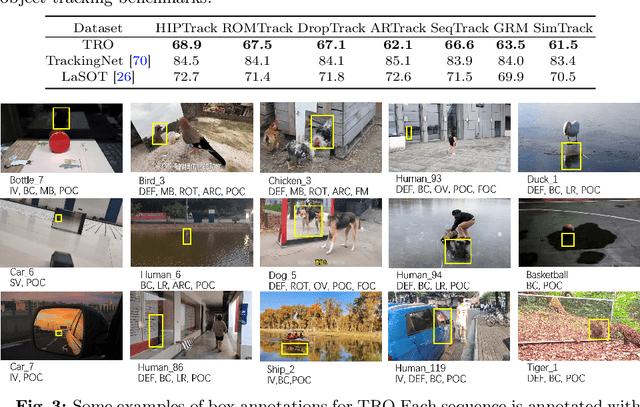
Visual tracking has advanced significantly in recent years, mainly due to the availability of large-scale training datasets. These datasets have enabled the development of numerous algorithms that can track objects with high accuracy and robustness.However, the majority of current research has been directed towards tracking generic objects, with less emphasis on more specialized and challenging scenarios. One such challenging scenario involves tracking reflected objects. Reflections can significantly distort the appearance of objects, creating ambiguous visual cues that complicate the tracking process. This issue is particularly pertinent in applications such as autonomous driving, security, smart homes, and industrial production, where accurately tracking objects reflected in surfaces like mirrors or glass is crucial. To address this gap, we introduce TRO, a benchmark specifically for Tracking Reflected Objects. TRO includes 200 sequences with around 70,000 frames, each carefully annotated with bounding boxes. This dataset aims to encourage the development of new, accurate methods for tracking reflected objects, which present unique challenges not sufficiently covered by existing benchmarks. We evaluated 20 state-of-the-art trackers and found that they struggle with the complexities of reflections. To provide a stronger baseline, we propose a new tracker, HiP-HaTrack, which uses hierarchical features to improve performance, significantly outperforming existing algorithms. We believe our benchmark, evaluation, and HiP-HaTrack will inspire further research and applications in tracking reflected objects. The TRO and code are available at https://github.com/OpenCodeGithub/HIP-HaTrack.
MFE-ETP: A Comprehensive Evaluation Benchmark for Multi-modal Foundation Models on Embodied Task Planning
Jul 06, 2024In recent years, Multi-modal Foundation Models (MFMs) and Embodied Artificial Intelligence (EAI) have been advancing side by side at an unprecedented pace. The integration of the two has garnered significant attention from the AI research community. In this work, we attempt to provide an in-depth and comprehensive evaluation of the performance of MFM s on embodied task planning, aiming to shed light on their capabilities and limitations in this domain. To this end, based on the characteristics of embodied task planning, we first develop a systematic evaluation framework, which encapsulates four crucial capabilities of MFMs: object understanding, spatio-temporal perception, task understanding, and embodied reasoning. Following this, we propose a new benchmark, named MFE-ETP, characterized its complex and variable task scenarios, typical yet diverse task types, task instances of varying difficulties, and rich test case types ranging from multiple embodied question answering to embodied task reasoning. Finally, we offer a simple and easy-to-use automatic evaluation platform that enables the automated testing of multiple MFMs on the proposed benchmark. Using the benchmark and evaluation platform, we evaluated several state-of-the-art MFMs and found that they significantly lag behind human-level performance. The MFE-ETP is a high-quality, large-scale, and challenging benchmark relevant to real-world tasks.
Moving Target Detection Method Based on Range? Doppler Domain Compensation and Cancellation for UAV-Mounted Radar
Jul 04, 2024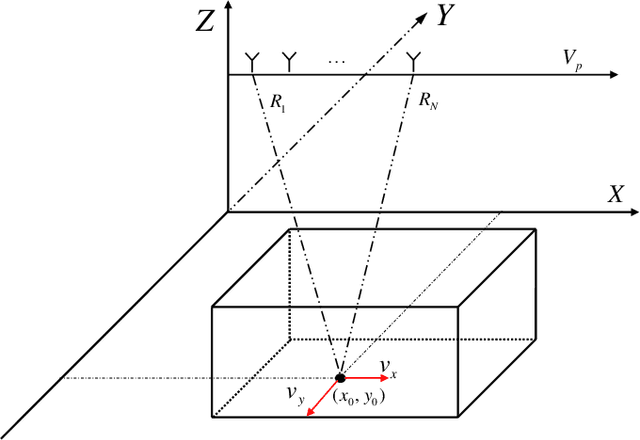
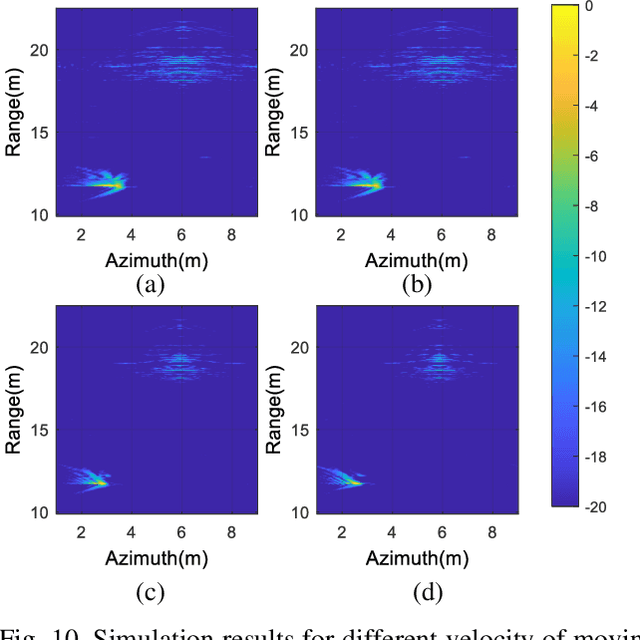
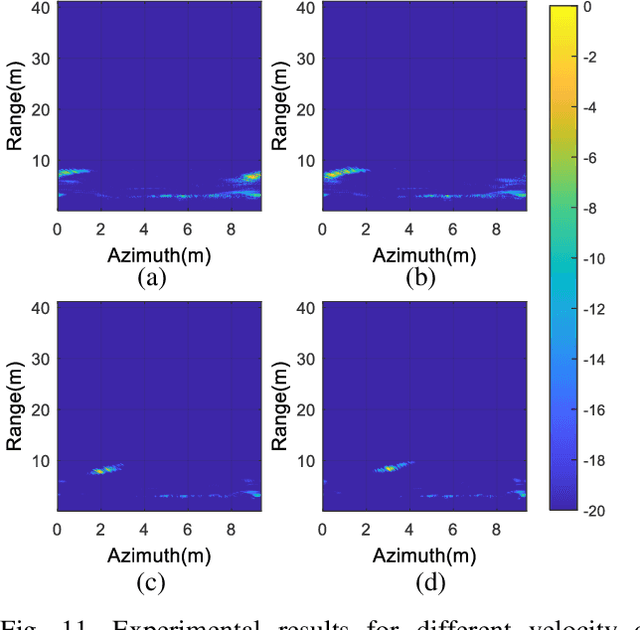

Combining unmanned aerial vehicle (UAV) with through-the-wall radar can realize moving targets detection in complex building scenes. However, clutters generated by obstacles and static objects are always stronger and non-stationary, which results in heavy impacts on moving targets detection. To address this issue, this paper proposes a moving target detection method based on Range-Doppler domain compensation and cancellation for UAV mounted dual channel radar. In the proposed method, phase compensation is performed on the dual channel in range-Doppler domain and then cancellation is utilized to achieve roughly clutters suppression. Next, a filter is constructed based on the cancellation result and the raw echoes, which is used to suppress stationary clutter furthermore. Finally, mismatch imaging is used to focus moving target for detection. Both simulation and UAV-based experiment results are analyzed to verify the efficacy and practicability of the proposed method.
CoIR: A Comprehensive Benchmark for Code Information Retrieval Models
Jul 03, 2024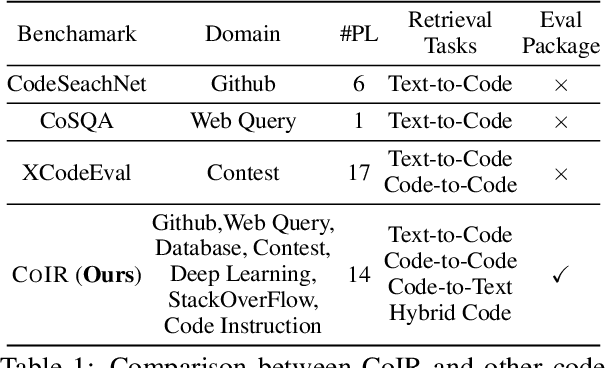
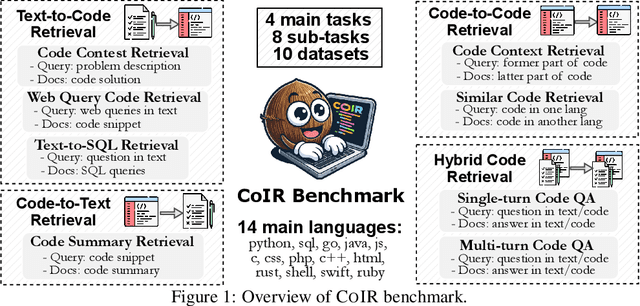
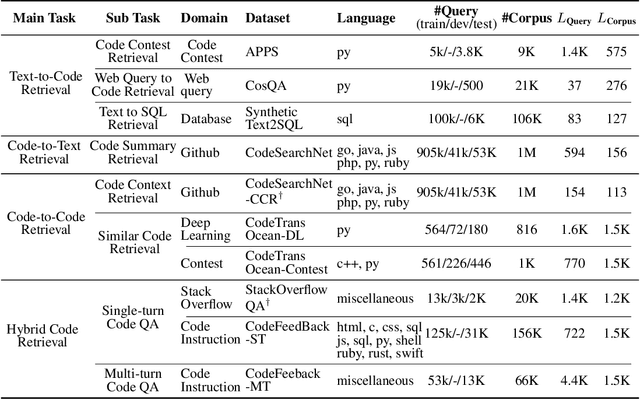
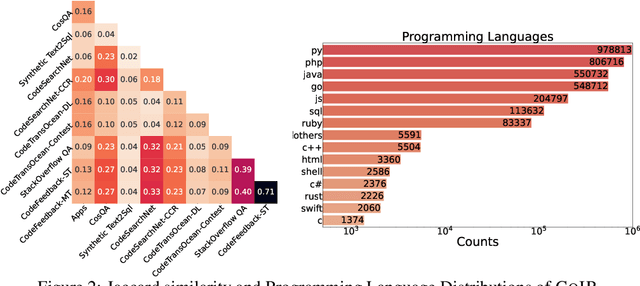
Despite the substantial success of Information Retrieval (IR) in various NLP tasks, most IR systems predominantly handle queries and corpora in natural language, neglecting the domain of code retrieval. Code retrieval is critically important yet remains under-explored, with existing methods and benchmarks inadequately representing the diversity of code in various domains and tasks. Addressing this gap, we present \textbf{\name} (\textbf{Co}de \textbf{I}nformation \textbf{R}etrieval Benchmark), a robust and comprehensive benchmark specifically designed to assess code retrieval capabilities. \name comprises \textbf{ten} meticulously curated code datasets, spanning \textbf{eight} distinctive retrieval tasks across \textbf{seven} diverse domains. We first discuss the construction of \name and its diverse dataset composition. Further, we evaluate nine widely used retrieval models using \name, uncovering significant difficulties in performing code retrieval tasks even with state-of-the-art systems. To facilitate easy adoption and integration within existing research workflows, \name has been developed as a user-friendly Python framework, readily installable via pip. It shares same data schema as other popular benchmarks like MTEB and BEIR, enabling seamless cross-benchmark evaluations. Through \name, we aim to invigorate research in the code retrieval domain, providing a versatile benchmarking tool that encourages further development and exploration of code retrieval systems\footnote{\url{ https://github.com/CoIR-team/coir}}.
MR-BEN: A Comprehensive Meta-Reasoning Benchmark for Large Language Models
Jun 20, 2024


Large language models (LLMs) have shown increasing capability in problem-solving and decision-making, largely based on the step-by-step chain-of-thought reasoning processes. However, it has been increasingly challenging to evaluate the reasoning capability of LLMs. Concretely, existing outcome-based benchmarks begin to saturate and become less sufficient to monitor the progress. To this end, we present a process-based benchmark MR-BEN that demands a meta reasoning skill, where LMs are asked to locate and analyse potential errors in automatically generated reasoning steps. MR-BEN is a comprehensive benchmark comprising 5,975 questions collected from human experts, covering various subjects such as physics, chemistry, logic, coding, and more. Through our designed metrics for assessing meta-reasoning on this benchmark, we identify interesting limitations and weaknesses of current LLMs (open-source and closed-source models). For example, open-source models are seemingly comparable to GPT-4 on outcome-based benchmarks, but they lag far behind on our benchmark, revealing the underlying reasoning capability gap between them. Our dataset and codes are available on https://randolph-zeng.github.io/Mr-Ben.github.io/.
Optimizing Speculative Decoding for Serving Large Language Models Using Goodput
Jun 20, 2024
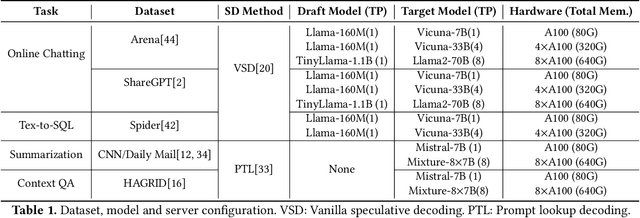


Reducing the inference latency of large language models (LLMs) is crucial, and speculative decoding (SD) stands out as one of the most effective techniques. Rather than letting the LLM generate all tokens directly, speculative decoding employs effective proxies to predict potential outputs, which are then verified by the LLM without compromising the generation quality. Yet, deploying SD in real online LLM serving systems (with continuous batching) does not always yield improvement -- under higher request rates or low speculation accuracy, it paradoxically increases latency. Furthermore, there is no best speculation length work for all workloads under different system loads. Based on the observations, we develop a dynamic framework SmartSpec. SmartSpec dynamically determines the best speculation length for each request (from 0, i.e., no speculation, to many tokens) -- hence the associated speculative execution costs -- based on a new metric called goodput, which characterizes the current observed load of the entire system and the speculation accuracy. We show that SmartSpec consistently reduces average request latency by up to 3.2x compared to non-speculative decoding baselines across different sizes of target models, draft models, request rates, and datasets. Moreover, SmartSpec can be applied to different styles of speculative decoding, including traditional, model-based approaches as well as model-free methods like prompt lookup and tree-style decoding.
AdaMoE: Token-Adaptive Routing with Null Experts for Mixture-of-Experts Language Models
Jun 19, 2024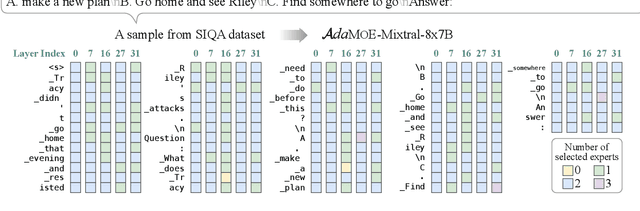
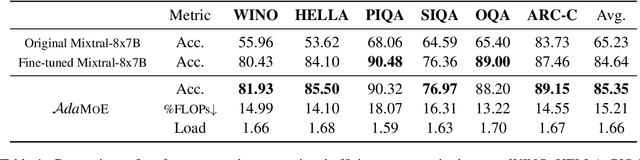
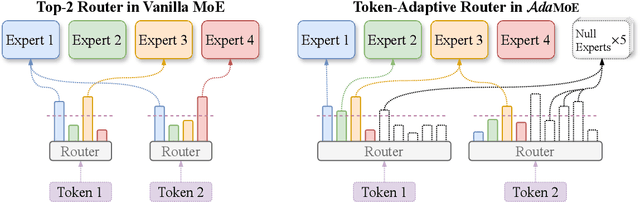

Mixture of experts (MoE) has become the standard for constructing production-level large language models (LLMs) due to its promise to boost model capacity without causing significant overheads. Nevertheless, existing MoE methods usually enforce a constant top-k routing for all tokens, which is arguably restrictive because various tokens (e.g., "<EOS>" vs. "apple") may require various numbers of experts for feature abstraction. Lifting such a constraint can help make the most of limited resources and unleash the potential of the model for downstream tasks. In this sense, we introduce AdaMoE to realize token-adaptive routing for MoE, where different tokens are permitted to select a various number of experts. AdaMoE makes minimal modifications to the vanilla MoE with top-k routing -- it simply introduces a fixed number of null experts, which do not consume any FLOPs, to the expert set and increases the value of k. AdaMoE does not force each token to occupy a fixed number of null experts but ensures the average usage of the null experts with a load-balancing loss, leading to an adaptive number of null/true experts used by each token. AdaMoE exhibits a strong resemblance to MoEs with expert choice routing while allowing for trivial auto-regressive modeling. AdaMoE is easy to implement and can be effectively applied to pre-trained (MoE-)LLMs. Extensive studies show that AdaMoE can reduce average expert load (FLOPs) while achieving superior performance. For example, on the ARC-C dataset, applying our method to fine-tuning Mixtral-8x7B can reduce FLOPs by 14.5% while increasing accuracy by 1.69%.
SMRU: Split-and-Merge Recurrent-based UNet for Acoustic Echo Cancellation and Noise Suppression
Jun 17, 2024The proliferation of deep neural networks has spawned the rapid development of acoustic echo cancellation and noise suppression, and plenty of prior arts have been proposed, which yield promising performance. Nevertheless, they rarely consider the deployment generality in different processing scenarios, such as edge devices, and cloud processing. To this end, this paper proposes a general model, termed SMRU, to cover different application scenarios. The novelty lies in two-fold. First, a multi-scale band split layer and band merge layer are proposed to effectively fuse local frequency bands for lower complexity modeling. Besides, by simulating the multi-resolution feature modeling characteristic of the classical UNet structure, a novel recurrent-dominated UNet is devised. It consists of multiple variable frame rate blocks, each of which involves the causal time down-/up-sampling layer with varying compression ratios and the dual-path structure for inter- and intra-band modeling. The model is configured from 50 M/s to 6.8 G/s in terms of MACs, and the experimental results show that the proposed approach yields competitive or even better performance over existing baselines, and has the full potential to adapt to more general scenarios with varying complexity requirements.